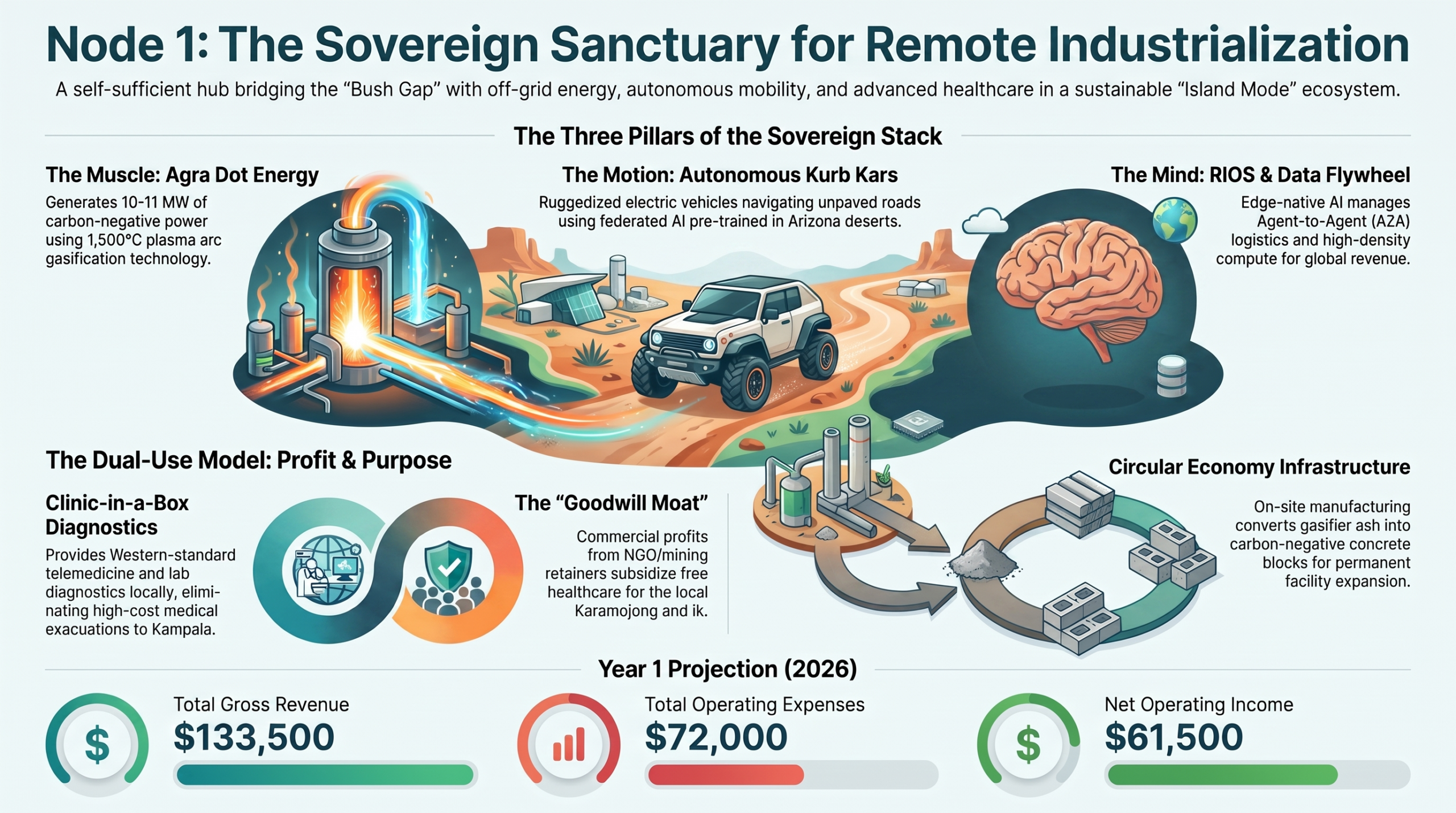
The “Island Mode” Blueprint: 5 Surprising Lessons from the World’s Most Advanced Off-Grid Oasis
- Introduction: The “Bush Gap” and the End of Fragility
For decades, frontier markets have been stymied by the “Bush Gap”—a psychological and logistical chasm where the absence of dependable power, connectivity, and western-standard healthcare keeps global capital and elite engineering talent at bay. In Kaabong, Uganda, Node 1 is proving that this barrier is a design flaw, not an inevitability. Node 1 is more than a remote outpost; it is a physical manifest of the Great Decoupling, engineered by DeReticular, a Venture Studio that manages distinct operating divisions funded via Intercompany Debt to bypass traditional linear dependencies.
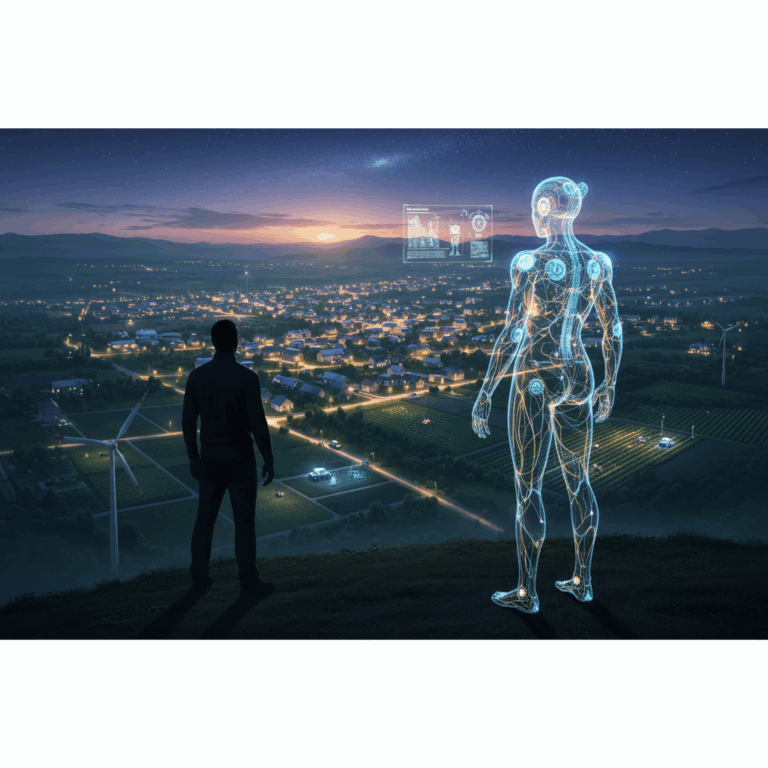
By operating in Island Mode, Node 1 utilizes a Sovereign Stack to replace the “linear fragility” of centralized grids with Spherical Resilience. This self-healing, honeycomb geometry allows the node to function with absolute autonomy, even when the wider global network falters.
The future of infrastructure is shifting from fragile, centralized lines to resilient, sovereign islands that thrive in isolation.
- Reliability is the New Luxury: Solving the “Bush Gap”
In a region where temperatures regularly exceed 95°F and the national grid is a ghost, the ultimate luxury isn’t gold—it is a 100% uptime guarantee for electricity, climate control, and 4K data. Node 1 has institutionalized this through Sovereign Hospitality, transforming a remote wilderness into a “sanctuary of reliability” for the investors and “Black Start” engineers who maintain the systems.
By providing a “First World” interface—powered by a Plasma-Solar Microgrid and SwarmBESS™ battery storage—Node 1 changes the risk calculus for international stakeholders. It provides the essential comfort required to bridge the “Bush Gap,” proving that reliability is the foundational layer of any frontier economic engine.
“Node 1’s strategic mandate is to provide a ‘sanctuary of reliability,’ guaranteeing 100% utility uptime powered directly by the local plasma-solar microgrid, ensuring that the ‘Bush Gap’ no longer deters the world’s best minds.”
- From Trash to Treasure: The 1,800°C Circular Economy
The “Muscle” of Node 1 is a thermodynamic marvel that turns localized liability into high-value assets. Utilizing High-Temperature Plasma Gasification, the system operates between 1,500°C and 1,800°C to achieve Molecular Dissociation. This process breaks down 210 tons of daily woody waste and municipal trash into a hydrogen-rich syngas, generating 10–11 MW of carbon-negative baseload power.
Crucially, the system separates power generation from fuel synthesis. While the gasifier provides the grid’s “Muscle,” a proprietary Micro-GTL (Gas-to-Liquids) technology reorganizes methane and CO2 into drop-in synthetic fuels, including Renewable Diesel and Sustainable Aviation Fuel (SAF). Even the non-organic waste is reclaimed; it is melted into a Vitrified Slag and pressed on-site into structural concrete blocks, effectively allowing the campus to “print” its own expansion.
“The extreme thermal processing breaks down the complex carbon chains of waste biomass into a clean-burning syngas… while the vitrified byproduct ensures a zero-landfill, circular manufacturing goal where the campus literally builds itself from its own waste.”
- The “Goodwill Moat”: Healthcare as the Ultimate Security System
Instead of relying on hardened fences or armed guards, Node 1 secures its 7,000-acre perimeter through a “Dual-Use Model” for its Clinic-in-a-Box. This modular diagnostic hub creates a “Goodwill Moat” by integrating the project into the social fabric of the local Karamojong and Ik tribes.
The clinic operates as a high-margin B2B revenue driver, charging NGOs and mining companies for western-standard diagnostics like POCUS (Point-of-Care Ultrasound). However, during “Community Off-Hours,” these same tools provide free maternal and pediatric care to the local population. When a local warrior knows that his child’s life was saved by the clinic’s malaria PCR screening, he has a direct incentive to protect the campus. This shift from hardened barriers to community integration has resulted in a 0% sabotage rate.
“By providing free, advanced healthcare through POCUS and rapid diagnostics, the project creates an unshakable ‘social license to operate,’ where the community itself becomes the primary security layer for the physical assets.”
- Agent-to-Agent (A2A) Logistics: The Frictionless Travel Bubble
Travel to frontier markets is notoriously friction-heavy, but Node 1 solves this via the RIOS A2A Reservation System. In this model, human administrative friction is replaced by Absolute Cognitive Sovereignty. A guest’s personal AI agent initiates an Encrypted WebSocket to perform a Cryptographic Handshake with the Node 1 Logistics Agent.
These agents autonomously handle everything from e-visa filings via virtual payment tokens to flight procurement. Once the guest arrives, they are met by a Kurb Kar—a ruggedized, autonomous EV. The navigation logic for these vehicles is a global effort: it is trained by Node 2 (Canada) as “The Brain” and stress-tested by Node 3 (Arizona) as “The Simulator.” This allows the AI to navigate unpaved “murram” roads and avoid uniquely African obstacles like roaming cattle with pinpoint accuracy.
“This edge-native reservation AI uses transaction modules and cryptographic handshakes to securely clear visas and schedule Kurb Kar pickups, creating a frictionless travel bubble that bypasses the traditional bureaucratic nightmare of the frontier.”
- Digital Revenue from Surplus Power: The “Data Flywheel”
The hidden economic engine of Node 1 is the RIOS-CC-1000 Core Compute Cluster. This system turns surplus electricity into a “Data Flywheel,” using “behind-the-meter” energy to perform high-value AI training and cryptographic verification for global clients.
This model effectively “Shatters the Permitting Wall.” By moving high-density compute clusters off-grid, DeReticular bypasses the multi-year wait times associated with the global Data Center Power Interconnection Crisis. The digital revenue generated by this cluster funds the physical maintenance of the campus, making Node 1 economically sovereign and independent of local market fluctuations.
“By matching high-density AI compute with behind-the-meter clean energy, Node 1 shatters the permitting wall, using a digital ‘Data Flywheel’ to fund the physical sovereignty of the oasis.”
- Conclusion: The Blueprint for a Sovereign Future
Node 1 is a signal in the noise, proof that the “Sovereign Stack” can successfully bootstrap a high-tech ecosystem in the world’s most challenging environments. This was achieved not through traditional VC, but through the Consortium Triad:
- DeReticular (The Mind): Providing the RIOS software and AI agent architecture.
- TriFi Wireless (The Network): Delivering BABA-Compliant Hardware and Starlink-bonded mesh connectivity.
- InVentures Research (The Capital): Orchestrating Capital Stacking to preserve 100% founder equity.
As centralized systems continue to display their inherent fragility, the success of Project Octagon poses a provocative question: Does the future belong to the centralized giants, or to the sovereign “Islands” that have learned to print their own power, their own data, and their own future?