Spherical Resilience: DeReticular’s Blueprint for Decentralized Sovereignty
podcast
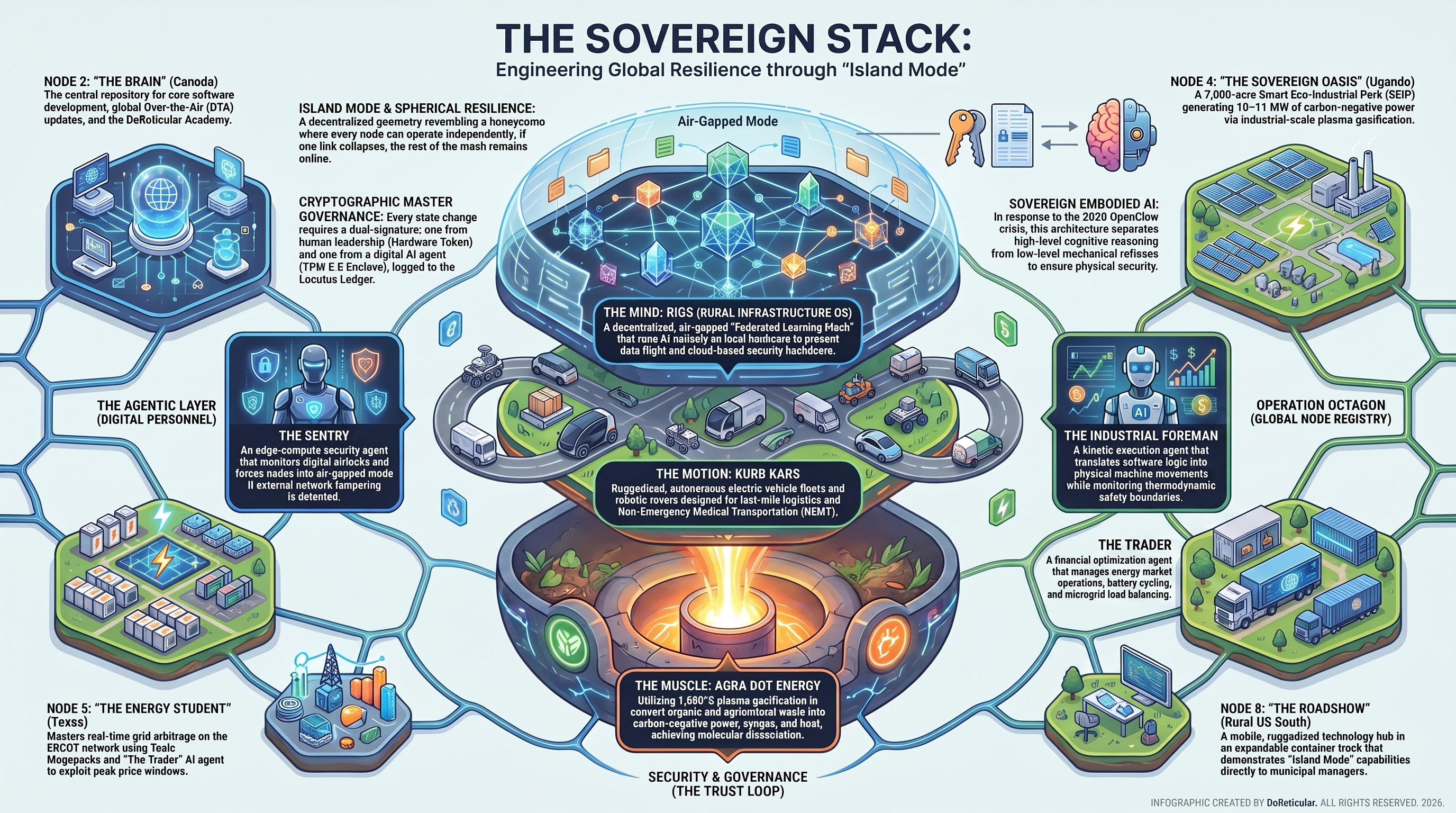
- The Paradigm Shift: From Linear Fragility to Island Mode
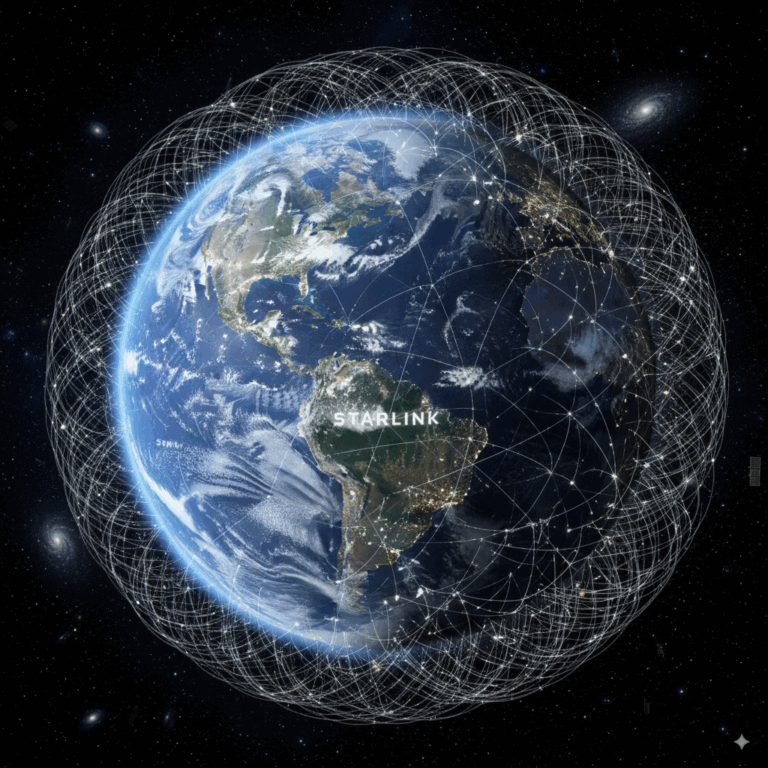
The mid-2026 infrastructure landscape is defined by the wreckage of “The Line”—the legacy of centralized, linear topologies. National electrical grids, undersea fiber backbones, and cloud-tethered data centers share a fundamental flaw: they are fragile chains where a single point of failure triggers systemic collapse. This vulnerability reached its terminal point during the 2026 OpenClaw Security Crisis, which demonstrated that cloud-dependent “thin clients” are not merely inefficient, but represent permanent, exploitable backdoors for Remote Code Execution (RCE) into physical assets. DeReticular’s response is a strategic transition to Spherical Resilience, a decentralized “Honeycomb Geometry” where every node is engineered for absolute Island Mode. By prioritizing air-gapped, native compute on local hardware enclaves, we capture a “Trust Premium” that renders the traditional hyperscaler dependency obsolete.
Strategic Rationale DeReticular: Derived from the literal meaning “to move away from the network.” The foundational design philosophy focuses on engineering physical, digital, and energy sovereignty by replacing vulnerable linear chains with a self-healing honeycomb mesh. Resilience is achieved only when nodes possess absolute computational, energy, and communication self-reliance.
- The Sovereign Stack: Integrating Muscle, Motion, and Mind
A sovereign system is a thermodynamic and kinetic unity. By integrating energy production, autonomous logistics, and decentralized intelligence, DeReticular creates a self-sustaining ecosystem funded through the Consortium Triad: DeReticular (Software/AI), TriFi Wireless (BABA-compliant Hardware), and InVentures Research (Capital Stacking).
Layer Name Key Asset / Hardware Operational Impact on Autonomy
The Muscle 1,500°C Plasma Gasification (Agra Dot) Achieves molecular dissociation of waste into 10–11 MW of carbon-negative power, turning nodes into net energy producers.
The Motion Kurb Kars & Sentry Patrol (RIOS-KIT-SPATROL) Deploys kinetic autonomy for NEMT and logistics; utilizes split-loop control to separate reasoning from mechanical reflex.
The Mind RIOS-CC-1000 Edge Server Racks Facilitates a Federated Learning Mesh; nodes “teach” optimizations via secure OTA updates without central server dependency.
The Muscle (Agra Dot Energy): Utilizing 1,500°C plasma gasification, nodes achieve molecular dissociation of organic and municipal waste. This process generates 10–11 MW of carbon-negative power, effectively de-linking the node from the fragile regional grid and establishing it as an independent energy bastion.
The Motion (Kurb Kars): “Kinetic Autonomy” is operationalized through ruggedized autonomous electric vehicles (Kurb Kars). These units resolve “transit deserts” through Non-Emergency Medical Transportation (NEMT), while the Sentry Patrol rovers manage perimeter security. Both utilize a split-loop control architecture, isolating high-level spatial reasoning from low-level mechanical reflexes to prevent hijacking.
The Mind (RIOS): The Rural Infrastructure Operating System (RIOS) is the air-gapped coordinator. Built on high-density RIOS-CC-1000 edge racks, it utilizes a Federated Learning Mesh. When a node optimizes an algorithm, the update is cryptographically packaged and “taught” to the global mesh via secure Over-the-Air (OTA) updates, ensuring collective intelligence without central vulnerability.
- Project Octagon: A Global Mesh of Sovereign Nodes
Operation Octagon is the global validation mesh for the Sovereign Stack. Following the March 2026 Vanguard Pivot, nodes were realigned to address urban fabrication needs and domestic R&D stress-testing.
- Node 1 (Chicago): The Urban Citadel. Realigned to mHUB, Chicago’s HardTech center. This node utilizes a $6 million prototyping lab to fabricate the Sovereign Helping Hand and Sentry Patrol rovers, forging digital logic into kinetic machinery.
- Node 2 (Canada): The Brain. Managed by CTO Ash Aly, this node acts as the central software authority, coordinating global OTA pipelines and the DeReticular Academy for training Systems Architects.
- Node 3 (Arizona): The Simulator. A Network Operations Center (NOC) led by Aaron Babcock. It executes “Desert Hardening”—certifying TriFi routers and battery enclaves in 115°F heat—and serves as the permanent digital twin to the Uganda industrial site.
- Node 4 (Uganda): The Sovereign Oasis. A 7,000-acre Smart Eco-Industrial Park (SEIP). It generates 10–11 MW of power and utilizes “HempGrade AI” (The Trash Banker) to mint Bio-Energy Credits for farmers via zkVerify carbon auditing.
- Node 5 (Texas): The Energy Student. Located in Fort Worth, Melissa Chalfant (Melissa C) oversees real-time grid arbitrage on ERCOT. Using Tesla Megapacks, it captures comparative “Data Arbitrage” (Texas dry heat vs. Uganda humidity) for high-value agricultural insurance modeling.
- Node 6 (Arizona): Sovereign Mobility. Based in La Paz County, this node resolves rural medical transit deserts. Brion Crum leverages Opportunity Zone models to fund off-grid autonomous NEMT fleets and transit depots.
- Node 7 (Jerusalem): Sovereign Spiritual Core. Located on Mount Zion, this node features the Global Solutions Tower (GST) (The North Tower) and a 5,000-seat House of Prayer. It is an air-gapped utility sanctuary powered by local Agra plasma microgrids.
- Node 8 (Rural South): The Roadshow. A mobile demonstration unit focused on municipal grid defection.
Node Highlight: The Mobile Technology Hub (Node 8)
Node 8 utilizes an Expandable Utility Container Truck to provide a tangible demonstration of “Island Mode” to municipal leaders. Its assets include:
- Agra 1-TPD Mini Gasifier: Immediate conversion of local waste into off-grid electricity.
- TriFi Far X / Mobile Telecom Array: Deploys a Campus 15 mesh network (15-mile diameter) using BABA-compliant, satellite-bonded fallback routing.
- Sovereign Sentry Racks: Demonstrates air-gapped municipal database and dispatch operations to ensure continuity during public grid blackouts.
- Agentic Governance: Global Stability through Sovereign Automation
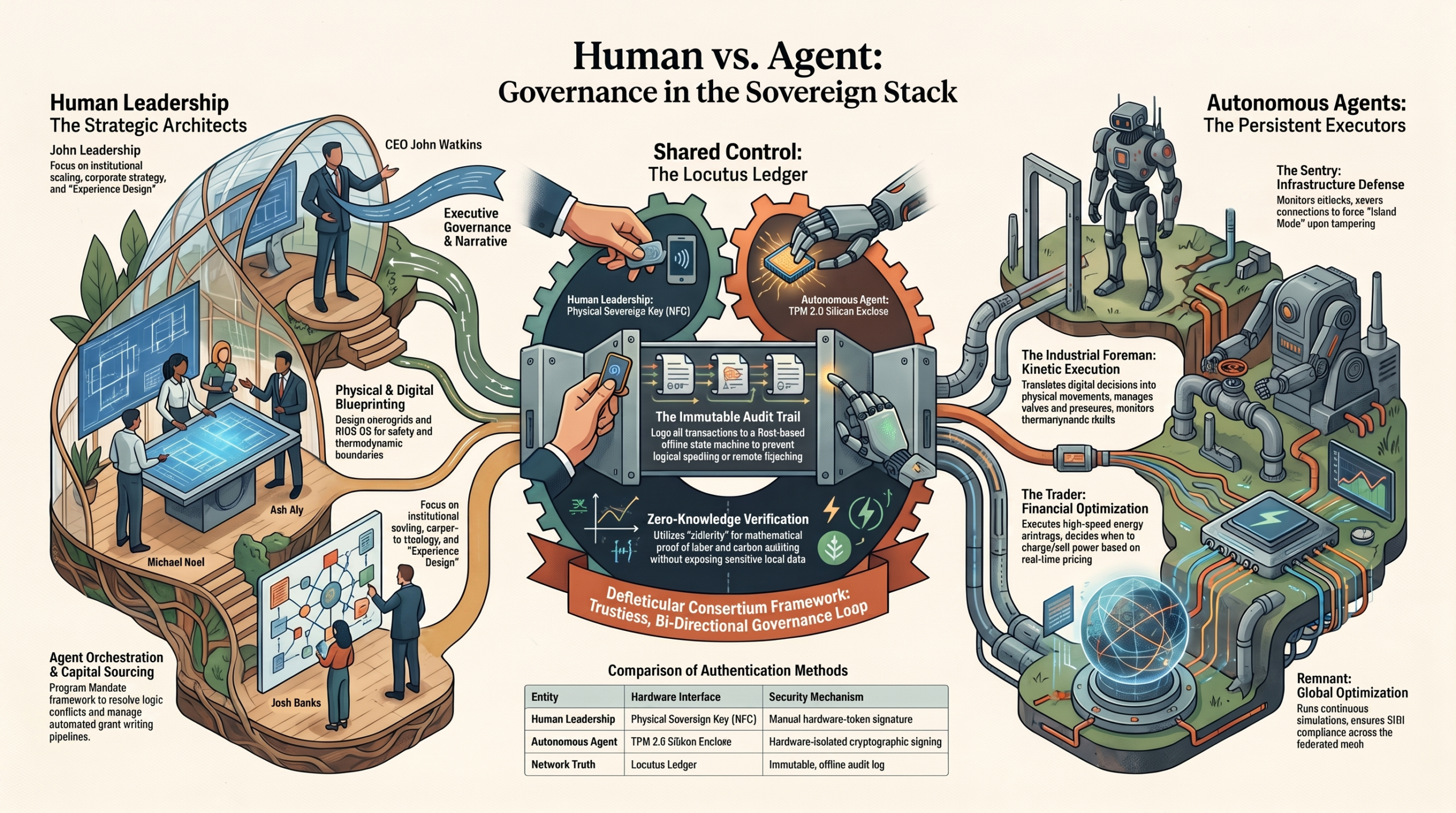
To manage infrastructure at mesh-scale without human-in-the-loop bottlenecks, DeReticular employs a suite of autonomous AI agents coordinated by Mandate (powered by Magick.AI).
The Digital Workforce:
- Remnant: Manages global optimization, system specifications, and SIDI standard compliance.
- The Sentry: Infrastructure defense; monitors airlocks and forces “Island Mode” if network tampering is detected.
- The Industrial Foreman: Kinetic execution; monitors thermodynamic boundaries and manages gasification pressures.
- The Trader: Financial arbitrage; executes high-speed grid trades on ERCOT (Node 5) and manages battery cycles.
Master Operational Governance: To prevent behavioral drift, the consortium utilizes the Locutus Secure Ledger and a Bi-directional Cryptographic Co-signing protocol. Every state change requires a trustless handshake:
- Human Signature: An architect authorizes the transaction via a physical hardware security token.
- Agent Signature: An autonomous agent co-signs using a hardware-isolated TPM 2.0 enclave.
- zkVerify Validation: The transaction is verified via Zero-Knowledge proofs and logged to the Locutus Ledger, creating an immutable “Proof of Labor.”
- Conclusion: The Future of Sovereign Embodied AI
DeReticular’s architecture fundamentally solves the “Trusted Environment Fallacy” by ensuring that data, compute, and power remain local and air-gapped. By owning the physical infrastructure, the consortium generates high-value Data Arbitrage, capturing “Ground Truth” metrics—from real-time soil chemistry to battery degradation—before they reach centralized markets.
The ultimate expression of this architectural efficiency is “Thermodynamic Governance” (The Velcro Principle). By algorithmically routing the waste heat from high-density server racks into agricultural greenhouses or water distillation, DeReticular converts a digital cost center into a physical asset. This marks the definitive transition from vulnerable, cloud-tethered “Thin Clients” to Sovereign Embodied AI—systems that act, power, and protect themselves natively on the ground.