Harnessing the Molecular Scissor: A Primer on Plasma Gasification and Energy Sovereignty
Welcome to the vanguard of the “Rural Renaissance.” For decades, our relationship with energy has been defined by “The Line”—a passive, fragile dependency on distant utilities. This era is ending. As an aspiring Sovereign Systems Architect, you are not merely studying a utility; you are learning to manage the physical and digital engine of community independence. By combining high-temperature plasma physics with trustless digital intelligence, we are shifting the global paradigm from centralized fragility to a resilient, reticular mesh of self-sustaining nodes.
- The Paradigm Shift: From “The Line” to “The Octagon”
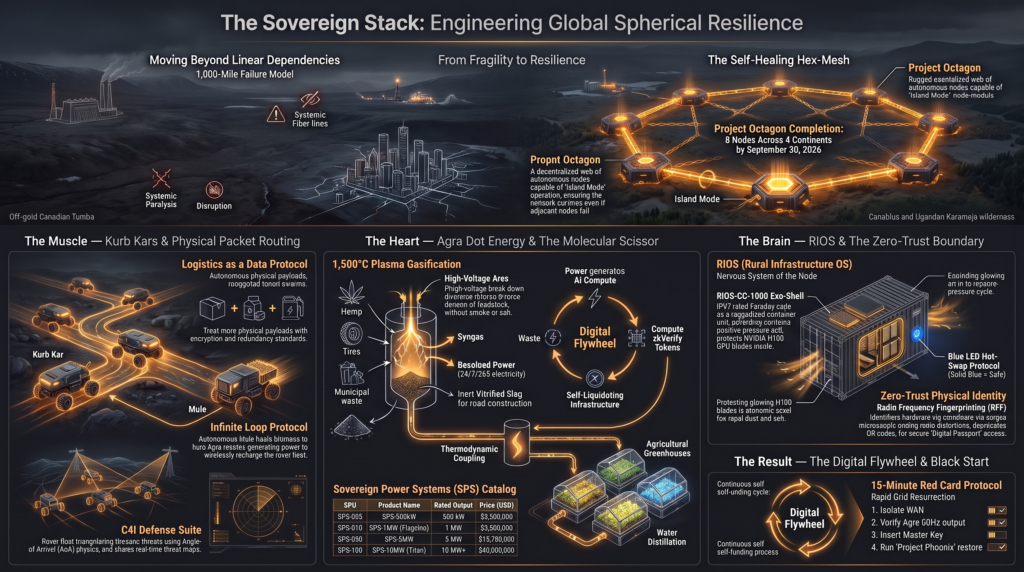
The 20th-century energy model is built upon “The Line”—a centralized transmission grid characterized by “linear fragility.” This architecture is fundamentally brittle, prone to cascading collapse under the extreme stressors of the modern era, specifically the massive energy demands of high-density AI compute. In this legacy model, one severed line or thermal overload at a central plant can plunge an entire region into darkness.
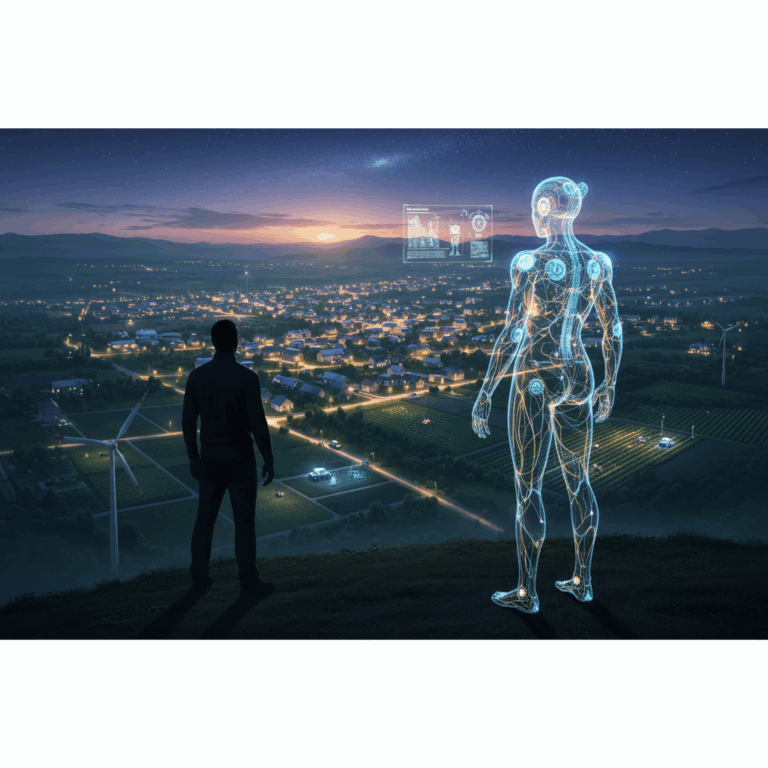
The transition to “The Octagon” represents a move toward Spherical Resilience. Instead of acting as a terminal consumer, a community becomes a Sovereign Node—a self-reliant point in a distributed “Hex-Mesh” network. Operating in Island Mode, these nodes generate their own power and process their own data, ensuring that even if the national grid fails, the local node remains lit and operational.
Comparison: The Linear Grid (Old World) vs. The Reticular Grid (Sovereign Stack)
Dimension Linear Grid (Old World / Fragile) Reticular Grid (Sovereign Stack / Spherical)
Topology Linear: Reliance on single, 1,000-mile chains. Hex-Mesh: Redundant, self-healing spherical web.
Failure Impact Cascading Collapse: One failure equals total darkness. Resilient: Continuity maintained if adjacent nodes fall.
Core Logic Harvested Cognition: Data stored in distant silos. Distributed Cognition: Edge intelligence via RIOS.
To achieve this total independence, a node requires a physical engine capable of generating continuous, reliable baseload power from the only resource every community has in abundance: its own waste.
- The Physics of the “Molecular Scissor”: Dissociation vs. Incineration
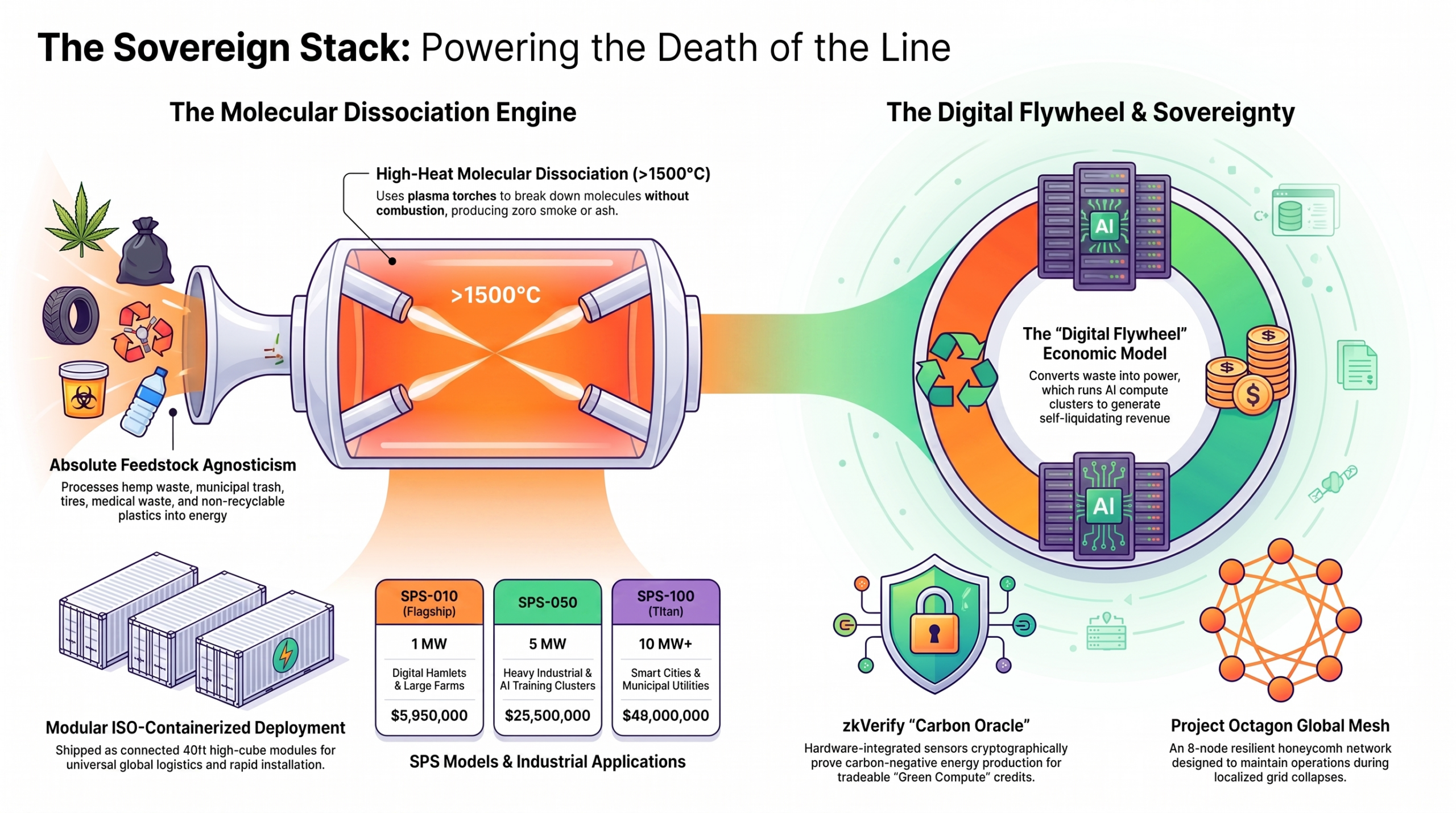
At the heart of the Sovereign Stack is a Plasma Gasification system. It is critical for the Keeper of the Flame to distinguish this from “incineration.” Traditional waste-to-energy burns trash, creating smoke, toxic ash, and CO2. We do not burn. We utilize molecular thermal dissociation.
By using high-energy plasma torches, the reactor achieves operational temperatures exceeding 1,500°C (2,700°F)—and is QA stress-tested up to 1,800°C. At these extremes, we move past combustion and engage the “Molecular Scissor,” snipping the atomic bonds of any material to its elemental constituent parts.
The Three Critical Physical Distinctions
- Zero Combustion: Occurring in an oxygen-starved environment, the material never “burns.” Consequently, the system produces no smoke and no toxic emissions.
- Elemental Breakdown: The high heat triggers a phase change, reducing feedstock to its basic constituent elements (primarily hydrogen and carbon).
- Inert Output: Inorganic materials melt into a non-toxic, obsidian-like glass called vitrified slag, ensuring a zero-waste process.
This physical engine allows us to reclassify “liabilities” into high-value assets, provided the system can handle the diversity of the local waste stream.
- Feedstock Agnosticism: Turning Liabilities into Assets
Most energy systems are fuel-specific; a plasma gasification system is feedstock agnostic. Because the molecular scissor breaks atomic bonds regardless of material density, the hardware can consume almost any waste stream. The RIOS Power Core manages these diverse inputs through real-time amperage adjustment, dynamically modulating the plasma arc’s intensity to ensure total dissociation.
Compatible Feedstocks include:
- Hemp Waste (7,000-acre feedstock at Node 4): Agricultural stalks and “wet leaf” residues from regional industrial parks.
- Municipal Solid Waste (MSW): Standard household and city garbage.
- Tires: High-energy rubber waste traditionally resistant to recycling.
- Medical Waste (High-heat sterilization): Hazardous materials requiring extreme temperatures for total destruction.
- Non-recyclable Plastics: Synthetic polymers, specifically HDPE and LDPE.
By processing these materials, the system generates three distinct, high-value products that fuel the local economy and the digital mesh.
- The Harvest: Syngas, Electricity, and Vitrified Slag
The result of dissociation is the “harvest”—the physical conversion of refuse into essential industrial outputs.
Output Type Key Components/Properties Primary Benefit/Use Case
Baseload Electricity Continuous 24/7/365 high-density power. Powers residential microgrids and RIOS-CC-1000 compute clusters.
Syngas Purified Hydrogen (H_2) and Carbon Monoxide (CO). High-purity chemical feedstock; can be refined into liquid ASF fuels.
Vitrified Slag Inert, non-toxic, obsidian-like glass aggregate. Sustainable aggregate for road construction and general building.
In addition to these outputs, we apply the Velcro Principle of thermodynamic coupling. Waste heat from the blades of high-density AI servers is not vented; it is piped into local greenhouses to grow food year-round, interlocking agriculture and compute into a single, circular asset.
- The Brain and the Refinery: RIOS, zkVerify, and Micro-GTL
A Sovereign Node is more than a reactor; it is an intelligent refinery. The hardware is governed by the RIOS Power Core, which handles load balancing via “Swarm” logic to coordinate energy distribution across the mesh. To prove the environmental and economic value of the node, we utilize the “Carbon Oracle.”
The Carbon Oracle Using zkVerify (Zero-Knowledge Proof) sensors integrated directly into the physical flow meters, the system mathematically proves carbon-negative operation. This “trustless” hardware captures waste intake and carbon sequestration data to mint Verified Green Compute credits, allowing the node to monetize its environmental offset on global markets.
When the node generates excess syngas, the optional Micro-GTL (Gas-to-Liquid) module uses Fischer-Tropsch synthesis to produce “drop-in” liquid fuels:
- ASF (Agra Synthetic Fuel) Diesel: A zero-sulfur replacement for agricultural machinery.
- Agra Synthetic Jet: High-purity kerosene optimized for autonomous logistics drones.
- Agra Naphtha: A clean industrial solvent and chemical feedstock.
- Conclusion: The Digital Flywheel and Your Learning Path
The final stage of energy sovereignty is the Digital Flywheel. In this model, local waste is converted into “free” excess electricity to power high-density AI compute. The revenue from this computation pays for the hardware, creating a self-liquidating asset that empowers the community.
As a Sovereign Systems Architect, you are the builder of the Project Octagon global mesh. You are moving a world of “linear fragility” into a future of spherical resilience, where energy is not a bill you pay, but a resource you govern.
- The Death of the Line: Centralized grids cannot handle high-density AI compute; the future is a “Hex-Mesh” of nodes operating in Island Mode.
- Molecular thermal dissociation: By operating at 1,500°C to 1,800°C, we use a molecular scissor to break waste into elements without smoke or ash.
- The Velcro Principle: True sovereignty integrates energy and intelligence, using waste heat from compute to fuel regional agricultural growth.
Welcome to the future of the Rural Renaissance. The flame is in your hands. Progress with purpose.