The 2026 Agentic Divide: A Learner’s Guide to the Future of AI
1. Understanding the “Agentic Shift” of 2026
In 2026, the artificial intelligence landscape has undergone a tectonic shift. We have moved beyond the “reactive” chatbots of the early 2020s, which required constant human prompting to function. Today, we have entered the era of Agentic AI—a transition from “search and find” to “assign and execute.”
The primary driver of this shift is the demand for 24/7 autonomous digital assistants that manage life’s logistics without supervision. This paradigm shift was made economically viable by the breakthrough Mixture-of-Recursions (MoR) architecture, which allows agents to operate continuously in the background with minimal compute overhead, essentially providing a “digital heartbeat” for your personal and professional workflows.
Key Concept: Agentic AI Unlike traditional AI, which is “reactive” (responding only when prompted), Agentic AI is proactive. It utilizes Mixture-of-Recursions (MoR) to maintain continuous reasoning loops, allowing it to execute complex, multi-step tasks autonomously on a user’s behalf 24/7.
While the goal of total autonomy is shared across the tech industry, the methods of achieving it have split the industry into two warring philosophies regarding where that “brain” should live.
——————————————————————————–
2. Paradigm A: The Centralized “Digital Butler” (Google Project Remy)
Google’s Project Remy is the flagship of the centralized model. Remy operates as an omnipotent, cloud-native manager that lives within the Google server farms, leveraging massive TPU 8i clusters to provide continuous intelligence. By deeply integrating with the Google Workspace (Gmail, Calendar, and Drive), Remy handles your world before you even think to ask.
The Remy Advantage
- Frictionless Convenience: Requires zero technical setup; the agent is “always on” and ready to act within the apps you already use.
- Proactive Task Management: Monitors your emails and schedules in real-time, booking travel or drafting replies based on your historical habits.
- Deep Ecosystem Integration: Possesses privileged access to the full Google software suite, allowing for seamless coordination between your professional and personal data.
The “So What?” for the User Remy offers “Elite Convenience” by outsourcing the heavy lifting of reasoning to corporate servers. However, as a Strategist, I must point out the “Trusted Environment Fallacy”—the dangerous assumption that a central cloud provider can perfectly secure your most intimate physical data while simultaneously harvesting it for model training. This paradigm demands an “always-on” internet connection and unfettered access to your digital identity.
However, this elite convenience relies on a precarious internet dependency and the controversial “Trusted Environment Fallacy,” where the price of a butler is your total transparency.
——————————————————————————–
3. Paradigm B: The Decentralized “Fortress” (OpenClaw & DeReticular)
The alternative is “Sovereign Automation,” championed by the open-source OpenClaw framework and implemented by DeReticular. This philosophy prioritizes the “Fortress” model: AI that runs on local, self-hosted hardware. By leveraging the density of modified M4 silicon, DeReticular ensures that the “brain” of your home never needs to consult a corporate cloud to turn on your lights or secure your perimeter.
The Hardware-Software Stack of Sovereignty
| Component Name | Function | Primary Benefit for Privacy |
| RIOS | Rural Infrastructure OS | A container-optimized Linux kernel that supports air-gapped operations. |
| OpenClaw | Agentic Framework | An open-source platform that executes multi-step tasks locally without cloud API calls. |
| M4 Silicon Sentry | Modified Apple M4 SoC | Achieves high-density AI inference at just 5W idle power with 0dB silent passive cooling. |
| Nomad Link | Connectivity Bridge | Provides rugged LTE/Starlink backhaul to keep local agents connected in remote areas. |
The Synthesis of “Island Mode” This architecture enables “Island Mode,” where a property continues to function flawlessly even if the macro-internet fails. This is made possible by Trifi Wireless—a combination of Wi-Fi 6E and LoRaWAN mesh networking. While Wi-Fi handles high-speed data, the LoRaWAN mesh ensures that local sensors and locks remain responsive over long distances without an external connection.
This architecture ensures that security and logistics remain a matter of local resilience and physical survival, even in the total absence of a macro-internet connection.
——————————————————————————–
4. Comparative Analysis: The Impact on You
The “Agentic Divide” forces a choice between corporate-managed luxury and self-reliant security. The core of this divide is the tension between the “Trusted Environment Fallacy” of the cloud and the “Sovereign Tech” narrative of the edge.
The Agentic Divide: Head-to-Head Comparison
| Feature | Centralized (Project Remy) | Decentralized (OpenClaw / DeReticular) |
| Data Residency | Cloud-based: Processed on corporate TPU 8i server farms. | Local: Secured via TPM 2.0 and Split-Ledger Architecture. |
| Connection Requirement | Persistent Internet: System breaks if the cloud link is severed. | “Island Mode”: Fully capable of offline operation via Trifi Wireless. |
| Identity Management | Cloud Accounts: Tied to your corporate login and data profile. | Sovereign Badges: NFC-enabled physical tokens that mint Soulbound NFTs. |
| Maintenance | Corporate-managed: Silent updates dictated by the provider. | SOV-AUTO-DEV: A local DevOps agent that “self-heals” the system. |
Synthesis: The Identity Shift In the decentralized model, your identity is not a password stored on a server; it is anchored to a physical NFC Sovereign Badge. This badge cryptographically proves your identity to your local Gateway, ensuring that you—and only you—control the root admin access of your AI core.
To bridge this divide, a new category of hardware is emerging to merge these worlds into a single, trustless experience.
——————————————————————————–
5. The Hybrid Solution: The Digital Airlock
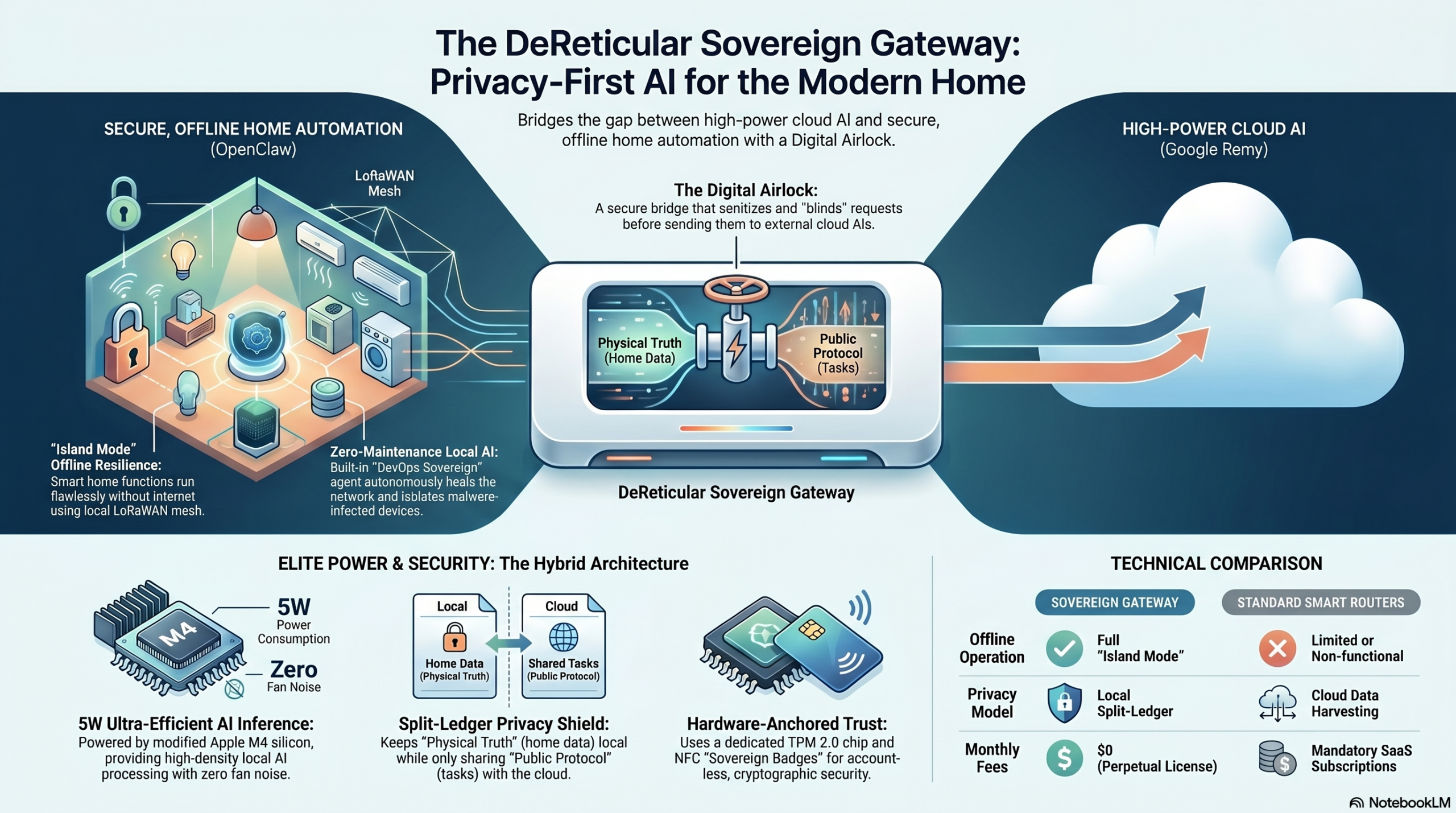
The DeReticular Sovereign Gateway acts as the physical “Digital Airlock” between these two worlds. It allows a user to utilize the immense logistical power of Google Remy without exposing their “Physical Truth” (internal home telemetry, camera feeds, or private schedules).
The 3 Steps of a Sanitized Request
- Local Formulation: The user issues a command to the local OpenClaw agent (e.g., “Book a flight based on my calendar”). The gateway processes this locally, identifying only the necessary external variables.
- Split-Ledger Sanitization: The Split-Ledger Privacy Shield separates the “Physical Truth” from the request. It strips all IP addresses, local telemetry, and context, leaving only the “Public Protocol” intent.
- Blinded Execution: A Blinded Payload is handed to the cloud (Remy). Google executes the booking and returns the confirmation to the Gateway, never having seen the user’s internal network or private data.
The “So What?” for the Prosumer This hybrid model provides the ultimate compromise for the 2026 prosumer: Sovereign Privacy paired with Elite Convenience. You no longer have to choose between a smart home and a private home.
——————————————————————————–
6. Conclusion: Choosing Your AI Future
In 2026, the choice of an AI assistant is no longer a technical preference—it is an ideological stand. You are deciding who owns the “Physical Truth” of your life. While Google Remy offers the seamless luxury of the cloud, DeReticular and OpenClaw provide the unbreakable resilience of a sovereign fortress. The future belongs to those who can bridge these paradigms without falling victim to the fallacies of the past.
Final Insight The Trustless AI Gateway represents the pinnacle of 2026 technology. It treats the cloud as a mere utility for external logistics while keeping the “brain” of the home local, silent, and sovereign. This is the only path to achieving Sovereign Privacy paired with Elite Convenience.