Operational Infrastructure Plan: Deployment of the Sovereign Stack for Lunar Industrialization
1. Strategic Framework: From Linear Fragility to Spherical Resilience
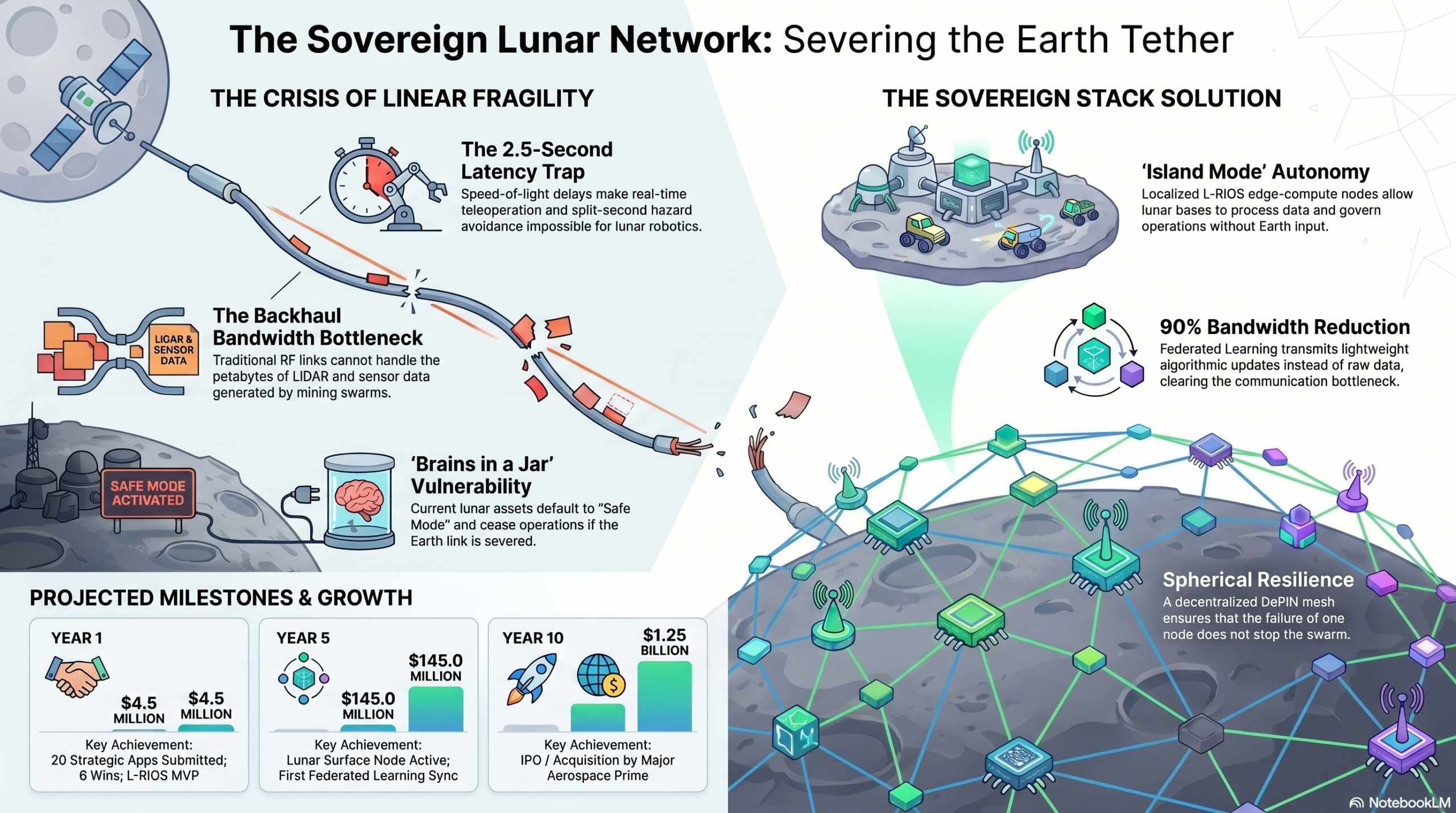
The expansion of industrial operations to the lunar surface requires a fundamental departure from the communication models of the last century. Current off-world operations are characterized by “Linear Fragility”—a paradigm where assets function as “brains in a jar,” tethered to Earth by a fragile umbilical cord of radio waves. This architecture, which Michael Noel defines as “The Line,” relies on terrestrial supercomputers to process telemetry gathered 250,000 miles away, creating a 2.5-second latency trap and a massive bottleneck at the Deep Space Network (DSN). If this linear link is severed—whether by solar flares, orbital occlusions, or DSN scheduling conflicts—mission assets default to a “safe mode,” leading to catastrophic operational downtime.
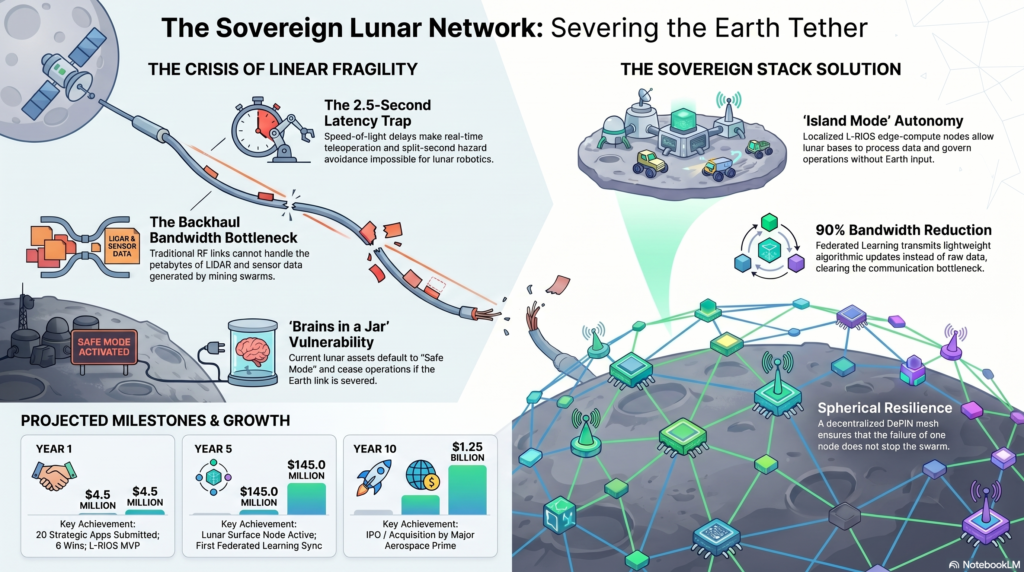
To achieve sustained lunar industrialization, we must embrace the “Death of the Line” and pivot to “Spherical Resilience.” The Sovereign Stack—the integration of the Lunar Infrastructure Operating System (L-RIOS) and Decentralized Physical Infrastructure Networks (DePIN)—replaces fragile linear links with a self-healing mesh. By establishing computational sovereignty at the destination, we enable “Island Mode” operations where lunar infrastructure can think, learn, and survive independently. This decentralization is the non-negotiable prerequisite for off-world autonomy; without it, the economic extraction of lunar resources remains mathematically and operationally unviable.
Table 1: Comparative Architecture Analysis
| Feature | Legacy “Earth-Cloud” Model | DeReticular “Island Mode” |
| Network Topology | Linear / Monolithic (DSN dependent) | Spherical / Mesh (DePIN) |
| Processing Site | Terrestrial Cloud (Centralized) | Lunar Edge Data Center (Localized) |
| Latency | >2.5s Round-trip | <20ms Localized Proximity |
| Bandwidth Usage | High (streaming raw telemetry) | Ultra-Low (transmitting 45 KB updates) |
| System Resilience | Fails to “Safe Mode” on link loss | Maintains “Black Start” Autonomy |
| Survivability | High risk (Single point of failure) | Self-healing (Peer-to-peer redundancy) |
The physical manifestation of this decentralized philosophy begins with the “Muscle”—localized hardware nodes providing autonomous power and communication.
2. The Muscle: Agra Dot Astro Power & Communication Canopy
Localized baseload power is the cornerstone of industrial sovereignty. In the hostile environment of the Lunar South Pole, the legacy approach of a centralized grid is replaced by Agra Dot Astro modules. While our terrestrial counterparts in Uganda (Node 4) utilize plasma gasification for off-grid power, the Lunar adaptation pivots to modular micro-nuclear fission and high-efficiency solar tracking. These modules facilitate a peer-to-peer energy-sharing network, ensuring that industrial operations are not dependent on a single, vulnerable power source.
Technical Capabilities of Agra Dot Astro Units
- Micro-Nuclear Fission & Vertical Solar Arrays: Units provide reliable, off-grid baseload power regardless of light conditions in crater valleys, routing energy dynamically when mining swarms encounter high-resistance regolith.
- LUNARSABER Integration: Each unit integrates with LUNARSABER masts—100-meter-tall deployable utility poles that act as central hubs for solar harvesting, surveillance, and PNT (Position, Navigation, and Timing).
- Proximity Transceivers: Equipped with space-hardened 4G/LTE/5G transceivers to create a localized high-bandwidth communication bubble.
- Thermal Resilience: Utilizing 14 thermally isolated mounting points on carbon-composite panels (validated during the IM-2 mission), the units absorb idle heat and expel operating heat to survive extreme Lunar South Pole fluctuations.
By utilizing 3GPP (COTS) cellular standards, we reduce capital expenditures (CAPEX) and R&D timelines. These terrestrial standards, recently validated on the lunar surface, provide the high-speed machine-to-machine (M2M) connectivity canopy required for the kinetic agents tasked with resource extraction.
3. The Motion: Kurb Crawler Swarms and Kinetic Operations
The era of the monolithic, billion-dollar science rover is over. Sovereign Space Systems (S3) utilizes modular, redundant swarms of Kurb Crawlers—heavy-duty mining automata that are 1,000 times quicker and exponentially less expensive than legacy rovers. These are the physical manifestation of intelligent infrastructure, designed to convert raw regolith into industrial assets.
Operational Parameters in Shackleton Crater
Operating within the Shackleton Crater, Kurb Crawler swarms execute water-ice harvesting and regolith logistics. They navigate the pitch-black environments of Permanently Shadowed Regions (PSRs) without the need for Earth-based commands or GPS. Utilizing the localized DePIN mesh, the crawlers employ multi-static sensory data—effectively using the proximity network signals as high-resolution spatial sensors to map the 3D environment for navigation and obstacle avoidance.
Advantages of Swarm Robotics
- Labor Division: Swarms collaboratively excavate terrain, dividing tasks based on localized resource density and equipment health.
- Redundant Reliability: The failure of a single Kurb Crawler does not impact mission success; the swarm dynamically re-allocates tasks to compensate for the loss.
- Collision Avoidance: Peer-to-peer communication via the local 4G/LTE mesh allows for real-time coordination and safe navigation within narrow crater corridors.
- Economic Scalability: Shifting from bespoke science platforms to low-cost, redundant swarms allows for aggressive industrial expansion that traditional rovers cannot match.
These physical agents serve as the mobile sensors and processors for the cognitive layer of the stack.
4. The Mind: L-RIOS and the Federated Learning Mesh
Computational sovereignty is the final step in severing the Earth-tether. The ~2.5-second latency delay makes real-time, closed-loop teleoperation dangerous. L-RIOS (Lunar Infrastructure Operating System) serves as the localized brain, processing data at the edge to bypass the DSN bottleneck and enable “Island Mode” survival.
Federated Learning Mesh Workflow
The intelligence of the system is governed by a decentralized Federated Learning Mesh:
- Physical Anomaly: A Kurb Crawler encounters a novel hazard, such as unexpectedly dense basalt or abrasive dust that threatens drill seizure.
- Localized Training: The crawler’s onboard GPU analyzes the thermal and kinetic feedback, training an optimized solution (e.g., a specific pulsating drill rhythm) locally.
- Algorithmic Update: The rover packages only the mathematical solution—a lightweight algorithmic weight update of approximately 45 KB.
- Mesh Broadcast: This update is broadcast via the local proximity mesh to the L-RIOS Edge Hub in <500 milliseconds.
- Swarm Sync: The update is instantly pushed to the entire fleet, transforming the “intelligence of one” into the “instinct of the swarm.”
This model reduces backhaul bandwidth requirements by over 90% and ensures that the colony’s collective knowledge evolves in real-time.
Sovereign Sentry AI and Trustless Verification: The cognitive layer is secured by Sovereign Sentry AI, utilizing Zero-Knowledge proofs (zkVerify) and Hardware Root of Trust (TPMs). Every M2M command is verified through RF Fingerprinting, ensuring the network is immune to spoofing. Access for human-in-the-loop intervention is managed via Sovereign Badges—NFT credentials on a decentralized ledger.
This cognitive architecture ensures total “Island Mode” autonomy, where the lunar base manages its own logic and survival.
5. Environmental Mitigation and Technical Resilience Protocols
Hardening the mesh against the hostile Lunar South Pole is critical for maintaining “Spherical Resilience.”
Abrasive Regolith & Dust Attenuation
Lunar dust is electrostatically charged and highly abrasive. Plumes generated by mining attenuate high-frequency RF signals. L-RIOS mitigate this by maintaining localized, peer-to-peer navigation through signal degradation, ensuring rovers do not default to “safe mode” during active excavation.
RF Multipath Fading in Metallic Craters
The steep, metallic walls of Shackleton Crater cause RF signals to bounce erratically without an atmosphere to scatter them, leading to phase cancellation (multipath fading). To counter this, S3 deploys Macro-Mesh Towers utilizing 100-meter-tall LUNARSABER masts on crater rims, providing unbroken line-of-sight into deep PSR mining pits.
The Black Start Vulnerability
The “Black Start” protocol, enabled by the RIOS operating system, ensures 100% operational uptime during total DSN blackouts. L-RIOS recognizes the link loss and shifts the swarm into “Island Mode,” orchestrating energy and logistics indefinitely while treating Earth as an asynchronous observer.
6. Implementation Roadmap: Project LUNA-NODE Execution
The transition to a sovereign lunar network follows a four-phase roadmap from terrestrial validation to flight readiness.
Phased Deployment Schedule
- Phase I: Terrestrial Validation (Operation Octagon): Testing prototypes at Node 3 (Arizona) for heat/dust and Node 4 (Uganda) for off-grid power to validate L-RIOS in zero-connectivity scenarios.
- Phase II: Flight Hardening: Certification of hardware through vacuum-chamber, radiation, and vibration testing to ensure survival at the South Pole.
- Phase III: CLPS Integration: Delivery of L-RIOS hubs and Kurb Crawler swarms to Shackleton Crater via NASA PRISM payloads.
- Phase IV: Full “Island Mode” Initialization: Establishing the permanently sovereign Edge Data Center.
Strategic Funding Mapping
| Funding Vehicle | Milestone Alignment | Specific Capitalization |
| SBIR Phase I | Concept Feasibility | $150,000 (Non-dilutive R&D) |
| SBIR Phase II | L-RIOS & Crawler Prototypes | $850,000 (Prototype maturation) |
| NASA Tipping Point | Flight-Ready Hardware | $2M – $15M (Industry cost-share) |
| SpaceWERX Pitches | Orbital Defense Sovereignty | Sovereign mesh for orbital security |
The establishment of the Sovereign Lunar Network represents the final severing of the Earth-tether. By deploying infrastructure that processes its own data, adapts its own algorithms, and generates its own power, we are establishing “Lunar Truth.” The era of the multi-planetary economy begins not with a bigger antenna, but with infrastructure that finally thinks for itself. Space is sovereign.