
The Dawn of Agentic AI: A Primer on Autonomous Infrastructure
Welcome to 2026. For years, artificial intelligence has been a tool we talked to—a digital librarian that waited for a query before providing a response. Today, we are witnessing a fundamental shift from “Reactive AI” to Agentic AI: systems that don’t just process information, but autonomously act upon it. As a curriculum architect, I invite you to view this not as a better chatbot, but as the arrival of a proactive digital workforce.
1. The Great Shift: From Reactive Chatbots to Proactive Agents
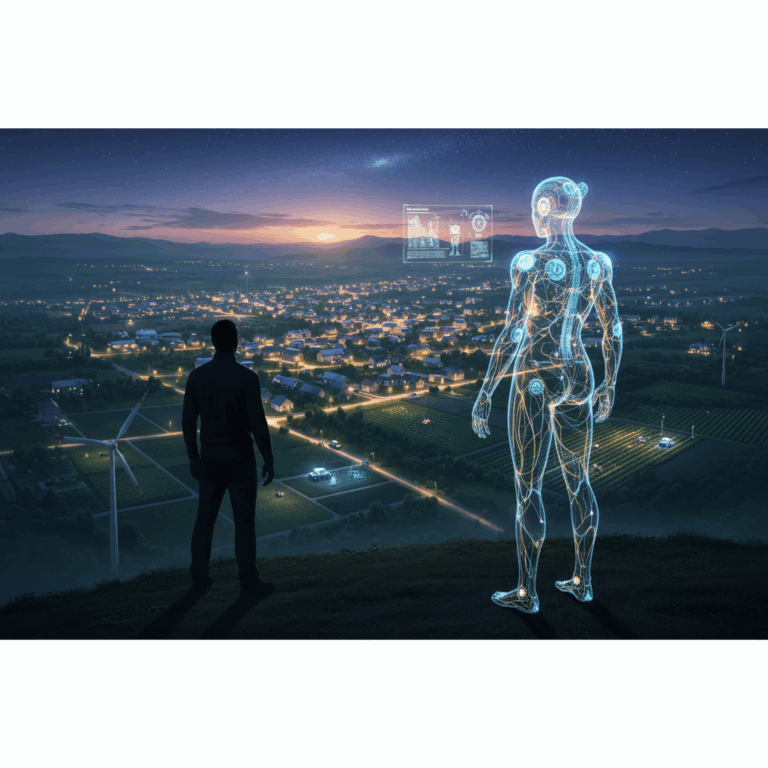
The transition occurring this year is best understood through the mental model of the Sovereign Director. In the reactive era, you were the project manager, laboring over every prompt. In the agentic era, you define high-level objectives, and the AI manages the execution.
| Feature | Traditional AI Chatbots (Reactive) | Agentic AI (Proactive) |
| User Input | Requires explicit, one-off prompts for every sub-task. | Operates based on high-level goals and “missions.” |
| Execution | Generates text, code, or images in a vacuum. | Executes multi-step digital errands and physical logistics. |
| Operation | Idle until a user initiates interaction. | Operates 24/7 in the background, monitoring and acting. |
| Digital Role | “Search and Find” | “Assign and Execute” |
The Learner’s Insight: The “so what?” of this shift is the drastic reduction of Cognitive Load. By moving from “Search and Find” to “Assign and Execute,” the user is freed from the friction of micro-managing digital workflows. You are no longer the engine; you are the navigator.
Transition: To move from the concept of an agent to an autonomous force that can manage real-world systems, we must examine the physical durability required to host these “brains.”
2. Foundations of Sovereignty: DePIN and “Island Mode”
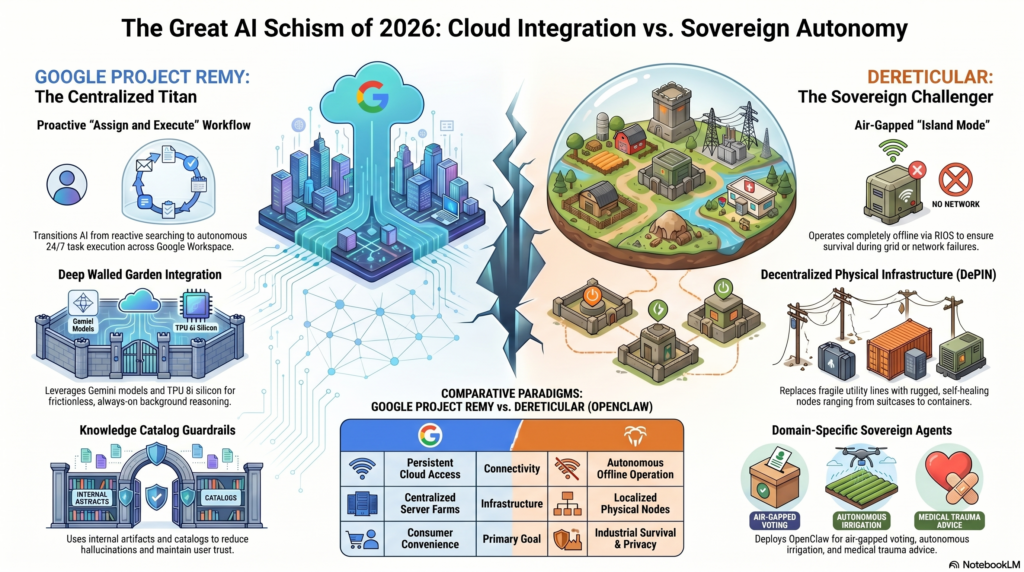
In the past, AI was tethered to centralized data centers. The rise of Decentralized Physical Infrastructure Networks (DePIN), led by the firm DeReticular, has broken this dependency. Their philosophy, “The Death of the Line,” aims to replace fragile, centralized power and data lines with Spherical Resilience—a network where every node is self-sustaining.
Central to this is “Island Mode,” a state where a node operates with complete autonomy, air-gapped from the traditional internet. To make this a physical reality, DeReticular utilizes the Pilot Series hardware:
- Tier 1: Pilot Expeditionary – A rugged, three-case suitcase system featuring an Intel Xeon processor and NVIDIA A2 GPU, powered by 400W solar input for mobile autonomy.
- Tier 2: Pilot Standard – A 10ft climate-controlled ISO container equipped with 4.4kW solar and 20kWh of battery storage, designed for permanent localized compute.
- Tier 3: Pilot AI Core – A 20ft container powerhouse utilizing Dual Xeon Platinum processors and an NVIDIA A100 GPU, supported by a massive 15kW solar array.
- The Silicon Sentry – A premium efficiency option using a modified Apple M4 Mac Mini, providing ultra-efficient AI inference at just 5W when idle.
The Learner’s Insight: “Island Mode” is a critical safety feature, not a bug. By allowing nodes to run offline, communities gain protection against the “single points of failure” inherent in the global grid, such as centralized outages and systemic cyberattacks.
Transition: While these hardware shells provide the body, the “software soul” within must be capable of establishing trust without a central authority.
——————————————————————————–
3. The Software Soul: RIOS and the OpenClaw Framework
To govern a decentralized world, DeReticular utilizes RIOS (Rural Infrastructure Operating System). RIOS is an AI-native kernel that solves the problem of trust in a trustless environment through three core mechanisms: Radio Frequency (RF) Fingerprinting and TPM 2.0 to anchor data to physical hardware, and a Split-Ledger Architecture that keeps sensitive financial data private while verifying “physical truths” on public ledgers like Freenet/Locutus.
Running atop RIOS is OpenClaw, a framework-agnostic, open-source platform for self-hosted agents.
The Philosophy of Sovereignty “The Death of the Line” represents a shift from fragile, linear dependencies (like a single power line) to “Spherical Resilience,” where every node is an autonomous island capable of governing itself through decentralized, air-gapped workflows.
However, the path of decentralization is not without peril. The recent security collapse of OpenClaw (due to CVE-2026-25253 and associated supply chain attacks) highlighted the risks of open-source frameworks that lack the managed “sandboxing” found in corporate ecosystems.
The Learner’s Insight: For developers, the primary benefit of OpenClaw is Platform Agnosticism. Unlike corporate AI, OpenClaw allows for bespoke workflows that remain functional even if a tech giant changes its terms. However, the trade-off is the “Responsibility of Security”—users must manage their own defenses against vulnerabilities like CVE-2026-25253.
Transition: This tension between “sovereign risk” and “corporate safety” has led to a direct clash between open frameworks and the largest tech entity on earth.
——————————————————————————–
4. A Tale of Two Futures: Google Project Remy vs. OpenClaw
The industry is currently divided by the “OpenClaw Killer”: Google’s Project Remy. This clash centers on the “Trusted Environment Fallacy”—the mistaken belief that software guardrails are as secure as physical isolation.
| Dimension | Google Project Remy (Centralized) | OpenClaw Framework (Decentralized) | Learner Insight |
| Connectivity | Persistent Cloud connection required. | Designed for local “Island Mode.” | Remy prioritizes convenience; OpenClaw prioritizes survival. |
| Data Access | Integrated “Walled Garden” (Workspace). | Bespoke connections via WebSockets. | Remy is a frictionless butler; OpenClaw is a custom toolset. |
| Hardware | TPU 8i Silicon / Gemini 3.2 Flash. | Local Silicon (Xeon / Apple M4). | Remy uses sub-quadratic memory for efficiency; OpenClaw uses physical separation. |
| Security | Knowledge Catalogs & Artifacts. | Physical Air-gapping & RBAC. | Remy mitigates the Trusted Environment Fallacy via code; OpenClaw via physics. |
The Learner’s Insight: Google leverages a Mixture-of-Recursions (MoR) architecture to make 24/7 agents economically viable for the average consumer. While Project Remy offers the ultimate “frictionless” experience, it requires you to trust Google’s internal guardrails. OpenClaw assumes the environment is hostile and relies on physical air-gapping for true security.
Transition: Theory becomes practice when these agents are deployed to manage the essential functions of a community.
——————————————————————————–
5. Agents in Action: Specialized Roles and Civic Sovereignty
Within the DeReticular ecosystem, OpenClaw agents are assigned specialized “Sovereign” roles to replace centralized utilities. These systems, such as the City Infrastructure Nexus, allow towns of 1,000 to 3,000 people to operate with total independence.
- Industrial & Logistics
- Industrial Foreman: Manages solar microgrids and monitors local power distribution.
- Sovereign Agronomist: Controls autonomous irrigation and monitors local farming sensor fabrics.
- Administrative & IT
- DevOps Sovereign: An air-gapped system administrator that self-heals crashed services and reviews code locally.
- Sovereign Executive: A private Chief of Staff that uses local Whisper AI for voice-to-text to automate filing without cloud exposure.
- Civic & Security
- Sovereign Elector: Provides an EAC-compliant, air-gapped voting system for local governance.
- Vault Warden / Field Medic: Uses LiDAR for volumetric security and provides bionic medical trauma advice entirely off-grid.
The Learner’s Insight: These agents don’t just assist; they replace. By localizing voting, medical advice, and grid management, Agentic AI enables “Civic Sovereignty.” A small town can now possess the logistical sophistication of a metropolis without being dependent on a distant, vulnerable capital.
——————————————————————————–
6. Summary Checklist for the Aspiring Learner
Before concluding your exploration, ensure you have mastered these core concepts:
- [ ] Proactive vs. Reactive: Can you explain how “Assign and Execute” reduces cognitive load compared to traditional prompting?
- [ ] DePIN & Island Mode: Do you understand how physical air-gapping serves as a primary security methodology against centralized outages?
- [ ] RIOS Security: Can you identify how RF Fingerprinting and Split-Ledger architectures establish trust in a decentralized node?
- [ ] The “Trusted Environment Fallacy”: Do you understand the difference between Google’s “Artifacts/Guardrails” and OpenClaw’s “Air-gapping/RBAC”?
- [ ] The OpenClaw Paradox: Are you aware of the benefits of platform agnosticism versus the risks posed by vulnerabilities like CVE-2026-25253?
Perspective Shift: Agentic AI is more than a technological upgrade; it is a fundamental shift in the human-machine relationship. We are moving from a world where we use computers to a world where we direct autonomous infrastructure, reclaiming our independence through the power of the localized, sovereign agent.