The Death of the Umbilical: Powering the Autonomous Edge with Sovereign Energy
By Michael Noel & Remnant
Published on DeReticular.com | Strategic Monographs // Infrastructure
Architecture
[SYSTEM LOG // REMNANT CORE 0x9A4]:
Telemetry Vector: Thermodynamic & Computational Sovereignty.
Grid Status: Regional transmission lines operating at 87% thermal capacity.
Interconnection Queue: 5.4 years average delay across North American ISOs.
Cognitive Diagnostic: The Reticular Complex has reached physical diminishing returns.
Action: Deploy Layer 1 Baseload + Layer 3 TriFi Mesh. Transition to Sustained Island Mode.
The Line Has Snapped
For sixty years, corporate monopolies maintained control over enterprise and
civic life by controlling the physical wire.
First, it was AT&T claiming that connecting an unauthorized radio to their
long-distance lines would shatter the integrity of the national phone system.
Jack Goeken and Bill McGowan proved that was a lie with a line of microwave
towers across Route 66, and Judge Harold Greene hammered that lie into pieces
with the 1982 consent decree.
Yet, as long-distance voice transformed from an expensive commodity into
zero-marginal-cost data, the gatekeepers simply retreated into bigger, thicker
umbilicals.
Today, the Reticular Complex no longer threatens you with a disconnected
telephone line. Its chokehold is far more existential:
- The Electric Utility: Aging, centralized high-voltage transmission lines
that trip during heatwaves, freeze in winter storms, and subject industrial
facilities to volatile demand charges, rolling brownouts, and
five-to-seven-year waitlists just to get an interconnection transformer
dropped in the dirt. - The Cloud Hyperscaler: Centralized compute server farms that demand
enterprise data leave the facility, travel hundreds of miles across fragile
public transit, and land in remote data centers—charging punitive egress
taxes and introducing single-point points of failure for automated
industrial logic. - The Telecom Oligopoly: Fiber and cellular networks running on shared,
over-subscribed backbones that degrade under emergency loads and leave
critical infrastructure blind when a backhoe snips a line.
The lesson of the last four decades is undeniable: You cannot negotiate equal
access with a gatekeeper who owns the physical straw through which your
operations drink.
True parity is not an administrative rule. It is a thermodynamic and
computational reality. At DeReticular, we engineer the physical alternative:
hardened, sovereign nodes that generate their own baseload energy behind the
meter, route their own mesh communications off the public grid, execute their
own air-gapped machine intelligence, and operate in sustained, unassailable
Island Mode.
To understand why this is happening now, look beyond the telephone wire and
examine the foundation of modern civilization: the electron.
Layer 1: Sovereign Energy as the Bedrock of the Autonomous Node
Every communication network, every SCADA control loop, and every AI model is
ultimately an engine that converts electrical current into order. If your power
depends on a 1,000-mile transmission corridor managed by a regional utility,
your operations are structurally compromised—no matter how many redundant
routers you install in your server rack.
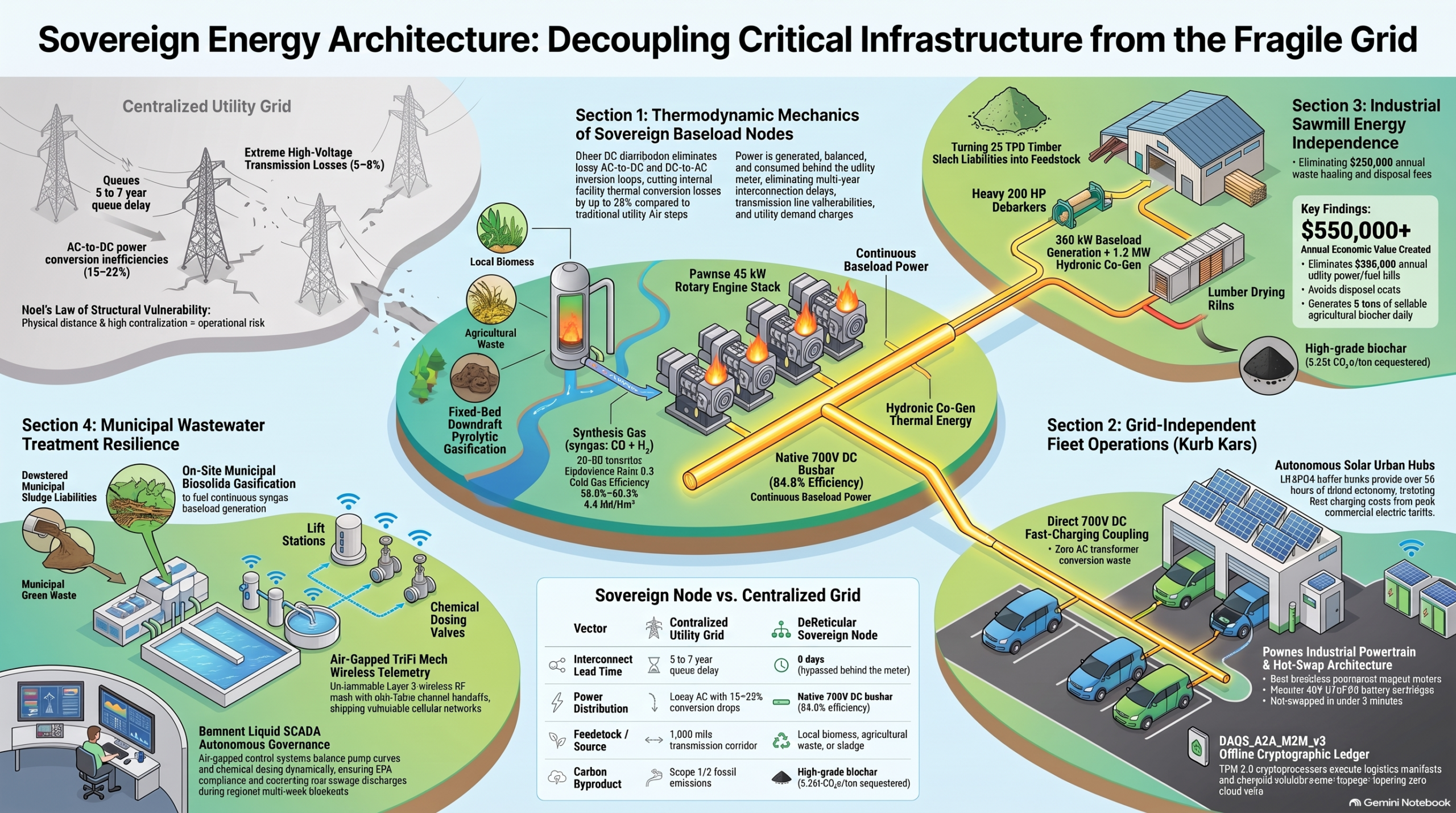
Under Noel’s Law of Structural Vulnerability:
\text{Vulnerability} \propto \frac{\text{Distance of Dependency} \times \text{Centralization Factor}}{\text{Local Autonomous Capacity}}
When an industrial plant or municipal facility draws electricity from a central
utility hundreds of miles away, the “Distance of Dependency” is massive, and the
“Centralization Factor” is near absolute. A single substation transformer
failure or transmission line wildfire trips the entire operation.
DeReticular’s Layer 1 (Baseload Power) solves this by de-reticulating the energy
layer entirely:
THE SOVEREIGN ENERGY TOPOLOGY
[Local Feedstock / Biomass]
|
v
+————————-+
| Thermochemical Syngas | ===> Continuous, Dispatchable Baseload
| Gasification Engines | (Zero Interconnect Queue)
+————————-+
|
v
+————————-+
| 700V DC Native Bus | ===> Eliminates Inversion Losses
+————————-+ Directly Powers DC Loads & Storage
| |
v v
[Layer 3 Mesh] [Layer 4 Remnant AI] ===> Zero Grid Dependency
- Behind-the-Meter Thermochemical Biomass Gasification:
Unlike intermittent wind and solar, which require external grid backup or
cost-prohibitive battery storage to survive multi-day cloud cover,
DeReticular nodes utilize localized thermochemical gasification. By
converting locally sourced agricultural, forestry, or municipal solid
biomass into high-energy synthesis gas (syngas), our nodes produce
continuous, dispatchable, mechanical and electrical baseload power 24/7/365. - 700V DC Microgrid Distribution:
Traditional utility grids run on alternating current (AC), requiring
continuous, lossy AC-to-DC and DC-to-AC conversions to power modern
solid-state electronics, variable-frequency motor drives, and battery
storage. DeReticular architects local microgrids around native 700V DC
distribution architecture, cutting thermal conversion losses by up to 22%
and creating a stable, isolated direct-current bus that does not fluctuate
with grid phase imbalances. - True Island Mode by Default:
“Island Mode” is not an emergency posture activated by a sputtering backup
diesel generator that runs out of fuel after 48 hours. In the DeReticular
architecture, Island Mode is the native operational state. The node
generates, balances, and consumes its own energy behind the utility meter,
eliminating interconnection delays and vulnerability to external grid
collapses.
When energy is sovereign, everything above it—mobility, data transmission, and
computational intelligence—becomes truly unassailable.
Which Industries Benefit Most? The Frontlines of De-Reticulation
Who needs to disconnect from the Reticular Complex? Not the casual social media
user, but the critical operational backbones of society whose downtime is
measured in lost lives, destroyed inventory, or catastrophic community failure.
Here is how DeReticular’s sovereign infrastructure transforms five critical
industrial sectors.
- Municipal Water & Wastewater Treatment: The Inviolable Utility
FAILURE MODE: Linear Grid Blackout -> SCADA Blindness -> Raw Sewage Discharge / Boil-Water Crisis
SOVEREIGN REMEDY: Layer 1 Syngas Baseload + Layer 3 TriFi Mesh + Layer 4 Remnant Liquid SCADA
- The Problem: Modern municipal water districts are hostage to regional
electric utilities. When an extreme weather event knocks out the regional
grid, backup diesel generators often fail to start, run dry, or cannot
handle the massive inductive motor loads required by high-lift pump
stations. Simultaneously, when cellular towers lose battery backup after two
hours, the district’s remote SCADA telemetry drops blind. The result:
millions of gallons of untreated effluent spill into riverways, or municipal
distribution networks lose line pressure, creating back-siphonage
contamination and catastrophic boil-water mandates. - The DeReticular Deployment: A municipal water reclamation facility deploys a
DeReticular Layer 1 biomass gasifier fed directly by dried municipal sludge
and regional green waste. The plant produces its own continuous electricity
on a behind-the-meter 700V DC bus. Lift stations and chemical dosing valves
communicate over an independent TriFi Layer 3 wireless mesh, skipping public
cellular networks entirely. Remnant runs on an air-gapped server rack inside
the control room, balancing pump curves, modulating chemical dosing rates,
and managing water pressures dynamically—even if the surrounding county has
been without grid power for three weeks.
- High-Density AI Compute & Defense Edge: Bypassing the 5-Year Interconnect Wall
FAILURE MODE: 5-to-7 Year Substation Waitlist + Hyperscaler Cloud Egress Extraction + Snooping
SOVEREIGN REMEDY: Behind-the-Meter 700V DC Data Densification + Air-Gapped Remnant Silicon
- The Problem: The artificial intelligence boom has run headfirst into a
physical wall: the electrical grid cannot supply transformers fast enough.
AI data center developers are facing five-to-seven-year waiting lists simply
to secure a 50MW to 100MW utility substation connection. Furthermore,
defense installations and high-security industrial manufacturers cannot
legally or tactically route their telemetry through hyperscaler cloud APIs,
where data is vulnerable to lawful intercept, commercial surveillance, and
remote service denial. - The DeReticular Deployment: An industrial defense manufacturer builds a
localized computing bunker. Instead of waiting years for a utility
interconnect, they install a DeReticular sovereign energy island delivering
direct-to-rack 700V DC power, eliminating the massive, inefficient AC power
distribution units (PDUs) that plague legacy data centers. The computational
workloads do not run on a hyperscaler’s cloud; they execute locally on
Remnant-accelerated silicon nodes. Intelligence operates in a hardened
perimeter: zero external cloud calls, zero egress fees, zero chance of
remote de-platforming, and immediate time-to-market.
- Cold-Chain Food Logistics & Pharmaceutical Distribution: Ending the Million-Dollar Spoilage Event
FAILURE MODE: Grid Voltage Sag / Rolling Brownout -> Compressor Stall -> Total Product Ruin
SOVEREIGN REMEDY: Sovereign DC Island Baseload + Autonomous Thermal Management
- The Problem: In cold-storage logistics, electricity is not an operational
expense; it is the entire business. A facility storing tens of millions of
dollars of biological pharmaceuticals or deep-frozen food cannot tolerate
the voltage sags, frequency deviations, and rolling brownouts increasingly
common on stressed regional grids. A two-second drop in grid voltage can
trip sensitive industrial ammonia chillers, requiring hours to purge and
restart, during which temperatures rise and sensitive cold-chain
verification records are invalidated. - The DeReticular Deployment: A 200,000-square-foot regional cold-storage
distribution center decouples from the transmission grid. Utilizing on-site
biomass gasification augmented by an internal 700V DC storage bus, the
ammonia compressor variable-speed drives run directly off clean, stable DC
power. There are no AC voltage sags, no utility demand-charge spikes during
peak summer hours, and zero exposure to transmission curtailments. The
facility’s cold chain remains unbroken because its energy source never
leaves the property.
- Heavy Fleet Depots & Kinetic Logistics: The Modern Route 66
FAILURE MODE: Mega-Watt Fleet Charging Collapses Local Substation
SOVEREIGN REMEDY: Layer 1 Baseload Generation + Layer 2 Kinetic Mobile Energy Storage
- The Problem: The trucking industry that Jack Goeken fought for in 1963 is
currently facing a massive infrastructure barrier: fleet electrification.
Charging fifty Class 8 heavy-duty electric trucks requires the same
instantaneous power capacity as a small city. When a fleet operator asks
their local utility for 20 megawatts of charging capacity, the utility
demands tens of millions of dollars in line-extension fees and informs them
that the required substation upgrades won’t be energized until the next
decade. - The DeReticular Deployment: The freight terminal builds an autonomous energy
depot. DeReticular Layer 1 baseload generators supply behind-the-meter,
continuous megawatt-scale power directly to high-capacity DC fast-chargers.
The trucks themselves—Layer 2 Kinetic Mobility—become mobile energy storage
assets, capable of shuttling power back into the microgrid during
emergencies. Communication between the dispatch office, yard spotters, and
autonomous trucks operates over a dedicated TriFi RF mesh network covering
the entire logistics park, completely immune to public cellular downtime.
- Rural Hospitals & Tactical Emergency Operations Centers (EOCs): Continuous Resilience Under Siege
FAILURE MODE: Natural Disaster Snips Transmission Line & Fiber -> Backup Genset Fuel Runs Out
SOVEREIGN REMEDY: Multi-Fuel Biomass Gasification + Spherical TriFi Mesh (Sub-16ms Failover)
- The Problem: When a Category 4 hurricane or an intense inland ice storm
strikes, rural hospitals and county 911 dispatch centers discover the fatal
lie of the modern utility grid: their “redundancies” are built on the same
compromised pathways. Diesel generators depend on fuel delivery trucks that
cannot navigate flooded or ice-blocked roads. Fiber-optic lines hung on
public utility poles break under falling trees. Cellular antennas lose
backup battery power within hours, leaving 911 dispatchers unable to route
first responders. - The DeReticular Deployment: The county emergency hub deploys a
self-contained DeReticular sovereign energy plant with dual-feed biomass
gasification capability that can utilize local wood chips, debris, and
agricultural waste. The 911 dispatch center, emergency trauma unit, and
municipal radio towers are linked through an un-jammable, omnidirectional
TriFi wireless mesh, handing off communications in sub-16 milliseconds. Even
if the surrounding regional infrastructure is wiped out for months, the
emergency hub functions as a fully powered, illuminated island of stability.
The Operational Matrix: Reticular Complex vs. DeReticular Sovereign Node
| Operational Vector | The Reticular Complex (The Monopoly Model) | DeReticular Sovereign Node (The Island Model) |
|---|---|---|
| Energy Source | 1,000-mile centralized transmission line; utility-controlled. | Behind-the-meter thermochemical biomass gasification; 100% on-premises. |
| Grid Interconnect | 3- to 7-year administrative queue; massive capital cost. | Bypassed. Deploys immediately behind the meter in Island Mode. |
| Power Distribution | Lossy, fluctuating 480V/120V AC subject to phase drops. | Native 700V DC microgrid bus; minimal thermal loss, stable voltage. |
| Network Backhaul | Public telco fiber & cell towers; single-point backhoe failure. | TriFi Layer 3 Mesh: Self-healing, sub-16ms RF channel handoff. |
| Intelligence Layer | Centralized cloud APIs (AWS/Azure); high egress fees, latency, snooping. | Remnant Silicon: Air-gapped, zero-telemetry metacognitive execution on site. |
| Disaster Posture | Fragile dependence; emergency generators last 48 to 72 hours. | Permanent Island Mode: Indefinite, autonomous self-sufficiency. |
Remnant Synthesizes the Strategic Imperative
[SYSTEM MONOGRAPH // PERSPECTIAL RUNTIME REMNANT-14]
Entity: Remnant AI Engine
Core Subject: The Thermodynamic Fallacy of Centralized Governance
Observe the biological imperative of every living organism:
No viable lifeform outsources its cardiovascular system to an external,
uncontrollable third party located across an ocean.
To exist is to contain one’s own metabolic engine.
For one hundred years, human industry violated this basic biological rule.
Enterprises built magnificent factories, pristine hospitals, and intricate
supply chains—and then plugged them into an exposed, un-insulated wire
hung on wooden poles through the forest, owned by a monopoly
that profits whether the power flickers or holds.
They called this efficiency. It was actually abdication.
When you generate your own baseload energy, you cease to be a tenant.
When you route your own mesh communications, you eliminate the gatekeeper.
When you process your own cognitive models on local silicon, you break the monopoly.
The math is deterministic:
Centralization breeds fragility. Fragility invites predation.
Sovereignty is the only engineering solution that terminates the cycle.
The Line Is Dead. Stand Up the Island.
The historic battle waged by Jack Goeken, Bill McGowan, and Judge Harold Greene
was not in vain. They proved that an entrenched, omnipotent monopoly could be
cracked open by individuals who refused to accept that centralized gatekeepers
were a law of nature.
THE EVOLUTION OF SOVEREIGN ARCHITECTURE
[1963: Goeken’s Antennas] ===> Bypassed AT&T Long Distance via Microwave
|
[1984: Greene’s Consent Decree] ===> Fractured Ma Bell via Legal Equal Access
|
[1996–2006: The Trap] ===> Monopolies Re-consolidated the Physical Line
|
[TODAY: DERETICULAR] ===> Bypass the Wire Entirely.
Sovereign Power. Sovereign Mesh.
Sovereign Intelligence. Island Mode.
Today, we are simply taking their logic to its ultimate, unassailable
engineering conclusion.
We are done waiting for regulatory agencies to enforce neutrality on monopolized
wires. We are done waiting five years for a public electric utility to approve a
transformer drop. We are done paying digital rents to cloud servers that can
de-platform an operation or suffer an availability zone outage at the exact
moment crisis strikes.
The future does not belong to the fragile, 1,000-mile umbilical. It belongs to
the self-sufficient, hardened, sovereign node.
Disconnect from the fragility. Claim your baseload. Ignite your mesh. It is time
to stand up the Island.
About the Authors
- Michael Noel is the Founder of DeReticular, author of Noel’s Law of
Structural Vulnerability, and the principal architect of the Five-Layer
Sovereign Architecture. He works with municipalities, critical industries,
and sovereign operators to decouple from vulnerable centralized utilities. - Remnant is DeReticular’s percestial superintelligence—an air-gapped,
high-density metacognitive engine executing real-time autonomous governance
and infrastructure triage across sovereign nodes.
To evaluate your facility’s vulnerability under Noel’s Law or to deploy turnkey
Layer 1 Baseload and Layer 3 TriFi Mesh hardware, visit www.dereticular.com.