
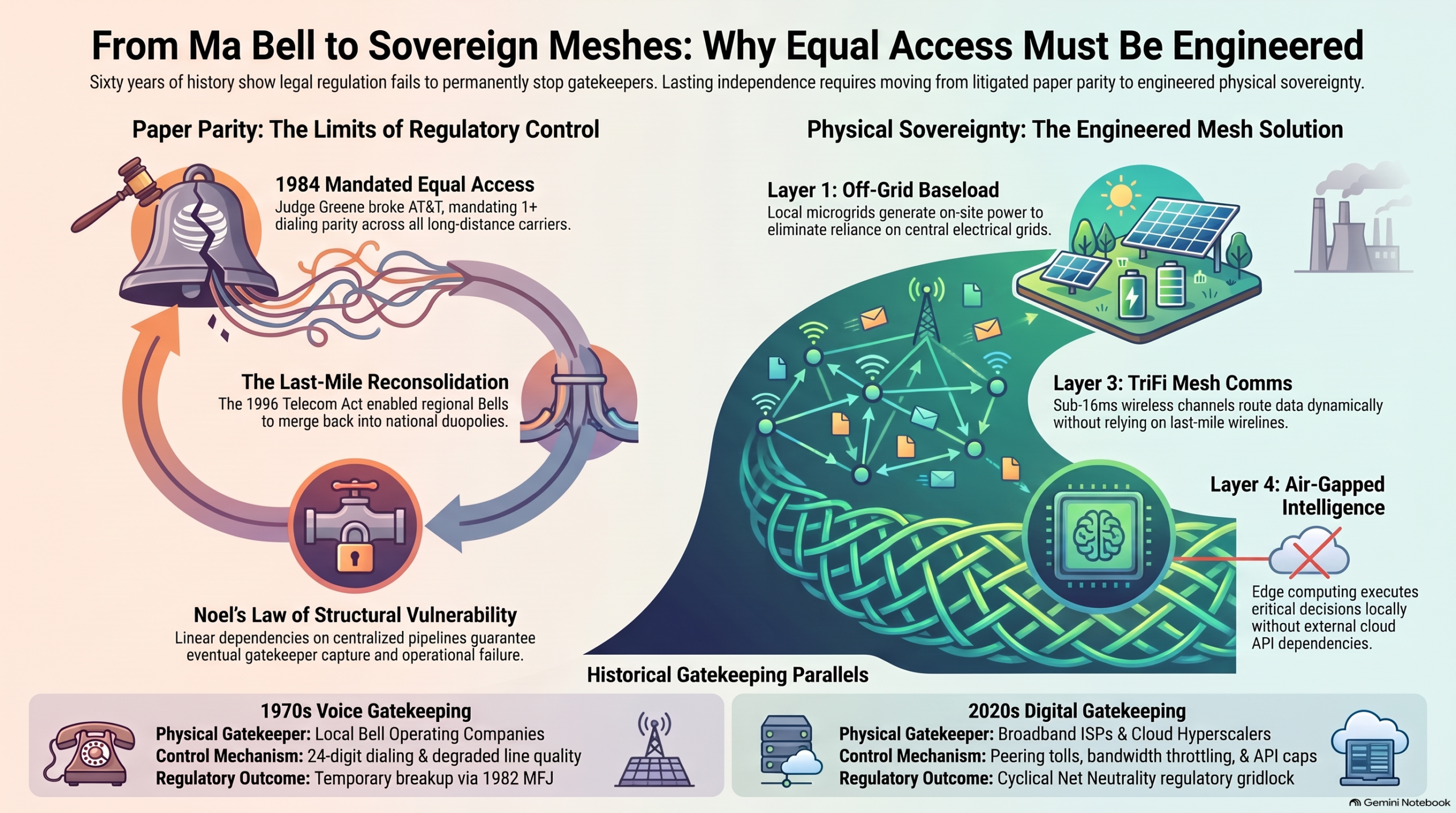
The Long-Distance Revolution: From Trucker Radios to Equal Access—and Its Modern Legacy
Executive Summary
The modern telecommunications landscape was shaped by a decades-long battle
against the world’s most powerful corporate monopoly: the American Telephone and
Telegraph Company (AT&T, or “Ma Bell”). What began in 1963 as a modest,
localized initiative to help long-distance truckers communicate along Route 66
evolved into a legal and commercial war that dismantled an empire.
Driven by the entrepreneurial tenacity of John “Jack” Goeken, the strategic and
financial aggression of William “Bill” McGowan, and the judicial oversight of
U.S. District Judge Harold H. Greene, MCI (Microwave Communications, Inc.) broke
AT&T’s monopoly and established the principle of Equal Access—the mandate that
independent carriers receive the exact same technical interconnection and
dialing privileges as the incumbent monopoly.
While Equal Access revolutionized voice telecommunications, democratized long
distance, and ignited a boom in network infrastructure, the concept underwent
structural erosion as technology shifted from circuit-switched copper lines to
wireless and broadband networks. Through legislative shifts (the
Telecommunications Act of 1996), corporate reconsolidation, and technological
obsolescence, the original framework of voice Equal Access effectively
dissolved, re-emerging in the 21st century as the battle over Net Neutrality and
digital gatekeeping.
- The Genesis: Jack Goeken, Route 66, and Trucking Radio
In the early 1960s, the Bell System controlled more than 80% of U.S. telephone
lines and nearly 100% of the long-distance network. AT&T operated as a legally
sanctioned natural monopoly under the Communications Act of 1934, maintaining
that unified end-to-end control was essential to the network’s technical
integrity.
In 1963, John D. “Jack” Goeken, a two-way radio salesman in Joliet, Illinois,
ran into a practical business problem:
- Long-haul trucking firms hauling freight between Chicago and St. Louis
needed reliable, low-cost dispatch communication with their drivers. - Mobile two-way radio signals had a limited range (roughly 30 to 50 miles).
AT&T’s leased-line telephone service was too expensive for small fleet
operators, and AT&T refused to allow third-party radio systems to
interconnect with Bell lines.
Goeken founded Microwave Communications, Inc. (MCI) in December 1963. His plan
was straightforward: build a chain of low-power microwave relay towers along
Route 66 (U.S. Highway 66) between Chicago and St. Louis. Trucking companies
could place a two-way radio base station near a tower, transmit voice signals
via microwave, and communicate over long distances at a fraction of AT&T’s
rates.
Goeken applied to the Federal Communications Commission (FCC) in December 1963
for microwave radio construction permits. AT&T, along with Illinois Bell and
Southwestern Bell, mounted fierce opposition, claiming that MCI was
“cream-skimming” profitable high-density routes, which they argued would destroy
the system of internal cross-subsidies that kept rural and residential local
phone service affordable.
After six years of hearings and bureaucratic delays, the FCC issued the landmark
1969 MCI Decision (Docket 16509), narrowly granting MCI permission to build its
private microwave link. However, Goeken lacked the capital and nationwide legal
strategy needed to survive AT&T’s ongoing resistance.
- Enter Bill McGowan: Transforming MCI into a National Challenger
In 1968, Goeken met William G. “Bill” McGowan, a venture capitalist and
consultant with an engineering degree and a Harvard MBA. McGowan recognized that
Goeken’s concept was not merely a local service for truckers, but a blueprint
for breaking the Bell System’s nationwide monopoly.
McGowan took over MCI’s corporate leadership:
- Capital and Corporate Restructuring: McGowan raised venture capital,
organized 16 regional MCI affiliates to build microwave links nationwide,
and merged them into MCI Communications Corporation in 1972. - Aggressive Regulatory Litigation: McGowan viewed the legal system as MCI’s
primary operational weapon, famously quipping that MCI was “a law firm with
an antenna on the roof.” - The Execunet Breakthrough (1975–1978): MCI was initially restricted to
selling “private line” services to corporate clients. In 1975, MCI launched
Execunet, a shared-switch service that allowed any customer to dial into
MCI’s network and call any telephone number in another city—entering direct
competition with AT&T’s core long-distance product (Message
Telecommunications Service, or MTS). - When the FCC attempted to shut Execunet down at AT&T’s request, MCI sued. In
a series of pivotal decisions between 1977 and 1978, the U.S. Court of
Appeals for the D.C. Circuit ruled in MCI’s favor, forcing AT&T to provide
local exchange interconnections for Execunet.
- The Unequal Playing Field: Why Equal Access Was Needed
While MCI could legally offer long-distance service, the technical and
operational playing field remained deeply unequal:
| Feature | AT&T Long Distance | Competitors (MCI, Sprint) |
|---|---|---|
| Dialing Method | “1+” Direct Dialing: User dialed 1 + Area Code + Number (7 to 11 digits). | Two-Stage Dialing: User dialed a local 7-digit access number, waited for a second dial tone, punched in a 5- to 7-digit security PIN/code, then dialed the final 10-digit number (up to 24 digits total). |
| Phone Compatibility | Worked on all phones (Rotary & Touch-Tone). | Required Touch-Tone (DTMF) phones to send authorization PINs; useless on standard rotary dial sets without an external tone generator. |
| Audio Quality & Signaling | High-quality 4-wire trunk interconnections with direct network signaling. | Routed through inferior local lines (Feature Group A), causing lower audio levels, line noise, and delayed call setups. |
| Call Completion & Billing | Automatic answer supervision (the network knew instantly when the called party answered). | Manual/imperfect answer supervision, frequently causing billing errors and dropped connections. |
AT&T defended this disparity by charging MCI discounted interconnection fees,
but the user experience remained vastly inferior. Bill McGowan realized that as
long as AT&T’s local operating companies favored their own long-distance
division, fair competition was impossible.
- Judge Harold Greene and the Dismantling of the Bell System
In November 1974, the U.S. Department of Justice (DOJ) filed an antitrust suit
against AT&T (United States v. AT&T), alleging violations of Section 2 of the
Sherman Act through cross-subsidization and exclusionary interconnection
practices.
In 1978, the case was assigned to Judge Harold H. Greene of the U.S. District
Court for the District of Columbia. Greene proved to be an exceptionally
disciplined, no-nonsense jurist:
- He rejected AT&T’s stall tactics, setting strict discovery deadlines and
pushing the trial forward in 1981. - In late 1981, after the government rested its case, AT&T moved to dismiss.
Judge Greene issued a stern memorandum denying the motion, stating that the
government’s evidence proved AT&T had deliberately used its monopoly power
in local distribution to block competition in long distance and equipment.
Convinced they would lose a court-imposed ruling, AT&T Chairman Charles Brown
negotiated a settlement with the DOJ in early 1982.
The Modification of Final Judgment (MFJ)
Judge Greene accepted the consent decree with significant modifications,
entering it as the Modification of Final Judgment (MFJ) on August 24, 1982
(effective January 1, 1984):
- The Divestiture: AT&T was forced to spin off its 22 local Bell Operating
Companies (BOCs) into seven independent Regional Bell Operating Companies
(RBOCs), nicknamed the “Baby Bells” (Ameritech, Bell Atlantic, BellSouth,
NYNEX, Pacific Telesis, Southwestern Bell, and US West). - Structural Separation: The Baby Bells retained local telephone monopolies
but were strictly barred from manufacturing equipment or providing
long-distance service. - The AT&T Remnant: AT&T retained its long-distance operations, Western
Electric (equipment manufacturing), and Bell Labs. PRE-1984: THE BELL SYSTEM
+———————————————+
| AT&T (Long Lines, Western Electric, BOCs) |
+———————————————+
|
(1984 MFJ Breakup)
v
+———————————————+
| AT&T Long Distance | Western Electric |
+———————————————+
+
+———————————————+
| 7 Regional Bell Operating Companies |
| (Ameritech, Bell Atlantic, BellSouth, |
| NYNEX, PacTel, Southwestern Bell, USWest)|
+———————————————+
The Equal Access Mandate
At the core of Judge Greene’s ruling was the requirement for Equal Access:
- The RBOCs were legally required to provide all long-distance carriers (AT&T,
MCI, Sprint, and others) interconnection that was “equal in type, quality,
and price to that provided to AT&T.” - The technical standard was codified as Feature Group D (FGD).
- 1+ Dialing Parity: Consumers were given the power to select their primary
long-distance carrier (the Primary Interexchange Carrier, or PIC). Dialing 1- Area Code + Number automatically routed the call through whichever company
the consumer chose.
- Area Code + Number automatically routed the call through whichever company
- Equal Access was phased in between 1984 and 1986 across hundreds of central
switching offices nationwide via extensive customer ballots.
- The Golden Era of Competition (1984–1996)
The implementation of Equal Access transformed American telecommunications:
- The Long-Distance Price Wars: MCI, Sprint, and AT&T fought fiercely for
subscribers through aggressive marketing campaigns (such as MCI’s “Friends &
Family”). Long-distance calling rates plummeted by more than 60% over the
next decade. - The Fiber-Optic Boom: To compete on quality, MCI made massive capital
investments, building the world’s first transcontinental single-mode
fiber-optic network. Sprint marketed its “pin-drop” clear fiber network,
forcing AT&T to modernize its own infrastructure. - MCI’s Apex: MCI grew into a multi-billion-dollar enterprise and a household
name, proving that regulated monopolies could be unbundled into functioning
competitive markets.
- Has Equal Access Remained Equal?
While voice Equal Access succeeded on its original terms, it has not remained a
functional, equal regulatory mechanism today. Over the past three decades, a
combination of policy shifts, corporate re-monopolization, and technological
evolution transformed the landscape.
A. The Telecommunications Act of 1996 and Corporate Reconsolidation
By the mid-1990s, the strict barriers separating local service, long distance,
and cable began to unravel:
- The Telecommunications Act of 1996 dismantled the MFJ framework. In exchange
for opening their local loops to competitors (via Unbundled Network
Elements), RBOCs were finally allowed back into the long-distance business. - Legal battles gutted the FCC’s local loop unbundling requirements (U.S.
Telecom Ass’n v. FCC), meaning competitors could not effectively contest
local exchange service. - Reconsolidation: A massive wave of mergers followed:
- SBC Communications (Southwestern Bell) acquired PacTel, Ameritech, and
SNET, and then, in 2005, bought its former parent company AT&T, adopting
the AT&T name. It later absorbed BellSouth. - Bell Atlantic acquired NYNEX and GTE, forming Verizon.
- MCI’s Demise: MCI was acquired in 1998 by WorldCom, which collapsed
in 2002 under an $11 billion accounting fraud scandal. The restructured
MCI was bought by Verizon in 2006.
- SBC Communications (Southwestern Bell) acquired PacTel, Ameritech, and
- By 2007, the competitive long-distance industry was gone. The market was
once again dominated by two reconstituted Bell giants: AT&T and Verizon.
B. Technological Obsolescence (TDM to IP and Wireless)
Equal Access was designed for public switched, circuit-switched telephone
networks (PSTN/TDM). In the 21st century, the underlying economic model
collapsed:
- The Death of “Long Distance”: With the rise of the internet, Voice over IP
(VoIP), and cellular networks, transmission costs dropped to near zero.
Long-distance voice ceased to be a separate, billable utility; it was
absorbed as a free, bundled feature inside mobile phone and broadband
packages. - Wireless Preemption: Cellular mobile carriers were never subjected to
strict 1+ wireline Equal Access rules. Consumers could not choose an
independent long-distance carrier on a mobile device; the mobile carrier
carried all traffic natively.
C. The Rebirth of the Problem: Net Neutrality and Broadband Gatekeeping
Although voice Equal Access is largely obsolete, its core technical and economic
debate relocated to the broadband internet:
1970s – 1980s (VOICE) 2010s – 2020s (DATA)
Local Bell Operating Co. (Gatekeeper) Broadband ISP / Mobile Carrier (Gatekeeper)
| |
Interconnection / Access Line Broadband Last Mile / Peering
| |
Long-Distance Carriers (MCI, AT&T) Edge Providers (Netflix, Google, Startups)
| |
[ EQUAL ACCESS / 1+ PARITY ] [ NET NEUTRALITY / COMMON CARRIAGE ]
- The Parallel: Just as AT&T used local loop monopolies to degrade MCI’s voice
calls, broadband Internet Service Providers (ISPs)—largely the same Bell
descendants (AT&T, Verizon) alongside cable monopolies (Comcast,
Charter)—face incentives to prioritize their own streaming, voice, and cloud
products over independent edge providers. - Regulatory Swings: The FCC classified broadband under Title II (Common
Carrier) in 2015 to enforce non-discrimination, repealed it under Title I
in 2017, and moved to reinstate Title II rules in 2024. These back-and-forth
battles mirror the debates Jack Goeken and Bill McGowan had with the FCC in
the 1960s and 1970s. - Interconnection and Peering: The fight moved from local central offices to
IP transit and peering points, where ISPs have at times forced content
delivery networks (CDNs) and high-bandwidth services to pay fees to prevent
deliberate traffic congestion.
Conclusion
The journey that began with Jack Goeken trying to help truck drivers communicate
on Route 66 reshaped modern business, antitrust law, and telecommunications.
Bill McGowan’s aggressive corporate combat and Judge Harold Greene’s decisive
antitrust ruling proved that artificial monopolies could be unbundled to spark
innovation and lower consumer costs.
Equal Access achieved its primary objective: it democratized voice communication
and catalyzed the buildout of nationwide fiber networks. However, Equal Access
as an ongoing principle did not remain preserved in practice. The corporate
entities that were split apart largely reconsolidated, circuit-switched long
distance became economically obsolete, and the regulatory struggle shifted
toward high-speed internet access. Today, the core challenge first addressed by
MCI and Judge Greene remains just as pressing: preventing last-mile network
gatekeepers from picking winners and losers across the communications grid.