
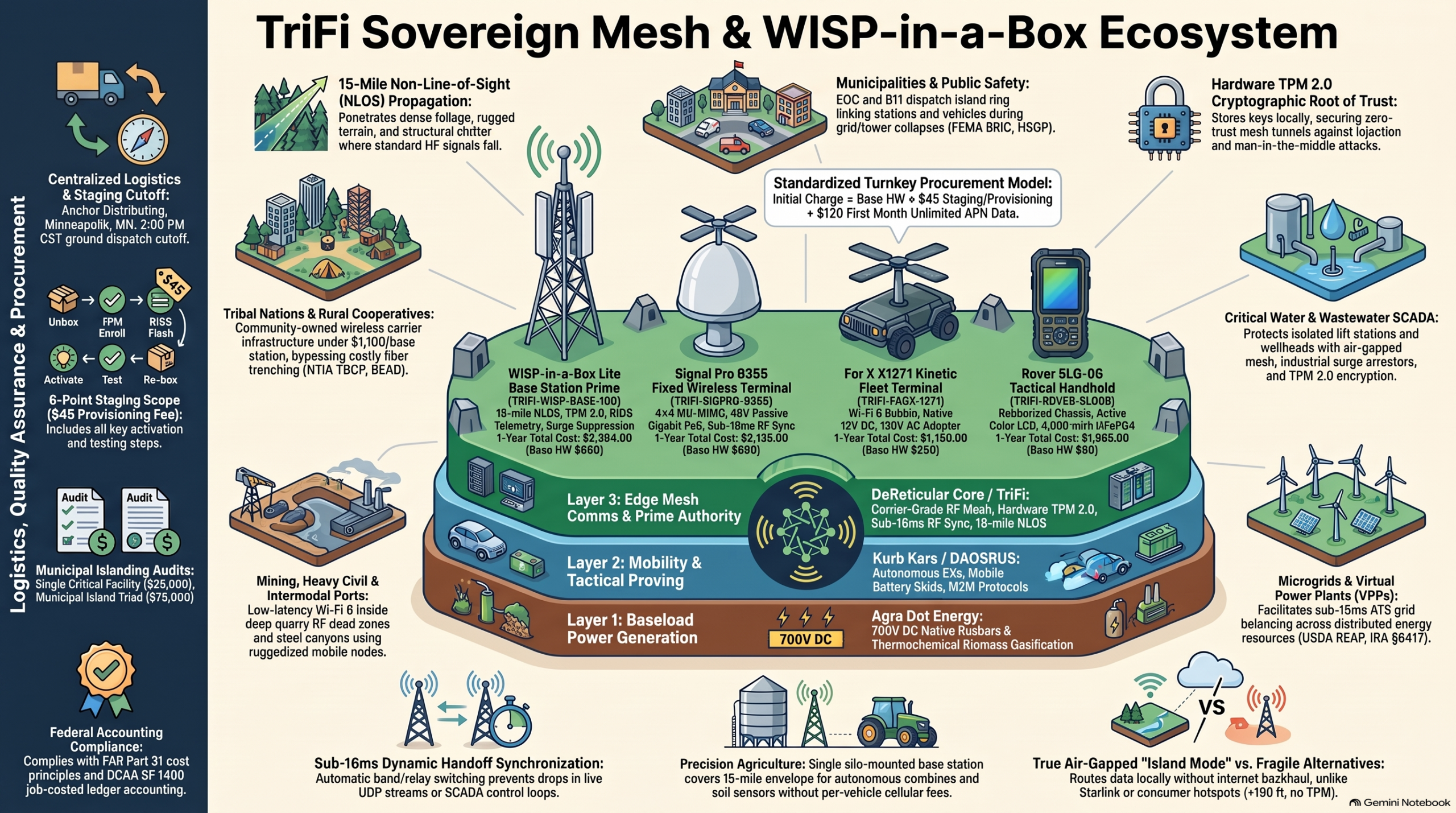
Sovereign Mesh Municipal Telecommunications Procurement Blueprint
- Executive Strategic Context & Architectural Framework
1.1 Mission & Systemic Vulnerability Analysis
Municipal communications infrastructure across North America faces an unprecedented crisis of systemic fragility. Modern local governance, emergency dispatch, and public utility operations rely almost entirely on hyper-centralized commercial telecommunications networks, terrestrial fiber optic backhaul lines, and remote cloud hosting providers. During severe meteorological events, cyber intrusions, or wide-scale regional electrical grid failures, this external dependency chain collapses, leaving local emergency operations centers, water authorities, and public safety personnel isolated. To ensure operational continuity during catastrophic events, municipal jurisdictions must transition from passive consumers of fragile commercial networks to sovereign operators of air-gapped, decentralized, localized telecommunications architectures designed to maintain uninterrupted local connectivity.
This strategic procurement blueprint is governed mathematically by Noel’s Law of Structural Vulnerability, which states:
“The survivability of any operational node is inversely proportional to the length and central coordination of its critical supply chains and communication backhauls.”
Under traditional network deployments, local government systems succumb to the 1,000-Mile Failure Model—a vulnerability paradigm wherein a local emergency facility or municipal water plant collapses not due to local physical damage, but because of remote failures occurring hundreds or thousands of miles away. These remote single points of failure include:
- Centralized Hyperscaler Cloud Reliance: Disruption of remote cloud data centers, domain name system (DNS) root servers, or centralized identity verification servers instantly paralyzes local supervisory control and data acquisition (SCADA) telemetry and agency communications, even if local physical equipment remains undamaged.
- Public Electric Grid Fragility: Commercial cellular towers and central office switches depend heavily on fragile regional power grids. Extended power outages exhaust local battery backups, causing total loss of commercial voice, text, and broadband coverage across entire counties.
- Remote Supply Chain Disruption: Centralized hardware sourcing and remote network operations center (NOC) management create prolonged delays when replacement equipment or manual system resets are required during regional emergencies.
To eradicate these vulnerabilities, the Sovereign Infrastructure Consortium (SIC) provides a defense-grade blueprint that establishes autonomous, locally owned networks capable of sustained off-grid operations. The foundational principles governing the Sovereign Infrastructure Consortium include:
- Sustained “Island Mode” Capability: Ensuring every municipal node possesses complete architectural autonomy, enabling continuous local data routing, device authentication, and SCADA control without requiring external uplink to commercial backbones, internet exchanges, or remote cloud servers.
- Air-Gapped Operational Technology: Maintaining local peer-to-peer data security through hardware-rooted cryptography, preventing external over-the-air exploitation, state-sponsored cyber intrusions, and remote service denial.
- Decentralized Infrastructure Multi-Tenancy: Unifying municipal power, mobility, telecommunications, and edge computing into a single, cohesive public utility stack that bypasses traditional utility interconnection queues and commercial carrier leaseholds.
- Non-Dilutive Capital Recovery: Structuring infrastructure procurements to qualify for maximum federal non-dilutive grant funding, turning capital investments into permanent, self-sustaining municipal assets.
These foundational operational principles are structurally operationalized through the deployment of a unified, multi-tiered technical stack across all municipal domains.
1.2 The Unified Sovereign 5-Layer Stack Architecture
Achieving true municipal resilience requires total structural integration across all physical and operational domains of public infrastructure. An isolated communication network remains vulnerable if its underlying power source fails, just as an off-grid power plant becomes unmanageable without secure SCADA telecommunications. The Sovereign Infrastructure Consortium addresses this challenge through the Unified Sovereign 5-Layer Stack Architecture—a comprehensive, multi-organization framework designed under Noel’s Law to eliminate single points of failure across municipal operations.
┌─────────────────────────────────────────────────────────────────────────┐
│ LEVEL 5: GOVERNANCE, ADVISORY & CAPITAL │
│ Biz Builder Mike / SIEA Academy (501(c)(3) P3 Stacking, USDA, IRA) │
├─────────────────────────────────────────────────────────────────────────┤
│ LEVEL 4: SCADA & COGNITIVE INTELLIGENCE │
│ DeReticular Energy (Air-Gapped Remnant AI, Liquid Immersion RIOS-CC-1000)│
├─────────────────────────────────────────────────────────────────────────┤
│ LEVEL 3: EDGE MESH COMMS & PRIME AUTHORITY ◄── [TRIFI & DERETICULAR] │
│ Hardware TPM 2.0, Sub-16ms RF Sync, 15-Mile NLOS Carrier Envelopes │
├─────────────────────────────────────────────────────────────────────────┤
│ LEVEL 2: MOBILITY & TACTICAL PROVING │
│ Kurb Kars & DAOSRUS (Autonomous EVs, Nomadic M2M Micro-Skids) │
├─────────────────────────────────────────────────────────────────────────┤
│ LEVEL 1: BASELOAD POWER GENERATION │
│ Agra Dot Energy (700V DC Busbars, Thermochemical Biomass Gasification) │
└─────────────────────────────────────────────────────────────────────────┘
The functional scope and organizational leads for each layer of the architecture are structured as follows:
- Layer 1: Power (Agra Dot Energy): Establishes baseload off-grid electrical generation through native 700V DC microgrid busbars and thermochemical biomass gasification/pyrolysis systems. This layer completely bypasses public electrical grid interconnections and multi-year utility queue delays, supplying continuous primary power to critical infrastructure.
- Layer 2: Mobility & Proving (Kurb Kars / DAOSRUS): Deploys autonomous commercial and utility electric vehicles (EVs), mobile battery energy storage skids, and nomadic field nodes operating on offline machine-to-machine (DAOS_A2A_M2M_v3) protocols. During total public electric grid collapse, when fixed stationary radio masts exhaust their localized power reserves, Layer 2 mobile battery skids and autonomous EV units dispatch to lost nodes. Utilizing localized DAOS_A2A_M2M_v3 handshake protocols, these mobile units supply high-voltage DC power direct to the mast busbars while simultaneously functioning as dynamic, high-gain mobile RF repeaters. This physical and wireless repositioning dynamically re-establishes Layer 3 mesh routing topology across blackout zones without human intervention.
- Layer 3: Mesh Communications (DeReticular Core / TriFi Wireless) [Active Scope]: Functions as the Prime System Authority providing turnkey, carrier-grade radio frequency (RF) mesh networks, sub-16ms low-latency channel failover, multi-carrier APN auto-failover, hardware Trusted Platform Module (TPM) 2.0 security, and long-range wireless backhaul distribution.
- Layer 4: SCADA & Cognitive Intelligence (DeReticular Energy): Houses air-gapped on-premise edge computing, liquid-dielectric immersion-cooled GPU clusters (RIOS-CC-1000), supervisory telemetry, and local intelligence agents that operate without external cloud connectivity.
- Layer 5: Governance & Advisory (Biz Builder Mike / SIEA Academy): Manages municipal islanding forensic audits, Public-Private Partnership (P3) structuring, and multi-tier non-dilutive federal capital stacking strategies (including USDA REAP, FEMA BRIC, and IRA §6417 Direct Pay).
Architectural Layer Primary Lead Organization Technical & Operational Specifications Municipal Operational Function
Layer 1: Power Agra Dot Energy 700V DC native busbars; thermochemical biomass gasification; off-grid baseload Primary off-grid power generation for municipal facilities; grid isolation defense
Layer 2: Mobility & Proving Kurb Kars / DAOSRUS Autonomous utility EVs; mobile battery skids; DAOS_A2A_M2M_v3 offline protocol Nomadic mobile power distribution, emergency logistics, and physical mesh restoration
Layer 3: Mesh Communications DeReticular Core / TriFi Wireless Hardware TPM 2.0; 15-Mile NLOS envelope; sub-16ms RF sync; RIOS telemetry agent District-wide carrier backhaul, local command connectivity, and air-gapped data routing
Layer 4: SCADA & Cognitive AI DeReticular Energy Air-gapped compute; liquid-dielectric immersion GPU clusters (RIOS-CC-1000) Real-time municipal telemetry processing, microgrid control, and local threat management
Layer 5: Governance & Capital Biz Builder Mike / SIEA Academy Forensic islanding audits; FAR Part 31 / DCAA SF 1408 ledgers; P3 capital stacking Grant application engineering, financial compliance, and inter-agency capital alignment
To execute the Layer 3 telecommunications requirements within this unified stack, public procurement authorities must deploy standardized, carrier-grade hardware components engineered specifically for decentralized mesh operations.
- Five-Layer Hardware Stack & Master Product Catalog
2.1 Core Telecommunications Infrastructure Hardware
Standardizing on carrier-grade, mutually interoperable networking hardware across municipal departments is essential to guarantee seamless dynamic roaming, unified security policies, and simplified supply chain logistics. The TriFi Wireless product ecosystem—engineered by DeReticular Core—provides a modular suite of hardware nodes that establish a robust wireless coverage envelope across rural, suburban, and urban municipal topologies.
┌────────────────────────────────────────┐
│ WISP-in-a-Box Lite (Base-100) │
│ 15-Mile NLOS Carrier Anchor │
└───────────────────┬────────────────────┘
│
┌────────────────┼────────────────┐
▼ ▼ ▼
┌───────────────┐ ┌───────────────┐ ┌───────────────┐
│ Signal Pro │ │ Far X │ │ Rover │
│ (Model 8355) │ │ (Model X1271) │ │ (Model SLG-06)│
└───────────────┘ └───────────────┘ └───────────────┘
TriFi WISP-in-a-Box Lite (Base Station Prime)
- Model / Master SKU: TRIFI-WISP-BASE-100
- Physical Form Factor: High-gain mast and tower-mountable primary carrier housing featuring integrated heavy-duty gas-discharge lightning surge suppression arrestors.
- Role & Network Position: Carrier Base Station Prime / Master District Mesh Anchor.
- Technical Specifications: High link-budget sub-6 GHz radio frequency array supporting a 15-Mile Non-Line-of-Sight (NLOS) propagation envelope; integrated hardware TPM 2.0 cryptoprocessor; factory pre-flashed with the proprietary Resilient Infrastructure Operating System (RIOS) telemetry agent; dynamic district mesh backhaul router.
- Municipal & Industrial Application: High-elevation mounting on municipal water towers, central communications masts, grain silos, emergency operations center (EOC) towers, or administrative headquarters buildings.
- Strategic Operational Advantage (“So What?”): Eliminates dependence on commercial telecom tower leaseholders by allowing municipal governments to establish their own autonomous, 15-mile carrier envelope. Its high link-budget NLOS capabilities allow signals to penetrate heavy foliage, undulating terrain, and dense urban structures during emergency events, ensuring continuous multi-departmental coverage without external backhaul links.
TriFi Signal Pro
- Model / Master SKU: Model 8355 / TRIFI-SIGPRO-8355
- Physical Form Factor: Low-profile, minimalist matte-white circular dome/disc constructed from IP67 weather-sealed, UV-stabilized cast composite and aluminum.
- Role & Network Position: Fixed Wireless Terminal / Campus Microgrid Client Premises Equipment (CPE) / Enterprise Gateway.
- Technical Specifications: 4×4 MU-MIMO high-gain directional array; IP67 weather-sealed housing; 48V Passive Gigabit Power-over-Ethernet (PoE); sub-16ms dynamic carrier handoff synchronization.
- Municipal & Industrial Application: Exterior building eaves, utility mast mounts, critical water/wastewater SCADA lift stations, electrical substations, public safety satellite facilities, and enterprise campus facilities.
- Strategic Operational Advantage (“So What?”): Delivers high-throughput, heavy-duty 24/7 connectivity for high-demand municipal facilities and SCADA nodes. By utilizing sub-16ms channel switching and IP67 weatherization, the Signal Pro maintains continuous high-bandwidth telemetry and voice links even during severe meteorological conditions and primary ISP fiber cuts.
TriFi Far X
- Model / Master SKU: Model X1271 / TRIFI-FARX-1271
- Physical Form Factor: Upright matte-gray desktop chassis featuring four (4) vertical 9dBi directional paddle antennas and a front-panel LED status array.
- Role & Network Position: Kinetic Fleet Terminal / High-Gain Rural Desktop Router / Field Office Access Point.
- Technical Specifications: Four (4) vertical 9dBi directional paddles; dual-band concurrent Wi-Fi 6 localized coverage bubble; dual power input via native 12V DC vehicle terminals and standard 120V AC wall adapter; sub-16ms RF carrier synchronization.
- Municipal & Industrial Application: Utility maintenance trucks, mobile emergency command vans, field inspection vehicles, remote public works facilities, and rural municipal offices.
- Strategic Operational Advantage (“So What?”): Solves the challenge of maintaining broadband access in fleet vehicles and remote field locations. Native 12V DC operation allows direct integration into vehicle electrical systems, while its four high-gain 9dBi paddle antennas pull in weak signals from distant base stations, generating a local Wi-Fi 6 bubble around mobile utility and public safety crews.
TriFi Rover
- Model / Master SKU: Model SLG-06 / TRIFI-ROVER-SLG06
- Physical Form Factor: Pocket-sized, drop-tested rubberized shock-absorbent handheld chassis with an integrated vertical full-color active LCD screen.
- Role & Network Position: Tactical Handheld Hotspot / Personal Field Node.
- Technical Specifications: Vertical color LCD displaying 4G signal strength, 5GHz status, battery percentage, data consumption metrics, and dynamic QR connection code; 4,000 mAh LiFePO4 battery chemistry engineered for thermal stability in extreme ambient heat up to 140°F (60°C); bidirectional USB-C Power Delivery (PD) pass-through charging.
- Municipal & Industrial Application: Handheld tactical communications for first responders, emergency evacuation kits, nomadic field inspectors, search and rescue (SAR) teams, and dashboard vehicle mounting during active wildfire or high-temperature summer operations.
- Strategic Operational Advantage (“So What?”): Provides instant, zero-configuration tactical Wi-Fi access in harsh field environments. The advanced LiFePO4 battery chemistry completely eliminates thermal runaway risk, permitting continuous dashboard mounting in direct sun or high-temperature response zones (up to 140°F / 60°C). The dynamic on-screen QR code allows incoming mutual-aid teams to pair field tablets instantly without entering complex security credentials.
Product Name Master SKU Primary Form Factor & Role Key Technical Specifications Ideal Municipal Topology
TriFi WISP-in-a-Box Lite TRIFI-WISP-BASE-100 Tower-mount Base Station; District Carrier Anchor 15-Mile NLOS envelope; TPM 2.0 crypto; RIOS agent; gas surge arrestor High-elevation carrier anchor (Water Towers, EOC Masts, Silos)
TriFi Signal Pro TRIFI-SIGPRO-8355 Matte-white circular dome (IP67); Fixed Wireless Terminal 4×4 MU-MIMO array; 48V Passive PoE; sub-16ms RF sync; heavy-duty build Critical SCADA substations, Water Treatment Plants, EOC Facilities
TriFi Far X TRIFI-FARX-1271 Upright matte-gray desktop router w/ 4 vertical paddles; Kinetic Fleet AP Four (4) vertical 9dBi directional paddles; Wi-Fi 6 bubble; native 12V DC / 120V AC; sub-16ms sync Utility Fleet Trucks, Mobile Command Vans, Remote Field Offices
TriFi Rover TRIFI-ROVER-SLG06 Pocket-sized rubberized chassis w/ color LCD; Tactical Hotspot 4,000 mAh LiFePO4 battery (up to 140°F); USB-C PD pass-through; dynamic QR code First Responder tactical gear, SAR teams, Evacuation Kits, Field Inspectors
Deploying this specialized hardware stack effectively requires a robust network security model, optimized RF protocols, and strict supply chain quality control mechanisms.
- Network Security, RF Protocols, & Supply Chain SLA
3.1 Zero-Trust Architecture & Hardware Cryptography
Municipal infrastructure networks are high-priority targets for cyber adversaries, state-sponsored actors, and ransomware organizations. Traditional software-based network security models rely on central cloud authentication servers, leaving localized operational technology (OT) vulnerable to credential theft, spoofing, and remote over-the-air firmware injection. The Sovereign Mesh architecture addresses these risks through an absolute zero-trust framework anchored in physical hardware cryptoprocessors embedded directly within every Layer 3 node.
Each TriFi node incorporates an integrated Trusted Platform Module (TPM) 2.0 hardware cryptoprocessor. The TPM 2.0 chip serves as a tamper-proof hardware root of trust that holds encrypted master keys, authenticates the device’s boot sequence, and validates firmware integrity prior to network access. Hardware-rooted cryptographic verification delivers three essential operational safeguards:
- Prevention of Over-the-Air Firmware Injection: The TPM 2.0 cryptoprocessor blocks unauthorized firmware modifications by requiring valid cryptographic signatures from the Sovereign Authority root key before flashing software updates.
- Zero-Trust Encrypted Mesh Tunnels: Peer-to-peer wireless links between nodes establish zero-trust, hardware-encrypted tunnels. Authorization is validated at the silicon level, preventing unauthorized access even if an attacker gains physical proximity to the radio signal.
- Local Peer-to-Peer Operations Without External Dependencies: Nodes discover, authenticate, and route data traffic directly between adjacent terminals without querying external Domain Name System (DNS) infrastructure or remote identity servers. If external commercial internet connections sever, the local mesh network continues routing encrypted municipal voice, telemetry, and SCADA data without interruption.
┌─────────────────────────────────────────────────────────────┐
│ Sub-16ms Dynamic Handoff │
│ │
│ ┌───────────────────────┐ ┌───────────────────────┐ │
│ │ Primary Cellular Band │ ──┐ │ Secondary Carrier / │ │
│ │ (Degraded Signal) │ │ │ Local Mesh Relay │ │
│ └───────────────────────┘ │ └───────────────────────┘ │
│ ▼ │
│ ┌─────────────────────────┐ │
│ │ Handoff Window (<16ms) │ │
│ └────────────┬────────────┘ │
│ │ │
│ ▼ │
│ ┌─────────────────────────┐ │
│ │ Uninterrupted Data Flow │ │
│ │ (UDP / SCADA Telemetry) │ │
│ └─────────────────────────┘ │
└─────────────────────────────────────────────────────────────┘
Radio frequency communications across the mesh architecture rely on sub-6 GHz propagation profiles designed for 15-Mile Non-Line-of-Sight (NLOS) performance. By utilizing high link-budget transmission profiles, the network penetrates physical obstacles such as dense tree canopies, heavy rainfall, smoke, and structural clutter that cause standard high-frequency millimeter-wave signals to fail.
To maintain persistent connectivity for mobile fleets and SCADA systems, the architecture utilizes Sub-16ms Dynamic Carrier Handoff Synchronization. At the packet level, every TriFi radio transceiver operates continuous dual-active interface monitoring across primary cellular channels, secondary bands, and adjacent local mesh nodes. The underlying media access control (MAC) layer executes continuous background Layer-2 pre-authentication across all candidate channels simultaneously. When signal degradation or packet drop thresholds are breached on the active path, the interface executes an immediate hardware-level frame redirection to the pre-authenticated secondary link within a sub-16ms window. Because this transition occurs below Layer 3, higher-level UDP telemetry streams, active VoIP/SIP voice sessions, and real-time SCADA polling loops experience zero TCP socket resets or packet loss.
Standardizing on secure hardware requires an equally rigorous staging and fulfillment model to maintain supply chain integrity prior to field deployment.
3.2 Supply Chain Staging, Fulfillment & Quality Assurance SLA
To guarantee rapid deployment readiness and maintain strict compliance with federal procurement standards, all Sovereign Mesh hardware is processed through a centralized, standardized supply chain management pipeline. Sourcing un-provisioned off-the-shelf equipment introduces integration delays, configuration errors, and security vulnerabilities. Centralizing supply chain operations through a single defense-grade facility ensures every unit delivered to a municipal site is tested, cryptographically enrolled, and ready for immediate deployment.
All hardware logistics, cryptographic provisioning, and quality assurance workflows are centralized at Anchor Distributing in Minneapolis, MN. Operating under strict Service Level Agreements (SLAs), Anchor Distributing enforces a daily 2:00 PM CST ground dispatch cutoff for same-day shipment of pre-configured equipment. To satisfy public sector procurement rules, all logistics fees and equipment charges are mapped to General Ledger Cost Code 5200-LOGISTICS, ensuring complete compliance with Federal Acquisition Regulation (FAR Part 31) and Defense Contract Audit Agency (DCAA) job-costing requirements.
Before dispatch, every device undergoes a mandatory 6-point staging and quality assurance workflow, billed at a fixed rate of $45.00 per unit:
┌─────────────────────────────────────────────────────────────────┐
│ 6-Point Staging & QA Workflow ($45) │
│ │
│ 1. Structural Inspection ──► 2. TPM 2.0 Root Key Enrollment │
│ │ │
│ 4. IMEI / SIM Activation ◄── 3. RIOS Firmware Flashing │
│ │ │
│ ▼ │
│ 5. Sub-16ms Bench Testing ──► 6. Barcode & Dispatch │
└─────────────────────────────────────────────────────────────────┘
- Physical Unboxing & Visual Structural Inspection: Performing structural checks, verifying physical seals, and inspecting connectors, internal antennas, and chassis housing for manufacturing flaws.
- TPM 2.0 Cryptographic Enrollment: Enrolling the hardware TPM 2.0 cryptoprocessor with the Sovereign Authority root key to establish hardware-rooted cryptographic identity.
- Flashing RIOS Telemetry Firmware: Overwriting stock consumer software by flashing the proprietary Resilient Infrastructure Operating System (RIOS) telemetry agent onto the device core.
- Cellular IMEI Activation & ICCID SIM Marrying: Activating the device’s International Mobile Equipment Identity (IMEI) number and binding its Integrated Circuit Card Identifier (ICCID) SIM card to a multi-carrier private Access Point Name (APN) backhaul network.
- Radio Bench-Testing & Failover Verification: Subjecting the device to simulated radio loopback testing to confirm dynamic carrier failover rates within the sub-16ms handoff threshold.
- Serialized Barcode Assignment & Dispatch: Assigning a unique serialized barcode linked to municipal asset registries, re-boxing the verified unit, and transferring it to ground freight dispatch.
This standardized preparation process establishes a completely predictable total cost of ownership structure for public capital planning.
- Total Cost of Ownership (TCO) & Procurement Financial Architecture
4.1 Commercial Pricing Structure & Unbundled vs. Turnkey Cost Models
Municipal hardware procurements frequently suffer from hidden operational expenses, complex licensing structures, and unpredictable recurring cellular data charges. The Sovereign Infrastructure Consortium eliminates this unpredictability by enforcing an audit-ready financial model that unifies hardware, staging, and recurring data bandwidth into a standardized acquisition formula. All hardware acquisitions and staging fees are classified as Direct Allocable Capital Costs under 2 CFR § 200 (Uniform Guidance for Federal Awards), ensuring full grant eligibility across public funding streams.
Every hardware unit within the TriFi product suite is priced using a fixed initial procurement model:
\text{Initial Acquisition Cost} = \text{Base Hardware} + $45.00 \text{ (Staging/Provisioning)} + $120.00 \text{ (Month 1 Data Service)}
Ongoing operational expenditures (OpEx) are locked at a predictable rate of $120.00 / mo per device. This flat monthly subscription provides uncapped, non-throttled multi-carrier cellular APN data access, eliminating per-gigabyte metered overage charges and consolidating regional carrier connections onto a single public ledger item.
┌─────────────────────────────────────────────────────────────┐
│ Turnkey Initial Cost Formula │
│ │
│ ┌──────────────┐ ┌────────────────┐ ┌───────────┐ │
│ │ Base Hardware│ + │ Staging Fee │ + │ Month 1 │ │
│ │ Price │ │ ($45.00) │ │ ($120.00) │ │
│ └──────┬───────┘ └───────┬────────┘ ─────┬─────┘ │
│ │ │ │ │
│ └─────────────────────┼────────────────────┘ │
│ │ │
│ ▼ │
│ ┌─────────────────────────┐ │
│ │ Initial Turnkey Charge │ │
│ └─────────────────────────┘ │
└─────────────────────────────────────────────────────────────┘
The comprehensive financial ledger across all four core hardware nodes is detailed below:
Device Name Model SKU Unbundled Hardware Price Staging / Provisioning Fee Initial Turnkey Charge Ongoing Monthly Data Fee 1-Year Total Cost of Ownership (TCO)
TriFi Rover TRIFI-ROVER-SLG06 $80.00 $45.00 $245.00 $120.00 / mo $1,565.00
TriFi Far X TRIFI-FARX-1271 $250.00 $45.00 $415.00 $120.00 / mo $1,735.00
TriFi Signal Pro TRIFI-SIGPRO-8355 $650.00 $45.00 $815.00 $120.00 / mo $2,135.00
TriFi WISP-in-a-Box Lite TRIFI-WISP-BASE-100 $899.00 $45.00 $1,064.00 $120.00 / mo $2,384.00
Note: All data service figures represent flat-rate, non-throttled, uncapped multi-carrier cellular APN profiles.
To maximize the return on hardware investments, municipalities can pair hardware procurements with specialized forensic engineering audits to validate network performance and secure federal grant funding.
- Municipal Engineering Audits & Statement of Work (SOW)
5.1 Forensic Infrastructure Audits & B2G Integration
Securing federal grant funding and ensuring regional network resilience requires detailed engineering data regarding local infrastructure vulnerabilities. Deploying communication hardware without performing prior forensic mapping risks leaving critical blind spots in emergency operations. To establish an empirical baseline of municipal resilience and fulfill federal grant application requirements, DeReticular provides specialized Statements of Work (SOW) for forensic engineering audits. These professional service audits are classified as Direct Allocable Capital Costs under 2 CFR § 200 (Uniform Guidance), allowing 100% reimbursement when bundled into federal grant applications.
┌─────────────────────────────────────────────────────────────┐
│ Municipal Island Triad Audit ($75,000) │
│ │
│ ┌─────────────────────────────────────────────────────┐ │
│ │ Node 1: City Hall & Administrative Governance │ │
│ └──────────────────────────┬──────────────────────────┘ │
│ │ │
│ ┌──────────────────────────┴──────────────────────────┐ │
│ │ Node 2: Water / Wastewater SCADA Infrastructure │ │
│ └──────────────────────────┬──────────────────────────┘ │
│ │ │
│ ┌──────────────────────────┴──────────────────────────┐ │
│ │ Node 3: 911 Dispatch & Emergency Operations Centers │ │
│ └─────────────────────────────────────────────────────┘ │
└─────────────────────────────────────────────────────────────┘
DeReticular offers two standardized professional service audit SOWs structured specifically for local government agencies:
- Single Critical Facility Audit ($25,000.00): A target-specific engineering assessment for isolated operational assets, such as a standalone water treatment facility, isolated wastewater lift station, Fire/EMS facility, or community hospital. Scope includes site-specific RF propagation mapping, failover latency analysis, emergency power integration review, and local SCADA backhaul security assessments.
- Municipal Island Triad Audit ($75,000.00): A comprehensive regional forensic evaluation covering the core local governance infrastructure triad:
- City Hall & Administrative Governance Headquarters: Evaluation of primary administrative computing systems, local communications resiliency, and executive command continuity.
- Water/Wastewater SCADA Infrastructure: Engineering analysis of remote lift stations, wellheads, treatment plants, and telemetry links to isolate public internet exposures.
- 911 Emergency Dispatch & Emergency Operations Center (EOC): Comprehensive evaluation of public safety answering points (PSAP), inter-agency dispatch routing, backup power systems, and tower link redundancies.
To facilitate immediate municipal procurement, contracting officers may insert the following pre-approved SOW language directly into RFPs, RFIs, or federal grant application justifications:
Sample RFP/Grant Scope Language — Single Critical Facility Audit ($25,000): “Contractor shall conduct a comprehensive forensic engineering assessment of the designated municipal facility to establish an air-gapped communications and power resilience baseline. Deliverables shall include: (a) sub-6 GHz RF spectrum propagation and foliage penetration mapping; (b) power failover latency and microgrid busbar transition analysis; (c) SCADA OT air-gap security audit verifying hardware TPM 2.0 enrollment; and (d) a formal Resilient Infrastructure Operating Plan detailing island-mode execution in compliance with 2 CFR § 200 direct cost recovery guidelines.”
Sample RFP/Grant Scope Language — Municipal Island Triad Audit ($75,000): “Contractor shall execute a regional forensic infrastructure audit across the municipal operational triad comprising City Hall Administrative Governance, Water/Wastewater SCADA facilities, and the 911 Emergency Operations Center (EOC). Deliverables shall include: (a) inter-agency mesh topology modeling with sub-16ms failover verification; (b) off-grid baseload generation and mobile battery skid transport modeling; (c) physical and cyber exposure analysis of public cloud SCADA links; and (d) an integrated Capital Stacking Engineering Report mapping all identified vulnerabilities to FEMA BRIC, USDA, and IRA §6417 grant mechanisms.”
To guarantee that consulting audit services and equipment purchases are eligible for full federal grant reimbursement, all DeReticular SOW agreements, staging fees, and hardware procurements adhere strictly to federal cost-accounting standards. Pricing ledgers comply with FAR Part 31 (Federal Acquisition Regulation: Cost Principles) and DCAA SF 1408 job-costed ledger criteria. This compliance ensures all expenses are fully auditable, direct-allocable costs under federal assistance programs.
These audit metrics and accounting frameworks provide the necessary documentation to structure multi-tier federal grant applications.
- Federal Grant Stacking & Capital Alignment Framework
6.1 Non-Dilutive Public Capital Integration
Deploying modern telecommunications infrastructure does not require increasing local municipal tax burdens or incurring long-term municipal debt. By aligning hardware specifications with federal infrastructure agendas, municipal entities can achieve up to 100% non-dilutive capital recovery for Sovereign Mesh deployments. Capital stacking combines multiple federal grant programs into a cohesive procurement funding plan, transforming telecommunications upgrades into fully funded public projects.
┌─────────────────────────────────────────────────────────────┐
│ Federal Capital Stacking Matrix │
│ │
│ ┌──────────────┐ ┌──────────────┐ ┌────────────────┐ │
│ │ FEMA BRIC │ │ USDA REAP / │ │ IRA §6417 │ │
│ │ (Public │ │ ReConnect │ │ Direct Pay │ │
│ │ Safety) │ │ (Ag/Energy) │ │ (Clean Power) │ │
│ └──────┬───────┘ └──────┬───────┘ └───────┬────────┘ │
│ │ │ │ │
│ └──────────────────┼───────────────────┘ │
│ │ │
│ ▼ │
│ ┌──────────────────────────────────┐ │
│ │ 100% Non-Dilutive Capital Recovery│ │
│ └──────────────────────────────────┘ │
└─────────────────────────────────────────────────────────────┘
The core federal funding streams mapped to the Sovereign Mesh architecture include:
- FEMA BRIC (Building Resilient Infrastructure and Communities): Grants funding for hazard mitigation, emergency communications hardening, EOC link redundancies, and lightning surge suppression installations for critical public safety facilities.
- USDA REAP (Rural Energy for America Program) & ReConnect: Supports rural telecommunications expansion, agricultural microgrid communications, and off-grid power monitoring for rural cooperatives and agricultural districts.
- IRA §6417 (Inflation Reduction Act Direct Pay): Provides non-dilutive direct cash reimbursement payments to tax-exempt entities (such as local governments, public utilities, and Tribal Nations) deploying off-grid microgrids and associated smart energy telecommunications infrastructure.
- NTIA TBCP (Tribal Broadband Connectivity Program) & IIJA BEAD: Funding designed to deploy high-speed broadband infrastructure to Tribal Nations, rural cooperatives, and unserved municipal districts, replacing costly multi-mile fiber trenching with turnkey wireless deployments.
Industry Vertical Typical Failure Mode / Operational Vulnerability Sovereign Mesh Architecture Deployment Primary Grant / Capital Source
Municipal & Public Safety Commercial tower congestion; backhaul fiber cuts during storms TRIFI-WISP-BASE-100 tower anchor linking EOC, City Hall, and public safety fleets in island mode FEMA BRIC, HSGP, ARPA
Water / Wastewater SCADA Cyber intrusions via public modems; isolated remote pumps Air-gapped TRIFI-SIGPRO-8355 mesh nodes with TPM 2.0 crypto and gas surge arrestors Clean Water SRF (CWSRF), FEMA BRIC
Distributed Microgrids Cloud latency delaying switchgear transfer during grid collapse TRIFI-SIGPRO-8355 paired with RIOS-CC-1000 for sub-16ms ATS grid balancing USDA REAP, IRA §6417 Direct Pay
Precision Agriculture Cellular dead zones across vast acreage; high recurring SIM fees Silo-mounted TRIFI-WISP-BASE-100 generating a 15-mile envelope for TRIFI-FARX-1271 tractors USDA ReConnect, Equipment ROI
Mining & Heavy Civil Rapidly shifting terrain; RF shadowing in deep open pits/quarries Shock-resistant TRIFI-FARX-1271 and TRIFI-SIGPRO-8355 mobile base mesh nodes Operational Efficiency, Heavy Equipment Telemetry
Ports & Intermodal Hubs Signal blocking caused by metal shipping containers (“canyons”) Gantry crane-mounted TRIFI-SIGPRO-8355 directional arrays delivering sub-16ms AGV handoffs Port Infrastructure Development (PIDP)
Tribal Nations & Rural Co-Ops Multi-million dollar fiber trenching costs; commercial carrier neglect Turnkey TRIFI-WISP-BASE-100 district base stations providing community-owned broadband NTIA TBCP, IIJA BEAD Program
Transitioning municipal communications from passive, fragile commercial subscriptions to sovereign network ownership is both an operational necessity and a sound financial strategy. By deploying hardware-rooted zero-trust security, sub-16ms carrier failover, and air-gapped processing capabilities, municipal governments can eliminate systemic operational vulnerabilities. Leveraging federal capital stacking mechanisms allows local leaders to build resilient, self-sustaining telecommunications networks that protect critical public services during extreme weather events and grid failures.