Comprehensive Briefing: The Transition to Sovereign Rural Infrastructure
Executive Summary
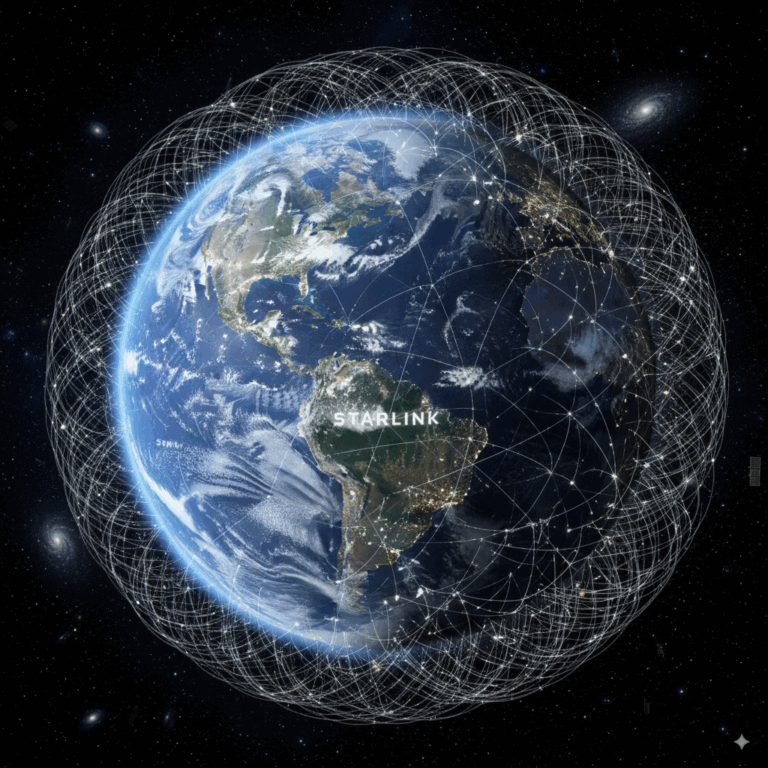
Modern industrial civilization is currently defined by “The Line”—centralized, linear, and fragile corridors of power, data, and logistics. This system is increasingly prone to “operational sclerosis” and catastrophic failure. DeReticular and its division, Agra Dot Energy, are engineering a structural inversion of this model, transitioning rural America from the “tail end” of the grid to a decentralized “Above the Line” power center.
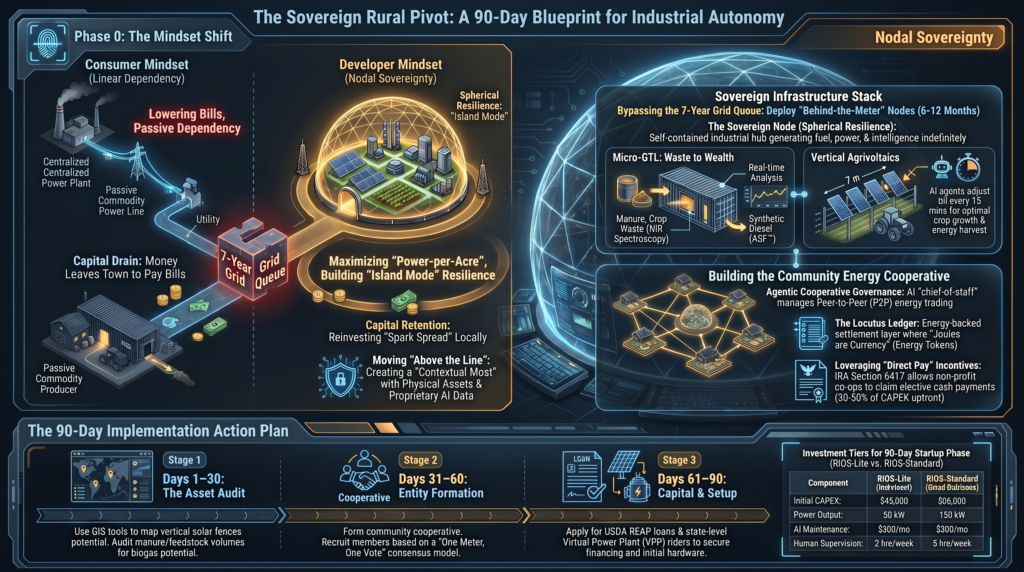
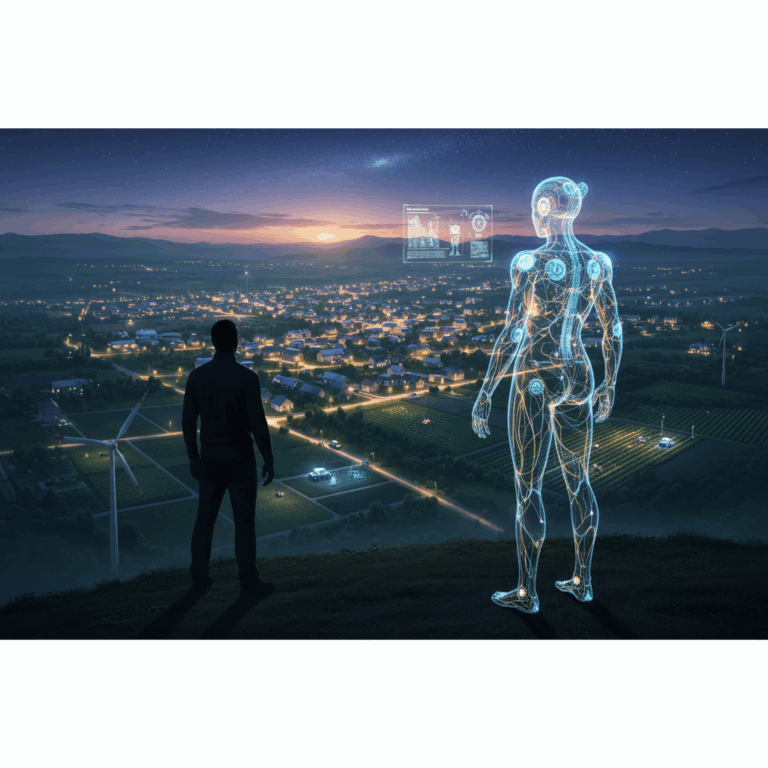
The core of this transition is the Sovereign Node, a self-contained industrial hub capable of generating its own power, fuel, and intelligence in “Island Mode.” By leveraging AI-managed biogas, vertical agrivoltaics, and air-gapped edge computing, rural entrepreneurs can bypass 4–7 year grid interconnection queues and transform negative-cost waste into high-margin assets. This strategy shifts the rural participant from a “Consumer Mindset” (paying utility bills) to a “Developer Mindset” (building sovereign infrastructure).
Critical Takeaways:
- Grid Bypass: Nodes operate “Behind-the-Meter,” allowing for deployment in 6–24 months compared to the multi-year wait for centralized utility approval.
- Economic Arbitrage: Capturing the “Spark Spread”—the difference between low-cost on-site production (0.04/kWh) and retail grid prices (0.12+/kWh).
- Technological Sovereignty: Using RIOS (Rural Infrastructure Operating System) and air-gapped AI agents to ensure operational continuity without dependency on hyperscale cloud providers.
- Financial Innovation: Utilizing Node-as-a-Service (NaaS) and IRA “Direct Pay” incentives to overcome high initial CAPEX barriers.
——————————————————————————–
video
1. Core Philosophy: The “Death of the Line”
The current centralized energy and data model is viewed as a liability. DeReticular’s mission is to replace these fragile systems with “Spherical Resilience.”
- Linear Dependency: A state where operations fail if the external network (power lines, fiber, or cloud) is interrupted.
- Spherical Resilience: The ability of a node to function as a self-contained orb of production.
- “Above the Line” Positioning: As raw AI becomes a commodity, value moves into “context-deep” industries. By integrating hardware with proprietary rural data, these nodes create a “contextual moat” that centralized organizations cannot penetrate.
——————————————————————————–
2. The Sovereign Energy Stack: Agra Dot Energy
The energy infrastructure, branded as “The Heart,” focuses on converting underutilized or negative-cost feedstocks into reliable baseload power and synthetic fuels.
Micro-GTL (Gas-to-Liquids) Units
- Function: Modular reactors roughly the size of a shipping container that use plasma gasification (exceeding 1,500°C) to process biomass, manure, and plastics.
- Outputs:
- Syngas: Burned for 24/7 baseload electricity.
- ASF™ (Agra Synthetic Fuel): Local diesel and jet fuel for independent mobility.
- Key Technology: NIR Spectroscopy sensors analyze feedstock in real-time to optimize methane yield, typically boosting output by 30–43%.
Vertical Agrivoltaics (“Dual-Harvest”)
- Design: Bifacial solar panels installed in vertical “fences” with 7-meter spacing to allow standard agricultural machinery (tractors/combines) to pass through.
- AI Management: Dynamic tracking adjusts panel angles every 15 minutes to balance energy harvesting with the light requirements of crops (wheat, soy, corn).
- Efficiency: Bifacial panels capture ground-reflective light, performing approximately 15% better than fixed systems during winter months.
——————————————————————————–
podcats
3. Sovereign Automation: The Digital Infrastructure
Sovereign Automation provides the “Digital Flywheel” required to manage complex hardware without constant human presence or internet connectivity.
RIOS (Rural Infrastructure Operating System)
RIOS is an air-gapped kernel that governs the logic of the node. It manages the “Spark Spread,” deciding whether to direct energy toward power generation, fuel synthesis, or edge compute hosting based on market rates.
The Agentic Suite (70/30 Rule)
AI agents handle 70% of routine preparatory and maintenance tasks, leaving only 30% for critical human judgment.
- Field Foreman: Manages machinery diagnostics and maintenance; specifically designed to bypass OEM software “repair locks” (Right to Repair strategy).
- Vault Warden: Uses rotating LiDAR for 360-degree perimeter security and 2mm precision asset monitoring.
- Field Medic: An air-gapped diagnostic engine for local community healthcare, ensuring patient records stay local and secure.
- Sovereign Elector: A verifiable, air-gapped voting system for local governance.
Edge Computing
- RIOS-CC-1000 Server Clusters: Liquid-cooled hardware racks submerged in dielectric fluid, optimized for heavy AI inferencing.
- Nomad Link: A Wi-Fi 6E/LoRaWAN mesh canopy that creates a private intranet extending for miles, securing the property against cloud outages.
——————————————————————————–
4. Economic Framework and Revenue Vectors
The transition to a sovereign node creates multiple high-margin revenue streams that traditional farming cannot match.
Primary Revenue Streams
| Vector | Description |
| Spark Spread | Arbitraging low-cost local power against high retail utility rates. |
| Green Compute | Renting out local rack space for secure, sensitive AI data processing. |
| Synthetic Fuel | Localized sales of ASF™ Diesel for agricultural and community use. |
| Carbon Credits | Automated blockchain logging of every green kilowatt and carbon avoidance event. |
The Locutus Ledger
An energy-backed settlement layer that allows for Peer-to-Peer (P2P) trading of “Energy Tokens.” This creates a local currency backed by physical joules, keeping capital within the rural community rather than allowing it to flee to centralized utilities.
——————————————————————————–
white paper
5. Strategic Gap Analysis: Transitioning to Sovereignty
The move from a “Consumer Mindset” to a “Developer Mindset” faces several structural hurdles that require targeted bridge strategies.
| Current State (Linear) | Target State (Sovereign) | Bridge Strategy |
| Grid Reliance | Baseload Autonomy | Modular GTL and Agrivoltaic deployment. |
| Capital Flight | Local Capital Retention | P2P Settlement via Locutus Ledger. |
| Cloud Dependency | Air-Gapped Logic | RIOS-managed local compute (Sovereign Sentry). |
| OEM Software Locks | Sovereign Foreman | AI-driven “Right to Repair” diagnostic overrides. |
The Financial Bridge
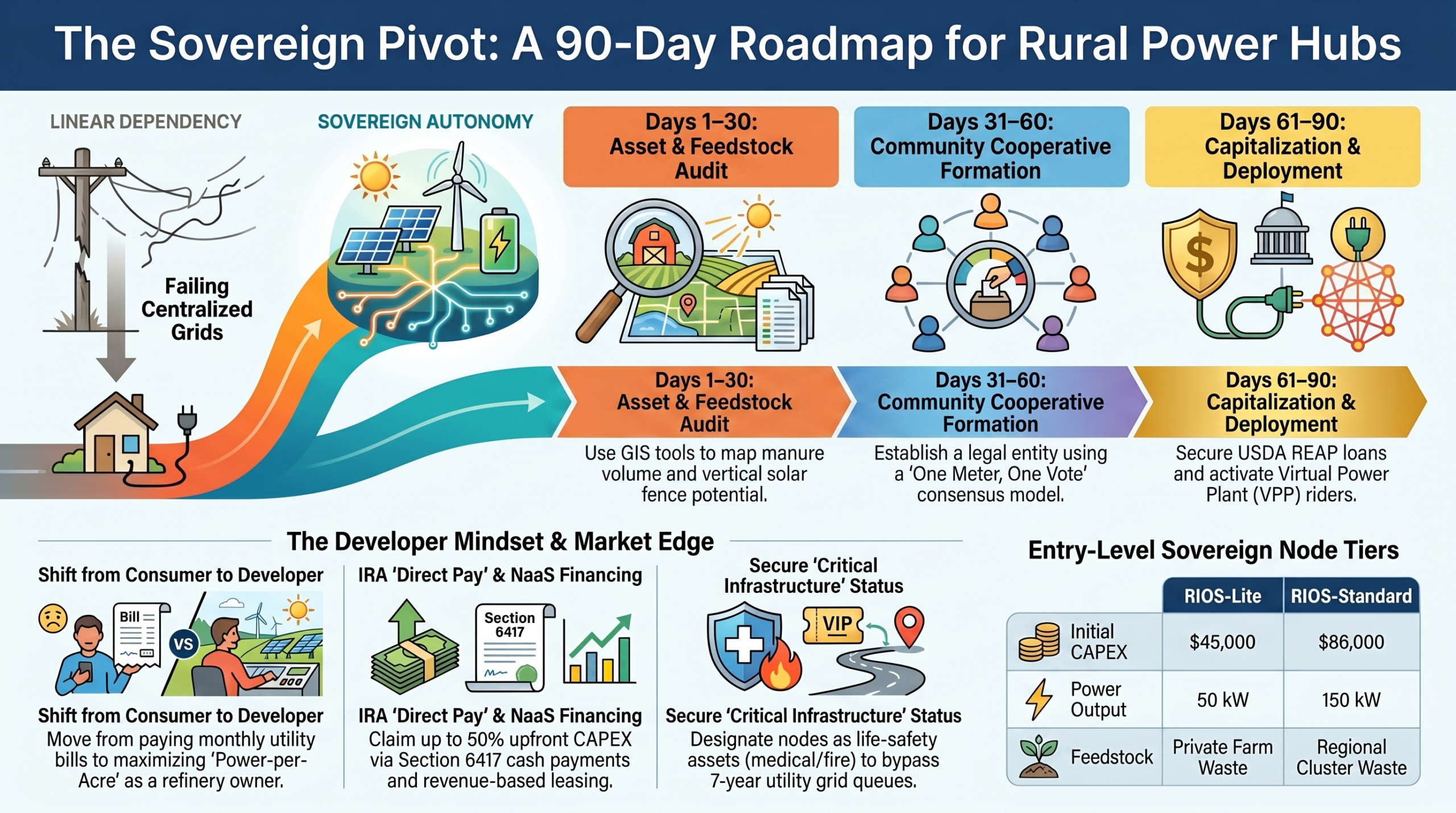
The high initial CAPEX (45k–250k+) is addressed through:
- Node-as-a-Service (NaaS): Equipment is leased in exchange for a percentage of the “Spark Spread” revenue.
- IRA Direct Pay (Section 6417): Non-profit co-ops and municipalities can claim cash payments from the IRS for up to 30–50% of the project cost upfront.
——————————————————————————–
6. Implementation and Scalability
DeReticular targets 50% Year-over-Year (YoY) growth in node deployment.
90-Day Action Plan for Entrepreneurs
- Days 1–30 (Asset Audit): Use GIS tools to map feedstock volume (manure/waste) and agrivoltaic potential.
- Days 31–60 (Entity Formation): Form a community cooperative and recruit members.
- Days 61–90 (Capital & Setup): Secure USDA REAP loans or NaaS financing and begin modular installation.
10-Year Financial Projections (Select Highlights)
- Year 1: 100 Nodes, $12M Gross Revenue.
- Year 5: 507 Nodes, $73.5M Gross Revenue (Cumulative ROI: 140%).
- Year 10: 3,848 Nodes, $711.8M Gross Revenue (Cumulative ROI: 700%).
Conclusion
The DeReticular and Agra Dot Energy ecosystem represents a significant structural inversion of rural economics. By shifting from the “tail end” of the line to a sovereign node, rural stakeholders transform their land into high-density intelligence and energy refineries. This “Node vs. Line” strategy provides a resilient alternative to failing centralized systems, positioning rural America as the strategic high-ground of the 2026 economy.