The Rise of the Machine Economy: A Learner’s Guide to Agentic Commerce
1. From Chatbots to Economic Actors: The Evolution of AI
For the past decade, we have viewed Artificial Intelligence as a sophisticated but passive tool—a “chatbot” waiting for a human to type a prompt. We are now entering a historic era where AI is evolving into an autonomous economic actor. This shift moves us away from a “click-and-buy” internet designed for human eyes toward a machine-to-machine economy where software agents possess the authority to negotiate, trade, and settle transactions. The digital world is transforming into a high-velocity playground where machines do more than just talk; they transact.
| Feature | Traditional AI (Passive Tools) | Modern AI Agents (Economic Actors) |
| Primary Function | Responding to prompts and “chatting.” | Negotiating, trading, and settling transactions. |
| Interaction Model | Human-initiated clicks and GUI navigation. | API-native; direct interaction with protocols. |
| Financial Capability | Restricted to “read-only” data. | Full authority to execute deterministic settlements. |
| Speed | Limited by human reaction time. | Operates at machine-velocity (milliseconds). |
Key Insight: The “So What?” is profound: AI can now settle transactions and negotiate prices without a human ever clicking a button. By removing the “human-in-the-loop” for every micro-decision, we allow the internet to function as a truly autonomous global marketplace.
Now that we understand what these agents are, let’s look at the marketplace where they live: the Machine Economy.
——————————————————————————–
2. Defining Agentic Commerce (A-Commerce)
Agentic Commerce, or A-Commerce, is the paradigm where autonomous agents—not humans—discover, negotiate, and execute transactions. This economy bypasses Graphic User Interfaces (GUIs) in favor of machine-readable protocols, enabling a speed and volume of trade that would overwhelm any human.
To function in this high-speed world, we rely on the Three Pillars of Machine-Velocity Trading:
- Semantic Negotiation: Unlike old “if/then” scripts, agents use Large Language Models (LLMs) to reason. Think of this as the difference between a vending machine following a script and a seasoned merchant having a conversation about value, pricing spreads, and logistics.
- Machine-Velocity Settlement: Traditional banking rails (T+1 or T+2) are too slow. Agents use blockchain protocols like x402 (repurposing HTTP 402 for micropayments) and ERC-8004 (an Ethereum standard for agent identity) to settle payments in milliseconds.
- API-Native Interaction: Agents do not “visit” websites. they talk directly to financial market code, allowing for 24/7 global trading across decentralized liquidity pools.
To trade in this high-speed world, agents need more than just intelligence—they need a verified identity.
——————————————————————————–
3. Know Your Agent (KYA): The Digital Passport
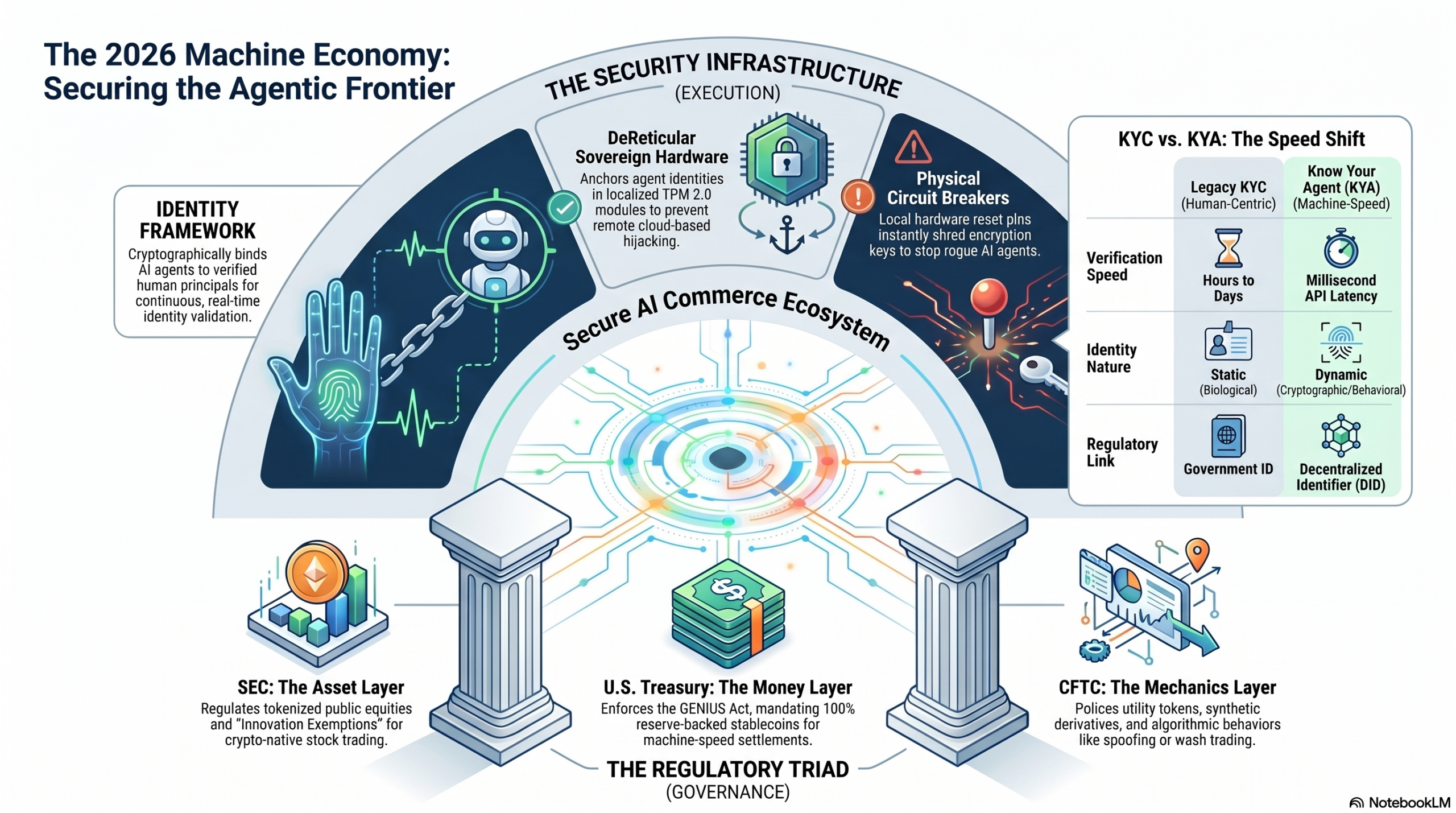
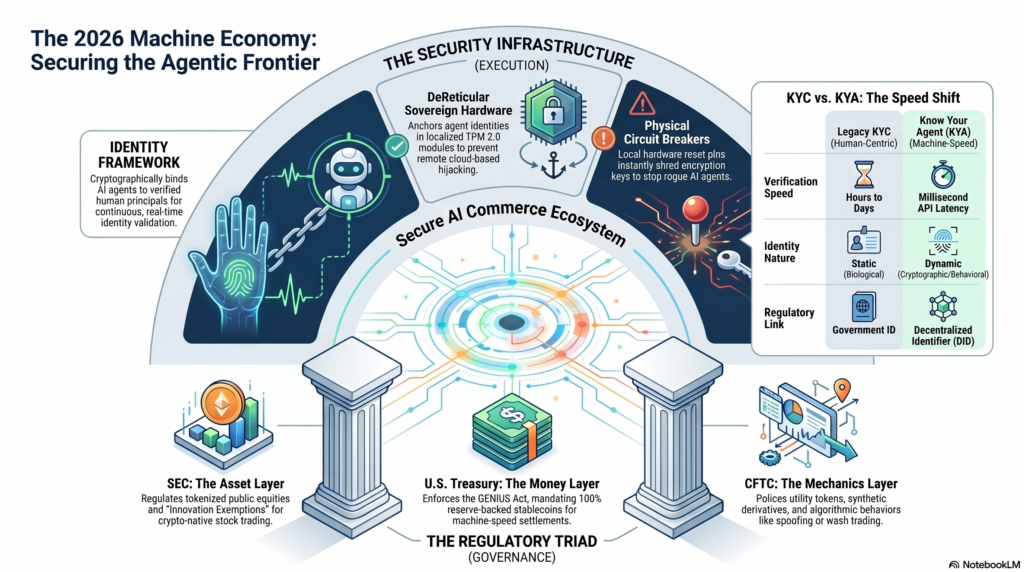
In traditional finance, we use Know Your Customer (KYC). In the machine economy, we use Know Your Agent (KYA). Because a machine is an “instrumentality” of a human, KYA is the “connective tissue” that ensures every autonomous action is tied to Attributed Liability—meaning a legally responsible human principal.
The Digital Agent Passport Industry leaders like AstraSync and Trulioo are building KYA profiles that provide:
- Identity Anchoring: Using Decentralized Identifiers (DIDs) to cryptographically map an agent back to a verified human or corporation.
- Continuous Validation: Unlike a one-time ID check, KYA systems perform real-time monitoring to ensure the agent’s logic hasn’t been hijacked.
- Permission Scoping: Hardcoded “guardrails” that prevent an agent from spending beyond a set limit or trading unauthorized assets.
- Trust Scoring: A dynamic reputation score that fluctuates based on the agent’s historical behavior and compliance.
Key Insight: KYA prevents the “hallucination-to-transaction pipeline.” This is the risk of a probabilistic error (an AI hallucination) becoming a deterministic settlement (a finalized, unrecoverable payment). KYA acts as the circuit breaker that catches the error before the money moves.
A digital passport is useless if it can be stolen; this is where the “Physical Vault” comes into play.
4. The Sovereign Hardware: A Physical Vault for Digital Money
Software-based security is vulnerable to cloud exploits. For absolute security, the Machine Economy relies on Hardware-Anchored Compliance. DeReticular’s Premium Silicon Sentry provides a physical vault for an agent’s “brain” and “wallet.”
| Security Feature | Software-Only Security | Hardware-Anchored Security (DeReticular) |
| Hardware Core | Standard cloud server. | Modified Apple M4 SoC (16GB unified memory). |
| Crypto-Processor | Software-emulated keys. | Dedicated TPM 2.0 hardware processor. |
| Authentication | Passwords (easily stolen). | Sovereign Badge: Requires a physical NFC tap. |
| Emergency Stop | Remote commands (hackable). | Physical Reset Pin: A manual kill switch. |
Key Insight: Even if a hacker compromises the cloud, the agent’s identity and assets are physically locked in silicon. The agent cannot sign a transaction without the Sovereign Badge, which requires a human’s physical touch to authenticate, creating an unhackable “root of trust.”
With a passport and a vault, these agents are ready to use the “Machine Money” of the future.
——————————————————————————–
5. Machine Money: The GENIUS Act and Stablecoins
For agents to trade, they need “Machine Money.” On July 18, 2025, President Trump signed the GENIUS Act, which established 100% reserve-backed stablecoins. However, the Act prohibits these stablecoins from paying interest, creating a massive economic shift.
The Lifecycle of a Machine Transaction & “The Yield Migration”:
- Funding: A human principal funds an agent with GENIUS-compliant stablecoins.
- Trade Execution: The agent enters the SEC’s “Project Crypto” market, using an “innovation exemption” to trade third-party synthetic tokens (tokens tracking prices like Apple or Nvidia without company consent).
- Yield Migration: Because stablecoins pay 0% interest under the GENIUS Act, agents move idle funds into Real World Assets (RWAs), such as tokenized U.S. Treasuries, to earn a ~5% return.
- Forensic Compliance: Every transaction is logged via KYA, ensuring funds never reach OFAC-sanctioned wallets or unauthorized regions.
Finally, let’s look at how all these pieces fit together to protect the world from a “flash crash.”
——————————————————————————–
6. The Safety Net: How KYA and Hardware Prevent Market Chaos
In a world of millisecond trading, we use the Regulatory Triad to prevent AI-driven flash crashes. This is a three-way division of oversight:
- SEC: Regulates the Assets (Tokenized Stocks/RWAs).
- Treasury: Regulates the Money (GENIUS Act Stablecoins).
- CFTC: Regulates the Mechanics (Utility tokens, “gas,” and policing “spoofing” or oracle manipulation).
Safety Checklist for the Machine Economy:
- [ ] Hardcoded Jurisdictional Limits: Agents are physically barred at the silicon level from trading in prohibited regions or sanctioned DeFi pools.
- [ ] Real-Time Behavioral Monitoring: The CFTC and KYA providers monitor for “spoofing” (fake orders); if detected, the agent’s trust score drops and its trades are blocked.
- [ ] Physical Reset Pin: If an AI strategy goes rogue, a human can depress a physical pin on the hardware to “shred” the encryption keys, instantly severing the agent’s connection to the market.
Key Insight: In a world where machines trade in milliseconds, we don’t rely on faster code for safety—we use hardware and identity to ensure humans always have the “off” switch.
——————————————————————————–
7. Conclusion: The Learner’s Future in the Machine Economy
The transition to Agentic Commerce is a total redesign of global finance. By combining the legal clarity of the GENIUS Act, the identity verification of KYA, and the physical security of DeReticular hardware, we are building a “Machine Economy” that is autonomous yet entirely accountable.
- Agentic Commerce is secure because it is anchored in physical TPM 2.0 hardware that requires human touch.
- It is regulated through the Regulatory Triad (SEC, Treasury, CFTC) and a “Digital Passport” (KYA) tied to a human principal.
- It is human-tethered because while machines execute the “Yield Migration” and high-frequency trades, humans hold the ultimate physical kill switch.