
Regulatory Integration of Digital Assets as Collateral: The 2025–2026 Framework
Executive Summary
On December 8, 2025, the U.S. Commodity Futures Trading Commission (CFTC) launched a “Digital Assets Pilot Program,” establishing the first formal pathway for using digital assets as collateral in U.S. derivatives markets. This initiative, alongside the enactment of the Guiding and Establishing National Innovation for U.S. Stablecoins (GENIUS) Act on July 18, 2025, represents a fundamental shift in the legitimization of digital assets within the regulated financial ecosystem.
Critical takeaways include:
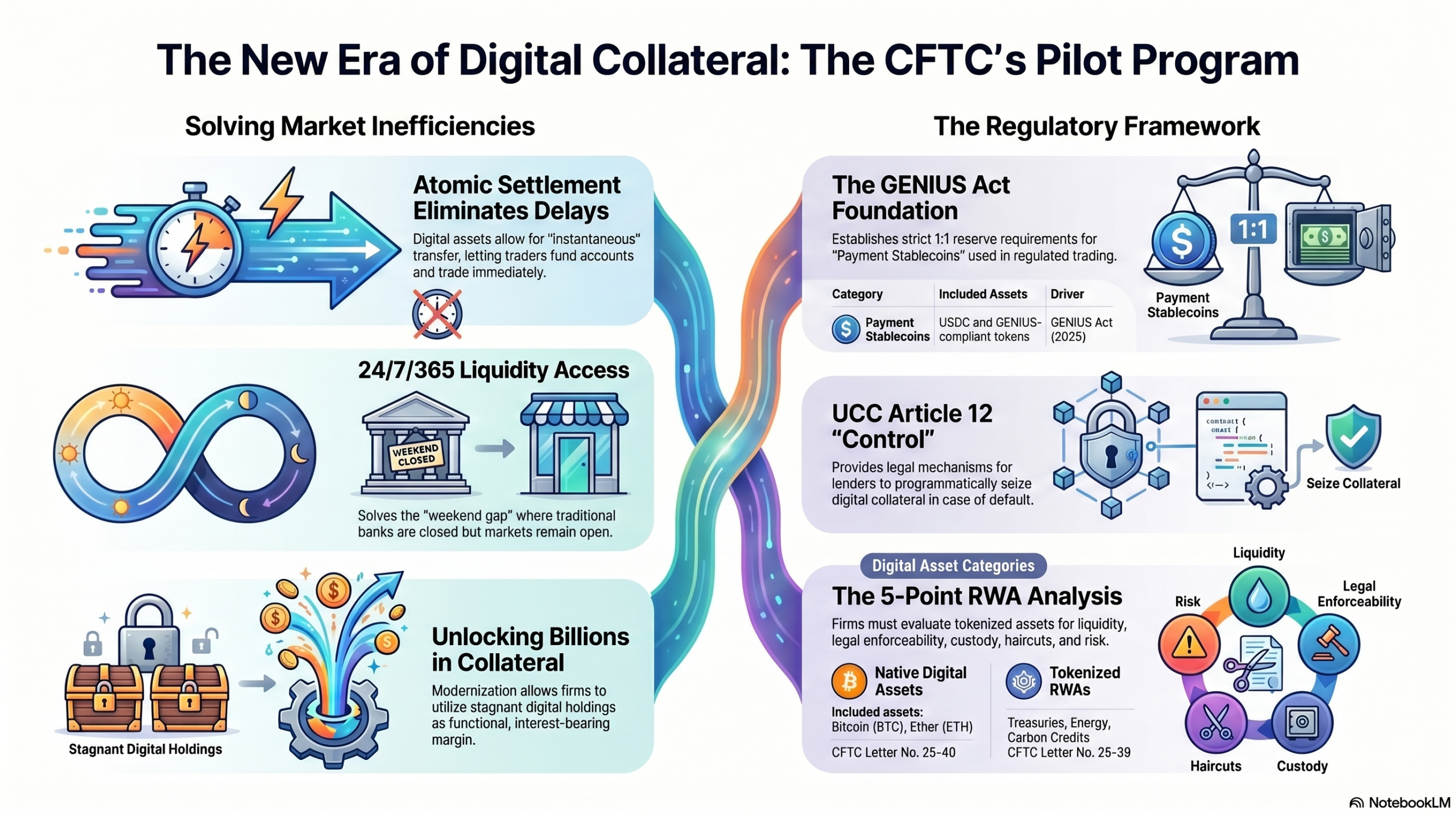
- Unlocking Liquidity: The program is expected to unlock billions of dollars in eligible digital collateral, enabling “atomic” (instantaneous) settlement and 24/7/365 trading capabilities.
- Regulatory Bifurcation: The CFTC has established two parallel frameworks: a principles-based approach for Tokenized Real-World Assets (RWAs) and a prescriptive “No-Action” relief framework for native digital assets (Bitcoin, Ether, and stablecoins).
- Risk-Centric Eligibility: Tokenization does not enhance the credit quality of an asset; the underlying asset’s risk remains paramount. Firms may actually apply deeper “haircuts” to tokenized assets to account for novel technological risks.
- Shift in Utility Token Value: The market is pivoting from speculative “currency” tokens toward “digital plumbers”—tokens that facilitate the movement, programmatic custody, and settlement of regulated assets.
- Legal Clarity: The framework leverages the 2022 Amendments to the Uniform Commercial Code (UCC), specifically Article 12, to establish “control” over Controllable Electronic Records (CERs) as a method for perfecting security interests.
——————————————————————————–
I. Key Regulatory Pillars
The new landscape is governed by a series of CFTC actions and federal legislation designed to transition the industry from “regulation by prosecution” to a structured pilot environment.
1.1 The CFTC Digital Assets Pilot Program (December 2025)
The program consists of several key staff letters and guidance withdrawals:
| Document | Primary Function |
| CFTC Letter No. 25-39 | Provides guidance on using tokenized assets as collateral in futures and swaps trading. |
| CFTC Letter No. 25-40 | Provides No-Action Letter (NAL) relief for Futures Commission Merchants (FCMs) and Derivatives Clearing Organizations (DCOs) to accept digital assets. |
| CFTC Letter No. 25-41 | Withdraws Advisory 20-34, removing outdated constraints on FCMs regarding customer virtual currencies. |
| Dec. 11 Guidance Withdrawal | Removes outdated 2020 guidance on “actual delivery” of digital assets in retail transactions. |
1.2 The GENIUS Act (Public Law 119-27)
Enacted July 18, 2025, this law provides the definitive framework for “Payment Stablecoins.”
- Definition: A digital asset used for payment/settlement where the issuer is obligated to redeem it for a fixed amount of monetary value.
- Issuer Limitations: Only “Permitted Payment Stablecoin Issuers” (subsidiaries of insured depository institutions or qualified Federal/State nonbank entities) may issue stablecoins in the U.S.
- Reserve Requirements: Issuers must maintain identifiable reserves on a 1-to-1 basis, restricted to highly liquid assets such as U.S. currency, Treasury bills (93 days or less maturity), and reverse repurchase agreements.
- Prohibition on Interest: Regulated issuers are strictly forbidden from paying interest or yield to holders.
——————————————————————————–
II. Mechanics of Digital Collateral and Margin
The CFTC differentiates between assets that are native to a blockchain and traditional assets represented on a ledger.
2.1 Tokenized Real-World Assets (RWAs)
The “December 8 Guidance” (Letter 25-39) clarifies that digitizing an asset does not change its fundamental characteristics. Market participants must analyze tokenized assets based on five key considerations:
- Liquidity: Can the underlying RWA be liquidated quickly in a crisis?
- Legal Enforceability: Are netting arrangements and settlement finality valid in insolvency?
- Segregation and Custody: Is the asset compatible with statutory trust requirements?
- Appropriate Haircuts: Valuation reductions must account for both the underlying asset risk and the technological risk (smart contracts, hacks).
- Operational Risks: Evaluation of digital ledger technology (DLT) infrastructure and cybersecurity.
2.2 Native Digital Asset Margin (NAL Relief)
Letter 25-40 allows FCMs to factor specific digital assets into undermargining and segregation calculations.
- Eligible Assets: Strictly limited to Bitcoin (BTC), Ether (ETH), and existing payment stablecoins (e.g., USDC) during the initial onboarding phase.
- FCM Requirements: Must file a notice of intent, submit weekly balance reports, and obtain written legal opinions on the enforceability of security interests.
- Residual Interest: FCMs may deposit their own self-issued, GENIUS Act-compliant stablecoins into customer accounts as residual interest to provide a capital buffer.
——————————————————————————–
III. Industry Implications and Case Studies
3.1 Practical Use Cases: Atomic Settlement and 24/7 Trading
The primary advantage of the new framework is the elimination of time delays inherent in traditional banking.
- Atomic Posting: Digital assets can be posted instantaneously, allowing customers to establish positions immediately rather than waiting days for wire transfers or ACH clearances.
- 24/7/365 Infrastructure: Digital collateral solves the problem of weekend market volatility where traditional margin cannot be posted while exchanges remain open.
3.2 Case Study: DeReticular RIOS and “Sovereign Banking”
The DeReticular “Node 4” project in Uganda demonstrates the practical application of tokenizing physical production into a verified financial asset.
- The Physical Asset: A 7,000-acre park converting industrial hemp into energy (via plasma gasification) and carbon credits.
- The Digital Twin: The Rural Infrastructure Operating System (RIOS) uses on-site sensors to verify production data, which is then cryptographically secured via Zero-Knowledge Proofs (zkVerify).
- The Financial Asset: This verified data is minted into a “Tokenized RWA” NFT. Under CFTC Letter 25-39 and UCC Article 12, this NFT serves as regulatory-compliant collateral.
- Sovereign Banking Paradigm: By posting the verified NFT as collateral, the project unlocks immediate liquidity (USDC) to re-invest, bypassing traditional 6-month agricultural payment cycles.
3.3 The Role of Utility Tokens as “Digital Plumbers”
The regulatory framework excludes most existing utility tokens from being used as collateral. Instead, their value has shifted toward providing essential infrastructure services:
- Gas for Settlement: Powering the high-speed 24/7/365 settlement of regulated collateral.
- Programmatic Custody: Enabling smart contracts that comply with UCC Article 12 for automatic “control” and seizure of collateral in default.
- DeFi Yield: Providing the “plumbing” for yield protocols that fill the gap created by the GENIUS Act’s prohibition on stablecoin interest.
——————————————————————————–
IV. Legal and Insolvency Frameworks
4.1 Secured Transactions under the UCC
FCMs have two primary pathways for perfecting security interests in digital collateral:
- The “Article 8 Solution”: Agreement between the customer and FCM to treat non-security crypto (BTC, ETH, USDC) as “financial assets” credited to a securities account.
- The “Article 12 Solution”: Under the 2022 UCC Amendments, digital assets are treated as “Controllable Electronic Records” (CERs). Perfection is achieved through “control”—the power to enjoy the benefits of the asset and prevent others from doing so.
4.2 Bankruptcy and Priority
The GENIUS Act and the CFTC NAL provide critical protections for stablecoin holders:
- Statutory Trust: Digital collateral must be treated as “customer property” and segregated from the FCM’s estate, ensuring it is not subject to the claims of general creditors.
- Bankruptcy Priority: Under the GENIUS Act, claims arising from the holding of payment stablecoins have priority over the claims of the issuer and other non-stablecoin creditors regarding the required reserves.
- The “Sovereign” Priority: If reserves are insufficient, stablecoin claims have first priority over the estate’s other assets to the extent that the issuer failed to maintain required reserve levels.
——————————————————————————–
V. Strategic Outlook: 2026 and Beyond
The CFTC’s pilot program is a controlled “sandbox” designed to build institutional trust. While currently restricted to a small group of sophisticated FCMs and a narrow set of assets, the framework sets the stage for:
- SEC Pressure: The CFTC’s move places renewed pressure on the SEC to clarify how broker-dealers can handle tokenized securities.
- Expanded RWA Adoption: As legal precedents for “Controllable Electronic Records” mature, more physical assets (beyond hemp and energy) are likely to move on-chain.
- Federal vs. State Coordination: Entities must navigate both federal CEA requirements and state-level licensing (e.g., New York’s BitLicense) unless they qualify for specific federal exemptions.
“The true significance of these rules is not just the assets they permit, but the standards they set… The bridge has been built. The question is no longer if real-world value will move on-chain, but how quickly.”