The Supercomputer Next Door.
Here is a long-form article tailored for the DeReticular website. It balances high-tech specification with the brand’s signature philosophy of economic sovereignty and community empowerment.
Why we tore apart the Data Center to build the RIOS-Campus Compute-1000.
By The DeReticular Team
For the last twenty years, the technology industry has been obsessed with centralization.
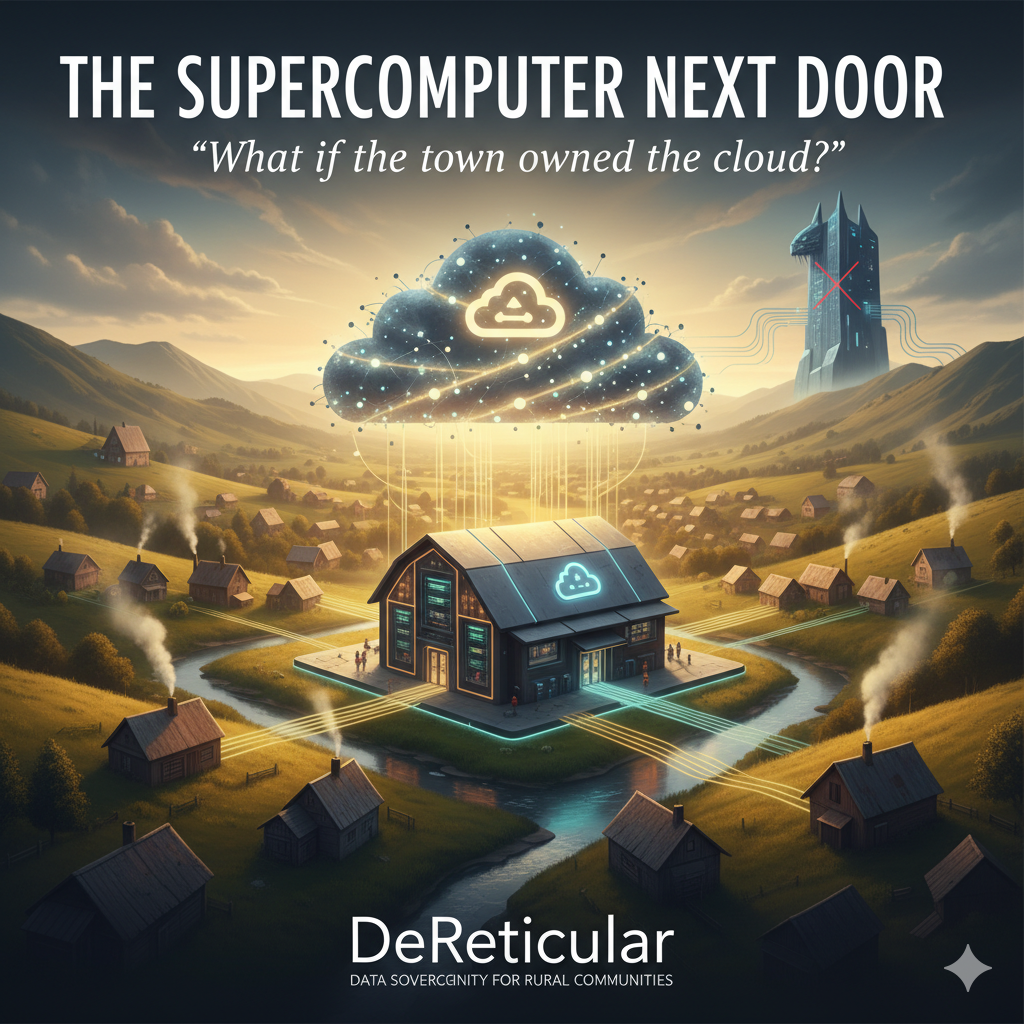
They told us to move everything to “The Cloud.” It sounded nice—fluffy, ethereal, floating above us. But we know the truth. The Cloud isn’t a cloud at all. It is a series of concrete fortresses in Northern Virginia and Silicon Valley, owned by three massive corporations, consuming enough electricity to power small nations.
When a rural community sends its data to the Cloud, they are engaging in modern-day digital sharecropping. You export your raw resource (data/money), they process it, and they sell it back to you as a service. The value leaves town and never comes back.
At DeReticular, we asked a dangerous question: What if the town owned the cloud?
And not just a few servers in a closet. What if a rural municipality owned a legitimate, Exascale-class Supercomputer?
Enter the RIOS-Campus Compute-1000 (CC-1000).
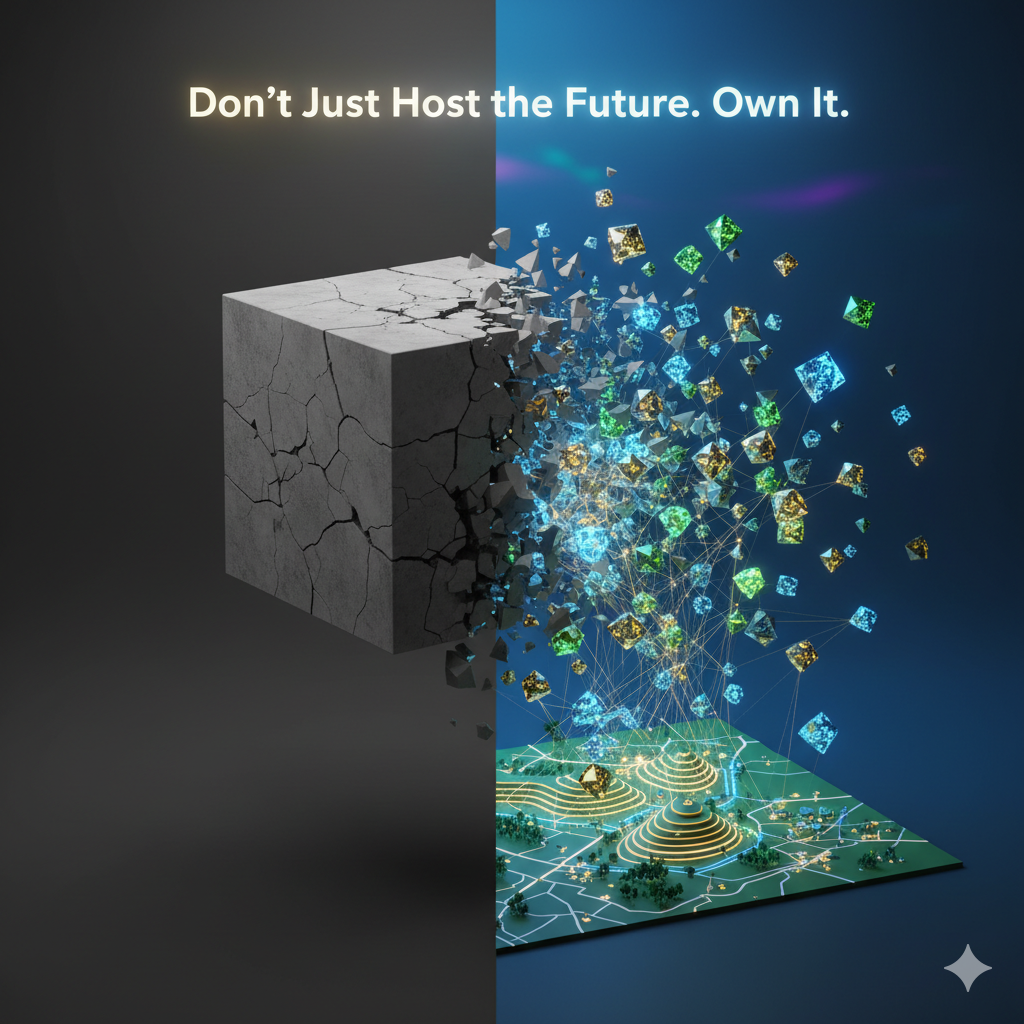
The Death of the “Fortress” Model
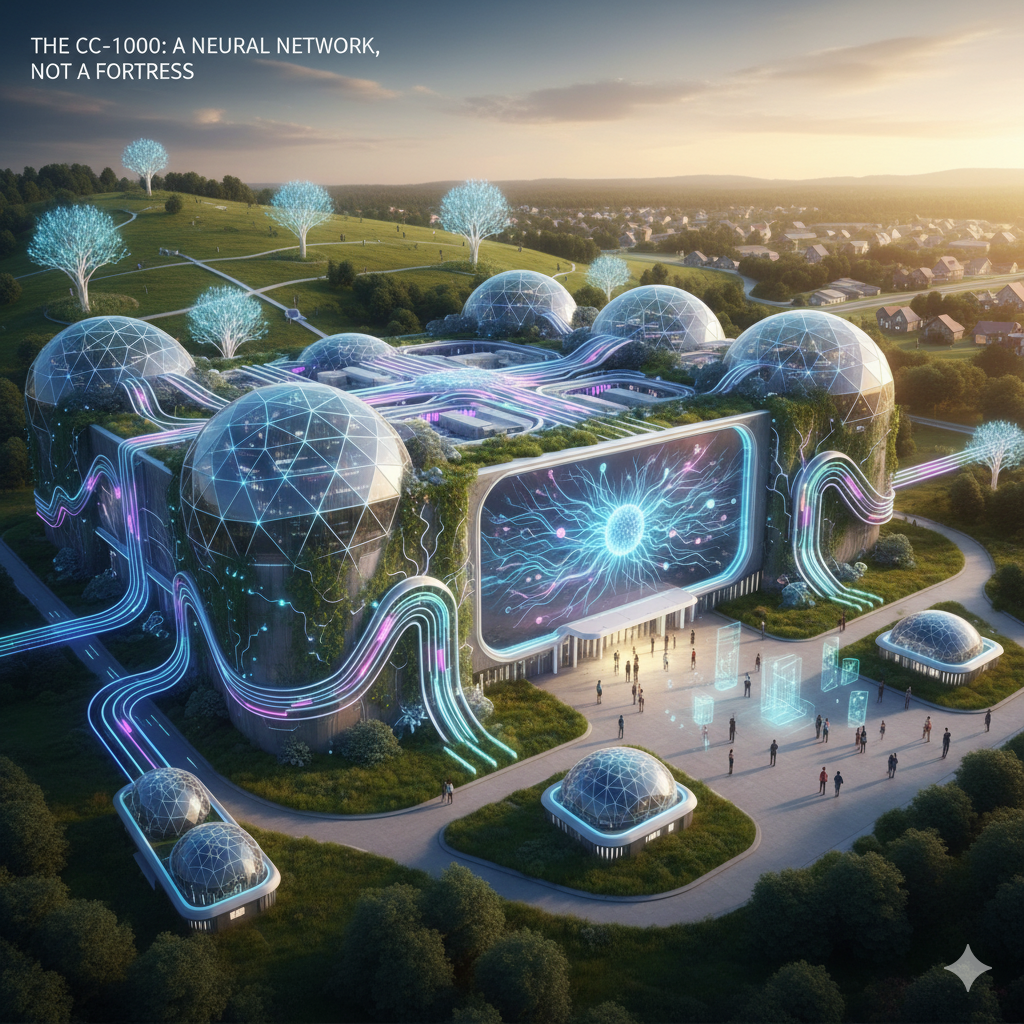
When we designed the CC-1000, we didn’t want to build another fortress. We wanted to build a neural network.
The CC-1000 is a distributed AI supercomputer. It packs the processing power of 1,000 NVIDIA H100 AI Servers—the gold standard of modern artificial intelligence. But instead of locking all 1,000 of them in a dark room where nobody can see them, we exploded the architecture.
We use a “Hub and Spoke” design that weaves the supercomputer into the physical fabric of your community.
1. The Hub: The Liquid Heart
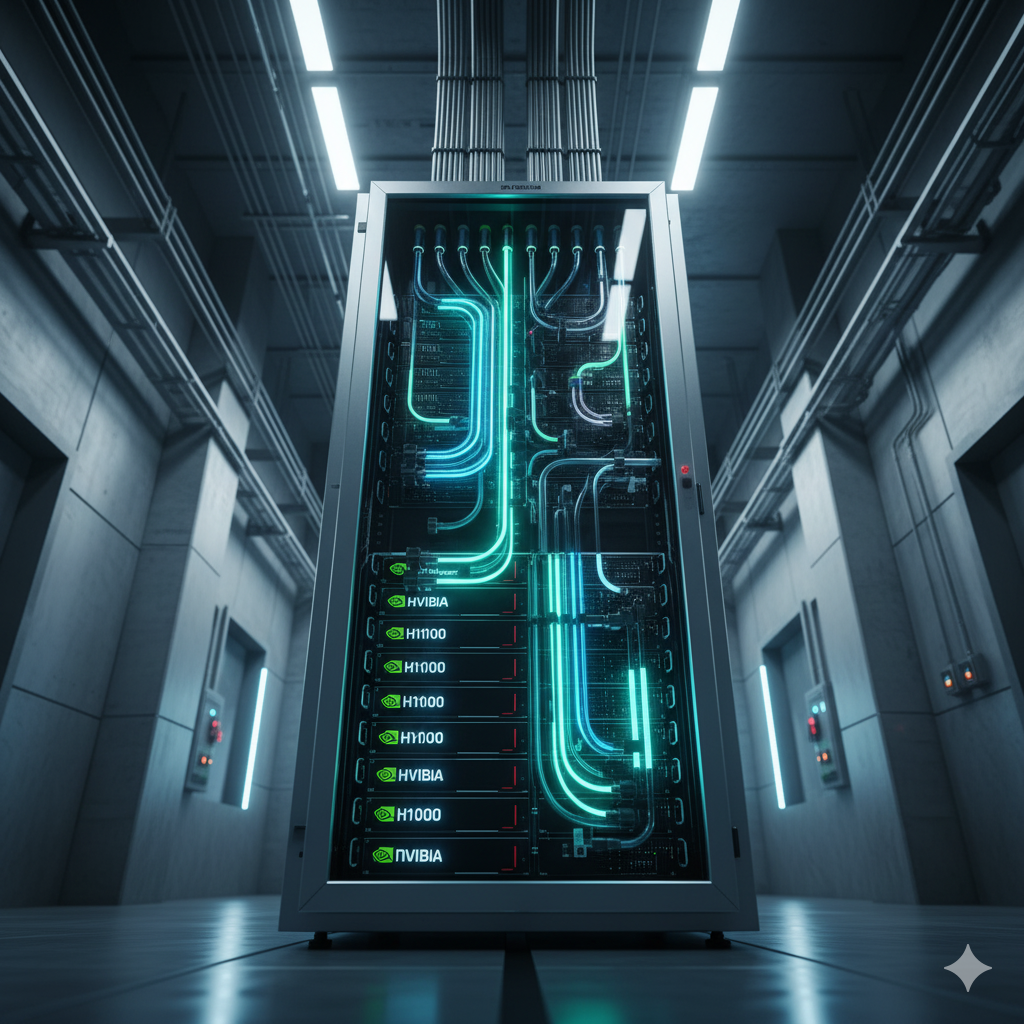
It starts at the source. Located at your power generation site (co-located with the Agra Energy Micro-GTL system), sits the Core Hub.
This is the “Heavy Iron.” It is a massive, 42U rack modified for Direct-to-Chip Liquid Cooling. It glows with cyan coolant tubes, humming silently as it dissipates heat that would melt a normal server. This Hub handles the heavy lifting—secure storage (the 1PB Data Vault), network aggregation, and the orchestration logic that keeps the system running.
2. The Spoke: The “Swarm”
Here is where it gets radical. We take the remaining ~960 AI servers and we give them to you.
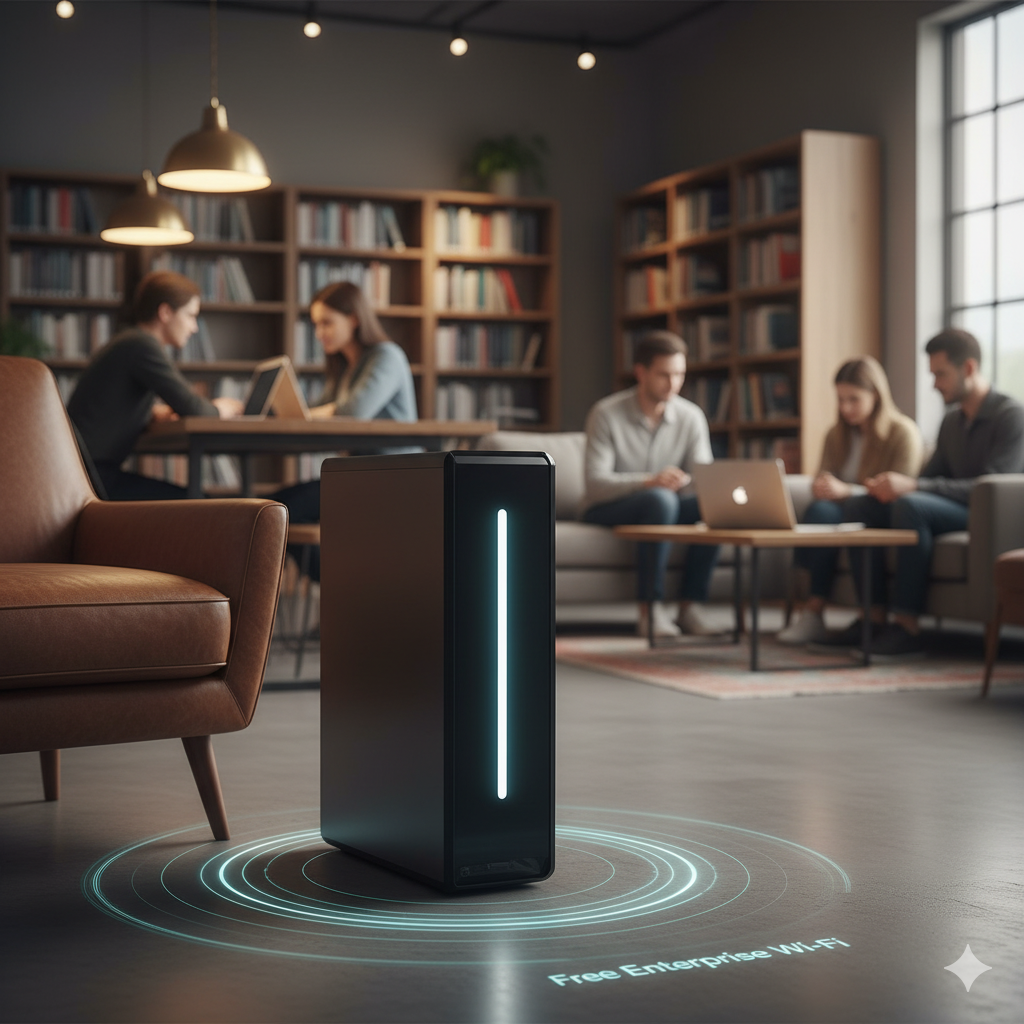
We deploy these Anchor Nodes to the heartbeat locations of your town:
- The Public Library: Gets an AI node to help research archival data.
- The Apartment Complex: Gets five nodes to serve its tenants.
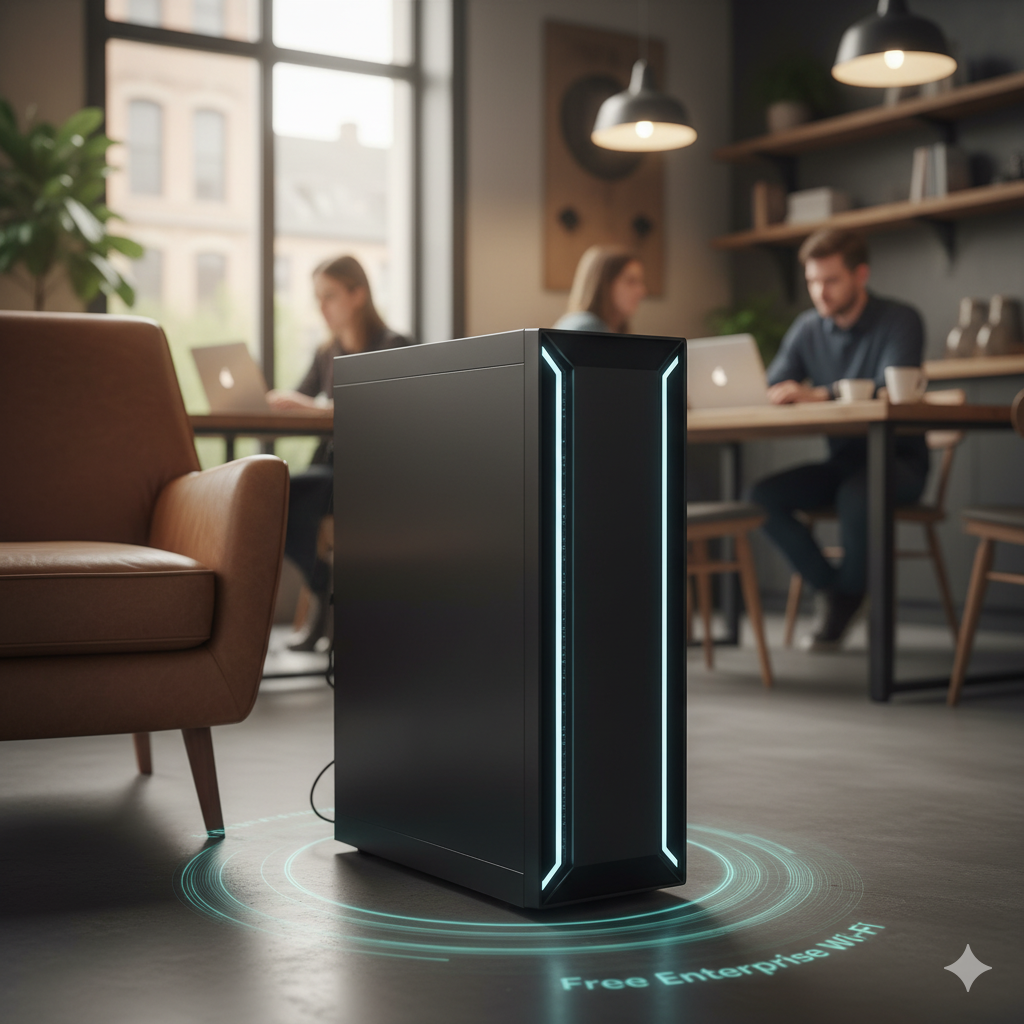
- The Local Coffee Shop: Gets a node to power its operations.
These aren’t loud, industrial boxes. They are the RIOS “Silent Monolith” towers—sleek, sound-dampened workstations that sit in a lobby or an office, looking beautiful while they process trillions of floating-point operations per second.
The “Golden Goose” Logic
“Okay,” you ask. “That sounds expensive. How does a town of 10,000 people afford a $45 million supercomputer?”
The answer is simple: The computer pays for itself.
The global demand for AI training is insatiable. When your local Anchor Nodes aren’t processing local data, they don’t just sit idle. They join the RIOS Compute Grid. They accept jobs from the global market—training LLMs, rendering 3D environments, solving complex protein folds.
This generates revenue. A lot of it.
We call this the “BizBuilder” Model.
Through our financing program, a local business owner or landlord pays $0 down to host a node. The revenue generated by the AI jobs pays off the hardware lease. Once it’s paid off, that revenue stream belongs to the community host.
It is infrastructure that behaves like an asset, not a liability.
Enter: BizBuilder Mike
Technology fails without adoption. You can’t just drop a supercomputer on a small business owner and say, “Good luck.”
That’s why the CC-1000 comes with a human element: BizBuilder Mike.
Mike is the RIOS ecosystem coach. He is part of the package. His job is to work with your local “Anchors”—the coffee shop owner, the pastor, the librarian—and show them how to use this tool.
- He teaches them how to monitor their “Mining” revenue.
- He shows them how to use the local AI to analyze their business data.
- He ensures the “Free Community Wi-Fi” (broadcasted by every Anchor Node) is running smoothly.
Mike isn’t tech support. He is a Local Economic Architect.
Why This Matters
The RIOS-Campus Compute-1000 delivers three things that “The Cloud” never could:
- Sovereignty: Your town’s data (medical records, legal documents, security footage) stays in your town, encrypted in the Core Hub’s Data Vault. It never crosses state lines.
- Equity: The revenue generated by the AI revolution is usually captured by Silicon Valley. The CC-1000 captures that revenue for the local library, the local landlord, and the local municipality.
- Connectivity: With 1,000 nodes scattered across town, each broadcasting Enterprise Wi-Fi 7, you accidentally created a ubiquitous, free gigabit wireless network for your residents.
The Future is Distributed
We are done with the era of the passive consumer. It is time to become a producer.
The RIOS-Campus Compute-1000 turns your community into a powerhouse of the AI age. It takes the most advanced silicon on earth, cools it with your local energy, and distributes the profit to your local businesses.
Don’t just watch the future happen on a screen. Build the engine that powers it.
Interested in bringing a RIOS Campus to your municipality? [Contact our Infrastructure Team] to schedule a site architecture review.