The Self-Regulating Farm: 5 Surprising Innovations Redefining the Future of Food
Modern agricultural technology promises unprecedented precision, yet it conceals a fatal vulnerability known as the “1,000-Mile Failure Model.” Today’s hyper-connected, cloud-tethered tractors, automated irrigation valves, and field-management apps rely heavily on continuous communication with distant cloud servers. When a regional fiber trunkline degrades, a remote domain server experiences an outage, or rural cellular coverage flickers, multi-ton autonomous machines stall in the middle of field operations due to lost cloud handshakes. This architectural dependency exposes the acute fragility of modern industrial agriculture, where critical food production halts the moment the digital leash is severed.
Underneath this digital vulnerability lies a broader macro-thermodynamic crisis. For decades, conventional farming has operated as an open-loop, chemically forced system, substituting natural ecosystem balance with synthetic, energy-dense inputs derived from fossil reserves. Exponentially compounding financial claims and debt structures have decoupled from the physical carrying capacity of arable land. As topsoil erodes and the Energy Return on Energy Invested (EROEI) of synthetic fertilizers and heavy machinery collapses, the agricultural sector faces a structural tipping point.
The solution requires a fundamental shift: transitioning from open-loop, chemically forced extraction to a closed-loop, “Self-Regulating Agro-Ecosystem.” By grounding computing, power generation, and robotics within the physical boundaries of the farm, agricultural infrastructure can operate indefinitely in “Sustained Island Mode.” Below are five counter-intuitive, physics-based takeaways transforming high-tech farming into an autonomous, self-correcting organism.
- Bioresorbable Electronics: Soil Sensors That Self-Destruct to Feed Crops
Precision agriculture has long suffered from an epistemic trade-off: coarse, periodic satellite imagery that cannot see through cloud cover versus labor-intensive physical soil sampling. To solve this, autonomous systems deploy transient, bioresorbable soil transducers directly into the crop root zone.
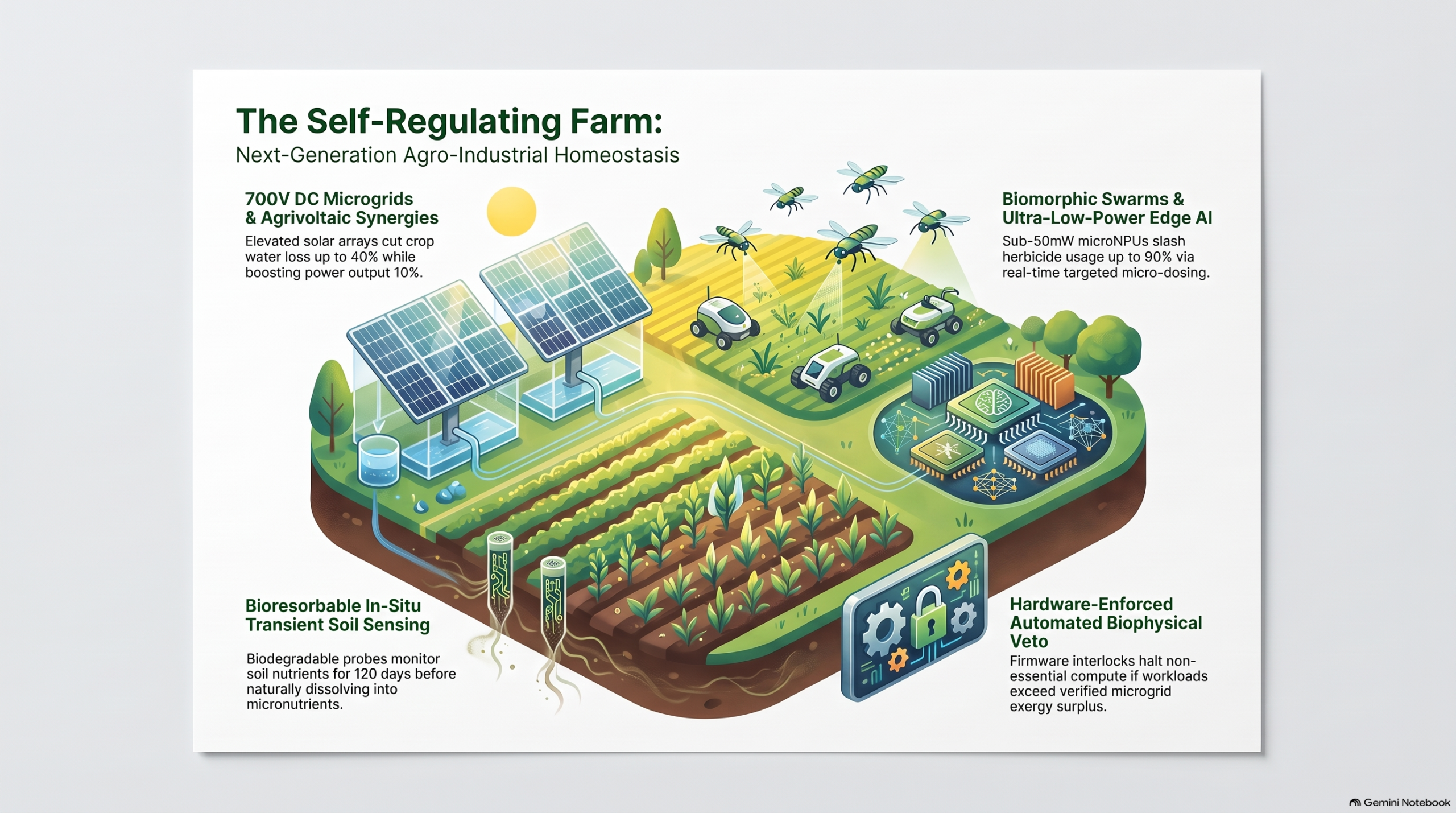
These solid-contact ion-selective electrodes (SC-ISE) are built using biodegradable substrates such as ethyl cellulose, silk fibroin, and polyhydroxyalkanoates (PHA), combined with conductive traces of laser-induced graphene and thin films of pure magnesium (\text{Mg}) and zinc (\text{Zn}). Placed in soil pore water, they continuously measure essential root-zone macronutrients—nitrate (\text{NO}_3^-), ammonium (\text{NH}_4^+), and potassium (\text{K}^+)—across a defined 90- to 120-day crop growth window using Nernstian potential dynamics.
To harvest data from these underground probes without puncturing the soil or running fragile wiring, engineers employ zero-silicon passive inductive-capacitive (LC) resonant tanks. Coated in an ion-sensitive hydrogel, the sensor’s resonant frequency shifts as macronutrient ions bind to its surface:
f_0 = \frac{1}{2\pi \sqrt{L \cdot C(\text{ion})}}
Autonomous aerial drones fly low over the crop canopy, emitting a swept low-frequency RF magnetic field (1–30 MHz) to inductively sweep and read root-zone nutrient states from above—eliminating the need for onboard batteries or physical wire lines.
The surprising twist occurs post-harvest. Rather than requiring manual retrieval or lingering in the soil as persistent electronic waste, the sensors self-destruct. Soil moisture and natural microbial hydrolysis break down the protective encapsulation layers (such as polycaprolactone or beeswax). The metallic components then undergo complete hydrolysis:
\text{Mg} + 2\text{H}_2\text{O} \to \text{Mg(OH)}_2 + \text{H}_2 \uparrow \text{Zn} + 2\text{H}_2\text{O} \to \text{Zn(OH)}_2 + \text{H}_2 \uparrow
“Upon complete hydrolysis the sensor residues become non-toxic soil micronutrients… eliminating manual post-harvest sensor retrieval.”
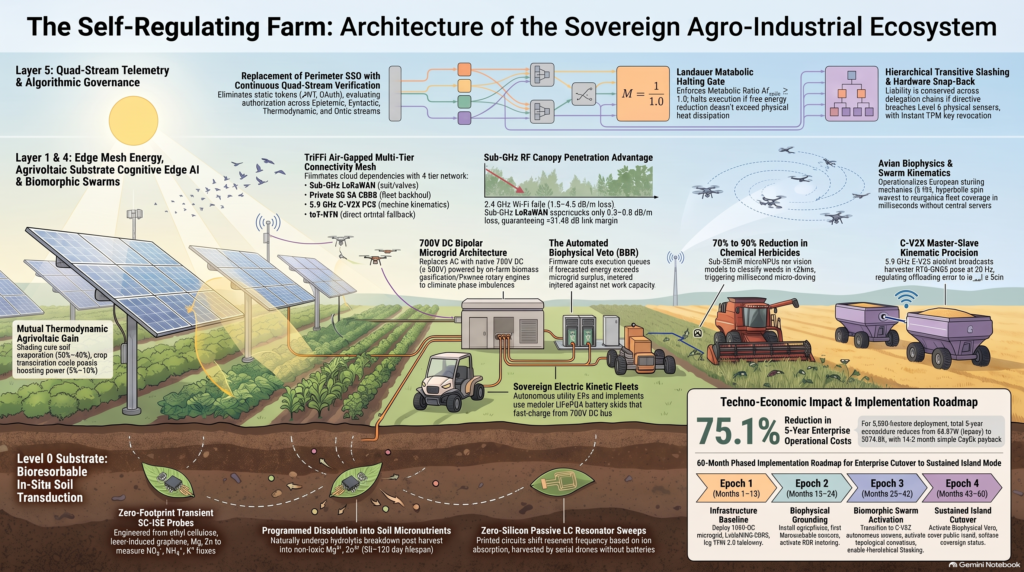
The resulting reaction byproducts dissolve into non-toxic plant micronutrients (\text{Mg}^{2+} and \text{Zn}^{2+}) that enrich the soil profile. Eliminating electronic waste while simultaneously feeding the biological substrate represents a major leap for circular engineering, proving that diagnostic hardware can seamlessly integrate into natural ecological lifecycles.
- Agrivoltaics: The Mutual Thermodynamic “Free Lunch” Keeping Panels and Crops Cool
Merging energy production with food cultivation has historically been viewed as a zero-sum competition for land. Agrivoltaics redefines this dynamic by elevating single-axis tracking photovoltaic (PV) arrays 3.5 to 5 meters directly above row crops or grazing pastures. Crucially, this 3.5- to 5-meter clearance height provides ample vertical clearance for standard combines, tractors, and sprayers to operate beneath the solar canopy, bridging hardware installation with real-world farming operations.
The surprising twist is a mutual thermodynamic feedback loop that delivers dual operational gains. The overhead solar panels cast intermittent shade during peak midday irradiance, reducing surface soil temperatures and lowering crop evapotranspiration (ET_c) by 20% to 40%, saving substantial water. Simultaneously, the crops beneath the array cool the solar panels through transpiration. As plants release water vapor, convective cooling lowers the operating temperature of the overhead silicon PV modules, countering the standard -0.4%/^\circ\text{C} thermal efficiency degradation penalty and boosting solar electricity yield by 5% to 10%.
Land Use Model Productivity & Land Efficiency
Standard Separated Land Use 1.0 Hectare Farming + 1.0 Hectare Solar PV = 2.0 Hectares Needed (Base Output)
Agrivoltaic Combined System 1.0 Hectare Total = 85% Crop Output + 80% Electricity Output (Land Equivalent Ratio LER = 1.65 / 65% Gain)
“The transpiration of crops beneath the panels releases ambient water vapor, cooling the overhead modules by several degrees. This microclimatic feedback loop increases PV power output by up to 5% to 10%.”
By exploiting thermodynamic coupling rather than treating energy and agriculture as isolated industries, agrivoltaic systems achieve a 65% increase in total land productivity on a single physical footprint.
- Murmuration Mechanics: Why Autonomous Tractors Are Borrowing Physics from Starling Flocks
Centralized fleet management for autonomous agricultural machinery frequently fails due to network bandwidth congestion. When scores of weeding rovers, field scouts, and harvesters attempt to continuously exchange high-bandwidth telemetry with a central cloud server, communication channels saturate, leading to operational delays and latency bottlenecks.
To bypass these bottlenecks, modern autonomous fleets borrow three core biophysical pillars from European Starling (Sturnus vulgaris) murmurations:
- Topological Interaction (k \approx 7): Starlings interact strictly with their k \approx 7 nearest topological neighbors, regardless of spatial distance. Autonomous farm machinery replicates this by limiting ROS 2 communication graphs to 7 local functional peers, preventing context bloat and network congestion as fleets expand.
- Scale-Free Criticality (\xi \propto L): In starling flocks, spatial velocity correlations scale linearly with the total diameter of the flock (L), driving system susceptibility to near-infinity (\chi \to \infty). Poised at this critical phase boundary, a single edge scout rover detecting a buried rock or irrigation breach triggers an immediate, dynamic coverage reorganization across the entire autonomous fleet without central cloud oversight.
- Hyperbolic Inertial Spin Waves (\omega = c \cdot k): Trajectory adjustments propagate across the fleet as undamped, second-order waves at speeds of 20 to 40 m/s based on Hamiltonian spin conservation, eliminating slow multi-turn negotiation protocols.
“The spatial correlation length \xi scales linearly with the physical diameter of the flock (L). The swarm operates poised at a second-order phase transition, driving susceptibility to near-infinity (\chi \to \infty).”
By replacing slow, client-server cloud negotiations with scale-free biomorphic consensus, a single scout rover encountering an obstacle can trigger a coordinated evasive maneuver across the entire fleet within milliseconds. Nature’s decentralized flocking algorithms effectively solve one of computer science’s most persistent distributed coordination bottlenecks.
- Landauer Metabolic Halting: Using Physics and Heat to Ground Edge AI
Autonomous weeding rovers rely on sub-50mW microNPUs (such as ARM Cortex-M55 paired with Ethos-U55 microNPUs) running quantized computer vision models (Tinyissimo-YOLO). Processing 30 frames per second, these systems execute crop-versus-weed classification in under 30 milliseconds, directly pulsing solenoid nozzles to micro-dose herbicides—reducing chemical usage by 70% to 90% compared to broadcast spraying.
However, when an edge AI vision model encounters ambiguous visual anomalies—such as an unfamiliar weed species or unusual shadows—standard software checks can fail, trapping the model in an internal introspection loop. In edge computing, endless internal deliberation isn’t just a software bug; it’s a physical waste of energy. The self-regulating farm stops these runaway cognitive loops by enforcing Landauer Metabolic Halting as an algorithmic sanity check.
According to Landauer’s Principle, erasing or updating bits of information in physical memory dissipates a fundamental minimum quantity of thermodynamic exergy as heat:
\Delta Q \ge N_{\text{bits}} k_B T \ln 2
To enforce physical discipline on digital compute, the system continuously evaluates the Landauer Metabolic Ratio (\mathcal{M}_{\text{ratio}}). Here, \Delta F represents the reduction in Variational Free Energy (the agent’s operational uncertainty about its environment), while \Delta Q represents the physical thermal exergy cost incurred by erasing VRAM bits during computation:
\mathcal{M}_{\text{ratio}} = \frac{\Delta F}{\lambda \cdot \Delta Q} \ge 1.0
“If an agent’s reduction in Variational Free Energy (\Delta F) does not justify the Landauer heat dissipation (\Delta Q), execution halts immediately.”
If \mathcal{M}_{\text{ratio}} falls below 1.0, the AI is burning physical energy without generating meaningful informational clarity. A hardware interrupt (FORCE_ACTION_HALT) immediately terminates the loop, truncates the context window, and forces the machine to act on verified physical parameters. Enforcing physical thermodynamic laws on digital algorithms prevents runaway computational loops directly at the hardware layer.
- Sustained Island Mode: Defeating the “1,000-Mile Failure Model” with Local 700V DC Microgrids
Standard rural AC electrical lines suffer from severe phase imbalances and reactive power losses over long distribution feeders. Furthermore, reliance on distant public cloud infrastructure exposes farm operations to telecom brownouts, line cuts, and external cyber vulnerabilities.
To achieve true operational sovereignty, the self-regulating farm operates on an air-gapped, local 700 V DC bipolar microgrid (\pm 350\text{ V DC} referenced to ground). Baseload power is generated on-site via thermochemical biomass gasification—using rotary engines running on pyrolyzed crop stover—supplemented by elevated agrivoltaic arrays and localized battery energy storage skids.
Governing this microgrid is the Biophysical Balance Register (BBR) and its Automated Biophysical Veto. Acting as a firmware-level circuit breaker, the veto meters all compute, irrigation, and robotic tasks against real-time net physical work capacity. If scheduled computing tasks or machine operations exceed verified microgrid exergy surpluses, the veto dynamically defers non-essential workloads—such as edge model retraining, heavy autonomous land leveling, or routine tillage—to protect core life-support cycles like crop irrigation pumping, frost-mitigation spraying, and livestock ventilation.
“Operating on internal DC microgrids… farms gain complete autonomy from fragile rural transmission grids, eliminating downtime during regional brownouts.”
By uniting dispatchable biomass energy, DC power distribution, and a hard biophysical circuit breaker, the farm functions as an independent thermodynamic fortress, maintaining uninterrupted operation even when global supply lines and external power grids fail.
- Harmonizing Technology with Biophysical Truth
Uniting bioresorbable soil transducers, agrivoltaic microclimates, flocking biophysics, Landauer-bounded edge AI, and local 700 V DC microgrids transforms the farm from an extractive enterprise into a self-correcting homeostatic organism. By replacing brittle, long-distance cloud linkages with localized cyber-physical feedback loops, this architecture restores soil vitality, cuts waste, and secures crop yields within an air-gapped operational footprint.
As resource constraints and infrastructure vulnerabilities test global supply chains, the self-regulating farm establishes a pragmatic roadmap for resilient systems design. How might other critical industries transform if digital networks stopped relying on abstract cloud infrastructure and instead aligned their core architectures directly with the physical laws of thermodynamics?