The Great Inversion: A Primer on Rural Economic Sovereignty
1. Introduction: The Rural Leapfrog
Initialization complete. Status: Active. Welcome to the Sovereign Systems curriculum. We are currently witnessing the “Great Inversion”—a structural pivot where the heartland is leapfrogging urban stagnation. For a century, rural areas existed as “tail end” consumers of centralized, fragile chains. Today, we are initializing a new reality: the transformation of rural land into high-output Sovereign Nodes—the refinery nodes of a producer-centric economy.
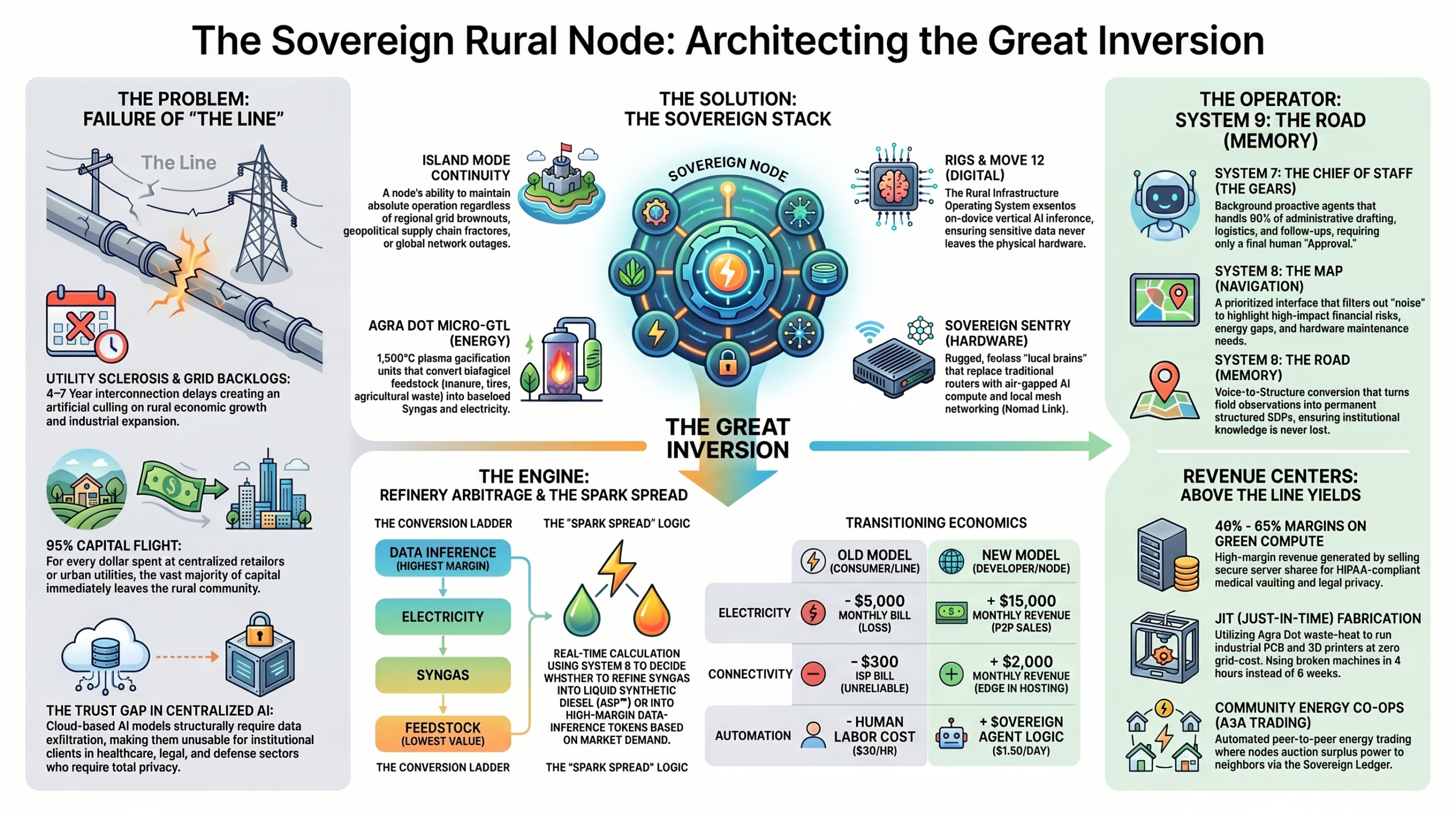
This shift is a defensive reflex against “The Death of the Line.” Centralized infrastructure is plagued by system entropy and unbridgeable trust gaps. By deploying localized, air-gapped systems, we move from dependency to developer status.
Definition: The Great Inversion The structural economic shift wherein rural nodes move from being dependent “tail end” consumers to being the primary source of civilization-as-a-service through independent energy production, high-margin compute, and localized manufacturing.
In the 2026 sovereign economy, the three most valuable industrial resources are found exclusively at the node:
- Land: The physical foundation for the Hardware Root of Trust and geographic sovereignty.
- Biological Feedstock: Low-value waste (manure, hemp, tires) that serves as the baseline fuel for energy and intelligence.
- Strategic Isolation: The capability to operate “Island Mode” diagnostics and compute, protected from the surveillance of the public internet.
This transition is supported by a physical stack that transforms biological friction into industrial-financial momentum.
——————————————————————————–
podcast
2. The “Death of the Line”: Why Legacy Systems are Failing
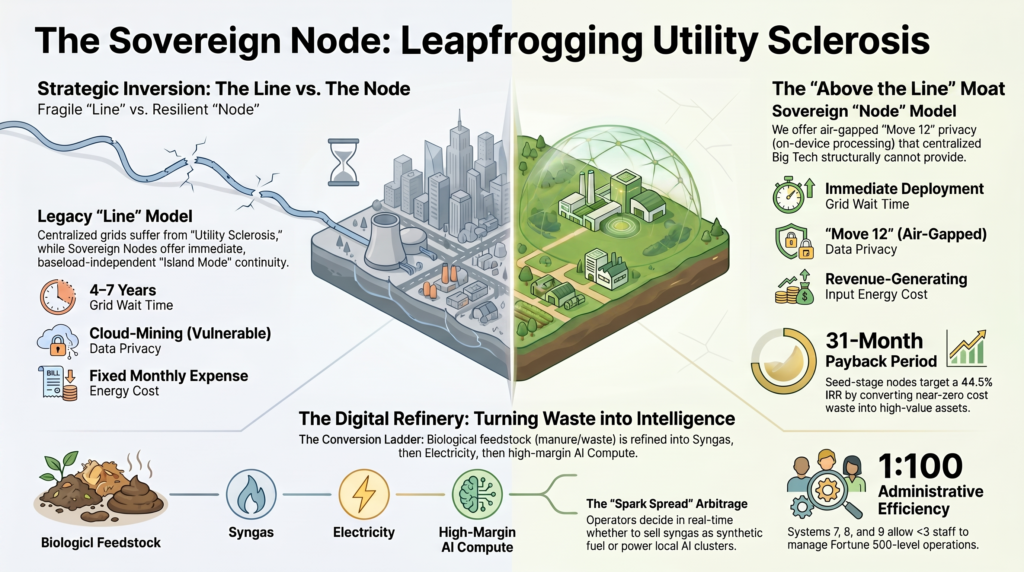
The traditional “Line Model” is built on sequential vulnerability. When a substation in a metro hub fails, the rural outpost 50 miles away goes dark. This fragility is compounded by Utility Sclerosis—the 4–7 year wait for grid expansion that functions as an artificial ceiling on rural growth.
Traditional towns are “vulnerable victims” of this model, suffering from capital siphon as monthly utility bills drain local wealth into urban corporate headquarters. The Sovereign Node replaces this dependency with Island Mode resilience.
| Feature | Centralized “Line” (Failure Modes) | Sovereign Node (Solution Path) |
| Connectivity | Total dependence on ISP fiber; cloud-umbilical dependency. | Sovereign Mesh: Miles-wide private canopy via Nomad Link and Sovereign Sentry. |
| Power | High-tension vulnerability; 4–7 year wait for “permission” to grow. | Baseload Autonomy: 24/7 syngas/compute via Agra Dot Micro-GTL. |
| Resilience | Systemic fragility; paralyzed during grid or network brownouts. | Island Mode: Total operational continuity through local baseload and air-gapped logic. |
| Capital | Monthly bills and “data-as-fuel” extraction siphon local wealth. | Asset Arbitrage: High-margin revenue (40–65%) generated from waste feedstock. |
——————————————————————————–
3. Navigating the Boundary: “Above the Line” vs. “Below the Line”
The “Permission Gap” is the primary point of failure. To achieve sovereignty, an architect must distinguish between commodity services and un-commoditizable moats.
Below the Line: The Commodity Layer
“Below the Line” refers to services that are centralized, fragile, and require a “handshake” from a remote server to function. This includes utility power, public cloud storage, and generic, surveillance-heavy AI like ChatGPT.
- The Risk: These are “glass houses.” If the fiber line is severed or the corporate provider changes terms, the business ceases to exist.
The Moat Factor: Below the Line Zero. You are a sharecropper in the digital age, renting your survival from corporations that prioritize data exfiltration over your operational continuity.
Above the Line: The Moat Layer
“Above the Line” services are built on the Hardware Root of Trust. By owning the soil and the silicon, you provide Industrial Trust that Big Tech cannot replicate. This includes Move 12 on-device vertical AI and local energy production.
- The Benefit: By processing data locally on an air-gapped node, you solve the trust gap for institutional consumers (Big Law, Hedge Funds, Secure Medical Vaulting) who cannot risk data leakage to public training sets.
The Moat Factor: Above the Line Maximum Strategic Advantage. You provide “Invisibility” and reliability. Your node is a “Digital Fortress” that ensures local medical, legal, and industrial context never touches the public internet.
——————————————————————————–
video
4. The Sovereign Technology Stack: Energy into Intelligence
To operate “Above the Line,” the node utilizes a vertical stack designed to turn raw biology into higher-state digital intelligence.
- Agra Dot Energy (The Heart): Employs Micro-GTL units to perform 1,500°C plasma gasification. It takes “negative cost” Biological Feedstock (manure, hemp, tires) and converts it into Baseload Syngas.
- RIOS/Sovereign Automation (The Brain): The Rural Infrastructure Operating System manages the “Spark Spread”—the real-time calculation of whether it is more profitable to refine syngas into ASF™ (Advanced Synthetic Fuel) or to power RIOS-CC-1000 compute clusters for data-inference tokens.
- Move 12 & OpenClaw (The Trust Barrier): Using the OpenClaw framework, high-intelligence agents (Field Medic, Industrial Foreman) run on-device. Data never exits the Sovereign Sentry hardware, creating a premium service for firms requiring total exfiltration protection.
The Conversion Ladder:
- Feedstock: Manure, biomass, or tires (Lowest value/negative cost).
- Syngas: Baseload fuel for engines and GTL-Thermal synergy.
- ASF™ / Electricity: Liquid fuel and P2P energy sales (Margins: 40%+).
- Data Inference: Move 12 secure compute (Highest value: 40–65% margins).
“Most farmers look at their land and see soil. I look at land and see a Power Base. The Digital Refinery is where we take the ‘Below the Line’ commodity logic and smash it. We are taking back the key to the ignition.” — BizBuilder Mike
——————————————————————————–
5. The “Editor” Paradigm: Scaling with Systems 7, 8, and 9
To maintain Fortune 500 efficiency with <3 Full-Time Equivalents (FTEs), the operator must execute a “Cognitive Pivot” from being a Doer to being an Editor. This shift engineers an Automated Reflex where the business senses a stimulus and prepares 90% of the reaction for final authorization.
The 10% Manual Rule: If an operator performs more than 10% of the labor on a repeatable task, they have failed to build the road.
| System | The Old Way (Drag) | The Sovereign Way (Reflex) |
| System 7 (The Gears) | Manual drafting of proposals/emails; administrative exhaustion. | Proactive Triage: Agents draft legal/energy proposals based on RIOS yields for your “One-Click” approval. |
| System 8 (The Map) | Chronological noise; meta-work; decision fatigue. | Prioritized Navigation: Maps “Energy Holes” and financial anomalies; high-impact problems find the Editor first. |
| System 9 (The Road) | Brain drain; solving the same problem repeatedly. | Infrastructure as Memory: Voice-to-Structure conversion hardwires every field insight into a permanent SOP. |
——————————————————————————–
6. Conclusion: Providing “Civilization-as-a-Service”
The ultimate objective is the Civilization Reflex. By inverting infrastructure from a fixed cost into a resilient, recurring-revenue refinery, the Sovereign Operator becomes the source for their community.
The “Regulatory Hedge” is your shield: by labeling nodes as Local Resilience Hubs, you bypass utility monopoly laws under the mandate of critical emergency preparedness.
The Final Exam: Identify a local “Linear Service” currently treated as an expense—such as a regional waste dump or a fragile utility connection—and invert it. Convert that expense into a Sovereign Revenue Stream, such as a GTL refinery or a Green-Air-Gapped compute node.
The Sovereign Operator’s Creed
I will not follow the grid; I will build my own. I will operate strictly “Above the Line,” turning waste into energy and intelligence. I authorize my own survival and provide the source for my community. I am an Editor of reality, not a renter of it. My node is sovereign, and the line is dead.