Briefing Document: Sovereign WISP Ecosystem and DeReticular Hardware Strategy
Executive Summary
The DeReticular Sovereign WISP (Wireless Internet Service Provider) ecosystem represents a paradigm shift in remote telecommunications, transitioning passive infrastructure costs into revenue-generating assets. Centered on the “WISP-in-a-Box” kit (SKU: RIOS-KIT-WISP), the system integrates ruggedized edge computing hardware with Starlink Business satellite backhaul to provide autonomous, off-grid internet gateways.
Key takeaways include:
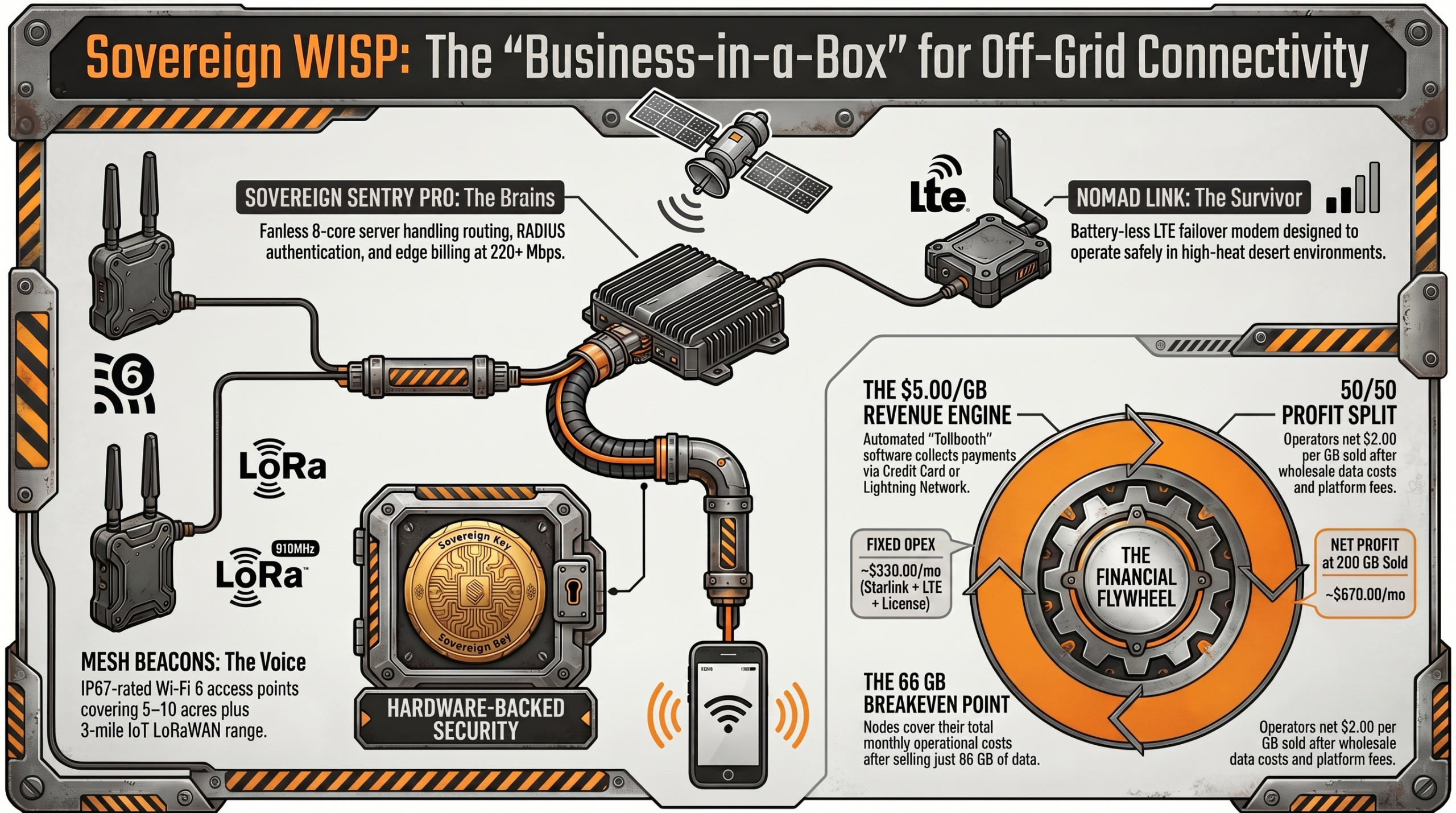
- Monetization Engine: A standard $5/GB retail data model allows node operators to achieve a 50/50 profit split with DeReticular, reaching operational breakeven at 66 GB of data sold per month.
- Ruggedized Reliability: Hardware is engineered for extreme environments, featuring fanless designs and battery-less LTE failover modems (Nomad Link) to eliminate fire risks in high-heat settings.
- Edge-Native Intelligence: The Rural Infrastructure Operating System (RIOS) ensures that billing, authentication, and local network operations remain functional even if satellite backhaul is interrupted.
- Strategic Roadmap: While Generation 3 (2026) focuses on Starlink and Wi-Fi 6, Generation 4 projections move toward multi-orbit resilience (SD-WAN), 5G Non-Terrestrial Networks (NTN), and cryptographic zero-trust access.
video
1. The Hardware Ecosystem: Generation 3 (2026 Baseline)
DeReticular’s hardware philosophy emphasizes physical security, decentralization, and industrial-grade durability.
The Sovereign WISP Kit (SKU: RIOS-KIT-WISP)
This turnkey bundle (MSRP: $1,749.00) includes:
- Sovereign Sentry Pro: The central router and compute hub.
- 2x Mesh Beacons: IP67-rated access points providing Wi-Fi 6 and 915MHz LoRaWAN.
- Nomad Link: A battery-less LTE bridge for failover.
- Power Accessories: PoE+ injectors and DC step-down converters for solar or UPS integration.
Component Specifications and Tiers
| SKU | Product | Role | Key Specifications |
| RIOS-SS-PRO | Sentry Pro | Core Router/Server | 8-core Intel i3-N305, 32GB RAM, Fanless, runs Proxmox VE. |
| N/A | Sentry Standard | Entry-level Compute | Intel N100 Processor, fanless architecture. |
| RIOS-EXT-01 | Mesh Beacon | Distribution Layer | Dual-radio (Wi-Fi 6 + LoRaWAN), 5–10 acre coverage. |
| RIOS-NL-01 | Nomad Link | Failover Bridge | Battery-less (BEC) design, -40°C to 85°C range. |
| N/A | Sovereign Deck | Field Audit Tablet | Ruggedized, runs Kali Linux, integrated RTL-SDR. |
| N/A | Sovereign Key | Security Token | FIDO2/PIV hardware authenticator for root access. |
2. Fulfillment and Activation Workflow
The fulfillment strategy utilizes a split delivery model between DeReticular and its partner, TriFiWireless.
Phase 1: Digital Partner Handoff
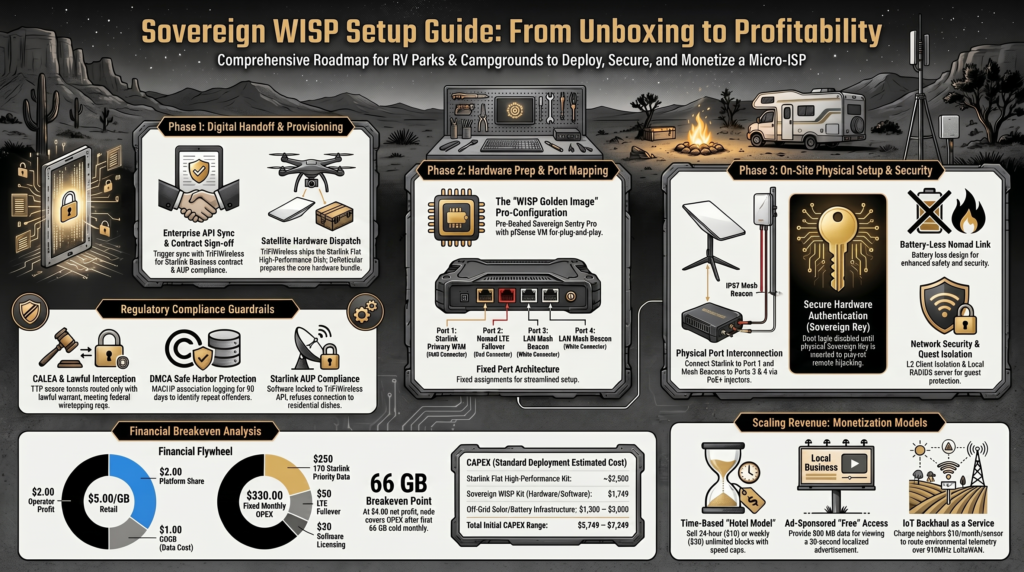
Upon purchase via WooCommerce, a webhook triggers a sync with TriFiWireless. TriFiWireless handles the enterprise Starlink Business contract and ships the Flat High-Performance Dish directly to the customer.
podcast
Phase 2: Physical Fulfillment (Node 3 Workshop)
DeReticular technicians prepare the compute bundle. A “WISP Golden Image” is flashed onto the Sentry Pro’s pfSense VM, pre-defining network topology and interface mapping for plug-and-play installation.
Phase 3: Customer Activation
The user performs physical port interconnection, inserts the Sovereign Key for hardware authentication, and executes the “Tollbooth” agent setup wizard to configure payout wallets.
Sentry Pro Port Configuration Blueprint:
- Port 1: Primary WAN (Starlink Business Dish).
- Port 2: Secondary Failover (Nomad Link LTE Bridge).
- Ports 3 & 4: LAN (Mesh Beacon Access Points).
3. Technical Architecture and Software Stack
The “brain” of the node resides at the edge, ensuring local operations continue during backhaul outages.
- Rural Infrastructure Operating System (RIOS): The centralized management interface and local database controller.
- OpenClaw “Tollbooth” Agent: A secure container managing the captive portal, payment processing (Stripe, PayPal, Crypto), and RADIUS mapping.
- Network Logic: The system enforces a strict bandwidth cap of 15 Mbps download / 2 Mbps upload per client to protect backhaul capacity.
- Failover Mechanism: Traffic automatically shifts to the Nomad Link LTE backup when packet loss on the primary Starlink connection exceeds 15%.
- Dual-Radio Projection: Beacons simultaneously broadcast Wi-Fi 6 for human users and 915MHz LoRaWAN for IoT sensors (3-mile radius).
4. Financial Framework and Monetization
The Sovereign WISP model transforms telecommunications from a passive cost center into a self-sustaining business.
The $5/GB Data Resale Model
- Retail Price: $5.00 per Gigabyte (GB).
- Cost of Goods Sold (COGS): ~$1.00/GB (wholesale data and API fees).
- Net Profit: $4.00/GB.
- Revenue Split: $2.00 to the Node Operator; $2.00 to DeReticular.
Operational Economics (Monthly)
- Fixed OPEX: ~$330 (includes 1TB Starlink Priority data via TriFiWireless, LTE backup, and software licensing).
- Breakeven Point: Selling 66 GB of data per month covers all fixed operational costs.
- Net Profit Example: Selling 200 GB of data generates ~1,000 gross, resulting in ~670 net profit for split distribution.
Alternative Revenue Streams
- Time-Based Access: Selling 24-hour or weekly blocks.
- Freemium Model: Free low-bandwidth text messaging; paid premium for streaming.
- IoT Backhaul as a Service: Charging ~$10/month per sensor for neighboring agricultural or industrial operations.
- Edge Compute Leasing: Leasing unused CPU cores to researchers or decentralized networks.
5. Market Segments and Use Cases
| Segment | Primary Need | Implementation |
| Sovereign Entrepreneurs | Passive Income/Offset Costs | Landowners charge tourists $5/GB to cover their own off-grid internet bills. |
| Hospitality (RV Parks) | Guest Satisfaction | Eco-resorts use Mesh Beacons to blanket properties with Wi-Fi 6 where fiber is unavailable. |
| Remote Industrial | Safety and Telemetry | Mining/AgTech uses battery-less Nomad Links in high-heat cockpits for fire-safe data syncing. |
| Emergency Management | Rapid Deployment | First responders use Sentry nodes and telescoping masts for secure, on-site comms during disasters. |
| Municipalities | Data Sovereignty | Small towns keep utility data localized on edge nodes rather than vulnerable public clouds. |
6. Regulatory Compliance and Risk Register
The ecosystem includes built-in mitigations for the legal complexities of operating a micro-ISP.
- AUP Compliance: The “Tollbooth” software refuses to boot if connected to a residential Starlink dish, ensuring only authorized enterprise connections are used.
- CALEA (Wiretapping): The Sentry router is pre-configured for secure tunneling to Trusted Third Parties (TTPs) for lawful warrant execution.
- DMCA (Copyright): Operators are advised to register DMCA agents; the software logs MAC/IP associations for 90 days to identify repeat offenders.
- Security: To prevent “Captive Portal Bypass,” the system monitors for rapid MAC address cycling and triggers automatic blocklisting.
7. Future Horizon: Generation 4 (Late 2020s)
Generation 4 shifts the paradigm from LEO-reliant systems to multi-orbit, zero-trust resilient networks.
| Technical Vector | Generation 3 (Baseline) | Generation 4 (Projected) |
| Primary Backhaul | Single-orbit (Starlink) | Multi-orbit SD-WAN (Starlink, Kuiper, OneWeb) |
| Failover | Terrestrial 4G LTE | 5G Non-Terrestrial Network (NTN) |
| Wi-Fi Standard | Wi-Fi 6 (802.11ax) | Wi-Fi 7 (802.11be) with Multi-Link Operation |
| Network Access | MAC-based Captive Portals | Cryptographic Zero-Trust Access (ZTNA) |
| Payments | Stripe/PayPal/Crypto | Automated Smart Contracts & Lightning Micro-p2p |
| Intelligence | Standard x86 (Intel i3) | Edge AI with dedicated NPUs |
8. Strategic Gap Analysis and Recommendations
The transition from the 2026 pilot phase to global deployment requires addressing several barriers:
- CAPEX Reduction: Current setup costs (~5,749–7,249) are high. Strategy: Implement Hardware-as-a-Service (HaaS) leasing models and standardize lower-cost solar microgrids.
- Legal Shielding: Operators are currently the “ISP of Record.” Strategy: DeReticular should restructure terms to act as the official ISP of record, shielding operators from regulatory burdens.
- Security Evolution: MAC spoofing remains a vulnerability. Strategy: Rapidly transition to WPA3-Enterprise with unique cryptographic tokens for each data transaction.
- Provider Diversity: The current stack is locked to the TriFiWireless/Starlink API. Strategy: Develop multi-satcom API bridges to support emerging constellations like Amazon’s Project Kuiper.