The Civilization-in-a-Box: Why the Future of Digital Sovereignty is a Fanless Monolith
1. Introduction: The Fragility of the Status Quo
Most modern digital lives are built on a foundation of sand. We rely on flimsy, consumer-grade “plastic routers” provided by ISPs and entrust our most sensitive data to proprietary black boxes in the cloud. This model is defined by planned obsolescence and centralized vulnerabilities; hardware is designed to fail, and software is designed to be rented, not owned. When the connection drops or the provider alters their terms of service, the “smart” home or rural clinic effectively ceases to function.
As an industrial systems architect, I build for resilience first. The Sovereign Sentry is a departure from this fragility—it is a “Digital Hearth” designed for Island Mode. It serves as a rugged, stationary anchor for your infrastructure, ensuring that your local systems remain operational even when the grid or the global internet fails. This isn’t just a gadget; it is a foundational appliance for those who recognize that if you do not own your hardware, you do not own your data.
2. Takeaway 1: The “Trinity” Stack—A Rack’s Worth of Gear in One Box
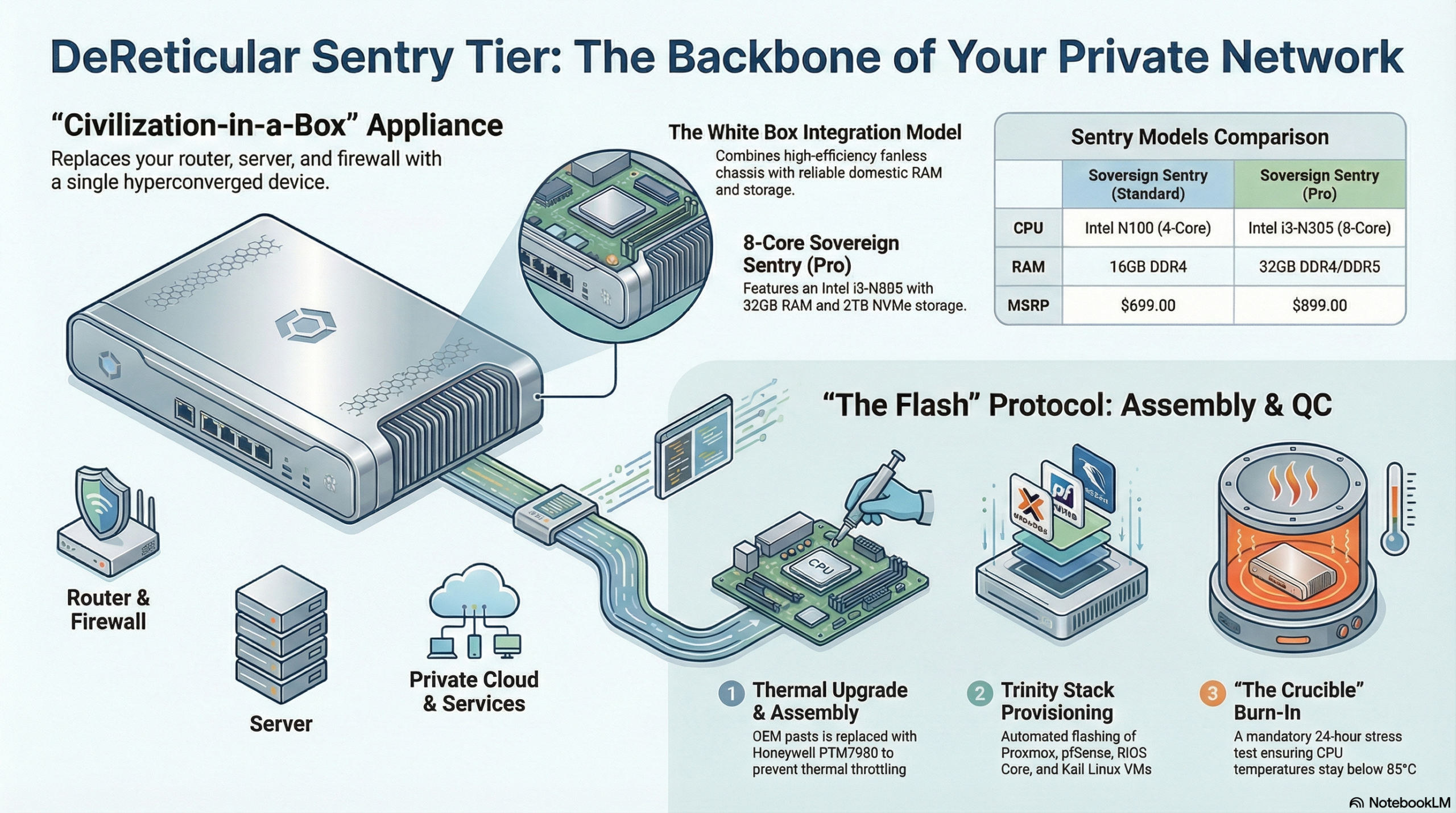
The Sentry utilizes a Hyperconverged Infrastructure (HCI) approach, condensing what used to require a full server rack into a single, silent unit. It achieves this by using Proxmox VE, an enterprise-grade bare-metal hypervisor. Unlike a standard OS, a hypervisor allows for “snapshot and restore” capabilities—providing a critical safety net where you can experiment without risking the core stability of your network.
The unit arrives pre-provisioned with the “Trinity” of isolated virtual systems:
- The Gatekeeper (VM 100): Allocated 2 vCores and 4GB RAM, this instance runs pfSense or OPNsense. It acts as your edge router and industrial-grade firewall, handling WireGuard VPN Gateways and Deep Packet Inspection (DPI) to secure every packet entering your domain.
- The Ledger (VM 101): Allocated 2 vCores and 8GB RAM, this RIOS Core (Ubuntu Server) instance runs the Freenet/Locutus daemon. It stores encrypted data shards and validates smart contracts as a silent participant in the decentralized web.
- The Sandbox (VM 102): Utilizing the remaining system resources, this environment is yours to command. Whether hosting HomeAssistant for local automation or a Plex media server, it remains physically and logically isolated from the Gatekeeper.
3. Takeaway 2: Built for the “Arizona Summer” (and Beyond)
Reliability in “island mode” requires hardware that can survive where consumer electronics melt. Every Sovereign Sentry is processed at the Node 3 Workshop in Arizona, where we address the thermal density of the Intel N100’s 6W TDP. We discard standard OEM thermal paste in favor of Honeywell PTM7950 phase-change material. This industrial-grade interface outperforms standard solutions in high-ambient environments like barns or utility closets, ensuring the CPU stays cool even under 100% load.
This obsession with heat management is driven by a fundamental engineering truth:
“Consumer electronics die because they have moving parts. Fans clog with dust, bearings fail, and chips overheat. The Sovereign Sentry has zero moving parts.”
By eliminating the fan, the Sentry becomes a silent, maintenance-free guardian capable of operating 24/7 in ambient temperatures ranging from -10°C to 50°C.
4. Takeaway 3: Physical Network Segregation is a Superpower
While consumer routers rely on software VLANs that can be “leaky” or misconfigured, the Sovereign Sentry utilizes Layer 2 physical isolation. Equipped with four Intel i226-V 2.5GbE ports (Hardware Revision 3)—the specific revision that fixed the connection drop issues of earlier models—the device allows you to physically separate your traffic.
In a sovereign setup, this looks like:
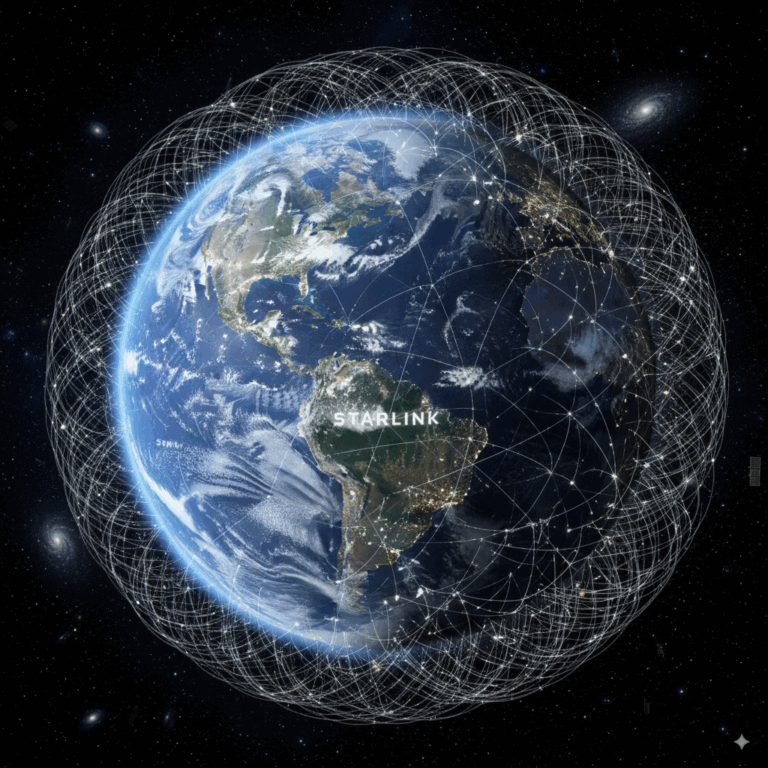
- Port 1 (WAN): A dedicated entry point for high-latency or remote connections like a Starlink dish.
- Port 2 (LAN): A high-speed internal link to your Local Wi-Fi AP or workstation.
- Port 3 (DMZ): An isolated zone for IoT sensors and cameras, preventing “chatty” or insecure hardware from ever seeing your financial data.
- Port 4 (Management): A dedicated “out-of-band” port for direct administrative access to the Proxmox brain.
5. Takeaway 4: Your Router Can Actually Pay for Itself
Traditional hardware is a passive expense—a depreciating plastic box that extracts a monthly fee for the privilege of connectivity. The Sentry transforms this into “Active Infrastructure.”
Through “The Ledger” (VM 101), the device acts as a financial participant in the Freenet/Locutus mesh. While it secures your perimeter, it simultaneously validates smart contracts and stores encrypted data shards for the network. This background activity earns network credits, turning your gateway into a piece of active capital. It is a router that functions as a localized bank and a validator for the decentralized web, providing an ROI on your digital sovereignty.
6. Takeaway 5: Utilitarian Aesthetic Meets “Zero-Touch” Simplicity
The Sentry’s physical design—a “Monolith” of matte black anodized aluminum—is purely utilitarian. Every fin is a radiator; every port is reinforced. With VESA 75/100 compatibility, it is designed to be mounted to a utility board or the back of a monitor and then forgotten.
Despite its industrial power, the experience is “Zero-Touch.” Each unit is pre-loaded with cryptographic identities locked to a TPM 2.0 Module. This enables Machine ID cryptographic attestation, ensuring that the node’s identity is verified at the hardware level. Whether deployed by a professional technician or a sovereign individual, the Sentry is designed to be a “silent guardian” that performs its duties without the need for constant reboots or manual tinkering.
7. Technical Snapshot: Under the Hood
| Component | Specification | Notes |
| CPU | Intel® Processor N100 | Quad-Core, 6W TDP (Alder Lake-N) |
| RAM | 16GB DDR4 3200MHz | Domestic Source (Crucial/Samsung) |
| Storage | 1TB NVMe M.2 SSD | High-Endurance (No QLC drives allowed) |
| Networking | 4x Intel i226-V 2.5GbE | Hardware Revision 3 |
| Security | TPM 2.0 HSM | Machine ID Cryptographic Attestation |
| Cooling | Passive / Fanless | Honeywell PTM7950 Phase-Change |
| Build Quality | Anodized Aluminum | Matte Black Industrial Chassis |
| Operating Temp | -10°C to 50°C | Designed for non-climate-controlled use |
| Dimensions | 135mm x 125mm x 40mm | VESA 75/100 compatible |
8. Conclusion: The Silent Guardian of Your Digital Life
The mantra “The Cloud is someone else’s computer” is a warning. The Sovereign Sentry is the solution—a physical manifestation of the belief that your infrastructure should be as permanent and reliable as the walls of your home. By merging industrial-grade durability with the power of virtualized sovereignty, it offers a path out of digital dependency.
As the world moves toward a decentralized and often unstable future, you must audit your own perimeter. Is your gateway a liability or an asset? If you are ready to reclaim your digital sovereignty, the choice is clear.
Silence is Sovereign.
The Civilization-in-a-Box: Why the Future of Digital Sovereignty is a Fanless Monolith
1. Introduction: The Fragility of the Status Quo
Most modern digital lives are built on a foundation of sand. We rely on flimsy, consumer-grade “plastic routers” provided by ISPs and entrust our most sensitive data to proprietary black boxes in the cloud. This model is defined by planned obsolescence and centralized vulnerabilities; hardware is designed to fail, and software is designed to be rented, not owned. When the connection drops or the provider alters their terms of service, the “smart” home or rural clinic effectively ceases to function.
As an industrial systems architect, I build for resilience first. The Sovereign Sentry is a departure from this fragility—it is a “Digital Hearth” designed for Island Mode. It serves as a rugged, stationary anchor for your infrastructure, ensuring that your local systems remain operational even when the grid or the global internet fails. This isn’t just a gadget; it is a foundational appliance for those who recognize that if you do not own your hardware, you do not own your data.
2. Takeaway 1: The “Trinity” Stack—A Rack’s Worth of Gear in One Box
The Sentry utilizes a Hyperconverged Infrastructure (HCI) approach, condensing what used to require a full server rack into a single, silent unit. It achieves this by using Proxmox VE, an enterprise-grade bare-metal hypervisor. Unlike a standard OS, a hypervisor allows for “snapshot and restore” capabilities—providing a critical safety net where you can experiment without risking the core stability of your network.
The unit arrives pre-provisioned with the “Trinity” of isolated virtual systems:
- The Gatekeeper (VM 100): Allocated 2 vCores and 4GB RAM, this instance runs pfSense or OPNsense. It acts as your edge router and industrial-grade firewall, handling WireGuard VPN Gateways and Deep Packet Inspection (DPI) to secure every packet entering your domain.
- The Ledger (VM 101): Allocated 2 vCores and 8GB RAM, this RIOS Core (Ubuntu Server) instance runs the Freenet/Locutus daemon. It stores encrypted data shards and validates smart contracts as a silent participant in the decentralized web.
- The Sandbox (VM 102): Utilizing the remaining system resources, this environment is yours to command. Whether hosting HomeAssistant for local automation or a Plex media server, it remains physically and logically isolated from the Gatekeeper.
3. Takeaway 2: Built for the “Arizona Summer” (and Beyond)
Reliability in “island mode” requires hardware that can survive where consumer electronics melt. Every Sovereign Sentry is processed at the Node 3 Workshop in Arizona, where we address the thermal density of the Intel N100’s 6W TDP. We discard standard OEM thermal paste in favor of Honeywell PTM7950 phase-change material. This industrial-grade interface outperforms standard solutions in high-ambient environments like barns or utility closets, ensuring the CPU stays cool even under 100% load.
This obsession with heat management is driven by a fundamental engineering truth:
“Consumer electronics die because they have moving parts. Fans clog with dust, bearings fail, and chips overheat. The Sovereign Sentry has zero moving parts.”
By eliminating the fan, the Sentry becomes a silent, maintenance-free guardian capable of operating 24/7 in ambient temperatures ranging from -10°C to 50°C.
4. Takeaway 3: Physical Network Segregation is a Superpower
While consumer routers rely on software VLANs that can be “leaky” or misconfigured, the Sovereign Sentry utilizes Layer 2 physical isolation. Equipped with four Intel i226-V 2.5GbE ports (Hardware Revision 3)—the specific revision that fixed the connection drop issues of earlier models—the device allows you to physically separate your traffic.
In a sovereign setup, this looks like:
- Port 1 (WAN): A dedicated entry point for high-latency or remote connections like a Starlink dish.
- Port 2 (LAN): A high-speed internal link to your Local Wi-Fi AP or workstation.
- Port 3 (DMZ): An isolated zone for IoT sensors and cameras, preventing “chatty” or insecure hardware from ever seeing your financial data.
- Port 4 (Management): A dedicated “out-of-band” port for direct administrative access to the Proxmox brain.
5. Takeaway 4: Your Router Can Actually Pay for Itself
Traditional hardware is a passive expense—a depreciating plastic box that extracts a monthly fee for the privilege of connectivity. The Sentry transforms this into “Active Infrastructure.”
Through “The Ledger” (VM 101), the device acts as a financial participant in the Freenet/Locutus mesh. While it secures your perimeter, it simultaneously validates smart contracts and stores encrypted data shards for the network. This background activity earns network credits, turning your gateway into a piece of active capital. It is a router that functions as a localized bank and a validator for the decentralized web, providing an ROI on your digital sovereignty.
6. Takeaway 5: Utilitarian Aesthetic Meets “Zero-Touch” Simplicity
The Sentry’s physical design—a “Monolith” of matte black anodized aluminum—is purely utilitarian. Every fin is a radiator; every port is reinforced. With VESA 75/100 compatibility, it is designed to be mounted to a utility board or the back of a monitor and then forgotten.
Despite its industrial power, the experience is “Zero-Touch.” Each unit is pre-loaded with cryptographic identities locked to a TPM 2.0 Module. This enables Machine ID cryptographic attestation, ensuring that the node’s identity is verified at the hardware level. Whether deployed by a professional technician or a sovereign individual, the Sentry is designed to be a “silent guardian” that performs its duties without the need for constant reboots or manual tinkering.
7. Technical Snapshot: Under the Hood
| Component | Specification | Notes |
| CPU | Intel® Processor N100 | Quad-Core, 6W TDP (Alder Lake-N) |
| RAM | 16GB DDR4 3200MHz | Domestic Source (Crucial/Samsung) |
| Storage | 1TB NVMe M.2 SSD | High-Endurance (No QLC drives allowed) |
| Networking | 4x Intel i226-V 2.5GbE | Hardware Revision 3 |
| Security | TPM 2.0 HSM | Machine ID Cryptographic Attestation |
| Cooling | Passive / Fanless | Honeywell PTM7950 Phase-Change |
| Build Quality | Anodized Aluminum | Matte Black Industrial Chassis |
| Operating Temp | -10°C to 50°C | Designed for non-climate-controlled use |
| Dimensions | 135mm x 125mm x 40mm | VESA 75/100 compatible |
8. Conclusion: The Silent Guardian of Your Digital Life
The mantra “The Cloud is someone else’s computer” is a warning. The Sovereign Sentry is the solution—a physical manifestation of the belief that your infrastructure should be as permanent and reliable as the walls of your home. By merging industrial-grade durability with the power of virtualized sovereignty, it offers a path out of digital dependency.
As the world moves toward a decentralized and often unstable future, you must audit your own perimeter. Is your gateway a liability or an asset? If you are ready to reclaim your digital sovereignty, the choice is clear.
Silence is Sovereign.