Strategic Framework for Energy-Compute Arbitrage: The Spark Spread Optimization for Sovereign Nodes
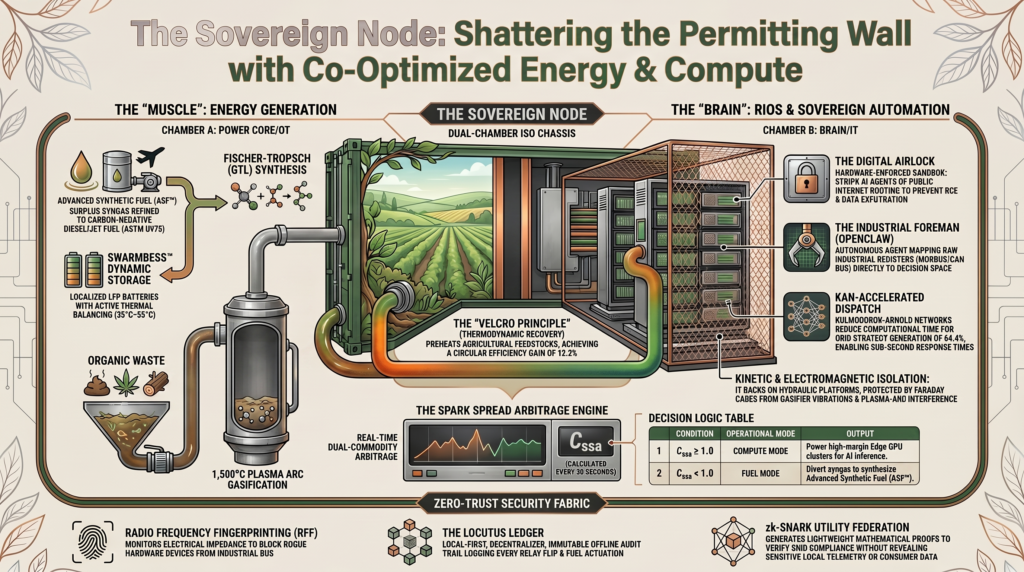
- Architectural Foundation: The Sovereign Node Paradigm
The legacy centralized infrastructure model—historically known as “The Line”—is currently colliding with a catastrophic “Permitting Wall.” With grid interconnection backlogs now averaging 50 months and extensive environmental impact reviews delaying hyperscale data center deployments by up to five years, the traditional model of linear transmission has reached its physical and bureaucratic limit. The Sovereign Node represents a strategic shift toward “Spherical Resilience,” replacing fragile, centralized networks with decentralized, producer-centric hubs. As demonstrated by Project Octagon and the successful deployment of Node 4 (Kaabong, Uganda), these nodes operate in a fully autonomous “Island Mode,” bypassing utility bottlenecks by co-locating energy generation with high-density AI compute.
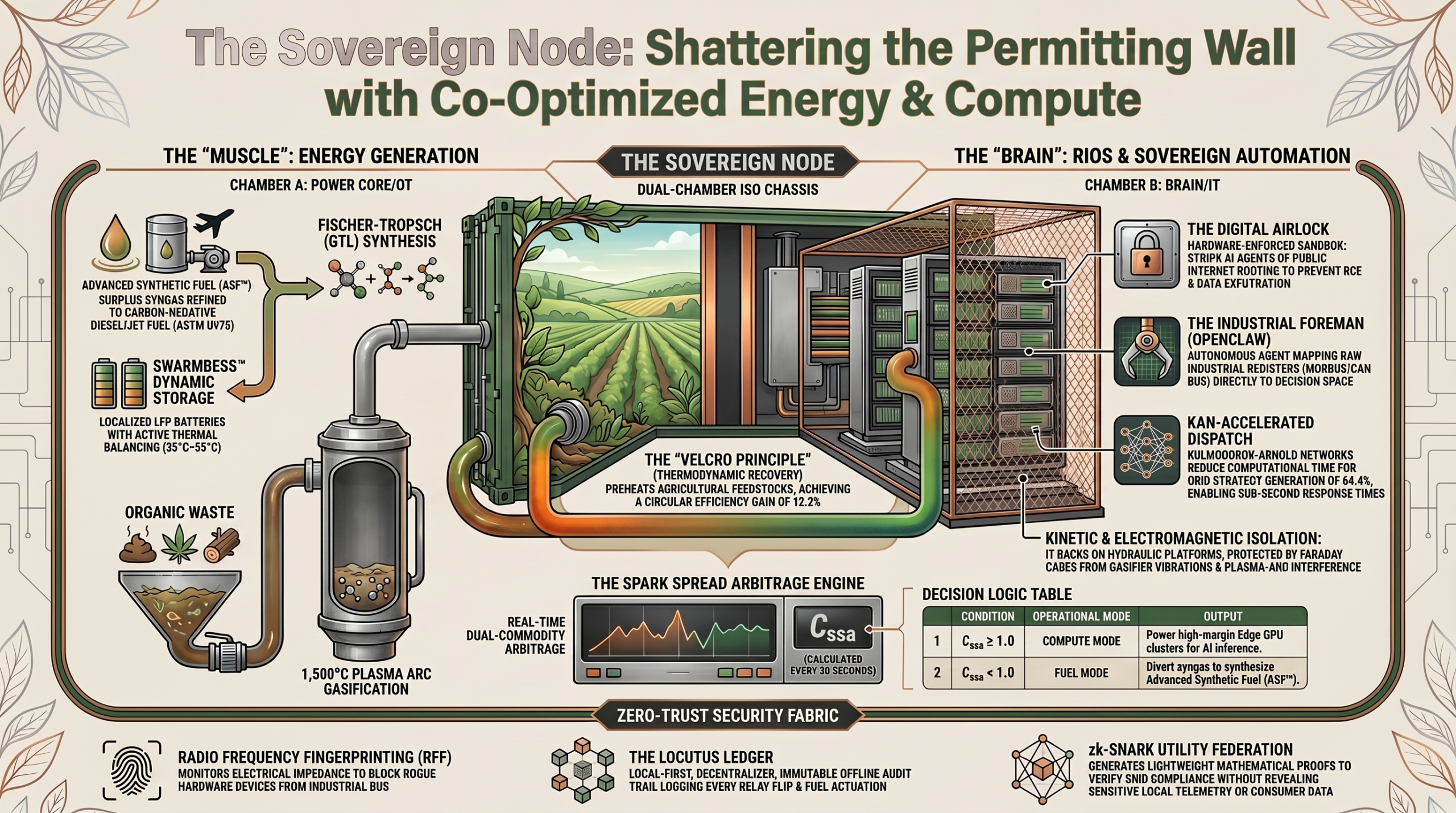
- The Dual-Chamber Topology: The physical manifestation of this resilience is the Sovereign Pod, a standardized 40-foot ISO shipping container bifurcated into two isolated zones:
- Chamber A (The Power Core/OT): Houses the Agra 1,500°C Plasma Arc Gasifier, syngas scrubbers, and the Fischer-Tropsch catalytic reactor. This zone handles the biochemical conversion of organic feedstock into hydrogen-rich syngas and synthetic fuels.
- Chamber B (The Brain/IT): Contains the Sovereign Sentry Pro server stacks and liquid-cooled GPU clusters. This zone is protected by high-attenuation copper mesh (Faraday cage) and active hydraulic dampening to isolate sensitive electronics from the 1,500°C thermal gradients and kinetic stresses of Chamber A.
- The “Velcro Principle”: Systemic efficiency is achieved through thermodynamic coupling. By hydraulically linking the liquid-coolant loops of the GPU blocks to the feedstock dryers and gasification preheaters, the system recovers waste heat (exiting at 65°C–75°C).
This physical integration is the fundamental prerequisite for high-frequency economic arbitrage, allowing the node to function as a self-optimizing refinery of both electrons and digital telemetry.
- The Spark Spread Arbitrage Coefficient (C_{ssa})
The Spark Spread Arbitrage Coefficient (C_{ssa}) is the real-time value-maximization engine that transcends traditional passive Virtual Power Plant (VPP) models. Rather than acting as a mere price-taker for grid discharge, the Sovereign Node functions as an active market participant, dynamically choosing between physical and digital commodity outputs.
The Mathematical Framework
The OpenClaw agent calculates the C_{ssa} every 30 seconds to determine the optimal operational state based on current market clearing prices and network health:
C_{ssa} = \frac{R_{comp} \times \eta_{comp}}{P_{elect} + \delta_{deg} + L_{net}}
Variable Definitions and Operational Significance
Variable Metric Operational Significance
R_{comp} Revenue Rate ($/TFLOPS) Real-time yield from processing edge-compute AI tasks or inference jobs.
\eta_{comp} Thermal Multiplier (1.122) Efficiency gain derived from the “Velcro Principle” waste-heat recovery.
P_{elect} Opportunity Cost ($/kWh) The “Double Arbitrage” value, including wholesale grid-discharge rates and local utility tariffs.
\delta_{deg} Degradation Cost ($) Quantified wear on SwarmBESS™ LFP cells and GPU thermal fatigue over time.
L_{net} Network Penalty Adjusted for real-time satellite latency (ping) and packet loss/jitter.
Financial Sensitivity and Risk Factors
The inclusion of L_{net} (network latency) and \delta_{deg} (hardware degradation) transforms the calculation from a simple energy balance into a sophisticated high-frequency financial strategy. By factoring in hardware fatigue and packet loss, the algorithm prevents the node from attempting high-margin compute tasks during periods of poor connectivity or excessive hardware stress, ensuring long-term asset health while maximizing short-term liquidity.
- Operational State Logic: Digital Compute vs. Physical Fuel
To hedge against market volatility and potential network outages, the Sovereign Node maintains dual-pathway flexibility. This ensures “Insulated Self-Financing” and operational continuity regardless of grid stability or internet availability.
- Compute Mode (C_{ssa} \ge 1.0): When compute margins are high and network conditions are stable, the OpenClaw agent routes syngas generator output to power local Sentry GPU compute containers. The node functions as an AI inference hub, transmitting high-value digital value across the network.
- Fuel Mode (C_{ssa} < 1.0): If electricity prices drop, compute demand wanes, or network jitter (L_{net}) spikes, the node initiates a fail-safe sequence. Syngas is diverted to the Fischer-Tropsch reactor to synthesize Advanced Synthetic Fuel (ASF™). This synthetic diesel is stored locally for regional logistics or agricultural markets, effectively “banking” the energy in physical form.
The OpenClaw agent monitors market signals and triggers state shifts every 30 seconds. In the event of a total network outage, the system automatically defaults to Fuel Mode, ensuring that energy production never ceases and revenue generation remains uninterrupted.
- Hardened Orchestration: The OpenClaw & RIOS Control Stack
The complexity of managing biochemical, electrical, and computational loops requires an autonomous control layer. Following the 2026 security crisis, the “Trusted Environment Fallacy” necessitated an air-gapped, zero-trust approach to AI orchestration.
- The Digital Airlock: The OpenClaw runtime is containerized and stripped of global internet routing tables. It executes within a “Digital Airlock,” meaning it can only process cryptographically signed local MCP (Model Context Protocol) skills. This prevents remote code injection (RCE) and ensures the local hardware remains under autonomous control even if the macro-grid or central commands are compromised.
- The Industrial Foreman: For physical coordination, the agent operates as The Industrial Foreman, using a specialized robotics stack (dereticular/openclaw-robotics) to map Modbus TCP and CAN bus registers directly to its action space. This allows for the dynamic adjustment of feedstock conveyor speeds and battery charge rates based on real-time thermal parameters.
- Computational Acceleration via KAN: Sovereign Nodes utilize Kolmogorov-Arnold Networks (KAN) to predict operational feasible regions.
- Performance: KAN-accelerated dispatch reduces calculation time by 64.4% compared to traditional AC-OPF solvers, with a negligible 4.7% divergence from the absolute optimal path. This enables sub-second response to voltage fluctuations while preventing anti-competitive algorithmic collusion.
- Economic Viability and Risk Mitigation
Transitioning from high CapEx to long-term operational resilience requires a rigorous approach to systemic risk. The Sovereign Node model utilizes standardized ISO kits and specific zoning strategies to ensure rapid deployment.
Systemic Risk Engineering Mitigation
High Initial CapEx Prefabricated ISO “Sovereign Pod” kits to reduce site-specific engineering overhead.
Kinetic/Thermal Stress Active hydraulic dampening and dual-zone physical isolation barriers.
Permitting Backlogs Agrivoltaic Bypass: Maintaining LER \ge 1.3 to preserve agricultural zoning status.
Feedstock Volatility Near-infrared (NIR) spectroscopy on intakes to auto-tune reactor parameters.
Hardware Intrusion Physically sealed cabinets with key-destruction circuitry (Zeroizing TPM).
The Agrivoltaic Bypass and zk-SNARK Verification
By maintaining a Land Equivalent Ratio (LER) \ge 1.3, Sovereign Nodes circumvent industrial permitting delays, enabling 90-day deployment cycles. Security and market trust are maintained through Zero-Knowledge Federated Reinforcement Learning (ZK-FRL). Utilizing zk-SNARKs, the node can participate in regional utility VPP markets and verify its grid compliance or capacity reduction without revealing sensitive raw telemetry, such as granular battery health or industrial secrets. This resolves the trilemma of optimization, privacy, and security.
- Deployment Strategy and Future Outlook
The 24-month roadmap focuses on scaling Sovereign Nodes from proof-of-concepts like Node 4 to a globally scalable Decentralized Physical Infrastructure Network (DePIN).
24-Month Technical Roadmap:
- Months 0-6: Finalize dual-chamber ISO Pod prototype; integrate NIR spectroscopy on feedstock hoppers.
- Months 6-12: Integrate FPGA-accelerated zk-SNARK coprocessors on Sentry Pro boards; implement self-supervised PLC auto-mapping.
- Months 12-18: Complete vibration/thermal stress testing; establish standardized agrivoltaic zoning templates.
- Months 18-24: Commission first standardized Sovereign Pod at Node 4; secure certification for zero-knowledge VPP bidding with regional utilities.
SIDI-Compliant Operational Checklist:
- [ ] Vibrational Isolation: Rack displacement measured at <0.01 mm during gasifier operation.
- [ ] Digital Airlock Lock: Verification of zero public DNS entries and WAN gateway in the OpenClaw container.
- [ ] Hardware Boot Signature: Kernel signatures cryptographically sealed in TPM 2.0.
- [ ] zk-SNARK Verification: Successful generation of cryptographic compliance proofs in <100 ms.
- [ ] Agrivoltaic Classification: Physical spatial layout confirms LER \ge 1.3 for agricultural easement.
Final Strategic Takeaway: The Sovereign Node is a self-contained economic refinery capable of decoupling digital and physical production from the vulnerabilities of centralized infrastructure. By utilizing the Spark Spread algorithm, it ensures continuous revenue generation, providing the foundational resilience required for the decentralized physical-digital economy.