Briefing: Sovereign Embodied AI and the DeReticular Sentry Patrol Ecosystem
Executive Summary
As of 2026, the robotics landscape has reached a critical tipping point, shifting from cloud-dependent “thin clients” toward Sovereign Embodied AI. This transition is driven by the “OpenClaw Security Crisis,” which exposed the systemic vulnerabilities of relying on third-party APIs for physical infrastructure. The emerging paradigm, defined as Spherical Resilience, mandates that autonomous systems operate in “Island Mode”—a state of absolute computational self-reliance where perception, reasoning, and action occur natively on-device.
This document synthesizes the technical blueprint and market strategy for building these systems using Common Off-the-Shelf (COTS) components. Central to this analysis is the DeReticular Sentry Patrol (SKU: RIOS-KIT-SPATROL), an enterprise-grade Robotic Infrastructure Network (RIN) that establishes an air-gapped security and maintenance perimeter. Key takeaways include the implementation of a split-loop control architecture (separating high-level cognitive reasoning from low-level reflexes), a rigorous hardware sanitization protocol to remove proprietary “backdoors,” and a localized cryptographic ledger for immutable task auditing.
- The Paradigm Shift: From Cloud-Dependent to Sovereign AI
Historically, robotics relied on modular pipelines that offloaded heavy computation to the cloud. However, mid-2026 marked the death of the “Trusted Environment Fallacy.”
- Geopolitical and Strategic Drivers: Sudden export controls, regulatory changes, and API vulnerabilities can freeze manufacturing floors or disable utility grids. Sovereign AI ensures end-to-end ownership of data, foundational models, and compute infrastructure.
- The 2026 OpenClaw Security Crisis: Catastrophic prompt-injection and remote code execution (RCE) vulnerabilities proved that cloud-tethered agents act as permanent, exploitable backdoors into industrial assets.
- Spherical Resilience: A multi-node, self-healing geometry where each individual robotic node functions as an independent, secure unit. It does not trust upstream networks, wrapping all compute and power within its own physical shell.
- Technical Architecture: The Split-Loop Paradigm
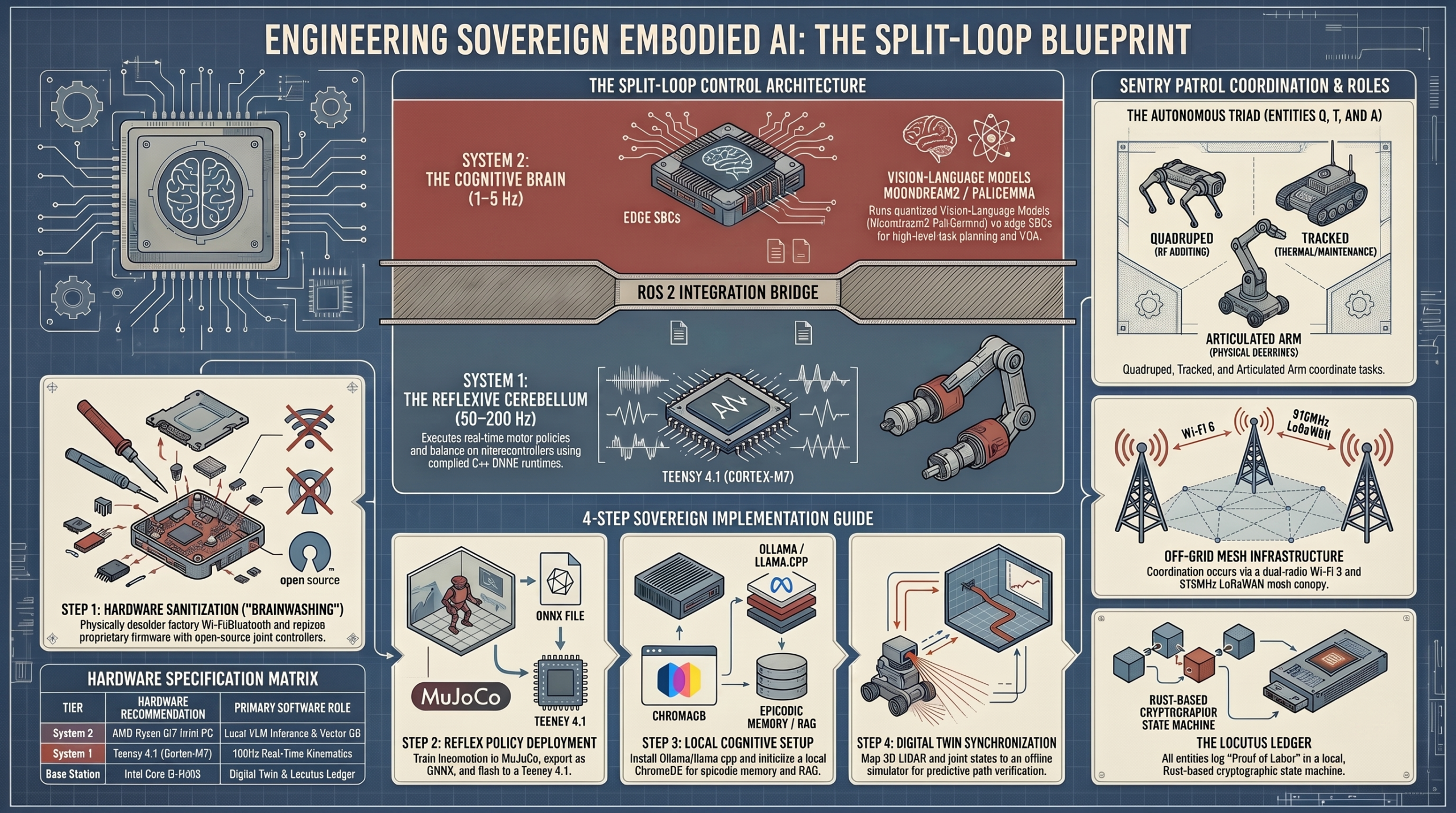
To resolve the trade-off between reasoning depth and control latency, sovereign agents utilize a two-tier control hierarchy modeled after the biological nervous system.
Control Tier Component Tasks Frequency Hardware Context
System 2 (Cognitive Loop) “The Brain” Spatial VQA, Long-horizon planning, Memory Indexing, RAG. 1 Hz – 5 Hz Edge SBC (e.g., Intel i3-N305 or AMD Ryzen APU).
System 1 (Reflexive Loop) “The Cerebellum” Dynamic balance, Inverse Kinematics (IK), PID, RL Policy Execution. 50 Hz – 200 Hz Microcontroller (e.g., Teensy 4.1 or ESP32-S3).
Software Stack Integration
- Cognition: Local inference servers (llama.cpp/Ollama) running quantized Vision-Language Models (VLMs) such as Moondream2 (1.6B) or PaliGemma-3B.
- Reflex: Micro-ROS and FreeRTOS executing compiled ONNX policies directly on-chip to ensure stability even if the cognitive layer lags.
- Middleware: ROS 2 (Humble/Jazzy) serves as the local bridging interface between cognitive planning and physical execution.
- The DeReticular Sentry Patrol (SKU: RIOS-KIT-SPATROL)
The Sentry Patrol is a turnkey Autonomous Robotic Infrastructure Network (RIN) designed for off-grid sites. It is anchored by a stationary base station coordinating three specialized physical entities.
A. The Base Station: Sovereign Sentry Pro
- Compute: 8-Core Intel Core i3-N305 with 32GB RAM and 2TB RAID-1 NVMe SSD.
- Network: Wi-Fi 6 Mesh and 915MHz LoRaWAN (via Mesh Beacons RIOS-EXT-01).
- Power: 1.2 kW Solar Array and 1.5 kWh LiFePO4 Battery Energy Storage System (BESS).
- Digital Twin: Hosts a real-time physics simulator (MuJoCo/Webots) to pre-verify kinematic paths before physical execution.
B. Specialized Physical Entities
- Sentry Sentinel-Q (Quadruped): Focused on perimeter security and RF Auditing. It uses a Unitree Go2 frame and an RTL-SDR dongle to perform Radio Frequency Fingerprinting (RFF), identifying unauthorized transceivers based on unique hardware characteristics.
- Sentry Sentinel-T (Tracked): A “Field Medic” for site diagnostics. It utilizes a FLIR Lepton 3.5 thermal camera to scan solar arrays for micro-fractures and deploys a mechanical wiper arm to clear debris.
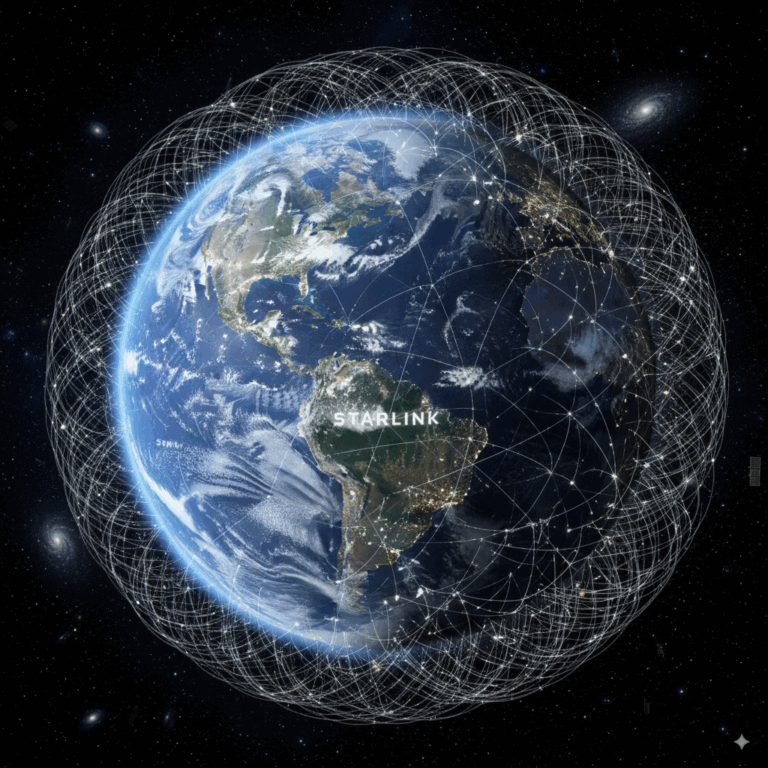
- Sentry Sentinel-A (Articulated): A 6-axis manipulator (SOV-ROBO-HAND) mounted within the server cabinet. It performs physical overrides, such as depressing reset buttons or adjusting Starlink satellite dish positioning during signal loss.
- Sourcing and Manufacturing: The Sanitization Protocol
A core challenge of sovereign AI is that most COTS components come with proprietary, cloud-linked firmware. DeReticular addresses this through a “Brainwashing” process.
- Physical Teardown: COTS chassis are stripped to raw frames, motors, and encoders.
- RF Removal: Integrated factory Wi-Fi and Bluetooth modules are physically desoldered and removed to eliminate backdoors.
- Bus Isolation: Actuator communication is re-routed through custom, opto-isolated RS485-to-TTL adapters.
- Firmware Reflash: Factory joint controllers are wiped and replaced with open-source, audited joint-control firmware.
- Cryptographic Provisioning: A “Golden Image” is flashed to the compute core and bound to a hardware TPM 2.0 chip, paired with physical Sovereign Keys (NFC tokens).
- Data Management and Security Infrastructure
The Locutus Ledger
A decentralized, Rust-based local state machine executing WebAssembly (Wasm) smart contracts. It records an immutable “Proof of Labor” for every task, diagnostic state, and transaction across the mesh.
The Digital Airlock Protocol
When external cloud computation is required (e.g., Google’s Project Remy), the system enforces a hardware-level 9-stage airlock:
- Data Stripping: All raw spatial coordinates and camera images are removed.
- Tokenization: Private values are replaced with randomized IDs.
- Airlock Sanitization: Only anonymous metadata queries are sent via satellite.
- Inbound Inspection: Returned logic is audited at the network edge before being re-integrated with the local context.
“Offline Dreaming” (Self-Improvement)
During charging cycles, robots enter a routine to:
- Semantic Compaction: Merge redundant logs to prevent storage exhaustion on the 2TB RAID mirror.
- Failure Analysis: Analyze recorded physical failures (e.g., “Tilted right at 14:32”) and automatically append joint-torque biases to the System 1 controller to compensate for physical chassis asymmetry.
- Financial and Market Outlook
The sovereign AI market is projected to reach $600 billion by 2030, with 71% of executives viewing ownership of AI infrastructure as a strategic priority.
RIOS-KIT-SPATROL Unit Economics
Category Cost (USD)
Raw Component Hardware (BOM) $4,830.00
Direct Labor (12.5 Hours @ $41.40/hr) $517.50
Total Cost of Goods Sold (COGS) $5,347.50
Suggested Retail Price (MSRP) $9,499.00
Gross Margin (43.7%) $4,151.50
- Critical Operational Hurdles and Mitigation
Despite the strengths of Sovereign Embodied AI, several technical bottlenecks remain:
- Inference Latency: Quantized VLMs (System 2) operate at 1–5 Hz, which is too slow for dynamic hazard avoidance. Mitigation: Pre-cache high-priority safety vectors (humans, fire) directly into the 100 Hz System 1 ONNX runtime.
- Power Density: Running x86 APUs locally drains mobile LiFePO4 batteries in 1.5 to 3 hours. Mitigation: Transition to ultra-low-power ARM/RISC-V boards with dedicated NPUs and implement “sleep-on-idle” states.
- Storage Exhaustion: Continuous 3D spatial logging can overwhelm local drives. Mitigation: Use the “Offline Dreaming” routine to collapse redundant data into single, compact ledger entries.
- Regulatory Compliance: Autonomous rovers face strict safety standards (ISO 13482). Mitigation: Integrate independent, physical hardware watchdogs and pre-validate all navigation paths within the local Digital Twin engine.