
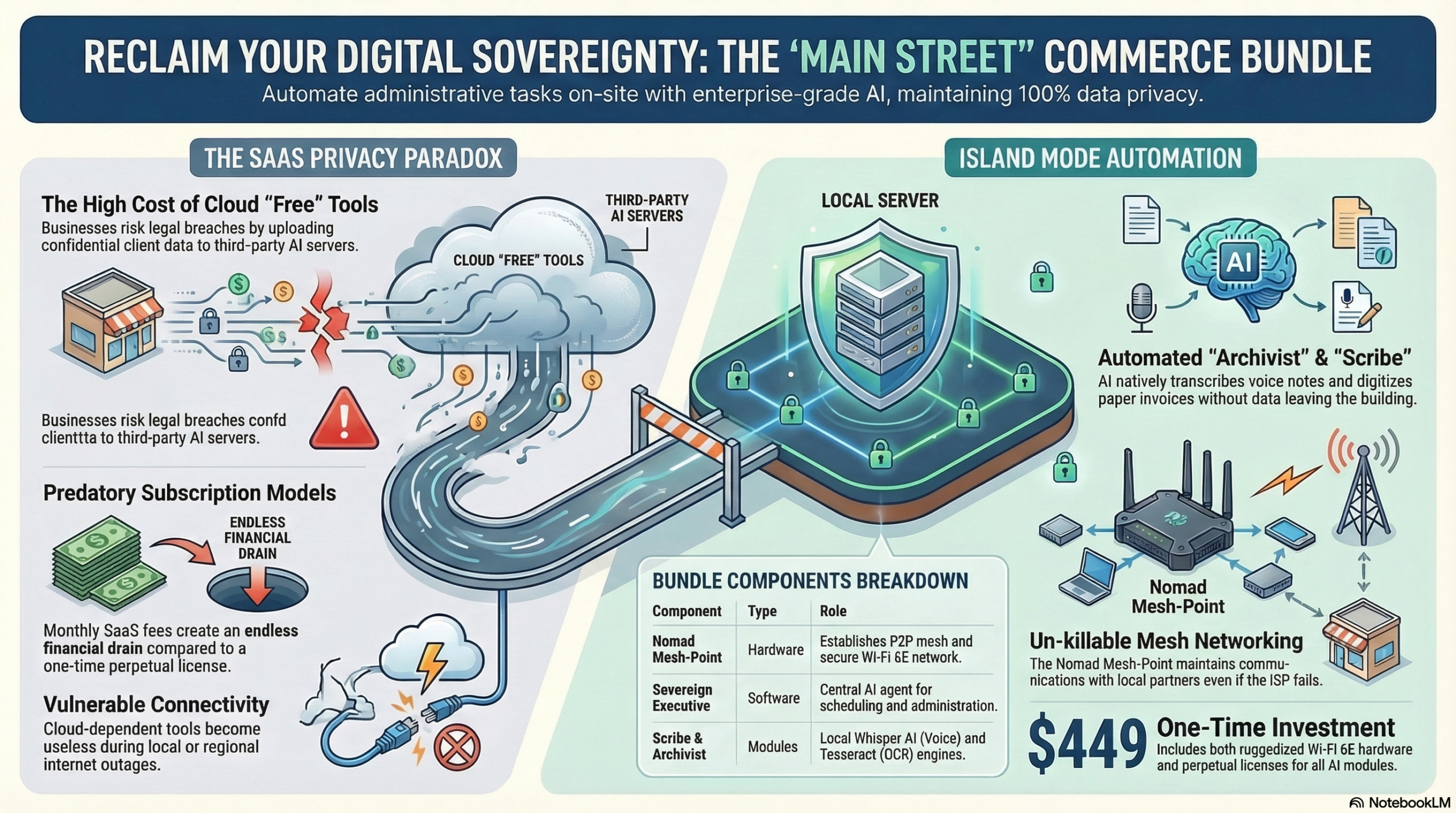
Strategic Business Case: Transitioning to Localized Sovereign Infrastructure for Main Street Enterprises
1. Executive Context: The Strategic Imperative for Digital Sovereignty
Modern Main Street enterprises—specifically high-compliance sectors such as CPAs, private medical clinics, and law offices—are currently trapped in a “Privacy Paradox.” To remain competitive, these firms require the administrative efficiency of AI-driven automation, yet the legal and ethical mandates of their professions often conflict with the data-harvesting business models of centralized cloud providers. Relying on third-party SaaS infrastructure for sensitive client data creates a systemic dependency that compromises operational continuity and professional privilege. Transitioning toward localized architectural autonomy is no longer a technical preference; it is a strategic imperative to protect client trust and ensure “Operational Sovereignty” in an increasingly volatile digital landscape.
The “Main Street” Commerce Bundle represents a fundamental paradigm shift in business operations. It is not merely a software suite, but a comprehensive infrastructure deployment that replaces the “tenant” model of cloud computing with a model of permanent digital ownership.
This business case is built upon three core pillars:
- Financial Predictability: Converting volatile monthly subscriptions into a stable, depreciable capital asset.
- Data Integrity: Establishing 100% data sovereignty through localized processing engines where sensitive information never exits the physical premises.
- Systemic Resilience: Ensuring internal communications and administrative functions remain active via decentralized mesh networking during regional ISP outages.
By addressing these pillars, the Main Street Commerce Bundle effectively neutralizes the inherent vulnerabilities of traditional SaaS models, which frequently expose small businesses to predatory pricing escalations and unauthorized data brokerage.
——————————————————————————–
2. Economic Analysis: Eliminating Subscription Creep and Predatory Pricing
From a strategic financial perspective, the traditional SaaS “per-user/per-month” model introduces significant long-term fiscal instability. For a growing enterprise, these costs are not fixed; they represent an escalating Operating Expenditure (OPEX) that scales with headcount and is subject to arbitrary price hikes by vendors. This “subscription creep” transforms essential utilities into permanent, unpredictable liabilities. In contrast, a Capital Expenditure (CAPEX) model allows a business to purchase its infrastructure outright, optimizing the balance sheet through predictable asset depreciation and the elimination of recurring sunk costs.
| Feature | Traditional Cloud/SaaS Model | Main Street Sovereign Model |
| Pricing Structure | Escalating monthly/annual fees per user. | $449.00 One-time perpetual license. |
| Estimated Cost (5 Users) | ~$150 – 250/month (1,800 – $3,000/yr). | $449.00 Total (Hardware + Software). |
| Core Services | OCR, CRM, Scheduling, Cloud Storage. | Included: Archivist, Scribe, Gatekeeper. |
| Networking | Standard ISP (Dependent on external uptime). | Localized Mesh (Nomad Mesh-Point). |
| Data Ownership | Data harvested/monetized by provider. | 100% Sovereign (Stored on-site). |
| Return on Investment | Negative (Infinite recurring liability). | ~2.0 Month Break-even. |
The “So What?” Factor: The elimination of monthly fees converts a recurring operational drain into a permanent digital asset, directly enhancing the business’s valuation. By owning the hardware and the perpetual software license, the enterprise gains absolute fiscal clarity. This shift from “renting” productivity to “owning” infrastructure ensures that essential tools remain operational even during periods of financial contraction or ISP service interruptions.
While the financial benefits secure the bottom line, the operational value is driven by the localized technical capabilities that convert this infrastructure into a productivity engine.
——————————————————————————–
3. Operational Powerhouse: The Sovereign Executive & Localized Automation
The core of this deployment is the “Sovereign Executive” (OpenClaw Office Edition), a localized administrative engine designed to automate complex workflows without the privacy risks of cloud-based AI. Unlike remote services, these containers run on a local host machine—such as a Sovereign Sentry Pro or an existing local server (minimum 8GB RAM required)—ensuring that all intelligence remains on-site.
The strategic impact is delivered through three specialized modules:
- The Archivist (OCR Automation): Utilizing local Tesseract-based processing, this module transforms paper-heavy workflows into searchable data. For example, a mechanic scanning supplier invoices will have the system automatically extract vendor names, dates, and totals via Ghostscript-enhanced processing, filing them directly into a local PostgreSQL database.
- The Scribe (Voice CRM): Leveraging localized Whisper AI, The Scribe allows professionals to dictate confidential notes via a secure local Signal channel. Because the voice-to-text processing occurs natively on the local host, it eliminates the ethical risk of sending privileged client conversations (e.g., legal strategy or HIPAA-protected health information) to external cloud servers.
- The Gatekeeper (Private Scheduling): This module replaces external tools like Calendly. By managing schedules via a local CalDAV approach, the AI agent negotiates meeting times through local email loops or SMS, protecting the proprietor’s availability from third-party data-scrapers and platform surveillance.
Collectively, these tools reduce manual administrative labor by an estimated 40% while maintaining a zero-cloud footprint. This software efficiency is supported by a resilient hardware layer designed for maximum uptime.
——————————————————————————–
4. Infrastructure Resilience: The Nomad Mesh-Point and “Island Mode”
In an era of increasing regional internet volatility, network independence is a strategic requirement. Standard business operations often collapse during an ISP outage. The Main Street Commerce Bundle mitigates this through the Nomad Mesh-Point Router, a ruggedized access point featuring a Quad-core ARM processor, 4GB RAM, and a 2.5GbE PoE+ Port.
The Mesh-Point creates a “secure Wi-Fi canopy,” but its primary strategic value lies in its “Island Mode” functionality:
- P2P Mesh Networking: The router automatically peers with neighboring DeReticular nodes, creating a decentralized communication web that functions independently of the global internet.
- LoRaWAN Failover (Risk R-NET-01): In the event of high-speed connection failure or physical obstructions (such as heavy concrete), the system automatically downshifts to low-bandwidth LoRaWAN to ensure that critical CRM updates and VoIP traffic continue to flow.
The “So What?” Factor: This local peering creates a “municipal mesh” that strengthens the resilience of the entire local business community. When enterprises are linked via a localized mesh, they transition from isolated points of failure into a collective, resilient network. This ensures that while the broader internet may be offline, the office—and its ability to communicate with local partners—remains functional.
This physical resilience provides the necessary foundation for a zero-trust security posture that fulfills the legal and ethical mandates of modern data privacy.
——————————————————————————–
5. Risk Mitigation: Neutralizing Data Harvesting and Egress Risks
Low-cost cloud services often carry a hidden cost: the harvesting and brokerage of sensitive business and client data. For legal and medical professionals, this is a direct threat to privileged information mandates. Localized sovereign infrastructure proactively neutralizes these threats through a defined Risk Register:
- Egress Firewall (Risk R-PRIV-01): The Nomad Mesh-Point defaults to “Island Mode,” actively blocking outbound traffic to known data-brokers. This prevents “SaaS Creep,” where local software might otherwise attempt to link secure CRM data to external marketing tools.
- Resource Management (Risk R-STOR-01): To prevent storage saturation during high-volume OCR tasks, the Archivist utilizes Ghostscript for automated PDF compression before filing data into the local PostgreSQL environment.
- Zero-Trust Mesh Identity: The system replaces vulnerable cloud-login credentials with a SHA-256 cryptographic license and X.509 certificates, establishing the business as a trusted, authenticated node within the local mesh.
The “So What?” Factor: This security posture allows professionals to confidently fulfill their legal and ethical obligations. By utilizing local LLMs and encrypted on-site storage, a clinic or law firm can provide a technical guarantee to their clients that sensitive records are never processed by, or stored on, a third-party server.
These protections culminate in a superior long-term investment, supported by a streamlined implementation roadmap.
——————————————————————————–
6. Conclusion and Implementation Roadmap
The “Main Street” Commerce Bundle, priced at a one-time $449.00, is the definitive solution for enterprises seeking to reclaim their digital sovereignty. By moving away from the restrictive and insecure SaaS model, businesses gain a localized AI assistant, a resilient network, and total control over their data assets.
The transition from “Tenant” to “Owner” is executed through a clear, three-stage sequence:
- Digital Provisioning: Upon purchase, the enterprise receives a unique SHA-256 Cryptographic License Key and X.509 Mesh Identity Certificate, granting immediate access to the private DeReticular software registry.
- Physical Fulfillment: The Nomad Mesh-Point hardware kit (including the 48V PoE Injector and Shielded Cat6 cabling) is dispatched via ground shipping from DeReticular Warehouse Node 3.
- Local Deployment: The user connects the Mesh-Point to their local host (Sovereign Sentry or equivalent local server). A one-line installer pulls the Sovereign Executive containers, automatically configuring local DNS (executive.local) and establishing the secure sovereign network.
In the modern digital landscape, the move to sovereign infrastructure is the essential strategic move for the local enterprise. It is a commitment to privacy, a safeguard against volatility, and a declaration of independence from the predatory cycles of the cloud.