Speed, Safety, and Sovereignty: Localized AI vs. The Cloud in Modern Manufacturing
1. The Tale of Two Factories: An Introduction to Computing Models
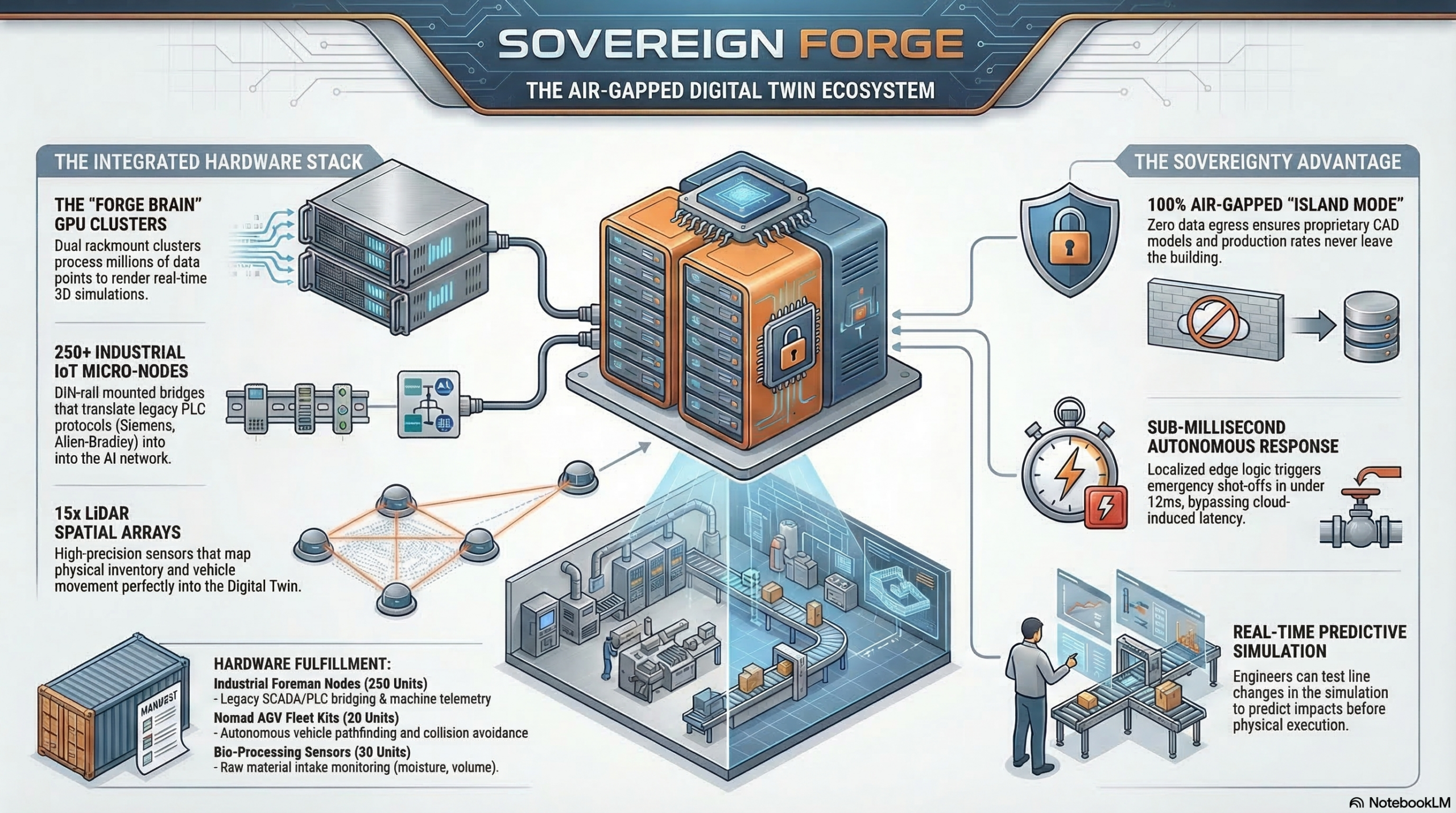
In the high-stakes world of modern industrial production, the architectural choice of how data is processed defines a facility’s resilience. The two primary computing models currently competing for dominance are Cloud-Based Manufacturing and Air-Gapped Localized AI, the latter often referred to as the Sovereign Forge model. Cloud models rely on massive, remote data centers to manage factory logic, while the Sovereign Forge operates in a strict “Island Mode,” where the factory’s “brain” is physically located within its own four walls, entirely disconnected from the macro-internet.
| Cloud-Based Systems | Air-Gapped Localized Systems |
| Data Location: External third-party data centers and remote “Big Tech” servers. | Data Location: On-premise, encrypted NVMe drives housed within the facility. |
| Connectivity Dependency: High; requires consistent macro-internet and external API stability. | Connectivity Dependency: Zero; operates in an isolated “Island Mode” with no external egress. |
| Primary Control Center: Remote cloud infrastructure shared across multiple clients. | Primary Control Center: Localized, dedicated GPU/NPU Sovereign Forge clusters. |
While the cloud offers the allure of outsourced maintenance and perceived convenience, the physical realities of a high-speed factory floor demand a more robust, deterministic approach to ensure operational survival.
——————————————————————————–
2. The Speed of Light vs. The Speed of Production: Understanding Latency
In industrial systems, latency—the delay between a sensor’s signal and the machine’s reaction—is the difference between a successful cycle and a catastrophic failure. For kinetic robotics, the source context identifies a critical requirement of <5ms latency to ensure safe operation. Routing data through external cloud APIs introduces “unacceptable latency” that cannot guarantee these deterministic timeframes. By contrast, the Sovereign Forge utilizes Sentry Pro nodes running the Industrial Foreman software to process telemetry locally, delivering sub-millisecond responses.
Scenario Spotlight: The Anomalous Vibration Scenario
Imagine a heavy stamping press operating at peak capacity. A sensor detects an anomalous vibration frequency indicating an imminent bearing failure.
- The Cloud Response: The data must travel to a remote server, be processed, and return via the macro-internet. Any “jitter” or network congestion could delay the response by seconds, leading to a total machine “crash” and significant floor downtime.
- The Localized Response: An on-site Sentry Pro edge logic controller running the Industrial Foreman analyzes the vibration frequency against the Digital Twin in real-time. It triggers a localized emergency line shut-off in exactly 12 milliseconds. This sub-millisecond deterministic response prevents the failure before a cloud-based packet could even reach its destination.
Speed is not just about efficiency—it is also the primary defense for a company’s most valuable secrets, ensuring that the system reacts faster than any external threat or mechanical failure can manifest.
3. Locking the Digital Vault: Intellectual Property (IP) Protection
Advanced manufacturers and defense contractors treat their production data as their most sensitive asset. When a factory uploads proprietary CAD models, production rates, or specific bioprocessing metrics to “Big Tech” servers, they create massive IP Vulnerabilities. True security is only achieved when a system operates in “Island Mode,” cutting off all physical and digital paths to the macro-internet to prevent data leaks.
The Risks of Data Egress:
- Espionage: Competitors or hostile nation-states can intercept proprietary production workflows and design files when they are transmitted to or stored on public cloud servers.
- Internet Outages: Reliance on external connectivity means a single fiber-optic cut or service provider failure can paralyze an entire autonomous production line.
- Data Surrender: Cloud-based AI models often require users to surrender data ownership to the provider, a risk that is unacceptable for sensitive defense or biological manufacturing projects.
Protecting this data at the source is the essential foundation for building a “Digital Twin,” ensuring that the virtual simulation of the factory remains as secure as the physical one.
4. The Digital Twin: Real-Time Simulation vs. Static Data
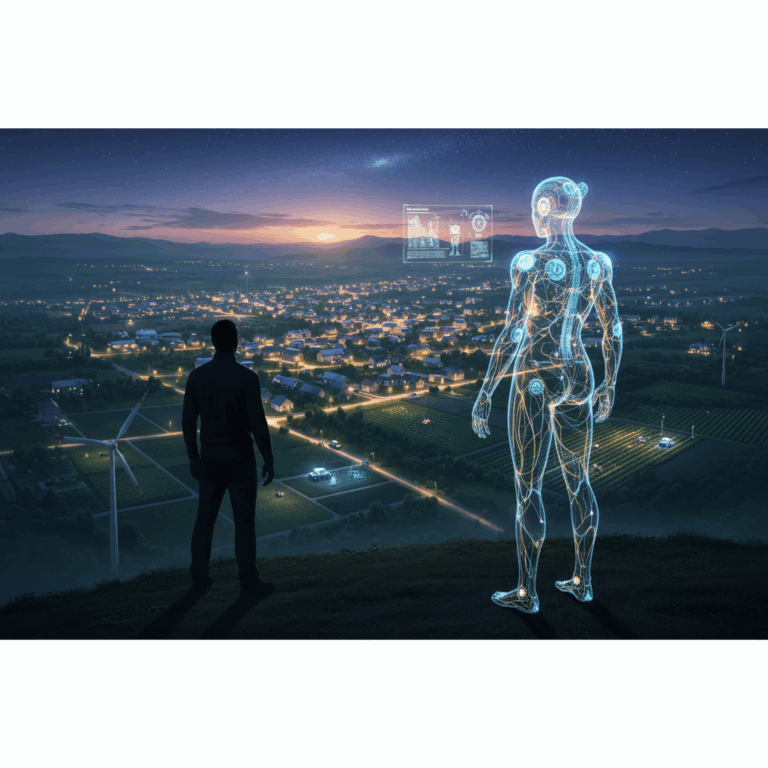
The Digital Twin is a live, 3D simulation of the factory floor, rendered in real-time by localized GPU/NPU clusters. Unlike static blueprints, this twin is perfectly synced with the physical world using Vault Warden LiDAR spatial arrays. This allows managers to interact with the facility through Supervisor Kiosks, where they can use a Deep Admin LLM to “query” the factory (e.g., “What is the maintenance runbook for this robotic arm?”) as if the entire physical plant were a searchable database.
The Three Steps of Twin Synchronization:
- Ingestion (CAD/BIM): This is a human-led phase where DeReticular engineers securely import the factory’s CAD models and Building Information Modeling (BIM) data directly into the air-gapped Forge clusters.
- Mapping (LiDAR): Vault Warden LiDAR modules physically scan the floor, mapping inventory, AGVs, and personnel to align the digital and physical worlds 1:1.
- Execution (Pathfinding): The AI uses the twin to coordinate real-time pathfinding for autonomous vehicles, instantly rerouting them if an obstacle—such as a spilled pallet—is detected.
This synchronization allows for “what-if” testing in the virtual environment before any changes are pushed to the physical machinery.
——————————————————————————–
5. The Anatomy of an Air-Gapped System (The Sovereign Forge BOM)
To maintain absolute sovereignty, a specialized “Bill of Materials” (BOM) is required. This hardware stack replaces the need for the cloud by providing massive, localized compute power and protocol translation.
| Component Group | Key Hardware | Practical Function |
| Core Compute | Sentry Pro “Forge Edition” GPU/NPU Clusters | The “Brain”: Processes millions of IoT streams and renders the 3D Digital Twin using dual AI-accelerators and 128GB VRAM. |
| The Floor | Industrial Foreman Micro-Nodes & Sentry Pro Edge Nodes | The “Nervous System”: Translates legacy protocols like OPC-UA, Profinet, and Modbus into the network and executes 12ms safety stops. Includes Bio-Processing sensors for intake metrics. |
| Logistics | Nomad AGV Fleet Kits & Vault Warden LiDAR | The “Movement”: Provides spatial pathfinding and collision avoidance by integrating directly into the CAN Bus of factory forklifts and robots. |
This complex hardware stack results in one final, overarching benefit: Absolute Production Sovereignty.
——————————————————————————–
6. Summary: Why Localized AI Wins the Factory Floor
The transition to localized AI is a requirement for any facility where downtime is not an option. The Sovereign Forge specifications prove that the modern factory must be self-contained to be truly advanced.
- Key Insight 1: Speed/Safety. Localized processing via the Industrial Foreman ensures deterministic, sub-5ms latency for kinetic robotics, enabling the 12ms emergency stops that protect human life and equipment.
- Key Insight 2: Security/Privacy. Operating in “Island Mode” ensures that sensitive CAD models and production rates are stored on localized NVMe drives, removing the risk of corporate espionage inherent in cloud models.
- Key Insight 3: Operational Continuity. By owning the hardware and the data center, the factory remains fully operational during macro-internet outages, maintaining production through absolute technical independence.
In Industry 4.0, the most advanced factory is the one that owns its own data and its own response time.