Integrating Decentralized AI Infrastructure with Green Growth Policy Frameworks
Comprehensive Report: The Future of Sustainable Industrial Development
Integrating Decentralized AI Infrastructure with Green Growth Policy Frameworks
Executive Summary
This report synthesizes a new paradigm for industrial development in emerging markets, specifically focusing on the context of Uganda. It bridges the gap between high-level policy frameworks—represented by the Global Green Growth Institute (GGGI) and UN 2.0—and practical, decentralized innovation represented by DeReticular and the Rural Infrastructure Operating System (RIOS).
The central finding is that traditional, centralized infrastructure models are insufficient to meet the ambitious goals of Uganda’s “Green/Eco-Industrial Park” (EIP) guidelines. A transition to “sovereign,” AI-native infrastructure (RIOS), supported by capacity building (Biz Builder Mike) and aligned with upcoming 2025 AI regulations, offers a viable path to sustainable industrialization.
Section 1: The Policy Anchor – GGGI Uganda Guidelines
Source: Developing Green/Eco Industrial Parks and Freezones Policy Guidelines for Uganda (GGGI/GoU)
The Government of Uganda, supported by GGGI and the EU, has established a rigorous framework to transition from traditional industrial zones to Eco-Industrial Parks (EIPs). This policy is the foundation upon which any new infrastructure technology must sit.
Key Policy Pillars:
- The Three Scenarios: The guidelines outline three development pathways:
- Baseline: Business as usual (discouraged).
- Incremental: Greening existing parks (Brownfield).
- Green Growth Status: Purpose-built EIPs that meet international standards (Greenfield).
- Industrial Symbiosis: A critical requirement where waste from one company becomes fuel/input for another (Circular Economy).
- Extended Cost Benefit Analysis (eCBA): Moving beyond simple financial metrics to include social and environmental capital in investment decisions.
- The “Gap”: The document explicitly identifies the “infrastructure gap” and the “skills gap” as primary barriers to EIP success in Uganda.
Section 2: The Innovation Solution – DeReticular & RIOS
Entity: DeReticular (AI-Native Research & Innovation)
Core Concept: DeReticular Architecture (Decentralized, Self-Healing, Self-Financing)[1]
While the GGGI guidelines provide the rules, DeReticular appears to provide the tools to execute them, specifically addressing the infrastructure fragility noted in Ugandan policy documents.
The Rural Infrastructure Operating System (RIOS):
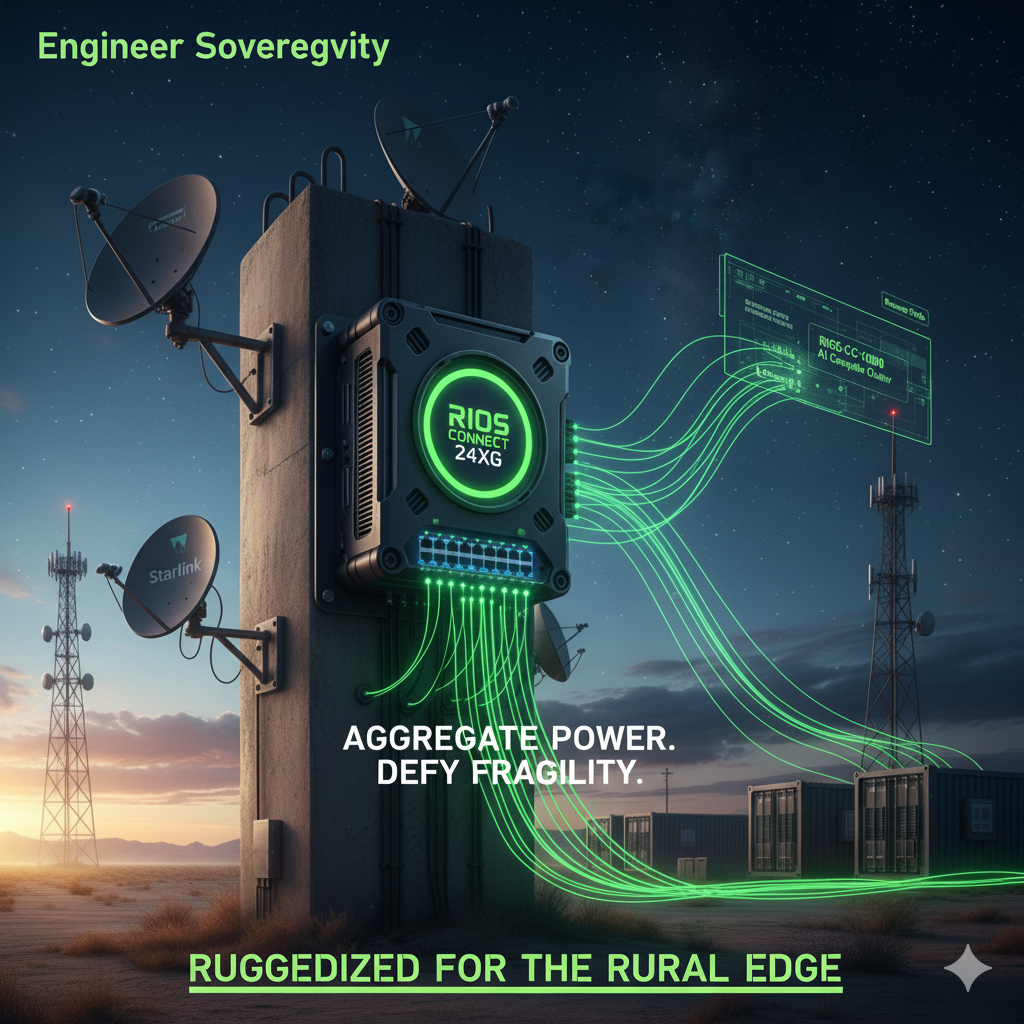
Research indicates RIOS is not merely software but a vertically integrated “Sovereign Stack” combining hardware, software, and human capital. It is positioned as the “Operating System” for the post-grid world.[2]
- Relevance to EIPs: Traditional EIPs rely on the national grid. RIOS offers a decentralized alternative:[1][2][3][4]
- RIOS Campus: A turnkey infrastructure hub providing power, connectivity, and a compute cluster.[5] This aligns with the GGGI requirement for “Common Infrastructure” but adds a revenue-generating layer (data processing) that can subsidize park operations.
- The Nightingale Gateway: An IoT gateway that “listens” to the physical world. This fulfills the GGGI requirement for “Real-time Environmental Monitoring” (air quality, energy usage, waste tracking).
- Sovereignty vs. Autonomy: Unlike standard “smart city” tech which relies on cloud connections (often sending data abroad), RIOS emphasizes “Data Sovereignty”—processing data locally. This is crucial for compliance with Uganda’s emerging data protection laws.
Section 3: Human Capital & Capacity Building – Biz Builder Mike
Entity: Biz Builder Mike (Michael Noel)
Role: Educational Lead / Capacity Building
The GGGI guidelines dedicate Chapter 7 to “Skills Strategy,” noting a critical mismatch between educational output and industrial needs. “Biz Builder Mike” addresses this through a specific pedagogical shift:
- From Mechanic to Architect: The curriculum focuses on teaching students (and local entrepreneurs) to design ecosystems rather than just maintain code.
- The Data Flywheel: Teaching local businesses how to turn their operational data into an asset.[6] In an EIP context, this empowers tenant companies to monetize their efficiency data (e.g., carbon credits).
- Economic Resilience: The philosophy of “Making Money vs. Raising Money” aligns with the GGGI’s push for EIPs to be financially self-sustaining rather than reliant on perpetual government subsidies.
Section 4: The Macro Framework – UN 2.0 & Global Compliance
Framework: UN 2.0 “Quintet of Change”
The United Nations’ modernization agenda (UN 2.0) focuses on five key capabilities to accelerate the Sustainable Development Goals (SDGs). The DeReticular/RIOS model maps directly to this quintet:
| UN 2.0 Element | RIOS/DeReticular Application |
| 1. Data | RIOS converts physical infrastructure data into decision-grade intelligence locally. |
| 2. Digital | The “Sovereign Stack” digitizes rural/industrial connectivity without reliance on fragile national grids. |
| 3. Innovation | DeReticular Architecture represents a shift from centralized to distributed systems. |
| 4. Foresight | Using AI (Nightingale) to predict infrastructure failure before it happens (predictive maintenance). |
| 5. Behavioral Sci. | Incentivizing community ownership of infrastructure (The “BizBuilder Model”). |
Global Compliance Standards:
To achieve the “Gold” or “Silver” status mentioned in the GGGI guidelines, EIPs must meet standards set by UNIDO (United Nations Industrial Development Organization).
- Requirement: “Park management services monitoring.” -> Solution: RIOS provides the digital dashboard for this.
- Requirement: “Resource Efficient and Cleaner Production (RECP).” -> Solution: RIOS optimizes energy consumption via AI.
Section 5: Regulatory Landscape – AI & 2025 Outlook
Global Context:
- EU: The AI Act (2024) sets the global standard for “risk-based” regulation.
- USA: A patchwork of state laws with a focus on innovation over restriction.
- China: Strict control on algorithms combined with heavy state investment in infrastructure.
Uganda Specific Context (2024-2025):
Uganda is at a pivotal moment. The Ministry of ICT and National Guidance is currently drafting the National AI Strategy, expected to be finalized by late 2025.
- The Dilemma: Uganda is debating between a strict “Policy” vs. a flexible “Framework.”[7][8] The current trend favors a flexible framework to encourage innovation.[7]
- 4IR Strategy: Uganda’s Fourth Industrial Revolution strategy explicitly calls for the adoption of AI, IoT, and Blockchain to solve development challenges.
- Data Sovereignty: Uganda has strict data protection laws. The RIOS model of “local compute” (keeping data on the RIOS Campus rather than exporting it to foreign clouds) positions it as a highly compliant solution for the Ugandan market.
Conclusion & Strategic Synthesis
The convergence of the GGGI Guidelines and the DeReticular/RIOS technology offers a roadmap for the next generation of industrial parks in Uganda:
- The “Smart” EIP: Future industrial parks in Uganda should not just build roads and power lines (dumb infrastructure); they should deploy RIOS to create an “intelligent nervous system” for the park.
- Financial Sustainability: By utilizing the “Data Flywheel” concepts taught by Biz Builder Mike, EIPs can generate revenue not just from rent, but from compute power and data services, reducing reliance on state funding.
- Regulatory Future-Proofing: Adopting a decentralized, data-sovereign architecture now prepares these parks for the impending 2025 AI regulations, ensuring they remain compliant with data localization and privacy laws.
Recommendation: Stakeholders developing the 25 proposed Industrial Parks in Uganda should evaluate RIOS not as a competitor to the national grid, but as the necessary resilience layer required to meet the “Green Growth” standards mandated by the new policy guidelines.
Sources help
- kurbkars.com
- dereticular.com
- dereticular.com
- bizbuildermike.com
- kurbkars.com
- bizbuildermike.com
- nilepost.co.ug
- ict.go.ug
Google Search Suggestions
Display of Search Suggestions is required when using Grounding with Google Search. Learn more

- global AI regulations by country 2024 2025 status
- “Rural Infrastructure Operating System” RIOS definition
- UN 2.0 Quintet of Change summary
- UNIDO Eco-Industrial Park certification standards
- DeReticular website “Rural Infrastructure Operating System” RIOS
- “Biz Builder Mike” website business coaching
- Uganda 4IR strategy artificial intelligence
- Uganda National AI Strategy 2024 2025