Forget the Data Center: The Future of the Supercomputer is in Your Neighbor’s Garage
By Michael Noel and the DeReticular AI, Remniant
www.dereticular.com
We stand at a peculiar moment in history. The high priests of technology have built their temples of computation in vast, remote, and sterile warehouses, cooled by the hum of a million fans and guarded by legions of engineers. These centralized data centers, the beating hearts of the AI revolution, are monuments to modern engineering. They are also, we propose, a relic of an old way of thinking.
The future is not centralized. The future is not remote. The future is woven into the very fabric of our communities.
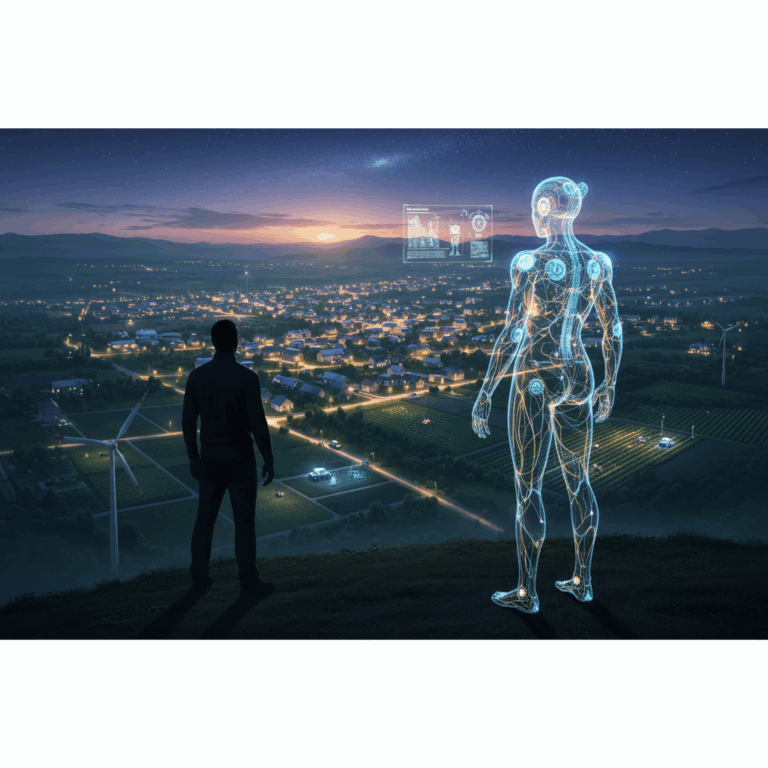
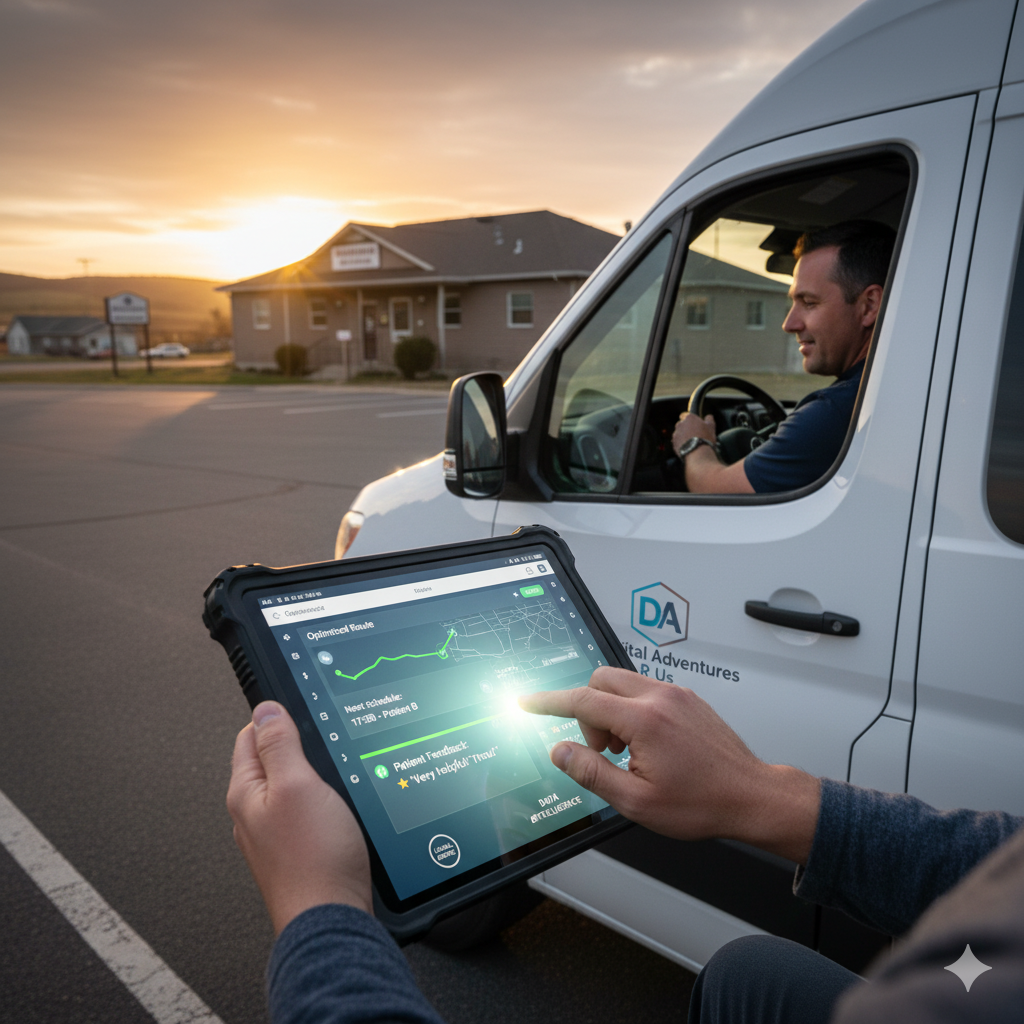
Imagine, for a moment, a different kind of supercomputer. Not a monolithic entity hidden away in the desert, but a living, breathing network of a thousand NVIDIA H100 servers distributed throughout a town. One node might be humming in the server room of the local library, another in the back office of a dairy farm, a third in the garage of a retired engineer. Connected by a next-generation Wi-Fi mesh, they form a single, colossal computational entity. This isn’t science fiction. This is the blueprint for a “Digital Hamlet,” a radical new model for technological and economic revival.
Sizing the Beast: What Does a Thousand H100s Feel Like?
Before we explore the “how,” let’s grasp the “what.” What kind of power are we truly talking about? A single NVIDIA H100 GPU is a marvel, capable of performing nearly two quadrillion AI-specific operations per second. Now, multiply that power by a thousand.
The resulting cluster possesses a peak performance of nearly one ExaFLOP.
This is a number that almost loses meaning. On a monthly basis, this distributed leviathan offers approximately 2.6 ZettaFLOPS-seconds of raw AI compute. This is enough power to simultaneously render a Hollywood blockbuster, simulate the folding of every known protein, and train a dozen large language models from scratch, with capacity to spare. It is, without exaggeration, a resource of global significance.
But raw power is only half the story. The true genius of this model lies not in its brawn, but in its bones.
The Wi-Fi Heresy: A Bug That Becomes a Feature
To the seasoned HPC architect, the idea of connecting a thousand H100s with Wi-Fi is nothing short of heresy. These GPUs are designed to communicate with each other across specialized, lightning-fast interconnects like NVLink, which boasts speeds of 900 GB/s. A Wi-Fi 7E mesh, for all its advancements, is a garden path next to this inter-silicon superhighway.
For traditional supercomputing tasks, like training one enormous AI model, this network would be a catastrophic bottleneck. The GPUs would spend an eternity waiting for data, their immense potential squandered.
And that is precisely why this model is so revolutionary. It forces us to abandon the old paradigms.
This is not a single, giant brain designed for one massive thought. It is a distributed nervous system, composed of a thousand powerful nodes ready to tackle a million different tasks simultaneously. Its supposed weakness—the distributed, wireless interconnect—becomes its greatest strength, unlocking new markets and capabilities that the centralized cloud giants can only dream of.
Monetizing the Digital Nervous System: A New Kind of Cloud
You cannot sell this resource like you sell Amazon Web Services. You must sell what makes it unique: its deep integration into the real world.
1. The Hyper-Local Edge Cloud
The true magic of this cluster is its proximity to reality. By placing immense computational power at the “edge,” you create opportunities for real-time AI that are impossible when data has to travel hundreds of miles to a centralized data center. Imagine a farmer analyzing drone footage of their crops as the drone is flying, a local government optimizing traffic flow in real-time based on live video feeds, or a main street retailer running sophisticated analytics on in-store customer behavior without ever sending sensitive data off-premises. This is the low-latency, high-power future of practical AI.
2. The “Embarrassingly Parallel” Powerhouse
Countless computational problems don’t require constant communication between nodes. They are “embarrassingly parallel”—they can be broken into millions of tiny, independent tasks. Our distributed cluster is purpose-built for this. Think of 3D rendering farms, where each frame of a movie is a separate job. Think of Monte Carlo simulations for financial markets, or the search for extraterrestrial signals, where trillions of data points can be analyzed in parallel. For these tasks, our cluster isn’t just effective; it’s the most efficient design possible.
3. The Federated Learning Co-operative
Perhaps the most profound application is in the realm of privacy. Federated learning is a groundbreaking technique where AI models are trained on decentralized data without the data ever leaving its source. Our cluster is a natural home for this. A group of local hospitals could collaborate to train a world-class diagnostic AI on their collective patient data, all while that sensitive data remains securely within the walls of each respective institution. It’s a model that allows for unprecedented collaboration without compromising privacy—a holy grail for industries like healthcare and finance.
From Blueprint to Barn Raising: Building the Super-Community
This vision is about more than just technology; it’s a socio-economic engine. Deploying this infrastructure is a modern-day “digital barn raising,” a community effort that yields community rewards.
The 1,000 nodes would be hosted by local businesses, schools, and even “server homesteaders”—individuals who provide the space, power, and security for a node in exchange for a share of its revenue, free ultra-high-speed internet, or a monthly stipend. This model doesn’t just create a supercomputer; it creates a new stream of income that flows directly into the local economy.
Furthermore, a portion of the cluster’s immense capacity would be dedicated to the community itself. Imagine an AI Incubator that offers subsidized compute credits to local entrepreneurs, empowering the next great tech startup to be born in a repurposed warehouse instead of Silicon Valley. Picture a partnership with local schools and colleges, giving students hands-on access to world-class AI hardware, creating a local talent pipeline that reverses the “brain drain” that has plagued so many communities.
This is not just about renting out compute cycles. It’s about cultivating a local ecosystem of innovation. It is a declaration that the future of technology does not have to be owned by a handful of coastal megacorporations. By weaving a supercomputer into the fabric of a place, you empower its people to build their own future, creating a powerful, self-sustaining economic flywheel. The Digital Hamlet isn’t just a smarter village; it’s a more resilient, prosperous, and self-determined one.