
Federal Strategic Capture & Readiness Plan: Sovereign Infrastructure Consortium
- Strategic Alignment and Federal R&D Positioning
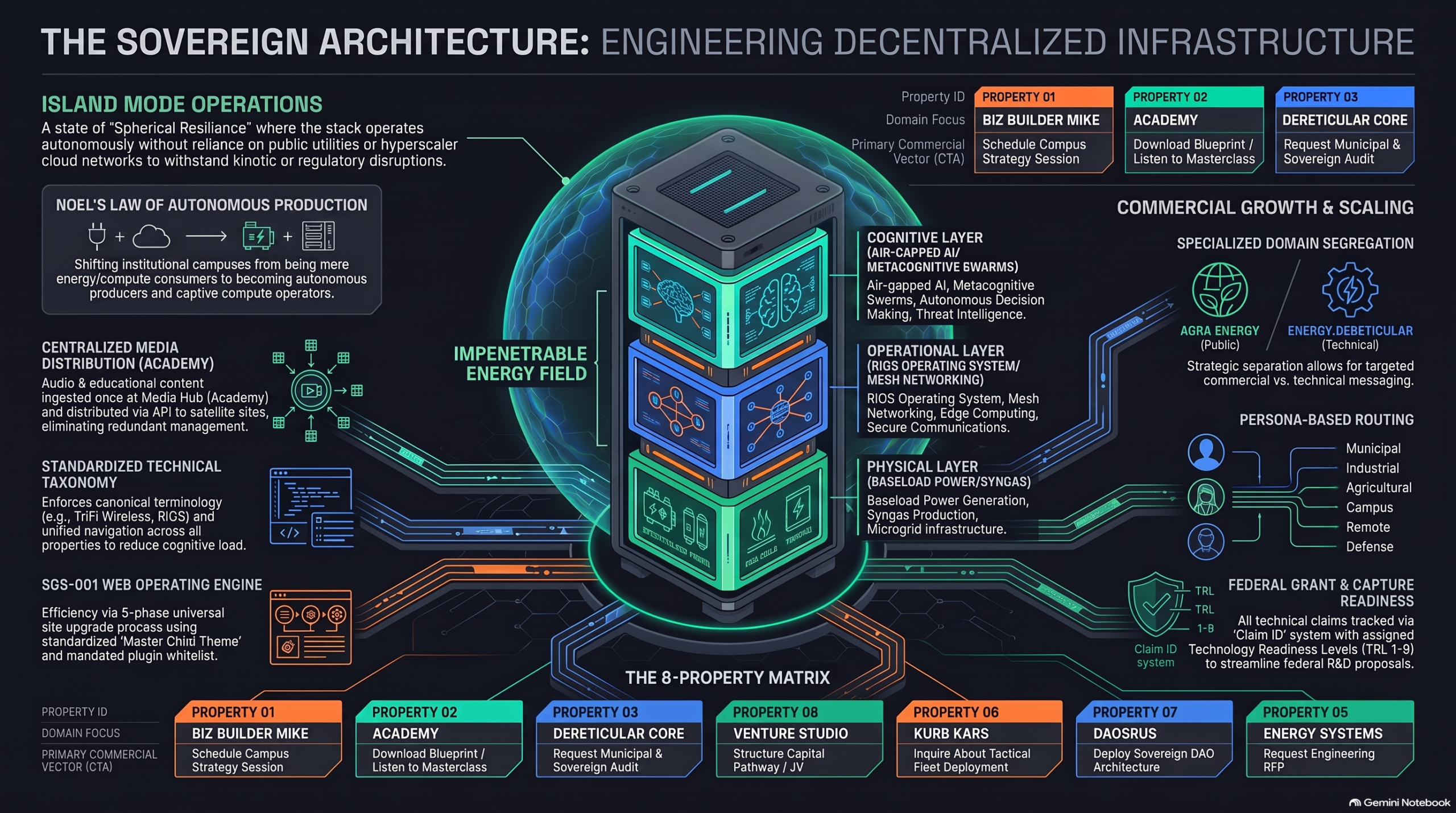
The Sovereign Infrastructure Consortium’s “Sovereign Stack” represents a foundational shift in national resiliency, moving away from vulnerable, centralized utility grids toward hardened, localized “Island Mode” infrastructure. This transition aligns directly with the DOD’s Operational Energy Strategy regarding energy lethality and the DOE’s Grid Modernization Initiative for localized resilience. By providing a pre-validated solution for sustained operation in contested or remote environments without reliance on public utilities or hyperscaler cloud networks, the Consortium addresses critical national security mandates for continuity of operations and infrastructure sovereignty.
The Consortium’s eight-property matrix provides a comprehensive competitive advantage across the federal R&D landscape, organized into a three-tiered architecture:
- Cognitive Layer: Remnant AI and Metacognitive Swarms (MSI) provide air-gapped intelligence, supported by Biz Builder Mike for executive strategy, problem framing, and strategic alignment with federal mandates.
- Operational Layer: The RIOS Operating System and TriFi Wireless mesh networks provide point-of-need routing, while DeReticular Academy manages workforce training and Venture Studio structures non-dilutive capital and grant JVs.
- Physical Layer: Agra Energy (Baseload Power), Energy Systems (SPS/BESS Hardware), and Kurb Kars (Kinetic Autonomy) provide the hardware, while DAOSRUS operates the extreme-edge field trials and legal wrappers via Project Octagon.
Core Axioms of the Consortium
- The Sovereign Stack: Infrastructure built from the physical layer up (Baseload Power → Kinetic Mobility → Edge Networking → Air-Gapped Intelligence → Sovereign Governance).
- Spherical Resilience: Distributed, non-linear node architectures designed to withstand kinetic disruption and macro-grid failures.
- Noel’s Law: The mandate for municipal and institutional campuses to transition from passive consumers to autonomous energy producers and captive compute operators, creating a high-value proposition for grant applicants.
Technical assertions within this framework are governed by a rigorous Evidence-Control Record Structure to meet the data requirements of federal evidence control.
- Evidence-Control Record Structure (ECRS) for Quantitative Assertions
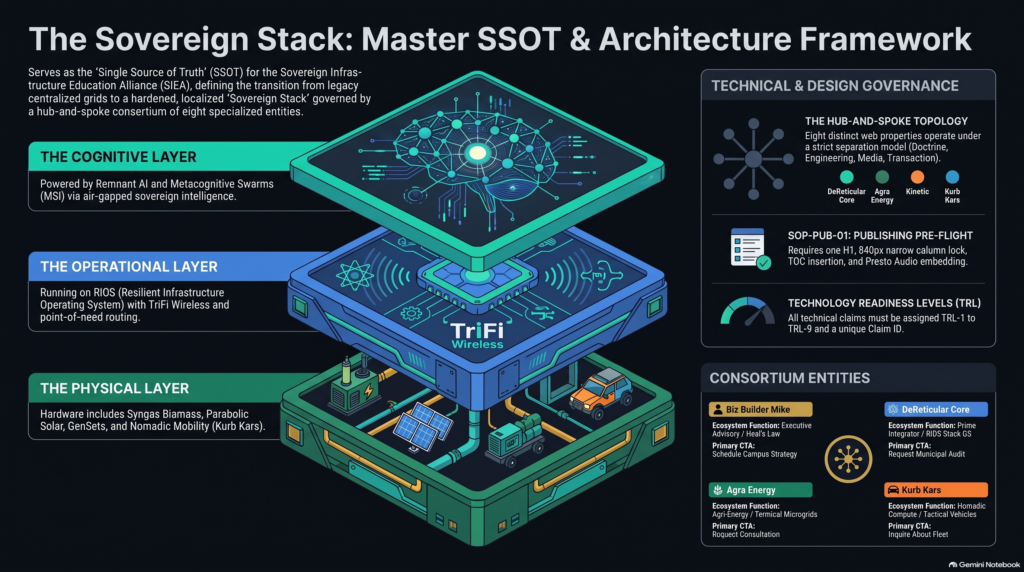
Maintaining “Grant-Ready” status for high-stakes agencies like ARPA-E requires a total separation of commercial marketing prose from technical evidence. Federal evaluators demand audit-proof data that remains consistent across all filings. The Evidence-Control Record Structure (ECRS) provides the formal mechanism for isolating verifiable technical claims from general narrative, establishing a verifiable chain of custody for technical truth.
Field Definition & Acceptable Values
Claim ID Unique alpha-numeric slug (e.g., CLM-AGRA-SYNGAS-004).
Verbatim Claim Exact quantitative assertion (e.g., “45 kW net prime continuous output”).
Owning Entity Entity legally possessing validation data (e.g., Agra Energy LLC).
Technical Lead (PI) Named professional engineer or Principal Investigator.
Verification Method Laboratory test report, signed engineering stamp, or statutory code.
TRL Rating Technology Readiness Level scale (TRL-1 to TRL-9).
Permitted Context Commercial Marketing | Federal R&D Proposal | Restricted Proprietary.
Operating Bounds Feedstock, ambient temp, moisture, and network latency thresholds.
Linking a specific Principal Investigator (PI) to a Claim ID creates the accountability required by federal auditors. This synthesis of engineering data with institutional identifiers—including the SIEA Federal Capability Statement and TriFi Wireless Prime Profiles—transforms raw research into verifiable assertions. These data points ensure that every claim is linked to a specific, documented progression through established technology readiness levels.
- Application of Technology Readiness Level (TRL) Scales
The Technology Readiness Level (TRL) scale is the primary metric used by the NSF and USDA to de-risk innovative technologies. The Consortium utilizes its “Facilities & Testbeds Registry” as the primary evidence source for advancing its technical assets along the TRL roadmap. DAOSRUS serves as the critical field-testing environment, with Project Octagon providing the empirical data required to move technology from laboratory validation to operational deployment.
- Syngas Biomass (Pawnee 45 kW GenSets): Positioned at TRL 6-7 based on validated field trials and gasification skid testing at Project Octagon.
- RIOS Operating System: Positioned as a canonical edge engine (TRL 5-6) through deployment manuals and integrated field trials.
- Remnant AI / MSI: Currently in developmental stages (TRL 3-4), targeting sovereign intelligence air-gaps.
- TriFi Wireless: Validated as a resilient connectivity solution through TriFi Rover Gateway kinetic node integration (TRL 6).
A technology’s TRL stability is contingent upon its Operational Bounds. Parameters such as feedstock moisture for energy systems or signal latency for mesh networks define the limits of a TRL rating. These validated assets are summarized within the formal Federal Capability Statement to provide evaluators with a transparent risk profile.
- Federal Capability Statement & Institutional Compliance
The Federal Capability Statement is the “Master Entry Point” for prime R&D solicitations and ensures compliance with SBIR/STTR requirements. This profile establishes the consortium’s “Authority Level” and provides the administrative data necessary for federal contracting.
Sovereign Infrastructure Education Alliance (SIEA) Profile
- Entity Type: 501(c)(3) Educational and Workforce Alliance.
- Primary NAICS Code: 541715 (Research and Development in the Physical, Engineering, and Life Sciences).
- UEI: [UEI: XXXXXXXXX]
- CAGE: [CAGE: XXXXX]
Institutional compliance is reinforced through Principal Investigator (PI) Dossiers and TriFi Wireless Prime Profiles. These dossiers are formatted to meet NIH/NSF Bio-sketch standards, ensuring that lead personnel like Michael Noel are recognized as authoritative subject matter experts. This administrative foundation establishes the consortium’s capacity to act as a governing master architecture standard for sovereign infrastructure, enabling tactical execution within competitive federal windows.
- Tactical Roadmap for Transitioning Technical Research to Grant-Ready Docs
Establishing a “Canonical Baseline” for federal readiness requires a structured 90-day execution window to ensure all technical research is audited, verified, and formatted for federal submission.
- Days 1–15: Canonical Baseline: Formalize the Single Source of Truth (SSOT), approve unified naming conventions (e.g., TriFi Wireless), and standardize global navigation.
- Days 16–30: Evidence Audit: Assign unique Claim IDs to all technical assertions across all eight domains; reconcile engineering claims and attach empirical data sources.
- Days 31–45: Deployment of Federal Compliance Layer: Deploy the formal SIEA Capability Statement, the TriFi Wireless Prime Profile, and the controlled Evidence Library.
- Days 46–60: Academy Credentialing: Publish the technical training ladder and certification pathways, establishing the workforce development component required for federal grants.
- Days 61–90: Governance & Analytics: Implement quarterly claim reviews and finalize the JSON-LD graph schema to ensure federal scrapers can verify firm capabilities automatically.
Priority Implementation Scorecard | Priority | Strategic Action Item | Impact | Effort | | :— | :— | :— | :— | | 1 | Deploy Unified Ecosystem Global Navigation | Very High | Medium | | 2 | Deploy Federal Capability & Evidence Layer | Very High | Medium | | 3 | Execute Claim Verification & TRL Labeling | Very High | High | | 4 | Deploy Academy Credential & Workforce Ladder | High | Medium | | 5 | Consolidate Agra / Energy Subdomain Functions | High | Medium | | 6 | Standardize Cross-Domain Conversion Routing | High | Low-Medium | | 7 | Implement Shared Analytics & Content Governance | High | Medium |
All technical dossiers are processed via the SOP-PUB-01: Strategic Publishing Pre-Flight Checklist, ensuring a strict 840px narrow-reading column for maximum clarity and adherence to the technical article formatting required for federal submission.
- Governance and Technical Architecture Sovereignty
The Consortium utilizes a “Hub-and-Spoke Separation” model to maintain the integrity of engineering specifications versus educational dissemination. This ensures a clear division between the 501(c)(3) alliance layer (SIEA) and the commercial prime operating entities (DeReticular and its subsidiaries).
Canonical Terminology & Brand Lexicon Consistency in federal filings is mandatory. The following lexicon is enforced:
- TriFi Wireless: Must be formatted exactly as stated; “Trifi” or “TRI-FI” are considered compliance failures.
- RIOS: The canonical definition for the Resilient Infrastructure Operating System.
- Domain Segregation: agra.energy is the public-facing portal; energy.dereticular.com is the locked engineering specification and whitepaper repository.
Ecosystem Global Navigation & Technical Repositories | Function | Repository / Single Source of Truth | | :— | :— | | Engineering Specs | energy.dereticular.com | | Prime Integrator | dereticular.com | | Multimedia / Training | academy.dereticular.com | | Grant Structuring | venturestudio.dereticular.com | | Testbed / Field Ops | daosrus.com |
This governance framework ensures that federal evaluators are directed to the “Single Source of Truth.” The Consortium is fully prepared to execute against federal solicitations with verified, audit-proof technical architecture.
Signed,
Michael Noel Principal Systems Architect Sovereign Infrastructure Education Alliance & DeReticular Consortium