From Earth to Intelligence: The Agra Dot Energy Gas-to-Compute Lifecycle
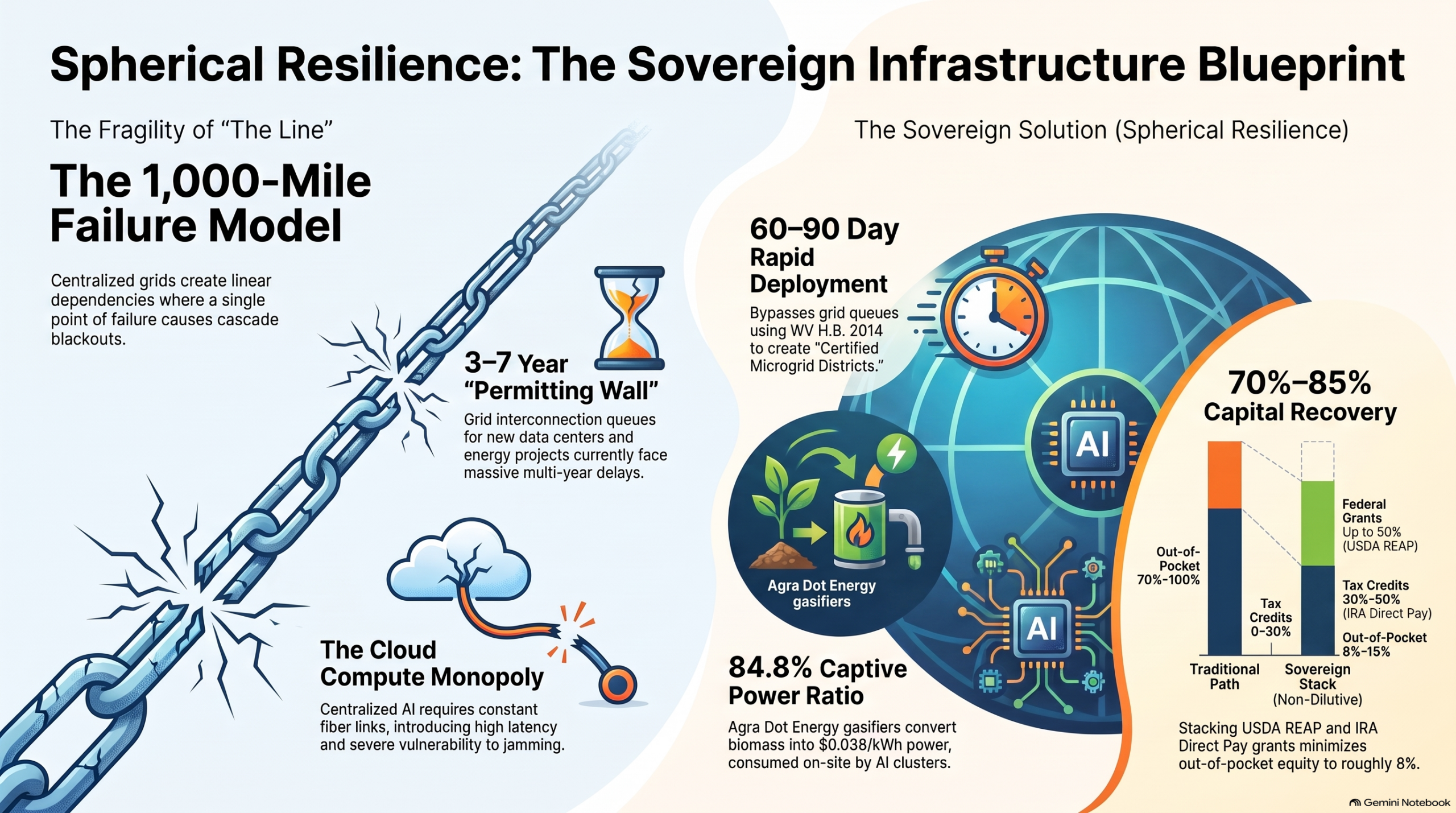
In the architecture of sovereign systems, we reject the fragility of “The Line”—the 1,000-mile failure model that defines centralized utility grids and cloud-dependent intelligence. To build for resilience, we must replace linear dependency with Spherical Resilience, creating self-contained enclaves that function independently of external collapse.
- The Foundation: Spherical Resilience vs. The Line
Architecting for the Sovereign Stack requires a fundamental shift in how we view the relationship between power, hardware, and intelligence. Most modern infrastructure is vulnerable to the “Permitting Wall,” where regional transmission operators (RTOs) delay grid interconnections by 3 to 7+ years. By contrast, the Sovereign Node operates behind-the-meter, utilizing West Virginia H.B. 2014 (W. Va. Code §5B-2-21 and §24-2-21a) to bypass Public Service Commission oversight and utility franchise exclusivity.
Feature The Line (1,000-Mile Failure Model) Spherical Resilience (Sovereign Stack)
Power Source Centralized grid; weather/accident vulnerable. Localized baseload; behind-the-meter generation.
Computing Cloud-based; requires constant fiber reach-back. Air-gapped; on-site deterministic Remnant AI.
Regulatory Years of RTO “Permitting Wall” delays. 60–90 day deployment via Statutory Exemption.
Memory Fabric Centralized/Latent DRAM. Kove:SDM (Microsecond-latency optical RAM).
Reliability Cascading failures; single points of collapse. Island-mode; 84.8% captive baseload ratio.
This 84.8% captive ratio is the magic key; by consuming the overwhelming majority of power on-site, we decouple from the grid and achieve true independence. This lifecycle begins at the earth’s surface with the harvesting of organic feedstocks.
- Step 1: The Input—Harvesting High-Energy Organic Waste
We do not view organic waste as trash; we view it as “energy batteries” primed by the earth and sun. By utilizing localized feedstocks, the Sovereign Stack eliminates the logistical vulnerability of centralized fuel transport.
Primary Organic Feedstocks:
- Forestry Slash and Timber Waste: Residual wood residues that represent a fire hazard in Appalachian hollows.
- Agricultural and Dairy Effluent: Manure and organic farm wastes converted into high-BTU fuels.
- Municipal Wood Waste: Local organic debris that would otherwise incur disposal costs.
Using localized waste instead of centralized fuel ensures that the energy generation remains as decentralized as the compute load. Before this waste enters the reactor, it must be primed by the concentrating power of the sun.
- Step 2: The Solar Spark—Concentrating Parabolic Thermal Preheating
Efficiency in the Sovereign Stack is not an afterthought; it is a requirement. The system utilizes DOE 80x concentrating parabolic solar troughs—curved mirror arrays that focus ambient sunlight onto stainless-steel receiver tubes with extreme precision. This process generates 350°C industrial process steam.
Learner Insight: Eliminating Parasitic Fuel Consumption
In traditional gasification, a significant portion of the fuel must be burned just to reach internal reactor temperatures. This “parasitic fuel consumption” reduces the total energy yield. By injecting solar-charged 350°C steam directly into the reactor, we reach the necessary thermochemical thresholds without consuming our own feedstock, maximizing the production of high-BTU gas.
- Step 3: The Alchemy—Thermochemical Gasification & Syngas
Inside the reaction chamber, we execute high-temperature plasma/thermochemical gasification. This is a molecular breakdown in a low-oxygen environment, resulting in the creation of Synthesis Gas (Syngas)—a potent combination of Carbon Monoxide (CO) and Hydrogen (H2).
This is a carbon-negative synthesis that yields a valuable primary byproduct: High-Grade Agricultural Biochar.
- Value: Realized market value of approximately $350 per ton.
- Benefit: Functions as a carbon-sink credit and a secondary revenue stream that stabilizes the micro-utility’s balance sheet.
- Step 4: The Sovereign Heartbeat—Pawnee Rotary GenSets & 700V DC Power
The syngas moves to a synchronized bank of Pawnee 45 kW Wankel Rotary GenSets. These units are uniquely multi-fuel, engineered to run continuously on unrefined syngas or raw biogas without catalytic scrubbers.
The electrical architecture utilizes a Native DC (Direct Current) Advantage:
- 700V DC Busbar: We bypass the lossy AC-DC-AC inversion cycle. Power is rectified directly to a 700V DC busbar.
- 97.7% Power-Chain Efficiency: By utilizing Direct-to-Chip DC Power Traces to feed 48V/12V DC-DC server power supplies, we eliminate the heat and energy waste of traditional data centers.
- Tactical Interconnects: The physical foundation relies on ODU AMC® NP quick-disconnect circular connectors and L-com 360° circumferential shielding to prevent RF noise leakage and contact fretting in high-vibration generation environments.
- Step 5: The Computing Load Sink—Liquid-Cooled GPU Clusters
In our lifecycle, the compute load acts as a “Sink” for the generated energy, co-locating high-density silicon at the exact point of generation. We deploy RIOS-CC-1000 GPU clusters housed in modular Appalachian enclaves—the “Silicon Hollows.”
Traditional Data Centers Sovereign Nodes (RIOS-CC-1000)
Grid-Tethered: Dependent on RTO utility stability. Behind-the-Meter: Powered by on-site gas/solar.
Air-Cooled: Inefficient fans; limited density. Liquid-Cooled: Direct-to-chip for extreme density.
Memory: Localized RAM bottlenecks. Kove:SDM: Disaggregated software-defined memory.
Liquid cooling is not merely for efficiency; it is the enabler of the extreme density required to run the Remnant AI Engine “bare-metal” without cloud reach-back.
- Step 6: The Output—Autonomous Intelligence & Remnant AI
The final output is Deterministic Edge Intelligence. We utilize the Remnant AI Engine and the Metacognitive Swarms of Intelligences (MSI) framework. This provides a “Deterministic Brain” for the Sovereign Node, capable of sub-5ms multi-spectral sensor fusion—a speed cloud-based probabilistic models cannot match.
The MSI Framework Core Features:
- Self-Monitoring: A meta-layer that performs internal confidence arbitration to suppress “hallucinations.”
- Anomaly Detection: Dynamic sensor re-weighting; if GPS is jammed, the meta-layer detects the error and shifts to visual-inertial odometry.
- Zero-Trust Security: Hardware-enforced TPM 2.0 Root-of-Trust ensures the air-gapped intelligence remains secure and non-exfiltratable.
- The Grand Insight: The 16.6x AI Compute Arbitrage
The “So What?” for the learner lies in the financial engineering. Selling raw electricity back to the grid is a low-margin commodity play. Converting that energy into deterministic intelligence creates an immense value multiplier.
The Arbitrage Multiple Math: The cost of generation is $0.038 / kWh. The market rate for GPU compute is roughly $1.85 per hour, and an H100 GPU consumes approximately 0.70 kW per hour.
- Value of Compute: 1.85 / 0.70 kW = 2.64 per kWh.
- Realized Arbitrage: A 16.6x multiple on every kilowatt-hour produced.
- Peak Potential: In certain configurations, the system achieves a 69.5x Gross Fuel Conversion Multiplier.
Sovereign Strategic Alert: The Permitting Bypass
This entire lifecycle is legally enabled by West Virginia H.B. 2014. By maintaining an 84.8% captive baseload ratio, we bypass the 3 to 7-year “Permitting Wall” of the PJM grid. A 1.0 MW Sovereign Node can move from an empty lot to an active AI cluster in 60 to 90 days, while traditional data centers remain trapped in the grid-interconnect queue.