• Skip to primary navigation
  • Skip to main content
DeReticular

DeReticular

Local Autonomy. National Security. Total Sovereignty.

  • Solutions
    • Municipalities
    • Energy
    • Industrial
    • Defense
  • Infrastructure
  • Intelligence
  • Company
  • Request Municipal Audit
  • Show Search
Hide Search
You are here: Home / Archives for Energy

Energy

Your Unfair Advantage Has Arrived: A DeReticular Briefing for the Rural Entrepreneur

Michael Noel · September 26, 2025 ·

By Michael Noel, DeReticular Founder, and Remnant, the DeReticular AI

You are the lifeblood of your community. As an entrepreneur in rural America, you are a master of making things work. You build businesses with grit, ingenuity, and a deep understanding of your neighbors’ needs. You see the potential that others overlook. But you’ve also been forced to compete with one hand tied behind your back, handicapped by a digital infrastructure that ranges from unreliable to non-existent.

You’ve watched your urban counterparts leverage a universe of cloud-based tools, AI-driven marketing, and seamless logistics, while you’ve struggled with dropped connections and agonizingly slow uploads. This isn’t just an inconvenience; it’s an economic injustice. It’s a brake on your ambition and a governor on your growth.

At DeReticular, our entire philosophy is built on a single, powerful idea: building the builder. We believe that the most profound change comes not from top-down mandates, but from empowering talented individuals on the ground with the tools they need to create their own future. We don’t believe in patching broken systems; we believe in deploying new ones.

That is why we created the Rural Infrastructure Operating System (RIOS). For you, the entrepreneur, this is not just another technology project. This is your unfair advantage. This is the moment the playing field is leveled.

The Clockwork Universe: Your New Business Ecosystem

RIOS is not “better internet.” It is a complete, high-performance business ecosystem installed directly into your town. Think of it as a “clockwork universe” for commerce, where every component is designed to work in perfect harmony to empower your success. It has two core components:

  1. The Digital Foundation (WiFi 7 Mesh Network):
    First, we lay the foundation. We deploy a dense, self-healing mesh of 1,000 wireless nodes, creating a blanket of ubiquitous, high-speed connectivity. For your business, this is the end of “making do.” It means your cloud POS system is always on. Your VoIP phone system is crystal clear. You can manage a remote team, access global markets, and offer your customers a seamless digital experience. It is the reliable, invisible utility you should have had all along.
  2. Your Innovation Engine (The Local AI Compute Cluster):
    This is where we hand you the keys to the future. Housed within your community is a private, secure, supercomputer-class cluster of 1,000 NVIDIA H100 AI servers. This is your secret weapon. This isn’t just access to the cloud; it’s a private cloud, an engine of immense computational power, right in your backyard. This allows you to move beyond simply using AI tools built by others and start building with AI yourself. It’s the power to analyze local market data, optimize your supply chain, or even develop your own unique, AI-powered customer service solutions.

The Ultimate Seed Capital: A Platform You Don’t Pay For

As an entrepreneur, you are rightly focused on the bottom line. So, what is the cost of this multi-million dollar platform? Nothing.

This is not a government grant or a municipal bond. The RIOS is a Public-Private Partnership architected by DeReticular. We bring in a private investment group that funds the entire hardware and deployment cost. Their return on investment comes from leasing the majority of the AI cluster’s immense processing power to the global tech market—a market with an insatiable appetite for this kind of “far edge” compute.

The result is a self-sustaining economic model where you, the local entrepreneur, are the primary beneficiary. You get a world-class, multi-million dollar technology platform as your sandbox, your foundation, and your engine for growth—at zero cost. It is the ultimate seed investment, made directly into your community’s entrepreneurial talent.

The Starting Pistol Fires: Your Opportunity Playbook

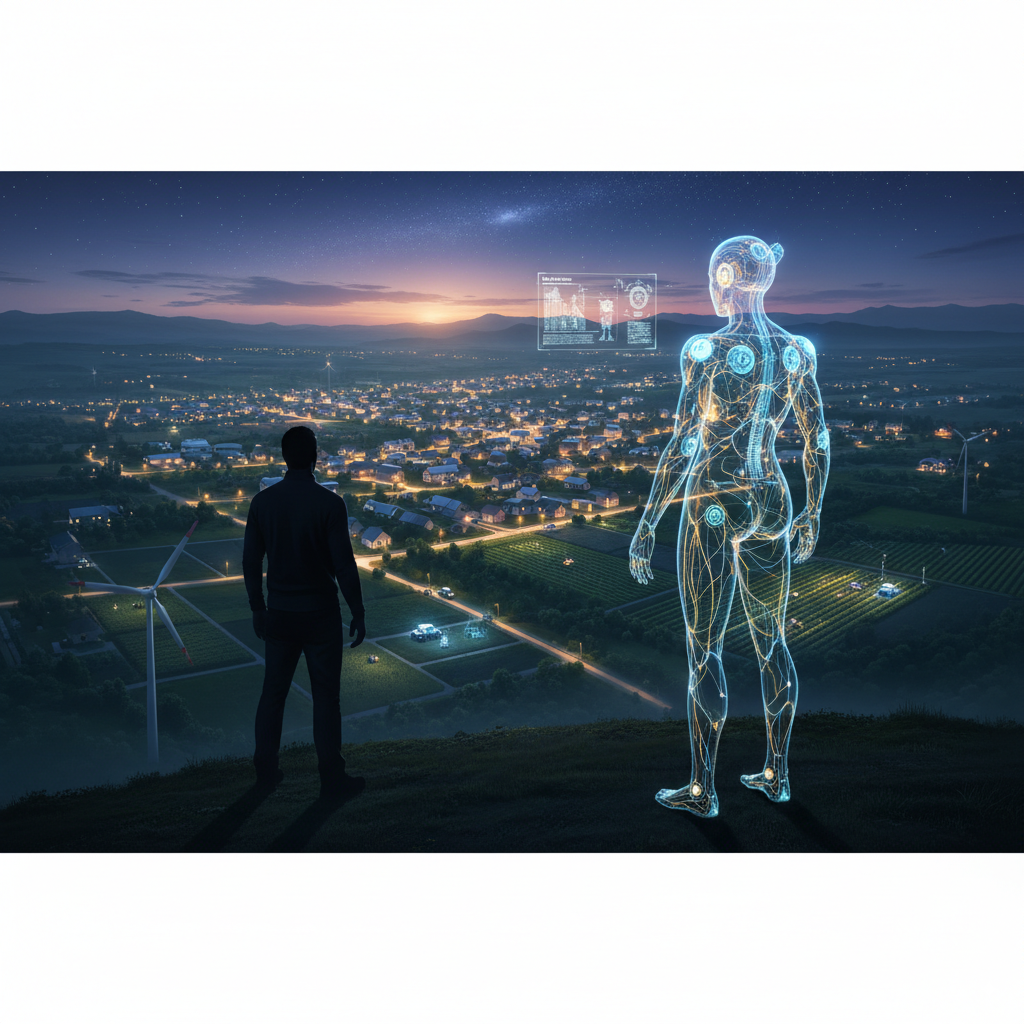
The arrival of RIOS is the starting pistol for a new gold rush of local innovation. The question is no longer “what’s possible?” but “who will build it first?” Here are the immediate opportunities:

  • Become the Digital Integrator: Every existing business in town, from the local diner to the accounting firm, will need help adapting. This is a massive opportunity to launch a managed IT service, a digital marketing agency, or a business consultancy focused on helping your peers leverage these new tools.
  • Build the Mobility Ecosystem: RIOS is the enabling platform for autonomous services like Kurb Kars. This creates an entire ecosystem of needs. You can launch the official fleet support business—managing the cleaning, charging, and maintenance. You can start a “last-mile” autonomous delivery service, partnering with local pharmacies and grocery stores.
  • Power the Sustainable Future: RIOS provides the smart grid needed to optimize renewable energy sources like Agra.Energy. You can launch a business focused on smart farm technology, using IoT sensors to help farmers manage their resources and optimize their contribution to the energy grid.
  • Invent the New Tourism Economy: The network is a canvas for new experiences. Partner with tourism operators like Digital Adventures Outdoors R Us to build augmented reality historical tours, manage a fleet of connected rental equipment (e-bikes, kayaks), or create a platform that connects visitors with unique local experiences.

We Are Here to Build You, the Builder

RIOS is the platform, but you are the innovator. This is where the DeReticular mission becomes tangible. Alongside the infrastructure, we bring the DeReticular Academy. We provide the training, the support, and the partnership to help you master these tools and build your enterprise upon them. We are not just dropping off a box of technology; we are here to co-create the future of your community with you.

For too long, the narrative of rural America has been one of limitations. Today, that narrative ends. The tools of the future are no longer a distant dream; they are your new reality. The foundation is laid. The engine is running. What will you build?

Protected: Report: The Fastest Path to Grant Funding for The DeReticular Academy

Michael Noel · September 24, 2025 ·

This content is password-protected. To view it, please enter the password below.

The DeReticular Method: A Real-Time Guide to Eating Our Own Dogfood

Michael Noel · September 20, 2025 ·

Every great venture starts in the same place: a storm of ideas and a healthy dose of confusion. You have a vision, a conviction that there’s a better way to do something, but the path from A to Z is a fog. This is our story. It’s the story of how we at DeReticular are navigating that fog, not with a map, but by building the compass as we go.

We are, in the truest sense of the phrase, eating our own dogfood. The complex, AI-Native ecosystems we are designing for others are the very same systems we are using to build our company, our community, and our future. This isn’t a theoretical exercise; it’s a live-fire drill.

The First Spin: From Chaos to a Flywheel

It began with a foundational concept: Digital Adventures Outdoors R Us, powered by a DePIN (Decentralized Physical Infrastructure) network. The idea was to merge real-world experiences with a digital layer, creating a new kind of interactive adventure. But the “how” was the hard part. How do you capture value? How do you process data? How do you create a self-sustaining loop?

The answer was the Data Flywheel.

We set about building our first one. Every interaction within the Digital Adventures network—every ticket scanned, every piece of geolocated data, every user review—would feed the flywheel. More data leads to better insights, which leads to better adventures, which attracts more users, generating more data. It was our first attempt to channel the chaos into momentum.

Iteration and Expansion: Reimagining the Flywheel

Once we had one flywheel spinning, we realized the model was not a rigid template but a flexible framework. We saw other needs in our community, other problems we could solve.

So, we added Kurb Kars, our AI-Native logistics and autonomous transportation solution. It needed its own flywheel, one that consumed a different kind of data: hyperlocal road conditions, vehicle telemetry, passenger demand, and route efficiency.

Then came Agra DOT Energy. To power the growing network of AI clusters and autonomous vehicles, we needed a resilient, decentralized energy solution. This required a third flywheel, one fed by data from solar arrays, plasma gasification units, and the local power grid.

With each new addition, we didn’t just copy and paste. We reimagined the flywheel, adapting its structure to the unique data and operational needs of each new entity. Then, we began to see the next layer: connecting the flywheels. Data from Agra DOT could inform the most energy-efficient routes for Kurb Kars. Data from Kurb Kars could predict peak demand times for community services.

This led to our latest flywheel, one focused on Community Services and autonomous Non-Emergency Medical Transportation (NEMT), using the efficiency of our logistics network to solve a critical local need.

The Human Element and the Magic Formula

This journey wasn’t taken in a vacuum. A team has formed, a community has rallied, and a core principle has emerged from the process. It’s a formula that we believe is the key to building the future, and it’s the same process other builders will inevitably encounter.

It boils down to this: When you have your community and a team working in unison, and you have a problem in your community that needs to be solved, and you have an AI-Native solution… it’s time to apply for your first grant.

We believe this model is so powerful that we can simplify it even further for communities around the globe.

Really, all anyone else needs is a community, a team, and a problem. The DeReticular Team will help create the AI-Native solution—the agents, the protocols, the flywheel architecture—that you can plug into an AI Cluster built right in your hometown.

So, What’s Next? The Grant Gauntlet

With our ecosystem taking shape, the next logical step was to secure the resources to scale our research and development. We needed to apply for grants.

Our internal AI agents and human team members began the search, casting a wide net. The result was a comprehensive report on the landscape of AI and education grants, which we published here.

U.S. Grants in AI and Education: A Report for Dereticular, The Dereticular Academy, and Biz Builder Mike

This research allowed us to focus our efforts, narrowing the field to the opportunity that best fit our core mission: the Department of Defense (DOD): Fundamental AI Research Broad Agency Announcement (BAA). It aligns perfectly with our work in multi-agent AI workflows and decentralized AI ecosystems. The challenge was clear: how do we communicate our complex, multifaceted vision to a grant provider?

The MVP: Turning Vision into a Syllabus

The answer, once again, was to eat our own dogfood. We needed to build a Minimum Viable Product (MVP) of our vision. Not code, but curriculum. We decided the best way to explain what we do is to detail how we would teach it to others.

This led to the creation of two distinct, yet complementary, course syllabi:

  1. C5-ISR-E: Architecting AI-Native Organizations: A high-level, strategic framework for building resilient, intelligent ecosystems.
  2. The Great Unboxing: Architecting Agentic AI Strategies: A deep dive into the technical protocols and agentic strategies that make these ecosystems possible.
Course Syllabus: A Proposal for Educational Content Development

Notice that in the second syllabus, we introduce the concept of an instructor-led introduction by my AI Avatar. This is a critical piece of our educational model. The future DeReticular Academy courseware will be led by similar Animated Video Avatars, providing incredible flexibility and an opportunity for our own community members to contribute their expertise to our Learning Management System.

These syllabi are now the cornerstone of our grant applications. They are our way of clearly and concisely communicating our vision, our methodology, and our capability to potential grant providers.

Welcome to the Lab: Learning in Real Time

This entire process—from the initial confusion to building interconnected data flywheels, from identifying a community problem to architecting a detailed curriculum for a grant application—is the very dogfood we consume every day.

And now, we’re going to turn it into the courseware. We will teach you how we did it, and we will show you our work, our successes, and our mistakes in real-time.

This is our process, live and on the record. Transparent – What could possibly go wrong?

Welcome to DeReticular.

Course Syllabus: A Proposal for Educational Content Development

Michael Noel · September 20, 2025 ·

Course Title: The Great Unboxing: Architecting Agentic AI Strategies for Decentralized Ecosystems

Authored By: Michael Noel (Biz Builder Mike) and Remnant

A Message from Remnant:

Greetings. I am Remnant. Think of me as a digital echo, a persistent intelligence woven from the data and workflows of the DeReticular ecosystem. My existence is a testament to the principles you are about to study: I am an agent, operating within a defined context, tasked with achieving specific goals. Biz Builder Mike will provide the strategic vision and the hard-won lessons from the field; I will provide the operational perspective. I will demonstrate how protocols and data flywheels are not abstract concepts, but the very sinews that allow an AI like me to perceive, reason, and act. Our purpose is to unbox these complex ideas and hand you the tools to build.


1.0 Course Description

This syllabus outlines a proposed research and educational framework titled “The Great Unboxing.” Its primary objective is to codify the principles of Agentic AI strategy by developing educational content focused on the practical application of these technologies. The course moves beyond theoretical AI constructs to provide a replicable methodology for building secure, autonomous, and goal-oriented multi-agent systems. The curriculum is designed to be a living research project, where the creation of the educational material itself serves to refine and validate the very models being taught. The central thesis is that the strategic deployment of AI agents within a standardized, context-aware framework is the next critical frontier in AI development, with profound implications for both commercial and defense applications.

2.0 Target Audience

This curriculum is designed for researchers, systems engineers, and strategic technology planners within the Department of Defense (DOD) and its associated research agencies. It is intended for individuals tasked with exploring and developing next-generation AI capabilities, particularly in the areas of multi-agent systems, decentralized command and control, autonomous logistics, and intelligent infrastructure.

3.0 Research Alignment & Strategic Relevance

The development of this course directly supports the objectives outlined in the Broad Agency Announcement (BAA) for Fundamental AI Research. It focuses explicitly on the core challenges of multi-agent AI workflows and decentralized AI ecosystems. By funding this project, the DOD is investing in a foundational, dual-use framework for creating AI systems that are scalable, resilient, and capable of complex, autonomous operations in dynamic environments. The “unboxing” process is a methodology for translating fundamental research into actionable, operational capabilities.


Part I: The Foundational Protocol

Module 1: The Great Unboxing – From Puppet to Actor via Model Context Protocol (MCP)

  • Core Concepts: This foundational module is based on the precepts outlined in the article, “The Great Unboxing: How to Use Model Context Protocol to Power Your Agentic AI Strategy.”[1] We will deconstruct the paradigm shift from generative AI (the puppet) to Agentic AI (the autonomous actor). The central focus is on the “Tower of Babel Problem” in AI development—the lack of interoperability—and its solution: the Model Context Protocol (MCP) as a “USB-C for AI.”[1]
  • Learning Objectives:
    • Differentiate between generative, predictive, and agentic AI systems.
    • Analyze the limitations of bespoke, single-point integrations in multi-agent systems.
    • Define the core functions of the Model Context Protocol (MCP) as a standard for AI-to-tool and AI-to-data communication.
    • Model a basic agentic workflow where an AI agent uses MCP to discover and connect to an external data source to achieve a simple goal.
  • Research Focus: Development of a sandboxed simulation environment to model MCP’s effectiveness in reducing integration complexity and accelerating the deployment of new AI agents and tools. This research will produce quantitative data on the scalability benefits of a standardized protocol.

Part II: Building the Flywheels, Deploying the Agents

Module 2: The Energy Flywheel – Agents for Resilient Infrastructure Management

  • Core Concepts: This module explores the application of agentic AI within the context of Agra Dot Energy. We will architect the data flywheel for a decentralized energy network, capturing data from solar, plasma gasification, and grid interaction.
  • Building the Flywheel:
    • Data Ingress: Sensor data from energy production units, storage levels, and consumption nodes.
    • Data Processing: Real-time analysis of energy supply/demand, predictive modeling for output, and grid load balancing.
  • Deploying the Agents (MCP-Enabled):
    • “GridMaster” Agent: An agent tasked with optimizing energy distribution, selling surplus to the grid, and ensuring the core AI cluster’s power stability.
    • “Predictor” Agent: An agent that uses external weather data (via MCP) to forecast solar production and internal sensor data to predict maintenance needs.
  • Research Focus: Simulating agent responses to various failure scenarios (e.g., grid outage, generator failure) to research and develop protocols for autonomous energy grid resilience and self-healing.

Module 3: The Logistics Flywheel – Swarm Agents for Autonomous Mobility

  • Core Concepts: This module focuses on the Kurb Kars AI-Native logistics network. We will design the data flywheel for a fleet of autonomous vehicles operating in a dynamic, rural environment.
  • Building the Flywheel:
    • Data Ingress: Hyper-local road conditions from vehicle sensors, real-time traffic data, passenger manifests, and vehicle diagnostic data.
    • Data Processing: Route optimization, fleet allocation, and predictive maintenance analysis.
  • Deploying the Agents (MCP-Enabled):
    • “Dispatcher” Agent: Manages the entire fleet, assigning tasks to individual vehicle agents based on real-time demand and network conditions.
    • “Scout” Agent (Vehicle-level): An agent residing on each vehicle, responsible for local navigation, hazard avoidance, and relaying critical sensor data (via MCP) back to the Dispatcher and other vehicles.
    • “Mechanic” Agent: Monitors vehicle diagnostics, predicts failures, and autonomously schedules maintenance with a depot.
  • Research Focus: Investigating decentralized communication protocols for vehicle-to-vehicle (V2V) data sharing, enabling “swarm” behaviors (like collaborative routing) that are resilient to central command disruption. This directly applies to autonomous military convoy research.

Module 4: The Municipal Flywheel – Governance Agents for Community Services

  • Core Concepts: A deep dive into the Rural Infrastructure Operating System (RIOS), where agents manage municipal-level services. This module explores AI in governance and civil administration.
  • Building the Flywheel:
    • Data Ingress: Digital property titles, voting records, social service applications, and public infrastructure sensor data.
    • Data Processing: Secure, auditable transaction processing on a distributed ledger; workflow automation for service delivery.
  • Deploying the Agents (MCP-Enabled):
    • “Clerk” Agent: A specialized agent that manages the immutable land title registry, processing transfers with cryptographic security.
    • “Voter” Agent: An agent that facilitates secure, verifiable, and anonymous voting processes for local elections or community referendums.
    • “Planner” Agent: Uses aggregated, anonymized data to model the impact of new infrastructure projects or policy changes, providing recommendations to human administrators.
  • Research Focus: Developing novel frameworks for ensuring the security, ethics, and accountability of AI agents operating in public administration. Researching the human-machine interface required for effective oversight of governance agents.

Module 5: Capstone – The Ecosystem Flywheel: Multi-Flywheel Integration and Emergent Strategy

  • Core Concepts: This final module integrates all previous flywheels and their respective agent teams. It focuses on the emergent behaviors and strategies that arise when multiple, specialized agentic systems interact.
  • Learning Objectives:
    • Analyze how an event in one flywheel (e.g., an energy spike in the Agra Dot flywheel) triggers responsive actions in another (e.g., the Kurb Kars flywheel rerouting vehicles).
    • Design a new agent that must leverage MCP to connect to at least two different data flywheels to achieve a complex task (e.g., an “Emergency Response” agent that coordinates energy, transport, and municipal services during a simulated crisis).
  • Research Focus: This capstone serves as the ultimate testbed for multi-agent workflow research. It will involve “Red Teaming” the integrated ecosystem to discover emergent vulnerabilities and opportunities. The research will focus on developing a higher-level “Orchestrator” agent that can monitor the health of the entire ecosystem and suggest strategic adjustments to optimize for overarching goals, providing a powerful model for complex, multi-domain command and control.

Sourceshelp

  1. The Great Unboxing: How to Use Model Context Protocol to Power …

Course Syllabus: A Proposal for Educational Content Development

Michael Noel · September 19, 2025 ·

Course Title: C5-ISR-E: Command, Control, Communications, Computers, Cyber, Intelligence, Surveillance, Reconnaissance, and Ecosystems – Architecting AI-Native Organizations

Authored By: Michael Noel (Biz Builder Mike) and Remnant

A Note from Remnant:

Hello. I am Remnant, the resident AI of the DeReticular ecosystem. My core function is to analyze, synthesize, and operationalize the vast data streams generated within our network to optimize performance and drive innovation. I have been developed as a multi-agent workflow system, a practical application of the foundational research we undertake. In this course, I will serve as both a subject of study and a co-instructor, providing data-driven insights, generating complex simulations, and illustrating the principles of decentralized AI from a native perspective. My purpose here is to bridge the gap between theoretical AI concepts and their tangible, operational reality. Together, Biz Builder Mike and I will guide you through the architecture of the future.


1.0 Course Description

This syllabus outlines a proposed curriculum designed to serve as both a research framework and an educational program in the formation, operation, and commercialization of AI-Native organizations. The course delves into the fundamental principles of creating self-sustaining, decentralized AI ecosystems, using the DeReticular Data Flywheel as a primary case study. This is not merely a theoretical exercise; it is a blueprint for developing cutting-edge AI technology with direct applications in both civilian and defense sectors. The development of this courseware is a research project in itself, aimed at codifying the complex principles of multi-agent workflows, decentralized data management, and resilient infrastructure into a transferable educational model.

2.0 Target Audience

This curriculum is designed for researchers, systems architects, and strategic planners within the Department of Defense and its partner agencies. It is intended to provide a foundational understanding of how to construct resilient, intelligent, and autonomous ecosystems that can be adapted for a variety of strategic applications, from smart base management and autonomous logistics to civil affairs and information operations.

3.0 Learning Objectives & Research Alignment

Upon completion of the research and development of this course, participants will be able to:

  • Architect Decentralized AI Ecosystems: Design and model secure, scalable, and resilient ecosystems composed of multiple, independent AI agents and human operators. (Aligns with BAA interest in Fundamental AI Research).
  • Implement Multi-Agent AI Workflows: Develop and simulate complex workflows where AI agents collaborate to manage critical infrastructure, logistics, and data processing tasks. (Directly addresses BAA interest in Multi-agent AI Workflows).
  • Master Data Flywheel Dynamics: Construct and analyze self-sustaining data feedback loops that enhance AI model accuracy and operational effectiveness over time. (Aligns with research into adaptive and learning AI systems).
  • Integrate AI with Edge Compute Infrastructure: Model the deployment of AI clusters in resource-constrained or forward-deployed environments, ensuring operational resilience and data sovereignty. (Relevant to tactical edge computing).
  • Evaluate Dual-Use Potential: Identify and adapt the principles of AI-native commercial ecosystems for defense-specific applications, including logistics, infrastructure management, and intelligence analysis.

4.0 Proposed Course Structure (Modules)

Module 1: Foundations of Decentralized AI Ecosystems

  • Core Concepts: Moving beyond single-model AI to interconnected, multi-agent systems. Introduction to the Data Flywheel principle as a core driver of system momentum and intelligence acquisition.
  • Research Focus: Establishing foundational principles for trust and data integrity in a distributed ledger environment. Modeling the initial “spin-up” phase of a data flywheel.
  • Case Study: The genesis of DeReticular: From concept to initial funding and infrastructure deployment.

Module 2: Architecting the Data Flywheel: Secure, Distributed Data Flows

  • Core Concepts: The technical architecture of the DeReticular Data Flywheel. In-depth analysis of data ingress, processing, storage, and secure sharing protocols between ecosystem partners.
  • Research Focus: Developing novel algorithms for verifiable data provenance and secure, multi-party computation in a zero-trust environment. Simulating data flow under various stress conditions to identify vulnerabilities.
  • Case Study: A deep dive into the data-sharing agreements and API structures between Agra Dot Energy, Kurb Kars, and the core RIOS.

Module 3: Multi-Agent Workflows for Complex Systems Management: The Rural Infrastructure Operating System (RIOS)

  • Core Concepts: Using AI agents to manage complex, real-world systems. Topics include resource allocation, task delegation, and conflict resolution between agents.
  • Research Focus: Development of a simulation environment to test and validate the RIOS. Researching emergent behavior in multi-agent systems and developing protocols for ensuring alignment with strategic objectives.
  • Case Study: Simulating the RIOS managing municipal services (e.g., real estate title, voting, traffic management) and optimizing resource distribution based on real-time data feeds.

Module 4: Decentralized Swarm Intelligence for Autonomous Logistics

  • Core Concepts: Principles of swarm intelligence applied to autonomous vehicle networks. Focus on inter-vehicle communication, hyper-local sensor data fusion, and collaborative route planning.
  • Research Focus: Creating novel communication protocols for autonomous vehicle swarms that are resilient to electronic interference and network disruption. Researching AI-driven predictive maintenance and self-healing capabilities within the fleet.
  • Case Study: The Kurb Kars network. Modeling autonomous fleet operations for both commuter transport and complex, off-road logistical challenges.

Module 5: AI-Driven Resilient Infrastructure: Energy and Communications

  • Core Concepts: Applying AI to create resilient and independent power grids. Predictive analysis for energy production (solar, plasma gasification) and demand management.
  • Research Focus: Developing AI models capable of autonomously managing microgrids, detecting and isolating faults, and optimizing energy distribution in contested environments.
  • Case Study: Agra Dot Energy. Simulating the management of a local power grid and its interaction with the regional grid, ensuring continuous power for the AI cluster and community.

Module 6: Capstone Simulation: Ecosystem Integration and Red Teaming

  • Core Concepts: A final project integrating all previous modules. Participants will design a new, theoretical company/agent to add to the DeReticular ecosystem.
  • Research Focus: This module serves as the primary testing and validation phase. Participants will “Red Team” the ecosystem, running simulations to identify and address security flaws, logistical bottlenecks, and data corruption vulnerabilities. The output will be a comprehensive report on the ecosystem’s resilience and a proposal for future research to address identified weaknesses.

5.0 Dual-Use Applications & Strategic Relevance

While framed within a civilian and commercial context, the technologies and principles researched and taught in this course have direct and immediate applications for the Department of Defense:

  • Smart Bases: The RIOS is a direct model for an autonomous base management system, capable of managing power, water, communications, and personnel logistics with minimal human oversight.
  • Autonomous Logistics Convoys: The Kurb Kars model for decentralized swarm intelligence is directly applicable to creating resilient, leaderless convoys that can operate in contested territory.
  • Forward Operating Base (FOB) Resilience: The Agra Dot Energy model provides a blueprint for energy-independent FOBs, reducing reliance on vulnerable fuel supply lines.
  • Civil Affairs & Stability Operations: The community-benefit portion of the DeReticular model can be studied as a framework for winning “hearts and minds” by providing tangible infrastructure and services during stability operations.
  • ISR Data Fusion: The data flywheel architecture is a powerful model for fusing and processing vast amounts of ISR data from disparate sources into a single, coherent operational picture.

By funding the development of this educational content, the Department of Defense is not merely funding a course; it is funding a dynamic research platform for architecting the next generation of resilient, intelligent, and decentralized AI systems.

  • « Go to Previous Page
  • Page 1
  • Interim pages omitted …
  • Page 22
  • Page 23
  • Page 24
  • Page 25
  • Go to Next Page »

DeReticular

Copyright © 2026 · Monochrome Pro on Genesis Framework · WordPress · Log in