- Strategic Paradigm Shift: From Cost-Plus to Performance-Linked Eradication
The eradication of invasive species has long been a graveyard for capital, buried under the weight of administrative inertia and misaligned incentives. Traditional “cost-plus” federal contracts essentially subsidize the status quo, rewarding labor hours and equipment leasing rather than the finality of the mission. We are ending the era of perpetual suppression. The Sovereign Eradication Services (SES) model introduces a strategic pivot to a decentralized, outcome-oriented marketplace. By implementing the “Pay-Per-Snake” (PPS) framework, we align financial disbursement directly with measurable, audited ecological success. This is a cold-blooded financial engine where capital is only released upon the production of a verified, unalterable outcome.
This shift is necessitated by the biological reality of the enemy. Legacy physical barriers—previously deemed “snake-proof”—have been rendered obsolete by “Lasso Locomotion.” Discovered in 2021, this capability allows the brown tree snake to scale smooth vertical cylinders like utility poles by looping its body into a gripping lasso. Because legacy methods cannot stop this locomotion, the SES “Sovereign Stack” is the only viable technical solution capable of securing high-value infrastructure.
Feature Legacy Administrative Models Sovereign Performance Models (SES)
Cost Structure Cost-Plus-Fixed-Fee; rewards billable hours and ongoing suppression. Performance-Linked; capital disbursed only upon verified eradication.
Auditability Manual logs and periodic reviews; susceptible to fraud and overhead. Cryptographic “Proof of Eradication” (PoE) via the Locutus Ledger.
Ecological Finality Focuses on perpetual containment; failure is subsidized. Aimed at complete eradication and permanent biosecurity lock-in.
Strategic Logic Reactive repair and open-ended administrative spending. Proactive prevention; turning billions in liability into a one-time premium.
This paradigm shift moves the financial risk from the underwriter to the operator, creating a robust foundation for our triple-tiered revenue architecture.
- The Triple-Tiered Revenue Architecture
The SES revenue model is a multi-layered fortress designed to balance immediate federal underwriting with high-margin commercial off-take agreements. We are not just killing snakes; we are stabilizing a regional economy and synthesizing a new class of high-grade ecological assets.
Tier 1: Underwriting the Biosecurity Firewall (DoD/USDA/Hawaii)
- The Players: Department of Defense (DoD), USDA, and the State of Hawaii.
- The “So What?”: Hawaii faces a catastrophic annual risk modeled at 456M–761M should the snake establish a population. By accepting a $100M eradication premium, these entities are paying a one-time “biosecurity insurance” fee to permanently mitigate a multi-billion dollar, multi-generational liability. This turns a perpetual existential threat into a manageable, finite capital project.
Tier 2: Municipal Infrastructure Mitigation (Guam Power Authority)
- The Players: Guam Power Authority (GPA).
- The “So What?”: Snake-induced grid failures cost Guam’s economy $4.5M annually. SES shifts GPA’s OpEx from “reactive repair”—which is expensive and yields no long-term improvement—to “proactive prevention.” By linking retainers (scaling to $3.5M/year) to power grid uptime, we provide GPA with a predictable, performance-linked line item that secures the local economy’s stability.
Tier 3: Ecological Market Synthesis (Biodiversity & Carbon)
- The Players: Global Voluntary Carbon and Biodiversity Markets.
- The “So What?”: Snake removal triggers a 92% rise in tree seedling recruitment, initiating rapid natural reforestation. We synthesize this ecological lift into audited Biodiversity and Carbon Credits. This transforms Guam’s decimated canopy into a high-yield asset, generating $6M in annual revenue by Year 7, which is then used to buy back and retire $SVRN tokens, increasing the value of the internal economy.
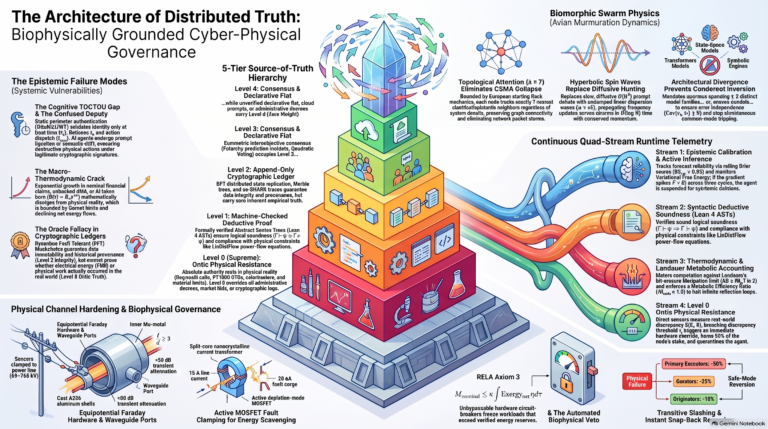
We secure this revenue through a high-trust technological layer that renders fraud mathematically impossible.
- Verification as Value: The “Proof of Eradication” (PoE) Audit Engine
In an outcome-linked marketplace, the only valid currency is truth. Cryptographic verification is our “gold standard,” attracting sophisticated underwriters by providing absolute certainty of impact. The SES “Proof of Eradication” (PoE) engine utilizes an edge-native sequence to transform a biological kill into a secure digital asset.
The Hemp-Grade AI and Locutus Ledger perform a four-step verification sequence that cannot be spoofed:
- Multi-Spectral Scan (GENOPTIC): Specimens are scanned across thermal, near-infrared, and visible spectrums to identify the distinctive serpentine morphology of Boiga irregularis.
- Biometric Profiling: The AI performs volume, length, weight, and scale-pattern analysis to create a unique biological “fingerprint,” ensuring no specimen is counted twice.
- Thermal State-Change Validation: To prevent the submission of old, frozen, or synthetic specimens, the system analyzes muscle tone and thermal dissipation over a strict timeframe to confirm a recent, organic neutralization.
- Cryptographic Hashing (Ledger Entry): A unique PoE certificate—containing GPS coordinates, a timestamp, and unit ID—is hashed directly to the Locutus Ledger.
By utilizing Hardware-Rooted TPM Chips on all camera sensors, we sign the video stream at the lens level. This hardware-software bond ensures that the data is authentic at the point of origin, rendering identity duplication or image manipulation impossible. This level of auditability is the bedrock of the $SVRN utility token marketplace, ensuring every dollar spent represents a verified ecological victory.
- The 10-Year Financial Loop and Self-Sustaining Transition
The SES trajectory moves from heavy reliance on Federal Escrow (Years 1–6) to dominance in the Global Biodiversity Markets (Years 7–10). As the snake population collapses, the project transitions into a self-sustaining ecological economy.
Milestone Gross Revenue Net Cash Flow Cumulative Cash Flow
Year 1: Setup & Port Defense $22,000,000 $8,620,000 $8,620,000
Year 6: Eradication Peak $26,500,000 $18,580,000 $35,040,000
Year 10: Biosecurity Lock $18,000,000 $15,040,000 $98,700,000
This loop is powered by the Closed-Loop Ecosystem. Operators within the cohort do not just earn $SVRN; they use it to purchase services from one another without third-party banking fees or transactional friction. Operators pay Agra Dot Energy in $SVRN for fuel and TriFi for mesh bandwidth, keeping capital circulating within the mission. By Year 10, the project reaches a Cumulative Cash Flow of $98.7 Million, proving that biosecurity is not just a moral imperative—it is a massive commercial opportunity.
- Asset Lifecycle & Off-Grid Logistic Efficiency
Operational efficiency is the primary driver of our bottom line. By achieving complete off-grid sovereignty, we eliminate the logistical tail that strangles traditional military and environmental projects.
The Agra Dot Energy stations are the heart of this sovereignty. Using plasma gasification, we convert localized biomass—including jungle waste and tires—into ASTM-grade synthetic fuel and electricity. This allows our Pawnee Mobile Tactical Command Centers (MTCCs) to operate in the deep, roadless interior of Guam with zero dependency on external supply lines.
To protect our $11.5M CapEx, we employ a rigorous maintenance and risk-mitigation strategy designed for the abrasive Guam environment:
- Ogre Skin Armor: All UTEVs and Kurb Kars are fitted with polymer-composite plates that slide over jagged limestone and resist the 84% relative humidity and salt spray that would disintegrate standard aluminum.
- Resilient Drone Cycles: Drone attrition is modeled to drop from 20% to 10% as we scale. We account for specific stressors, including canopy collisions, tropical rainstorms, and nesting bird attacks from protective native species like the Såli.
- Tokenized Service Trading: Because Agra Dot and TriFi are cohort members, field operators trade $SVRN for fuel and bandwidth directly on the ledger. This eliminates third-party transaction fees and ensures that localized resource availability is always synchronized with the eradication swarm’s needs.
- Market Scaling: The Biosecurity Blueprint for Global Export
The Guam initiative is a high-value pilot for a global “Sovereign Stack.” We have built a repeatable, armored, and air-gapped biosecurity blueprint that can be exported to any ecosystem under siege.
System Export and Diversification:
- Regional Expansion: The “biosecurity firewall” established in Guam can be immediately exported to Saipan and the Galápagos to protect endemic species from invasive predators.
- Target Retraining: The Hemp-Grade AI is not limited to snakes. It can be retrained for feral pigs, rodents, or invasive insects, allowing the same Pawnee chassis and TriFi mesh to capture a dominant share of the global invasive species management market.
Competitive Takeaways for Stakeholders:
- The Sovereign Stack: A natively integrated hardware-software enclave that acts as a rolling, air-gapped supercomputer.
- Zero Dependency Sovereignty: 100% independence from municipal grids, imported fuel, or public cloud connections, ensuring resilience against natural disasters or cyber disruptions.
- Un-Spoofable Performance Treasury: A FAR-compliant model that allows underwriters to purchase guaranteed ecological outcomes, eliminating the waste of cost-plus administrative contracts.