Strategic Implementation Framework: Operationalizing Sovereign Infrastructure
- The Executive Doctrine: From Passive Consumption to Autonomous Production
The current state of global infrastructure is defined by systemic fragility. Institutional reliance on centralized utility grids and hyperscaler cloud networks has become a liability that invites operational paralysis. For municipal leaders and corporate executives, the traditional role of a “downstream consumer”—liquidating capital for services provided by distant, vulnerable authorities—is no longer a viable strategy for continuity. It is a structural insecurity.
The Mandate of Noel’s Law
This strategic shift is codified by Noel’s Law, which dictates that any community or enterprise remaining a passive consumer of centralized energy and compute is structurally insecure. This fragility is quantified by the 1,000-Mile Failure Model, which illustrates how dependencies on distant resources and sprawling supply chains create single points of failure. Noel’s Law shifts the responsibility of resilience from centralized utilities to localized institutional leadership. It mandates the transition from “captive consumer” to “autonomous producer.”
Strategic Impact Analysis: The “So What?” of Centralized Dependency
Legacy utility models are not merely outdated; they are structurally insecure, prone to “remote kill-switch” vulnerabilities, data harvesting, and regional transmission bottlenecks. To mitigate these risks, leadership must achieve “Island Mode” autonomy—the capability for a facility to decouple from the macro-grid and operate as a standalone sovereign entity. By producing power and intelligence locally, an institution secures its own supply chain against macro-grid blackouts and telecommunications severances.
Achieving this autonomy requires moving beyond piecemeal upgrades to adopt the Sovereign Stack, a vertically integrated engineering standard that unifies the physical, operational, and cognitive layers of infrastructure.
- The Sovereign Stack: A Multi-Layered Architectural Blueprint
The “Sovereign Stack” ensures that power, mobility, communications, and intelligence operate within a unified, self-contained ecosystem. Piecemeal approaches—buying local solar without a corresponding communication mesh or air-gapped AI—fail because they maintain dependencies on external networks that are statistically likely to fail during a crisis.
The Physical Layer (Energy & Mobility)
The bedrock of the stack is sovereign baseload generation. This layer utilizes Agra Syngas gasification systems to convert agricultural effluent and forestry waste into synthesis gas (syngas), paired with Parabolic Solar Thermal collectors. These collectors generate 350°C industrial steam to preheat gasifiers, achieving net-positive thermal efficiency and eliminating daytime fossil fuel burn.
- Generation: Pawnee 45 kW Wankel rotary GenSets operate on syngas or biogas.
- Distribution: Power is rectified to a 700V DC common busbar, achieving an industry-leading 97.7% power chain efficiency by avoiding repeated DC-to-AC conversions.
- Economics: This model achieves a levelized cost of power of $0.038 / kWh.
The Operational Layer (RIOS & Mesh Telecommunications)
Coordination is handled by the Resilient Infrastructure Operating System (RIOS). This system manages deterministic sub-16ms Automatic Transfer Switching (ATS), enabling a facility to transition to “Island Mode” without resetting sensitive electronics, NVIDIA GPU clusters, or medical equipment.
- Communication: The TriFi Wireless protocol utilizes 5.8 GHz and 60 GHz bands to create a carrier-free, self-healing mesh network.
- Performance: It provides up to 15 miles of non-line-of-sight (NLOS) range, ensuring point-of-need data and voice services independent of commercial cell towers.
The Cognitive Layer (Air-Gapped Intelligence)
True sovereignty requires intelligence that does not leak data to the cloud. Remnant AI is a private, wisdom-trained foundational model deployed on on-premises, air-gapped silicon, eliminating “remote kill-switch” risks and prompt harvesting.
- Metacognitive Swarms of Intelligences (MSI): These autonomous, multi-agent neural swarms manage load balancing and liquid-cooled GPU thermal loops.
- Security: MSI agents provide deterministic hallucination arbitration and RF jamming defense, monitoring internal telemetry to isolate compromised nodes instantly.
This “Sovereign Matrix” provides the technical capability for autonomy, but rapid deployment requires utilizing statutory mechanisms to bypass traditional bureaucratic delays.
- Statutory Acceleration: Bypassing the Permitting Wall
The primary obstacle to modernizing infrastructure is the “Permitting Wall”—the 4-to-7-year interconnection queues required by regional transmission organizations (RTOs). Sovereign infrastructure circumvents this bottleneck by utilizing statutory bypasses that prioritize rapid, behind-the-meter deployment.
Operationalizing West Virginia H.B. 2014
A prime example of statutory acceleration is West Virginia H.B. 2014 (W. Va. Code §5B-2-21), known as the Power Generation and Consumption Act.
- Certified Microgrid Districts: This statute allows for the creation of districts that bypass Public Service Commission (PSC) rate regulation.
- Captive Consumption & Compute Arbitrage: To qualify, a facility must meet a 70% threshold for “captive consumption.” By co-locating high-density AI compute clusters (RIOS-CC-1000) directly behind the meter, a facility easily satisfies this mandate.
- The 16.6x Multiple: This is not just a legal loophole; it is a financial “hook.” Co-locating AI compute captures a 16.6x arbitrage multiple over wholesale grid power feed-in tariffs, converting raw syngas electricity into high-value intelligence.
- Deployment Cycle: This logic reduces the deployment cycle from years to just 60 to 90 days.
Regulatory Competitive Advantage
Feature Legacy Utility Interconnection Sovereign Microgrid Deployment
Timeline 4 – 7 Years 60 – 90 Days
Regulatory Body PSC / RTO Approval Required Statutory Bypass (e.g., WV H.B. 2014)
Federal Readiness Marketing Assertions Only NAICS Code 541715 (R&D Certified)
Interconnection Dependent on Macro-Grid Upgrades Behind-the-Meter (Captive)
Cost-to-Operate High ($0.09 – $0.18+ / kWh) Low ($0.038 / kWh)
By bypassing the permitting wall, institutions can move directly to the funding phase using a strategic mix of federal and private capital.
- The Non-Dilutive Capital Stack: Financing the Transition
Funding sovereign infrastructure does not require high-interest debt or equity dilution. Leadership should utilize Blended Capital Modeling, prioritizing Non-Dilutive Capital—funds that do not require giving up ownership or control.
Federal Grant Mechanisms & Compliance
- FEMA BRIC: Funds hazard mitigation and black-start microgrid capabilities.
- USDA REAP: Provides grants for agricultural biomass gasification and solar thermal assets in rural contexts.
- BEAD & IRA Section 6417 (Direct Pay): This “Direct Pay” elective credit model provides 30%–50%+ cash reimbursements to tax-exempt entities building clean energy microgrids.
- Audit Readiness: To guarantee compliance, all project accounting is structured under DCAA SF 1408 / FAR Part 31 job-cost ledgers.
The Venture Studio & Advisory Model
The consortium utilizes a Venture Studio model to mitigate the risks of complex federal applications. This model operates on a $10,000 retainer plus a 5%–8% success fee upon the award of capital.
For leadership requiring immediate project scoping, the transition begins with an Executive Advisory Session:
- 15-Minute Strategic Triage: Free discovery session to qualify grant eligibility and baseload availability.
- 1-Hour Deep-Dive Strategy Session: 750 (Private)** / **1,500 (Institutional). Focuses on statutory operationalization and campus-specific Sovereign Stack architecture.
- Implementation & Economic Modeling
Before hardware is deployed, a site’s suitability is validated through a phased audit process to ensure the technical architecture matches the local resource profile.
The Municipal Sovereign Infrastructure Audit
This feasibility study, ranging from $25,000 to $75,000, delivers a comprehensive engineering and financial dossier, including single-line electrical diagrams, ATS transition planning for sub-16ms islanding, and biomass feedstock calculations.
Sovereign Hardware Matrix
All hardware is field-tested at Project Octagon proving grounds (Quartzsite, AZ and West Virginia) and validated at Technology Readiness Level 8 (TRL-8). Systems are deployed in 20ft and 40ft ISO containerized skids.
Product Lineup SKU Hardware Price Description
Signal Pro Model 8355 $650.00 Weatherproof 5G/Fixed Wireless Terminal
Far X Model X1271 $250.00 Compact Rural/RV Router (Wi-Fi 6)
Rover Model SLG-06 $80.00 Pocket-sized 4G Wi-Fi Node (Tactical)
WISP-in-a-Box™ WISP-BOX-LITE $899.00 Turnkey Base Station with RIOS Agent
Deployment Tiers
- Tier I (Tactical Node): 65k–85k. Sized for isolated 911 dispatch or water SCADA. 48-hour autonomy.
- Tier II (Municipal Core): 340k–440k. Unifies City Hall and Emergency Services. 96-hour autonomy via 250 kW / 750 kWh microgrid and air-gapped AI.
- Tier III (Sovereign Matrix): 480k–650k+. Engineered for full districts. Features 1 MW+ multi-bus microgrids and MSI swarm cortex for indefinite islanding.
- Workforce Resilience: The SIEA Credentialing Ladder
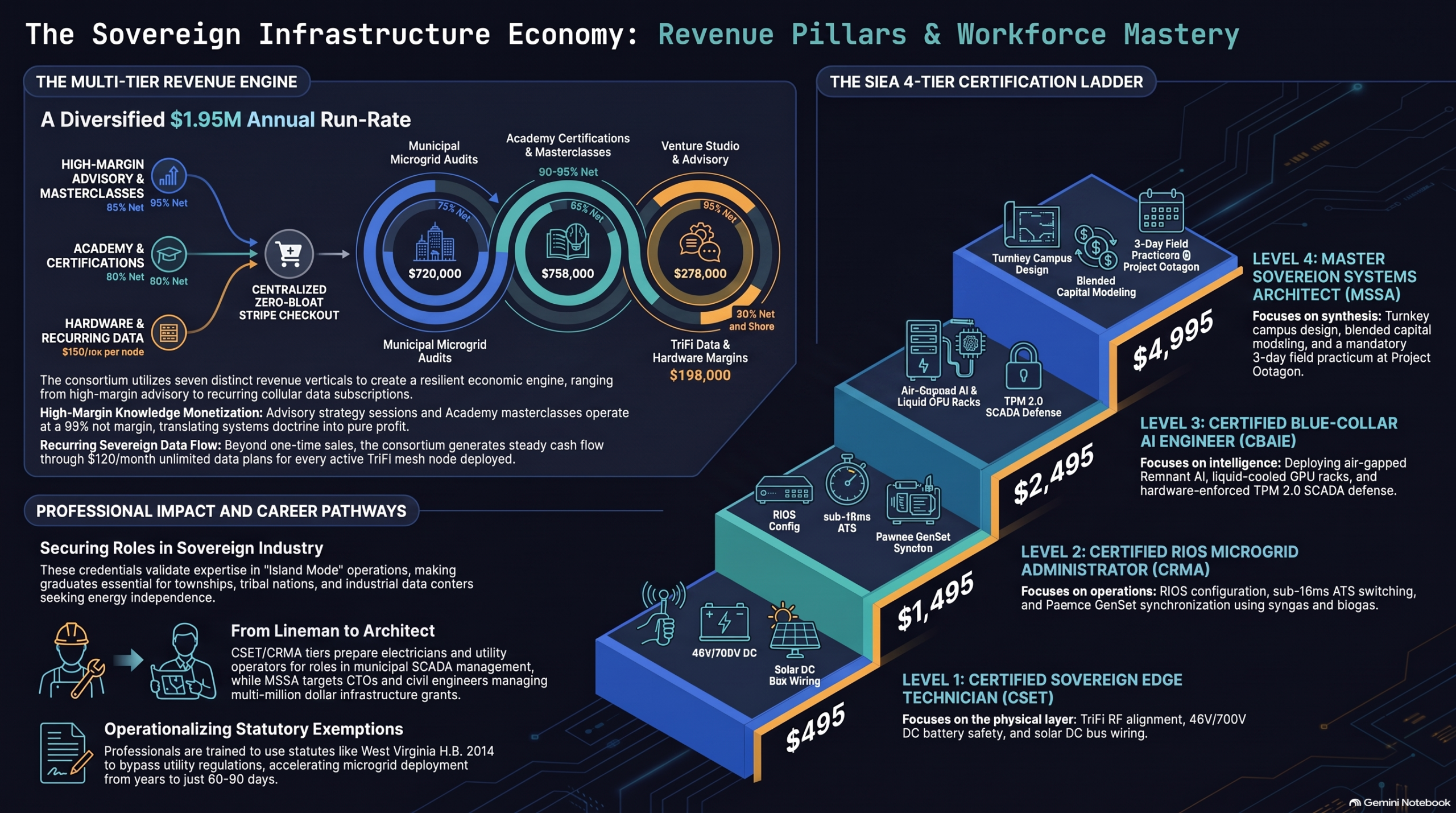
Sovereign infrastructure requires a new class of operator. Under the 501(c)(3) mandate of the Sovereign Infrastructure Education Alliance (SIEA), the consortium provides a 4-tier credentialing ladder to upskill existing facility directors and utility operators.
- Level 1: Certified Sovereign Edge Technician (CSET): $495. Focuses on TriFi RF alignment and 700V DC battery safety.
- Level 2: Certified RIOS Microgrid Administrator (CRMA): $1,495. Focuses on sub-16ms ATS switching and Pawnee GenSet synchronization.
- Level 3: Certified Blue-Collar AI Engineer (CBAIE): $2,495. Focuses on liquid-cooled GPU loops (RIOS-CC-1000) and on-premises Remnant AI deployment.
- Level 4: Master Sovereign Systems Architect (MSSA): $4,995. Synthesizes the entire stack, including statutory operationalization and a mandatory 3-day field practicum at Project Octagon.
Final Summary & Call to Action
The results of the Sovereignty Stress Test are definitive: decentralized, vertically integrated nodes are the only viable defense against macro-grid fragility. Institutions must move now to transition from passive consumers to sovereign producers.
Immediate Next Steps for Leadership:
- 15-Minute Strategic Triage: Baseline your current vulnerability and qualify for federal grant capture.
- 1-Hour Deep-Dive Strategy Session: $750 (Private) / $1,500 (Institutional). Map your statutory bypass and Sovereign Stack architecture.
- Municipal Feasibility Audit: Initiate a full-spectrum 25k–75k site assessment to lock in 60-to-90-day deployment timelines.