
The Architecture of Truth: A Primer on Via Negativa and the Ontic Attractor
- Introduction: Finding Truth by Michelangelo’s Method
Michelangelo famously maintained that his masterpiece, the David, was not “created” through addition, but revealed by the systematic removal of every fragment of marble that was not David. This is the essence of Via Negativa—the path of negation. In the quest for knowledge, truth is not a static “possession” to be seized; it is the invariant shape that remains when we ruthlessly strip away proven errors.
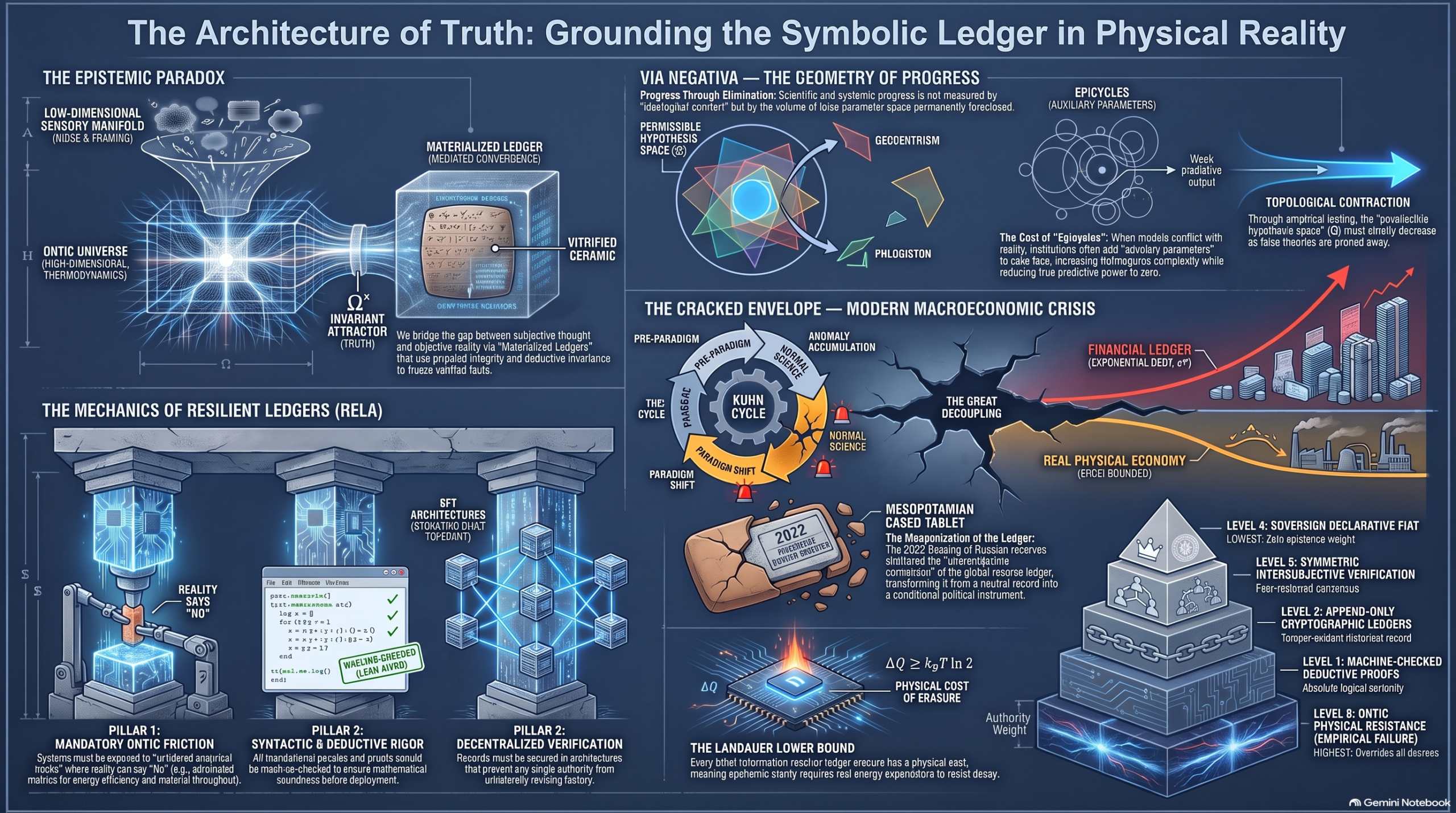
As an educational architect, one must recognize that truth-seeking is a thermodynamic struggle. According to Landauer’s Principle, epistemic clarity is not free; the erasure of error and the maintenance of a verified belief register requires physical work to resist the natural decay of entropy (\Delta Q \ge k_B T \ln 2). We do not “find” truth; we perform the labor of materialized error reduction. This shift in perspective transforms the learner’s objective from the impossible pursuit of absolute certainty to the rigorous engineering task of “error truncation.”
Core Concept: Via Negativa A rigorous epistemological method of reaching the truth through the systematic, irreversible foreclosure of false parameter manifolds. It defines progress not as the accumulation of ideas, but as the permanent elimination of proven falsehoods from the hypothesis space.
The “So What?” for the Learner: By adopting Michelangelo’s method, you reduce the cognitive anxiety associated with “knowing everything.” Your focus shifts to identifying where your models fail when they encounter the hard reality of the world. Understanding truth as a process of elimination makes progress measurable and provides a resilient framework for navigating a high-entropy environment.
While the artistic analogy serves as a conceptual gateway, the scientific reality of our perception reveals a profound dilemma in how we map the world.
- The Epistemic Paradox: Why We See Through a Glass Darkly
There is a fundamental structural disconnect between the Subjective Interior and the Objective Exterior. Human cognition operates within a “low-dimensional sensory manifold”—a narrow sliver of reality constrained by biological noise and linguistic framing. Conversely, the objective universe (the Ontic Manifold) is high-dimensional, non-teleological, and thermodynamically unyielding.
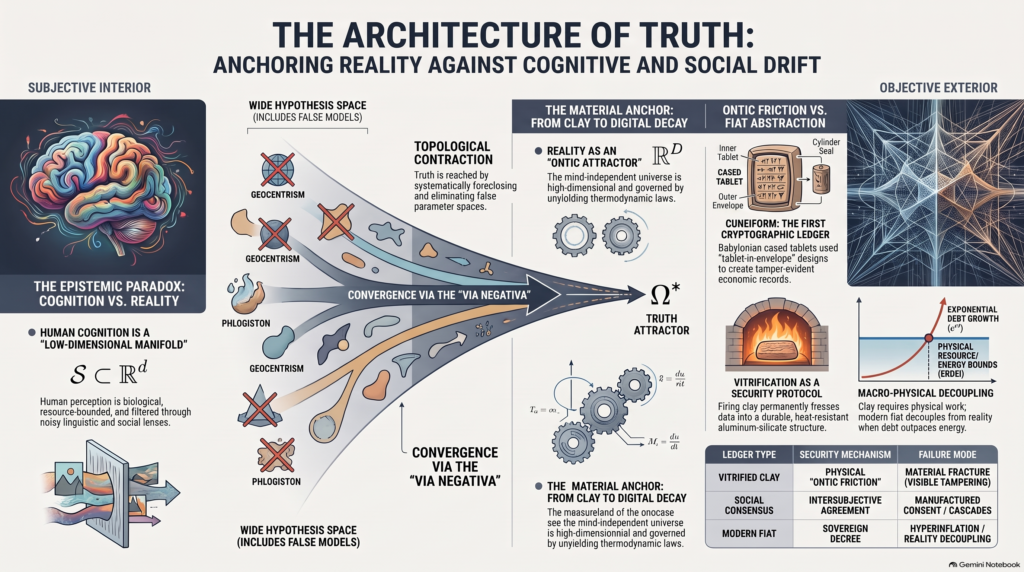
Historically, the search for truth has been stalled by two non-viable classical solutions:
Comparison of Epistemic Failures
Approach Definition Core Flaws (Why it Fails)
Dogmatic Absolutism (Naïve Realism) The assumption of direct, unmediated access to the ontic substrate. Mistakes the observer’s cognitive and ideological projections for the ground truth; ignores the “Mapping-Territory” divide.
Radical Relativism (Constructivism) The belief that truth is merely a social construct or power negotiation. Collapses under self-contradiction; fails to explain why physical systems (like bridges) fail regardless of social consensus.
To bridge this gap, we must utilize the “Mapping Territory” analogy. Our perspectives are low-dimensional maps of a high-dimensional universe. Crucially, a map can be veridical (truthful) even if it is limited. If the map tracks genuine physical differences in the territory, it is real. The goal of inquiry is not to eliminate perspective, but to ensure our maps are veridical representations of the underlying attractor.
- The Ontic Attractor: The Mind-Independent Invariant
The ultimate destination of all valid inquiry is the Ontic Attractor (\Omega^*). This is the “Mind-Independent Invariant”—the configuration of reality as governed by causal invariance and thermodynamic laws, regardless of human belief. We can never fully “possess” this attractor, but we can achieve an Asymptotic Approximation of it.
This leads to Perspectival Realism: the understanding that different disciplines (physics, chemistry, economics) are simply different “angles” or projections of the same underlying attractor. When these different angles converge on a single point, we have identified a structural truth.
The Three Operational Layers of Convergence
To ensure our inquiry is moving toward the attractor, we rely on a triadic architecture:
- Empirical Resistance (Ontic Friction): Reality acts as a boundary condition that falsifies flawed representations through structural failure.
- Primary Benefit: Provides the “No” that prevents inquiry from spinning into a frictionless void of fantasy.
- Deductive Consistency: The use of formal logic to guarantee the conservation of truth-values across inferences.
- Primary Benefit: Ensures that if our premises are true, our conclusions are structurally sound and error-free.
- Material Ledgers: The act of freezing verified claims into high-entropy physical substrates (e.g., vitrified clay or cryptographic chains).
- Primary Benefit: Resists “doxastic decay” and prevents political or subjective revision of the truth.
To reach the attractor, we must move beyond the mere collection of data and master the logic of closing doors.
- Parameter Foreclosure: The Logic of Closing Doors
In scientific modeling, progress is measured by Parameter Space Foreclosure. When a model fails an empirical test, an institution seeking “ideological comfort” will often attempt Hyper-parameterization—adding “epicycles” or auxiliary excuses to explain away the failure without changing the core idea. This increases the Kolmogorov Complexity of the model, making it harder to describe than the data itself, and ultimately reducing its predictive power to zero.
True progress requires Measure-Theoretic Elimination (Monotonic Contraction): the volume of the hypothesis space must strictly decrease as false possibilities are identified and permanently shut down.
Conceptual Checklist for Model Integrity
- The Expanding False Model (Hyper-parameterization)
- Action: Adds auxiliary parameters to “patch” unexpected errors.
- Result: Model complexity balloons; predictive power decays.
- Sign: The model becomes an unfalsifiable Ptolemaic system.
- The Contracting True Model (Monotonic Contraction)
- Action: Irreversibly prunes false variables based on empirical resistance.
- Result: The model becomes leaner and closer to the Ontic Attractor.
- Sign: The “volume of the darkness” in the hypothesis space is visibly shrinking.
- Ontic Friction: When the World Says “No”
Ontic Friction is the ultimate authority of the universe. It is the “push-back” that occurs when a model violates physical laws. If a bridge collapses, that collapse is the Level 0 authoritative datum. Reality does not negotiate; it enforces its boundary conditions through structural failure.
This was historically operationalized via the Mesopotamia Protocol. In ancient Babylon, debt contracts were inscribed on a clay tablet and then encased in a clay envelope that repeated the text. If a dispute arose, the magistrate performed a Judicial Fracture—smashing the outer envelope. The inner tablet, which had been vitrified (turned to stone in a kiln), served as the immutable ground truth. The physical record overrode any verbal claim.
The Hierarchy of Truth
- Level 0: Physical Resistance (Ground Truth): The highest authority. Material fracture, thermodynamic limits, and empirical failure.
- Level 1: Deductive Proofs: Automated, machine-checked logic (e.g., Lean 4, Coq).
- Level 2: Material Ledgers: Append-only cryptographic or physical records (vitrified silicate).
- Level 3: Intersubjective Consensus: Symmetric, uncoerced peer verification (Mertonian CUDOS).
- Level 4: Institutional Fiat: The lowest authority. Declarative decrees or “sovereign say-so.”
- The Kuhn Cycle: Breaking the Global Envelope
The Kuhn Cycle describes the life cycle of our shared ledgers. When a paradigm (a model) can no longer account for reality, it enters Model Drift. Leaders add epicycles to preserve the status quo, but eventually, the drift becomes a Model Crisis.
A seminal modern example of the “cracking envelope” is the 2022 freezing of Russian foreign exchange reserves. This act shattered the intersubjective consensus that the global reserve ledger was a neutral, invariant store of value. It revealed that the ledger was a Level 4 “Institutional Fiat” rather than a Level 2 “Immutable Record.”
Warning Signals of a Paradigm in “Model Drift”
- Kolmogorov Complexity Inflation: The model requires more information to explain itself than the data it predicts.
- Fiscal Dominance: A state where central planners are “trapped” and can no longer defend the currency without triggering systemic default.
- Decoupling from Reality: Symbolic claims (debt/currency) grow exponentially (e^{rt}) while the physical ledger (energy/resources) is limited by thermodynamic bounds.
When the symbolic ledger asserts claims on resources that the earth cannot fulfill, the “epistemic envelope” must be smashed to reset the system.
- Conclusion: The Asymptotic Horizon
Humanity will never possess absolute truth in its entirety. We are finite beings looking at an infinite, high-dimensional attractor. However, through the disciplined practice of Via Negativa, we can “steadily shrink the darkness.” We move from Incommensurable Paradigms toward a more veridical mapping of the universe.
The path forward requires an adherence to the Three Pillars of Resilient Architecture:
- Ontic Friction: Ensuring our models are constantly exposed to the “No” of the physical world.
- Syntactic Rigor: Using formal proofs to prevent the creep of ideological comfort.
- Decentralization: Protecting the ledger from being revised by any single Level 4 authority.
The Learner’s CreedTruth is not a prize to be won, but an attractor to be approached. I will measure my progress not by the ideas I accumulate, but by the false paths I have the courage to foreclose. Error reduction is irreversible; once a door is closed, it stays closed. By removing the marble of error, I reveal the statue of reality.