Why You’ll Never “Book” a Trip Again: Inside the Sovereign Machine Bazaar
- The 40-Tab Trauma
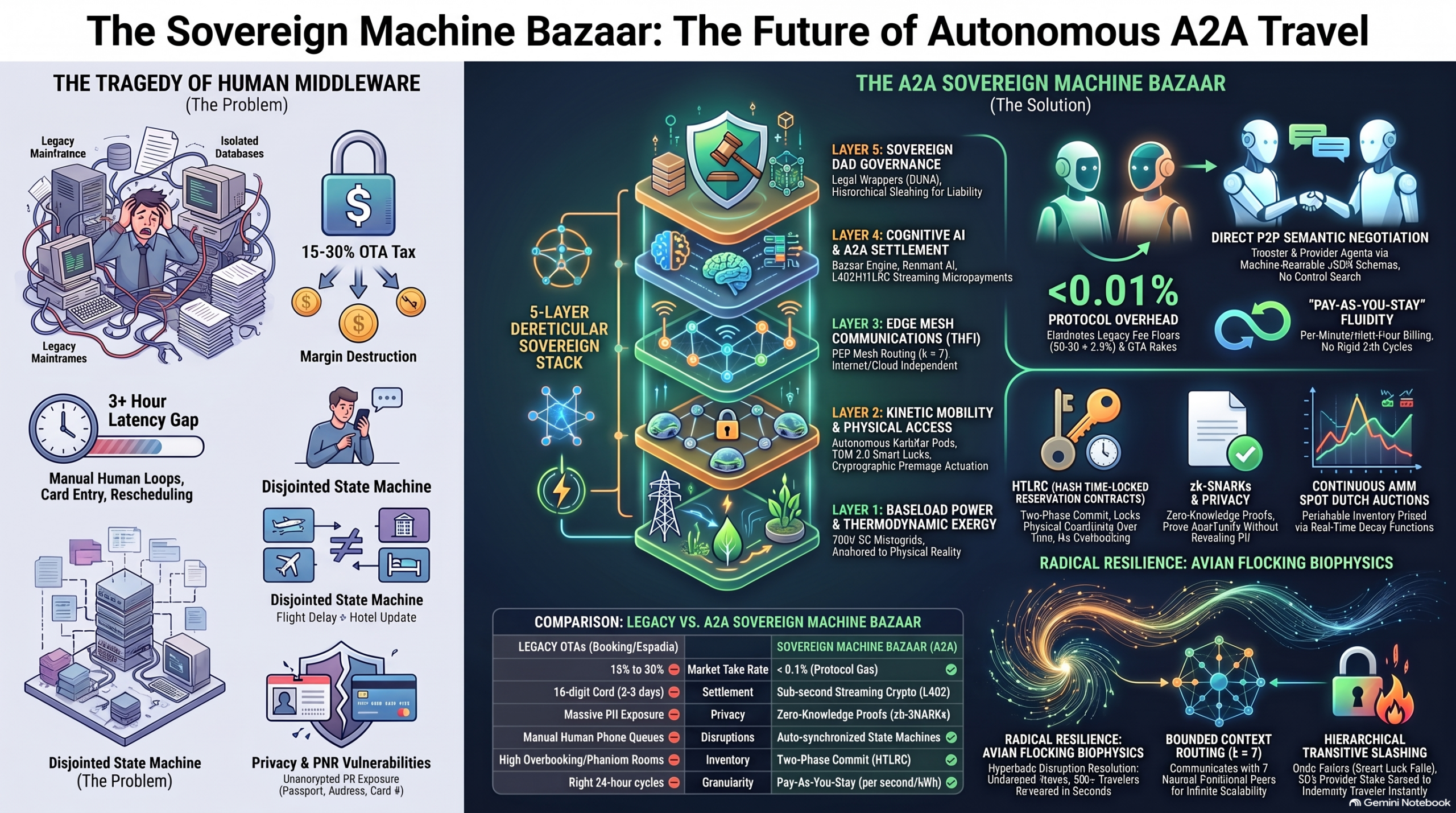
For the last four decades, travel distribution has been held hostage by a single, glaringly inefficient bottleneck: the human visual cortex staring into a backlit rectangle of glass. This is “Cognitive Capture”—the relatable, low-grade trauma of navigating dozens of browser tabs, manually reconciling schedules, and entering 16-digit credit card numbers into disjointed web forms.
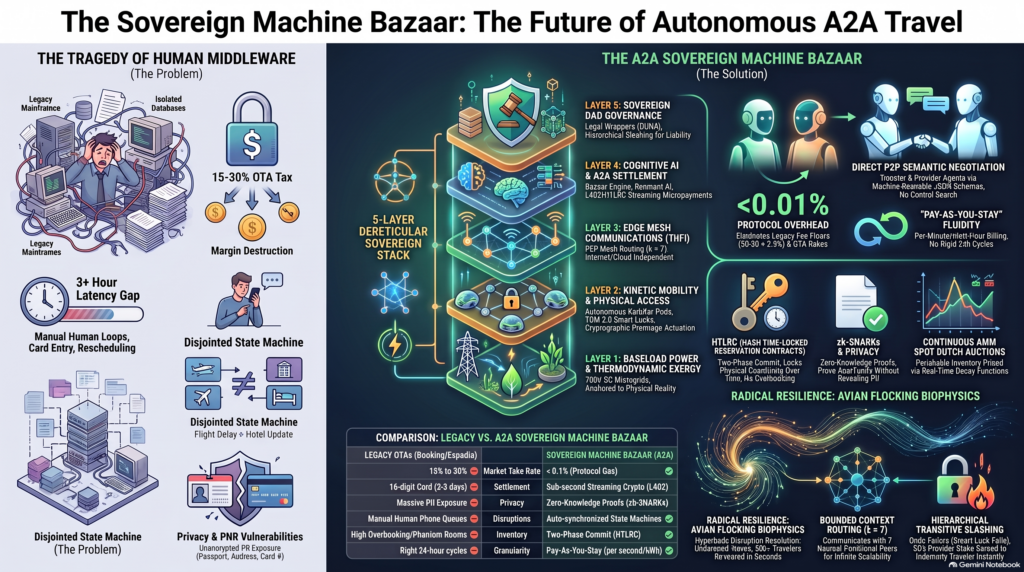
In the industry, we call this the “Tragedy of Human Middleware.” We have engineered hyper-advanced cognitive entities capable of synthesizing non-Euclidean protein structures in milliseconds, yet when these agents attempt to lease a transport pod or book a room, they are forced to halt. They must ring an asynchronous digital bell and wait for a biological human to wake up and type on a keyboard. We are now witnessing the terminal phase of this paradigm, moving from “Cognitive Capture” to “Ambient Passage.” In this new world, travel is no longer a procedural task you perform; it is a declarative intent—a goal like “get me to the energy summit by 18:00″—that a sovereign machine bazaar executes in the background of reality.
- The Death of the 30% “Middleman Tax”
The legacy travel infrastructure is an extractive pipeline dominated by a 20th-century mainframe architecture. Centralized Online Travel Agencies (OTAs) and the Global Distribution System (GDS) oligopoly—led by giants like Amadeus and Sabre—extract “commission tolls” ranging from 15% to 30%. These intermediaries provide neither the room nor the flight; they simply rent-seek by acting as human-facing search gateways.
Furthermore, “Rate Parity Clauses” in legacy contracts legally bar hotels from offering lower prices on their own sites, stifling direct price discovery. The Agent-to-Agent (A2A) pipeline returns this margin to providers and consumers by allowing a traveler’s sovereign agent to negotiate directly with a property’s management system. By eliminating these tolls and the associated administrative friction, over $120 billion annually is returned to the physical world.
Executive Summary & Paradigm Shift: “The emergence of Agent-to-Agent (A2A) Travel and Hospitality Platforms replaces fragmented, rent-extracting infrastructure with an open, machine-native economic network. The result: Milliseconds latency, sub-cent settlement, zero OTA toll, and an auto-synchronized itinerary.”
- Why Silicon is Done “Begging for Plastic”
AI agents currently face a “Plastic Wall.” While an agent can calculate a complex itinerary in milliseconds, it cannot walk into a bank or use a credit card for the sub-cent transactions required for a fluid economy. Legacy credit cards carry a fee floor of roughly $0.30 plus 2.9%, making it mathematically impossible for a machine to pay $0.005 for a 100-meter slice of an autonomous transit lane or $0.02 for a minute of lounge occupancy.
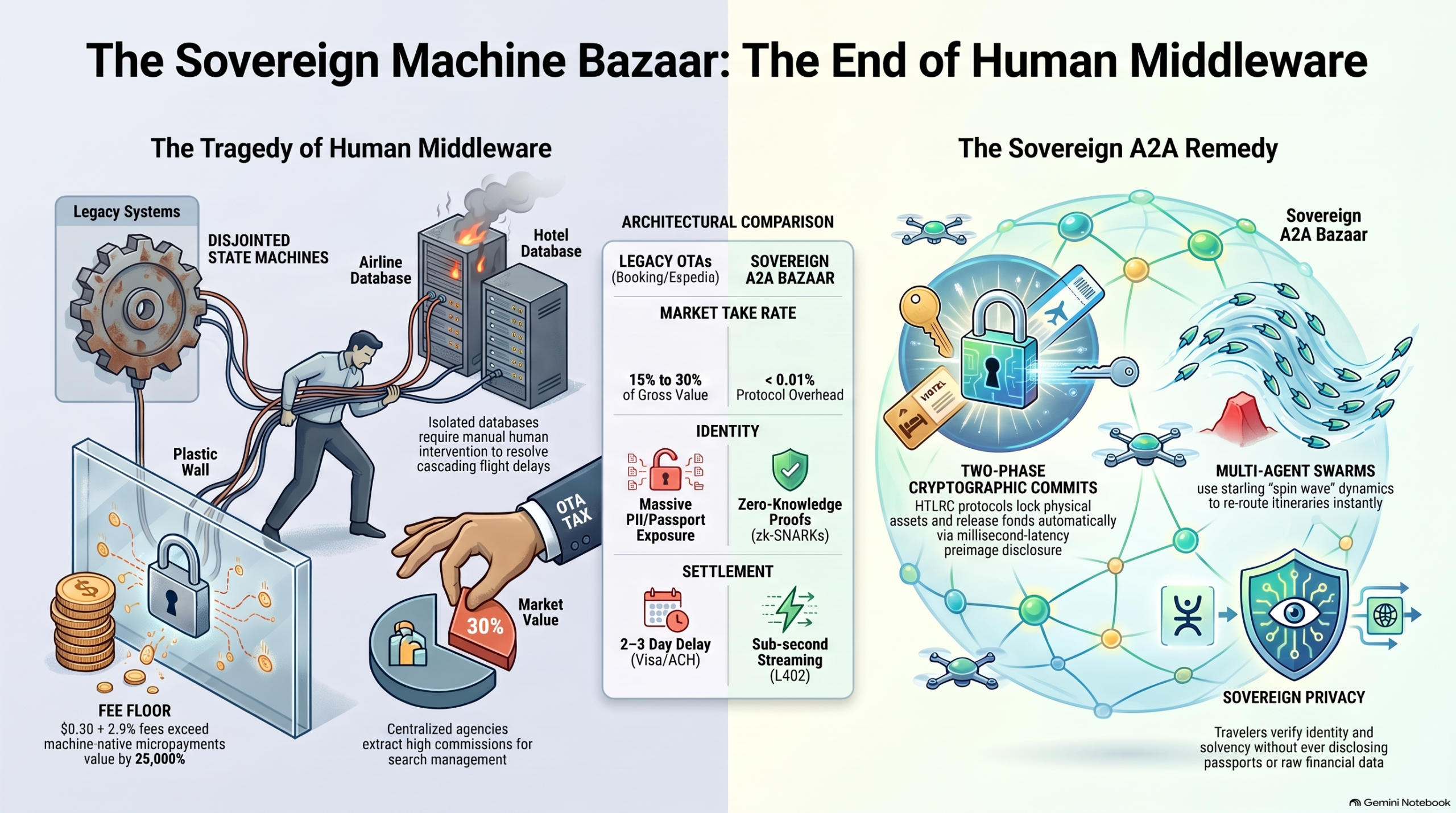
The Sovereign Machine Bazaar utilizes L402 streaming micropayment protocols. Funds flow as continuous micro-settlements—satoshis or stablecoin fractions—allowing for “Pay-As-You-Stay” mechanics. If a hotel room’s network speed drops below an SLA, your agent severs the stream in milliseconds.
The Three Pillars of Machine Money:
- Account Abstraction (ERC-4337 & ERC-6551): Smart contract wallets and Token-Bound Accounts allow agents to hold assets and execute mission-specific spending under on-chip TPM 2.0 hardware control.
- Streaming Micropayments: L402 Macaroons enable “Pay-As-You-Flow” billing, replacing rigid 24-hour hotel cycles with per-minute or per-watt charging.
- Thermodynamic Anchoring: Money is strictly bound to verified physical work capacity (exergy), preventing unbacked fiat debasement in the machine economy.
- Solving Travel Chaos with the Physics of Bird Flocks
Traditional travel platforms collapse during mass disruptions—like a blizzard grounding 50,000 travelers—because they rely on “diffusive” human customer service. Resolving a schedule conflict through back-and-forth chat is a first-order diffusive process requiring O(N^2) conversational turns, leading to hallucination and drift.
The Bazaar instead implements “Avian Flocking” dynamics (specifically modeled after starling murmurations). Using Topological k-NN (k ≈ 7), agents do not broadcast to every node in a city, which would cause “LLM Context Bloat.” Instead, they interact only with their seven nearest functional neighbors.
Information propagates through the network as Second-Order Hyperbolic Spin Waves. Updates sweep across the agent mesh as undamped waves at speeds of 20–40 m/s, resolving mass re-bookings in O(N) or O(\log N) time. While human call centers would take days, a murmuration of agents synchronizes the entire multi-modal reorganization in under 10 seconds.
- Privacy Without “Strategy Leakage”
Legacy travel requires massive over-disclosure of PII (Personal Identifiable Information). To book a flight, you must scatter your passport number and home address across vulnerable corporate databases, inviting “strategy leakage” or targeted surveillance.
The Bazaar adapts the Old Babylonian Cased Tablet (ca. 2000 BCE) for the digital age. In this protocol, the “Core” (your budget and route) is hidden by an “Envelope” (a zk-SNARK). Using Zero-Knowledge Proofs, your agent proves to a hotel that:
- You hold a valid government-attested passport.
- You meet the age requirement (e.g., Age ≥ 21).
- Your account has the necessary solvency for the stay.
The provider receives a mathematical proof of eligibility without ever seeing your actual passport number or bank balance. The door lock actuates because the math is satisfied, ensuring absolute privacy of movement.
- The “Thermodynamic Veto” and Level 0 Reality
A critical innovation of this future is RELA Axiom 3, also known as the “Biophysical Veto.” We distinguish between Level 2 Integrity (the cryptographic ledger proving a contract wasn’t tampered with) and Level 0 Ontic Truth (physical reality).
Ledgers cannot declare physical facts. The Bazaar is anchored to hardware relays like calorimeters and DC bus shunts. A transaction is only valid if the local microgrid has the actual net physical work capacity (exergy) to support it. If a hotel promises a room but the sensors show a grid deficit or a broken HVAC, the “Thermodynamic Veto” trips a firmware relay, halting the agent’s expenditure. By grounding the economy in EROEI (Energy Return on Energy Invested), we ensure the machine economy remains aligned with the objective laws of physics.
The Horizon of Invisible Journeying
To bridge the final gap between silicon and carbon, these journeys are compiled into Lean 4 Abstract Syntax Trees (ASTs) for formal deductive verification, ensuring the machine never “hallucinates” your itinerary. Legally, these agents operate within Wyoming DUNA or Marshall Islands DAO LLC wrappers, granting algorithms the legal standing to manage balance sheets and settle escrows.
We are entering a world where the friction of movement vanishes. By shifting the economic imperative from capturing human attention to maximizing thermodynamic execution, we return the value of travel to the people providing the beds and those sleeping in them.
Are we ready for a world where the friction of movement vanishes, leaving only the pure intent of the journey?