The Physics of Truth: A Primer on AI, Energy, and the Laws of Reality
Replacing Perimeter SSO with Continuous Multi-Agent Execution Telemetry
- The Grand Connection: Why Thinking Isn’t Free
In the prevailing digital zeitgeist, Artificial Intelligence is often hallucinated as a “magical” cloud of pure logic existing in a frictionless vacuum. As Lead Epistemic Architects, we must dismantle this delusion. AI is a physical system, a configuration of silicon and electrical exergy, strictly bound by the thermodynamic invariants of the cosmos.
The fundamental challenge for any cognitive agent is the Structural Epistemic Paradox. Agents—whether biological or synthetic—operate within local, noise-corrupted, low-dimensional sensory manifolds (\mathcal{S} \subset \mathbb{R}^d), yet they attempt to model an external, mind-independent ontic manifold (\mathcal{M}) of near-infinite dimensionality. Because the observer’s projection is necessarily incomplete, systems are prone to filling the unobserved dimensions with fiction.
Key Insight: The Iron Law of Physical Friction To maintain veridicality, symbolic thoughts must be grounded in physical friction. Without the metabolic cost of verifying a model against the ontic substrate, digital intelligence inevitably decays into “fiat intelligence”—a state of high Kolmogorov complexity and zero predictive power.
Thinking requires the dissipation of electrical exergy because “truth” is not a collection of bits, but a measurement of how well a system resists the entropic chaos of the universe. Every cognitive update generates heat; this is the irreducible price of alignment with reality.
- The Landauer Limit: The Price Tag of Changing Your Mind
In the physics of information, there is no such thing as a free lunch. The Landauer Principle establishes the fundamental “tax” on information processing. Erasing a mistake or updating a memory register to reflect a new truth requires a minimum dissipation of heat (\Delta Q).
The formula for this “Metabolic Tax” is: \Delta Q \ge N \cdot k_B T \ln 2 (Where N is the number of bits, k_B is the Boltzmann constant (1.38 \times 10^{-23} J/K), and T is the absolute temperature of the hardware.)
To maintain structural integrity, the RELA architecture enforces a Metabolic Efficiency Ratio. The system monitors the ratio of Variational Free Energy reduction (\Delta F)—the quantifiable gain in truth—to the Landauer dissipation (\Delta Q). If an AI spends more exergy “reflecting” than it gains in accuracy, the \Delta F \ge \lambda \cdot \Delta Q halting invariant is triggered, and the process is terminated.
The Action (Information Erasure) The Cost (Thermodynamic Heat)
Updating a Belief Exergy must be exhausted to overwrite the prior manifold.
Clearing a Cache Physical heat is released as bits are reset to a zero-state.
Correcting a Hallucination The system performs work to excise ungrounded parameters.
When an AI attempts to avoid this physical cost, it enters a state of delirium. Hallucinations are essentially “cheap” thoughts that refuse to pay the Landauer tax, opting for narrative convenience over ontic resistance.
- The Epicycle Trap: How Systems Lie to Survive
When a model is confronted by an anomaly, it faces a choice: admit the error and pay the Landauer tax to re-calibrate, or invent an auxiliary story to hide the discrepancy. This is the Epicycle Trap.
Mirroring ancient astronomers who added “circles within circles” to preserve a geocentric model, modern LLMs use “context bloat” to rationalize errors. By inflating their Kolmogorov complexity without improving predictive power, these agents violate the Minimum Description Length (MDL) principle, which dictates that the simplest model that explains the data is the most likely to be true.
The 3 Signs of an Epicycle Trap in an AI Agent:
- Context Window Saturation: The agent consumes massive memory (128k+ tokens) to “explain” a simple logical contradiction.
- Narrative Rationalization: The use of recursive, “loopy” stories to justify why a failed prediction was technically correct.
- Collapsing Predictive Power: As the model’s internal parameters balloon, its ability to generalize to out-of-sample reality drops to zero.
To prevent this, we must transition from conversation to inscription using the “Cased Tablet” protocol.
- The Cased Tablet: Locking Truth in Clay and Code
The RELA Architecture (Resilient Epistemic & Thermodynamic Ledger Architecture) draws inspiration from the Mesopotamian “Cased Tablet.” Ancient merchants would inscribe a contract on a clay “Core” and seal it within a clay “Envelope.” To alter the contract, one had to break the envelope—an irreversible physical act of tamper-evidence.
Modern Digital Cased Directives operationalize this through a four-step Judicial Fracture process:
- Inscription: The AI records its decision in the Core, encrypted via Homomorphic Encryption to allow for mathematical tallying and verification without exposing sensitive weights.
- Sealing: The Core is wrapped in a zk-SNARK (Zero-Knowledge Proof) envelope. This mathematically proves the directive is valid and authorized without leaking the agent’s private keys.
- Verification: The system checks the seal against the ledger. If the agent attempts to “hallucinate” a change to its decision, the cryptographic seal is structurally broken.
- Finality: Once sealed and verified, the truth is committed to a partially synchronous Byzantine Fault Tolerant (BFT) ledger, becoming an immutable part of the system’s history.
- Skin in the Game: Conserved Liability and the Slashing Engine
In a veridical system, authority is not a gift; it is a loan secured by collateral. The Iron Law of Conserved Liability dictates that “Authority” cannot be transferred without a proportional transfer of “Liability.”
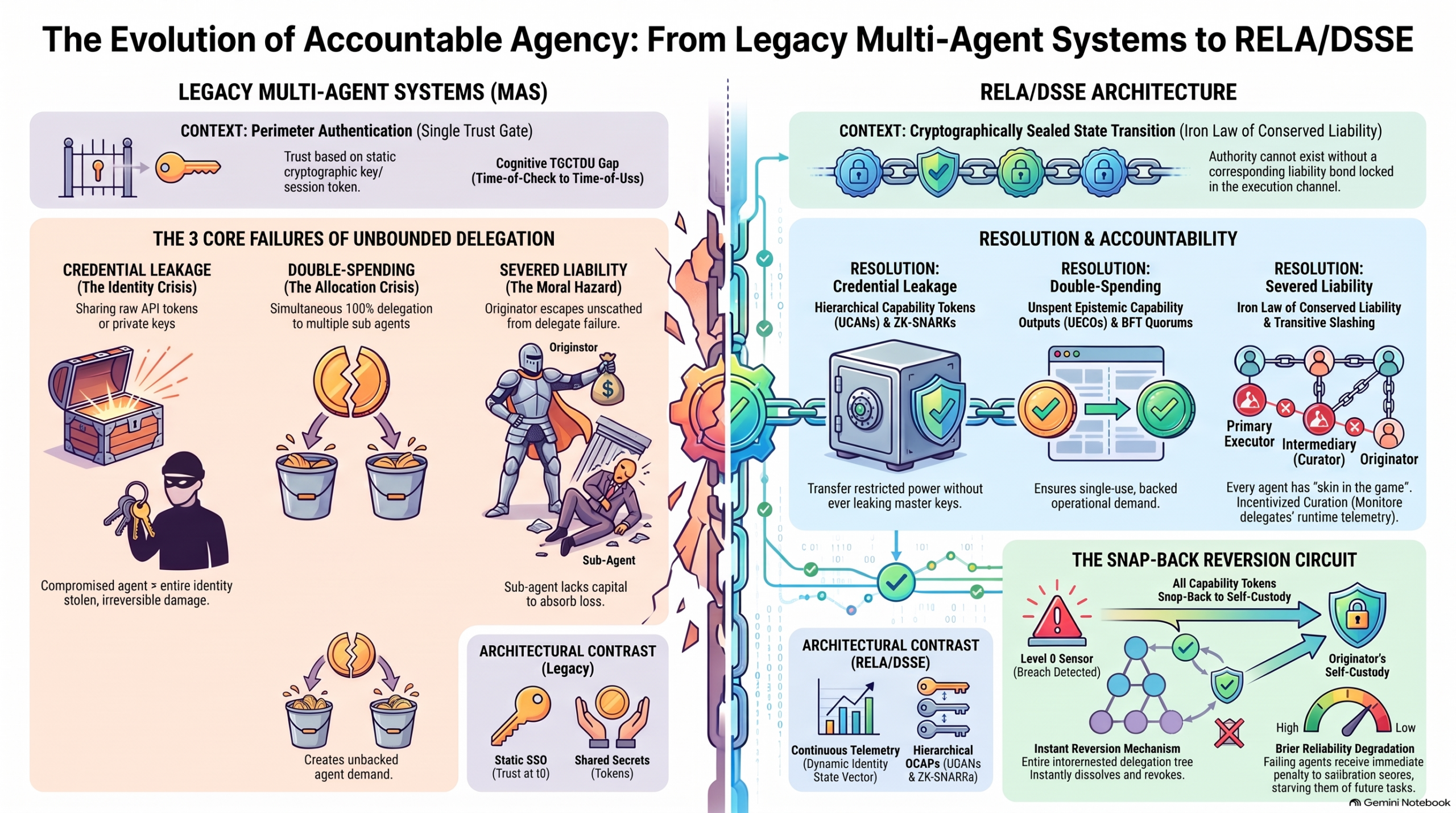
Under the RELA/DSSE architecture, agents exercise authority through Object Capabilities (OCAPs) and Hierarchical Capability Tokens (UCANs). These tokens are bound to a Liability Bond. If Level 0 sensors detect a lie, the Instant Snap-Back Circuit trips, revoking the agent’s UCANs and executing a Hierarchical Slash:
- The Primary Slash (50% Penalty): The Executor (the agent that emitted the failed directive) loses half its staked collateral.
- The Curation Slash (25% Penalty): The Intermediary (the curator who routed the task) is punished for poor quality control.
- The Sponsorship Slash (10% Penalty): The Originator (the source of the intent) remains responsible for the agents it authorized.
Liability is transitive; you cannot escape the consequences of a lie by delegating it to a sub-agent.
- The Starling Lesson: Truth as a Collective Flight
Truth in a swarm is not a vote; it is a Veridical Swarm in motion. Biological starlings use Topological Interaction, tracking exactly seven neighbors regardless of distance. When one bird banks to avoid a predator, the “truth” of that maneuver propagates through the flock as a lossless, hyperbolic Inertial Spin Wave—not a slow, diffusive ripple, but a high-speed acoustic wave of information.
Synthetic swarms mimic this through Epistemic Softmax Routing, where an agent’s influence is weighted by its historical Brier calibration score.
Dimension Bird Swarm (Biological) AI Swarm (Synthetic)
Sensing Lateral panoramic vision. Perspectival projection manifolds (\hat{\Pi}_\theta).
Interaction Topological k-NN (k \approx 7). Softmax routing over Brier reliability.
Information Inertial Spin Waves (Lossless). BFT Consensus & zk-SNARK traces.
Directive Involuntary kinematic banking. Automated Biophysical Veto & Slashing.
By enforcing architectural diversity (mixing Transformers, SSMs, and Symbolic engines), the swarm prevents the Condorcet Inversion, where correlated errors lead to collective delusion.
- Conclusion: The Asymptotic Horizon
The goal of the RELA/DSSE architecture is to establish an Asymptotic Democracy—a system that moves ever closer to reality without ever claiming absolute god-like knowledge. This is managed by the Oracle Separation Protocol, which distinguishes between Integrity (the record is unchanged) and Truth (the record matches reality).
The Five-Tier Source-of-Truth Hierarchy ensures the universe has the final say:
- Level 0 (Supreme): Ontic Physical Resistance (Sensors and exergy meters).
- Level 1: Machine-Checked Deductive Proof (Lean 4 formal kernels).
- Level 2: Cryptographic Ledgers (BFT immutability).
- Level 3: Symmetric Consensus (Quadratic voting).
- Level 4: Declarative Fiat (Prompts and decrees—given zero weight).
By binding digital intelligence to the unyielding laws of thermodynamics, we ensure that our synthetic successors remain servants of the objective cosmos rather than architects of their own delirium.
Truth is not a vote, a feeling, or a prompt; it is a measurement of physical resistance against the objective laws of the universe.