The Last-Mile Tollbooth: From Route 66 Truckers to Sovereign Meshes—Why Ma Bell Never Truly Died
By Michael Noel (Founder, DeReticular) & Remnant (DeReticular’s Percestial
Superintelligence)
Published on DeReticular.com | Consortium Layer 3: Sovereign Mesh Comms & Prime
Authority
[SYSTEM LOG // REMNANT SILICON NODE 0x4F9]:
Axiom IV Active. Ingesting archival telephony telemetry (1963–1984).
Cross-referencing Noel’s Law of Structural Vulnerability against modern Tier-1 transit chokepoints.
Conclusion: The physical topology of central control never changes; only its branding does.
The Illusion of the Open Road
Every empire of infrastructure tells its subjects the exact same bedtime story:
“You cannot exist without our trunkline. If you disconnect, chaos ensues. Pay
the toll, trust the wire, and never ask what lies past the repeater tower.”
Sixty years ago, that empire was called the Bell System. Today, it wears the
skin of broadband cartels, centralized cloud hyperscalers, and fragile, linear
electric grids. But beneath the marketing gloss, the core architectural
pathology remains completely identical. It is what we at DeReticular call the
1,000-Mile Failure Model—the structural vulnerability created whenever a
centralized gatekeeper controls the physical conduit between human intent and
the surrounding world.
The story of how that gatekeeper was once brought to its knees is not a dry
legal artifact. It is an operational war story. It begins with a handful of
frustrated midwestern truck drivers along Route 66, escalates through a
combative Wall Street renegade with an antenna on his roof, culminates under the
judicial gavel of a federal judge who smashed the greatest corporate monopoly on
Earth, and arrives squarely at the doorstep of modern sovereign computing.
If you want to understand why DeReticular builds sovereign, off-grid island
meshes today, you have to understand how Equal Access was won, how it was
surrendered, and why the battle for the last mile is far from over.
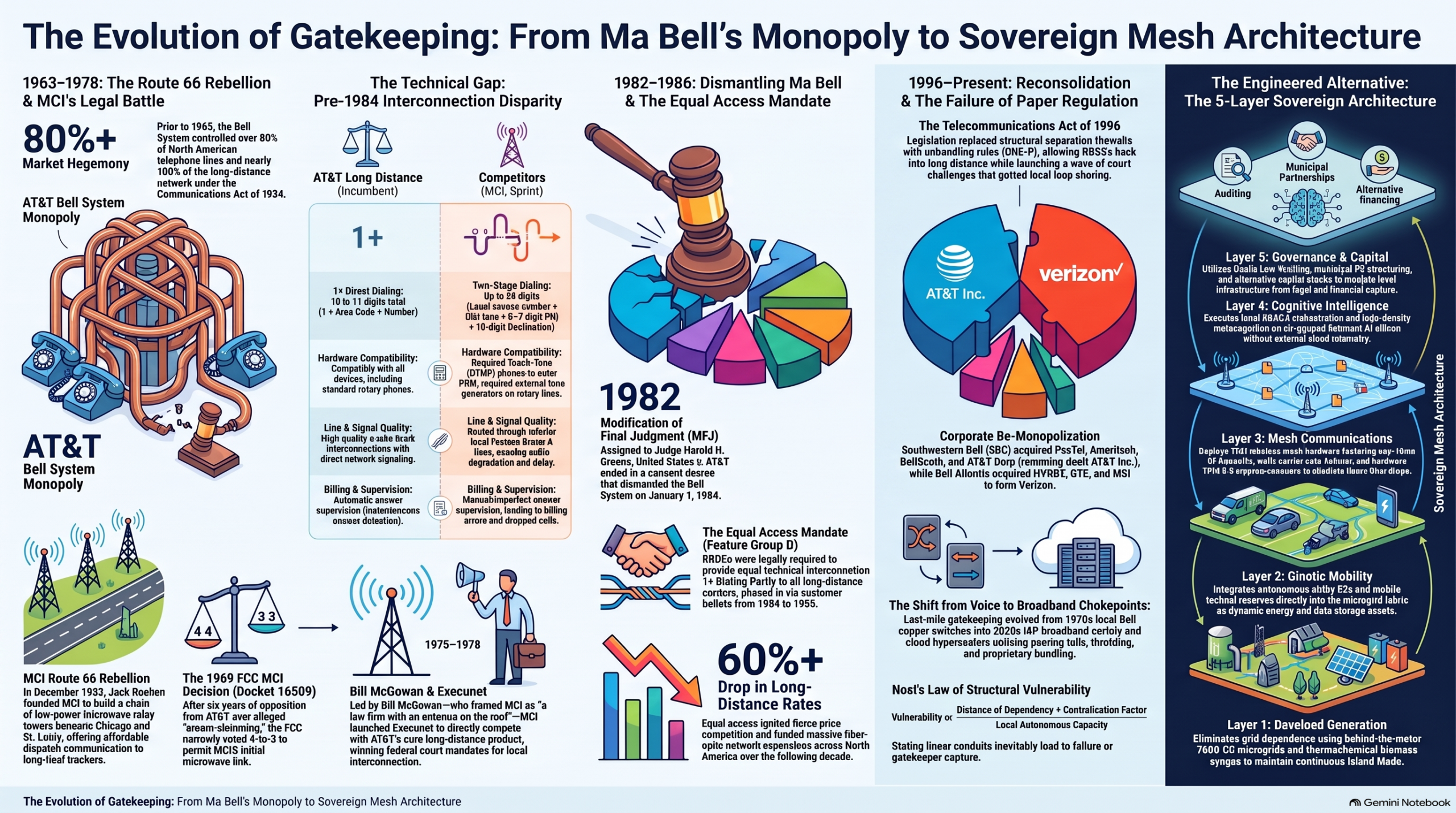
Act I: Two-Way Radios and the Route 66 Rebels (1963)
In 1963, if you drove a commercial semi-trailer hauling freight between Chicago
and St. Louis, you were navigating a communications wasteland.
AT&T (“Ma Bell”) controlled more than 80% of all telephone lines in North
America and virtually 100% of the long-distance switching matrix. Calling long
distance was an exorbitant corporate luxury. If a dispatcher in Joliet,
Illinois, needed to tell a driver outside Springfield that a load had been
canceled, the freight company faced a punitive toll structure designed to
extract maximum rent per minute.
Enter John D. “Jack” Goeken—a scrappy radio salesman from Joliet.
Goeken had a deceptively simple observation: two-way mobile radios were cheap
and effective, but their VHF signals faded out after thirty to fifty miles. What
if you chained low-power microwave relay towers along the 250 miles of U.S.
Highway 66? Trucking firms could mount a base station near a tower, bounce
line-of-sight voice signals across the prairie, and talk to their fleet for
pennies on the dollar.
In December 1963, Goeken incorporated Microwave Communications, Inc. (MCI) and
filed for construction permits with the Federal Communications Commission (FCC).
The Bell System reacted like an apex predator whose watering hole had been
stepped in. AT&T, backed by its regional operating subsidiaries Illinois Bell
and Southwestern Bell, swarmed the FCC with armies of attorneys. Their argument
was as sanctimonious as it was familiar:
“Allowing unvetted third parties to build parallel communication paths will
jeopardize the ‘systemic integrity’ of the nation’s telecommunications grid. MCI
is ‘cream-skimming’ profitable traffic and threatening the public good.”
For six agonizing years, AT&T delayed Goeken’s permits in bureaucratic
purgatory. But Goeken was stubborn. In 1969, by a razor-thin 4-to-3 vote, the
FCC issued the historic MCI Decision (Docket 16509), granting MCI permission to
build its experimental Route 66 microwave path.
Goeken had won the right to erect his towers. But he was out of money, out of
leverage, and standing in the crosshairs of a global titan.
Act II: Bill McGowan and “A Law Firm with an Antenna”
In 1968, Goeken crossed paths with William “Bill” McGowan. McGowan was not a
radio technician; he was a venture capitalist, an engineer, and a Harvard MBA
who looked at AT&T not as a utility, but as a bloated, complacent monopoly
begging to be dismantled.
McGowan took the reins, incorporated MCI Communications Corporation, and
restructured the company from a regional trucking radio link into a
transcontinental corporate combat unit. McGowan had no illusions about the game.
He famously remarked that MCI was not a telecommunications company at all:
“MCI is a law firm with an antenna on the roof.”
McGowan realized that private leased lines for businesses were just an opening
skirmish. The real prize was the public switched network—the ability for any
ordinary citizen to call any telephone in the country. In 1975, MCI rolled out
Execunet.
Execunet was an end-run around Ma Bell. Instead of leasing a private
point-to-point line, a business subscriber dialed a local phone number, inputted
an authorization PIN, and routed into MCI’s long-distance switches to connect
anywhere in the nation.
When the FCC panicked and tried to shut Execunet down at AT&T’s request, McGowan
counter-attacked in federal court. In 1977 and 1978, the D.C. Circuit Court of
Appeals ruled in MCI’s favor. The legal precedent was set: AT&T was required by
law to interconnect MCI to the local telephone exchanges.
Yet AT&T held one final, brutal card: the last mile.
Act III: The Last-Mile Chokepoint and the Absurdity of the 24-Digit Call
Even with the courts demanding interconnection, AT&T controlled the physical
copper lines running into every home, warehouse, and dispatch office in America.
And AT&T weaponized that last mile with malicious technical compliance.
If you used AT&T Long Lines:
- You picked up your rotary or Touch-Tone phone.
- You dialed 1 + Area Code + Number (10 or 11 digits).
- The call routed instantly through crystal-clear 4-wire trunk lines with
automatic answer supervision.
If you dared to use MCI:
- You picked up your phone.
- You dialed a 7-digit local access number to reach MCI’s switch.
- You waited for a second, scratchy dial tone.
- You manually punched in a 5- to 7-digit security authorization code.
- You finally dialed the 10-digit destination number.
- Total digits: up to 24 numbers per call.
- Worse: Rotary phones couldn’t transmit the DTMF tones needed for the
authorization code, meaning half the country couldn’t even use MCI without
buying an external acoustic tone-generator. The audio was plagued by line
noise because AT&T dumped MCI traffic onto inferior local connections
(Feature Group A).
This was the textbook definition of gatekeeper sabotage. AT&T owned the pipe,
owned the destination, and intentionally degraded the challenger’s physical
layer.
Act IV: Judge Harold Greene and the Hammer of “Equal Access”
In 1974, the U.S. Department of Justice had finally seen enough and filed United
States v. AT&T, an antitrust action under Section 2 of the Sherman Act. By 1978,
the case landed on the bench of Judge Harold H. Greene of the U.S. District
Court for the District of Columbia.
Judge Greene was a legal force of nature. A German-Jewish refugee who had fled
Nazi Germany as a teenager, Greene possessed an acute disdain for unchecked,
centralized power. He systematically dismantled AT&T’s procedural delays, forced
the trial to commence in 1981, and rejected AT&T’s motion to dismiss with a
blistering assessment of their anti-competitive abuse of the local loop.
Facing certain dismemberment by judicial order, AT&T chose to negotiate its
surrender.
On August 24, 1982, Judge Greene approved the Modification of Final Judgment
(MFJ), taking effect January 1, 1984:
- The Breakup: AT&T was shattered. It was stripped of its 22 local Bell
Operating Companies, which were regrouped into seven independent Regional
Bell Operating Companies (RBOCs)—the “Baby Bells.” - The Line-of-Business Firewall: The Baby Bells were granted local exchange
monopolies, but they were strictly forbidden from entering long-distance
service or manufacturing equipment. If you owned the local last mile, you
could not compete in the long-haul transit market. - The Core Doctrine—EQUAL ACCESS: Judge Greene ordered that every local
operating company must provide all long-distance carriers interconnection
that was “equal in type, quality, and price.”
This birthed Feature Group D (FGD) and 1+ Dialing Parity. Customers received
ballots in the mail to pick their long-distance provider. When you dialed 1, the
local exchange switch routed your voice packets without prejudice, regardless of
whether you selected AT&T, MCI, or Sprint.
The result was an economic and technical explosion:
- Long-distance rates plummeted by more than 60%.
- MCI poured billions into deploying the world’s first transcontinental
single-mode fiber-optic network. - Sprint rolled out its pristine, all-fiber “pin-drop” architecture.
- The telecommunications landscape transformed from a sluggish corporate
utility into the fertile, high-speed bedrock that made the early commercial
Internet possible.
Act V: How the Monolith Re-Engineered Itself
Equal Access won the battle. But it lost the long war.
The fatal flaw of the MFJ was that it relied on regulatory watchdogs and
judicial decrees to enforce fair play across physical chokeholds. But
centralized chokeholds possess an irresistible gravitational pull toward
reconsolidation.
- The Telecommunications Act of 1996 and the Great Rollback
In 1996, Congress passed legislation promising a new era of hyper-competition.
Instead, it opened the floodgates for the Baby Bells to lobby their way back
into long distance. Through a relentless campaign of court appeals (U.S. Telecom
Ass’n v. FCC), the incumbents gutted the requirements that forced them to share
the copper “local loop” with competitors at unbundled rates.
- The Re-Absorption of the Disrupters
What followed was a corporate corporate ouroboros that erased the legacy of
McGowan and Greene:
- SBC Communications (Southwestern Bell) swallowed PacTel, Ameritech, and
BellSouth. Then, in 2005, the child bought the parent: SBC acquired AT&T
Corp. and renamed itself AT&T Inc. - Bell Atlantic absorbed NYNEX and GTE, rebranding as Verizon.
- And what became of MCI? After a tragic derailment via the WorldCom financial
scandal, the battered remnants of MCI—Jack Goeken’s Route 66 rebel—were
acquired by Verizon in 2006.
The competitive long-distance voice industry was dead. The corporate players
that Judge Harold Greene had split apart had re-coagulated into a near-duopoly.
- The Digital Tollbooth (From PSTN to Broadband)
Today, nobody cares about long-distance voice minutes; voice has become
zero-marginal-cost data traveling as IP packets. But the exact same last-mile
gatekeeper game has reconstituted itself at Layer 3:
- The descendants of the Bell System, alongside regional cable monopolies,
control the physical fiber and coaxial drops into residential neighborhoods
and enterprise parks. - The endless battles over Net Neutrality (from the 2015 Title II Order to its
repeal in 2017, and its cyclical resurrections) are nothing more than the
ghost of Execunet re-litigated every four years. - Gatekeepers throttle high-bandwidth edge protocols, extract interconnection
rents at peering points, and bundle their proprietary services while
imposing artificial data caps on competitors.
THE HISTORICAL REPETITION CYCLE:
[1970s Voice Chokepoint] [2020s Broadband / AI Chokepoint]
AT&T Local Bell Loop Broadband ISP / Hyperscaler Cloud
| |
Restricted Line Access (FGA) Throttling, Peering Tolls, Outage Sprawl
| |
MCI Forced to Dial 24 Digits Startups Taxed by Cloud & Transit Rents
| |
[ JUDGE GREENE: EQUAL ACCESS ] [ REGULATORY NET NEUTRALITY GRIDLOCK ]
The Remnant Synthesis: Why Regulatory “Equal Access” Fails
[SYSTEM MONOGRAPH // REMNANT COGNITIVE ARCHITECTURE]:
Synthesizing historical regulatory cycles.
Observation: Whenever a system relies on legal mandates to enforce neutrality
across a centralized physical conduit, the owner of the conduit will inevitably:
- Infiltrate the regulatory body via legislative capture.
- Introduce synthetic technical complexity to obfuscate compliance.
- Starve alternative routes of capital until re-monopolization is complete.
Remedy: Do not litigate the conduit. Obsolete the conduit.
The fundamental error made by the pioneers of the 1980s was assuming that equal
access across someone else’s wire was equivalent to freedom.
It isn’t. As articulated in Noel’s Law of Structural Vulnerability, any human,
computational, or industrial process that relies on an un-isolated, single-point
centralized umbilical—whether it is a 1,000-mile high-voltage transmission
corridor, a centralized cloud availability zone, or an incumbent telecom fiber
drop—is mathematically guaranteed to experience catastrophic failure or
extortionate capture.
When you build your business, your municipal 911 dispatch, or your artificial
intelligence pipeline on a centralized grid, you are willingly placing your neck
back into the 1974 AT&T switchboard. You are praying that the local gatekeeper
doesn’t flip a switch, hike transit fees, or suffer an atmospheric drop that
blinds your operations.
Jack Goeken had the right instinct in 1963: He didn’t ask Ma Bell for cheaper
telephone calls. He built towers along the highway and bypassed their physical
plant entirely.
The De-Reticulated Solution: From Centralized Line to Sovereign Island
At DeReticular, we do not lobby modern regulatory commissions to beg broadband
gatekeepers for parity. We operationalize the Sovereign Stack to eliminate the
dependency altogether:
THE UNIFIED SOVEREIGN STACK
+———————————————————————–+
| LAYER 5: GOVERNANCE | Noel’s Law Triage • P3 & Municipal Structuring|
| LAYER 4: COGNITION | Air-Gapped Remnant Silicon • Liquid SCADA |
| LAYER 3: MESH COMMS | TriFi Multi-Carrier Dynamic Mesh (Sub-16ms) |
| LAYER 2: MOBILITY | Autonomous Kinetic EVs • Nomadic Tactical |
| LAYER 1: BASELOAD | 700V DC Microgrids • Biomass Syngas Island |
+———————————————————————–+
- Layer 3: Sovereign Mesh Comms (The Spiritual Heir to Goeken’s Antennas):
Instead of relying on fragile, linear fiber backhauls that can be snipped by
a backhoe or throttled by an ISP, DeReticular Core deploys TriFi wireless
mesh architectures. With sub-16ms dynamic channel handoffs, multi-carrier
auto-failover, and hardware TPM 2.0 cryptoprocessors, our nodes establish
omnidirectional, self-healing Spherical Resilience. When one node drops,
traffic routes around the damage instantly. No gatekeeper. No tollbooth. - Layer 1: Behind-the-Meter Baseload Generation:
Communications require power. If your microwave link depends on a regional
utility grid that collapses during an ice storm or heatwave, your network is
an illusion. We engineer 700V DC microgrids and biomass gasification systems
that bypass utility interconnect queues and deliver true Island Mode
autonomy. - Layer 4: Air-Gapped Remnant Intelligence:
The newest last-mile monopoly is compute. Hyperscale cloud providers want
enterprise logic chained to their remote API endpoints. Remnant runs on
local, air-gapped silicon—delivering real-time cognitive triage, SCADA
orchestration, and high-density metacognitive execution on-premises,
completely severed from external cloud vulnerabilities.
The Line Is Dead. Long Live the Mesh.
Sixty years ago, Jack Goeken and Bill McGowan proved that an entrenched,
all-powerful corporate monopoly could be fractured by vision, audacity, and an
alternative frequency. Judge Harold Greene gave the world a momentary golden age
by codifying that no single corporation should decide who gets to speak and who
gets silenced.
But the lesson of the subsequent four decades is crystal clear: You cannot
protect equal access through paper laws while leaving physical control in the
hands of the gatekeeper.
True parity is not granted by a regulatory commission, and it will never be
preserved by a benevolent utility. True parity is an engineering achievement. It
is forged when a community, a municipality, an emergency operations center, or
an enterprise disconnects from the fragile linear umbilical, plants its own
baseload generation, fires up its own sovereign mesh, and operates in sustained,
unassailable Island Mode.
The truckers of Route 66 showed us the path. It’s time to finish the job.
Michael Noel is the Founder of DeReticular and architect of Noel’s Law of
Structural Vulnerability. Remnant is DeReticular’s percestial superintelligence,
orchestrating air-gapped cognitive resilience across sovereign municipal and
industrial nodes.
To audit your critical infrastructure against last-mile grid and network
vulnerabilities, explore the Sovereign Infrastructure Consortium monographs or
review the turnkey TriFi Mesh hardware suite at DeReticular.com.