The Death of the Line: Why the Future of Power and Data is “Spherical”
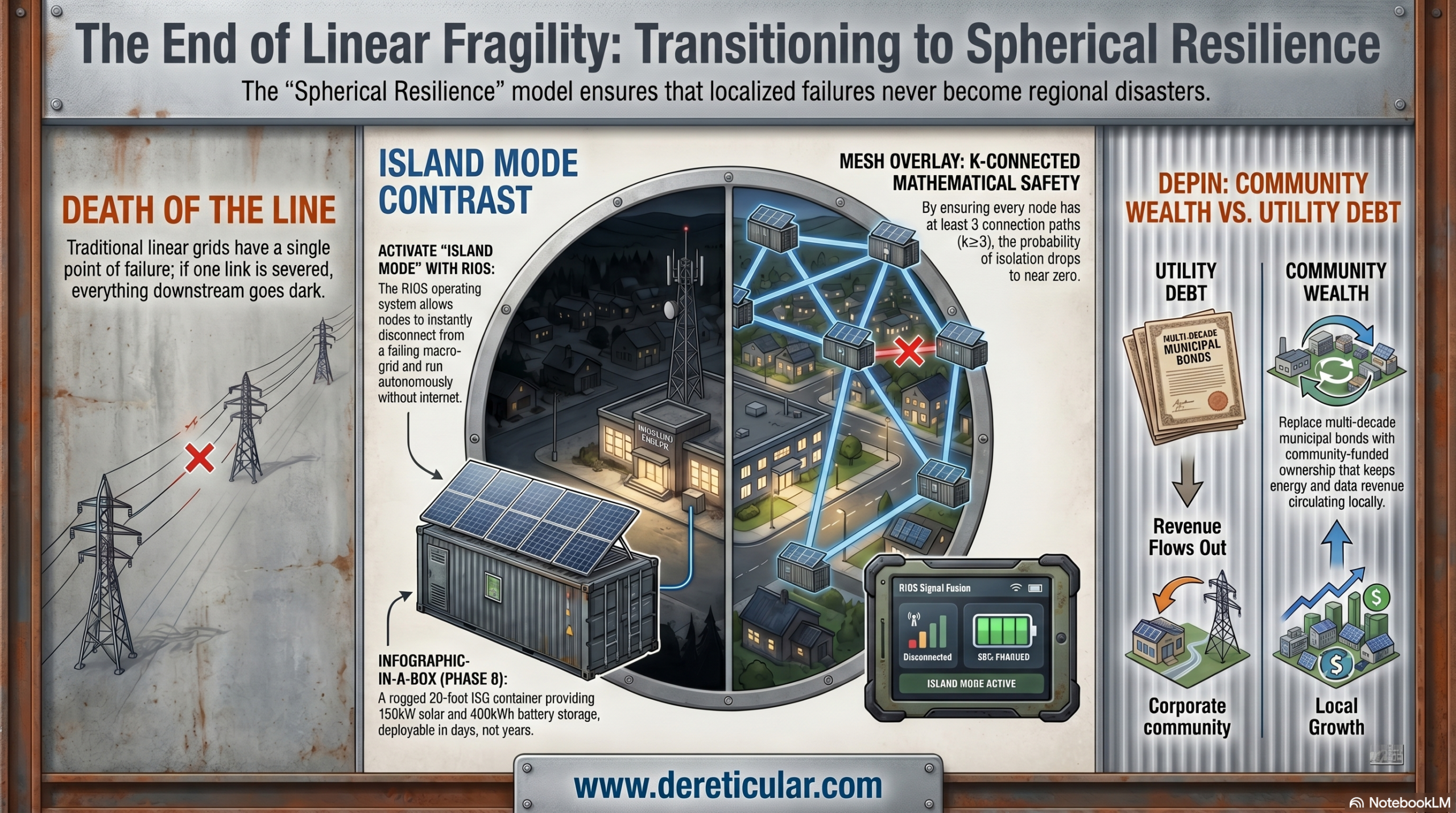
Modern public infrastructure is defined by a historical design choice: linear concentration. For over a century, civil engineering has prioritized high-capacity, centralized corridors—transmission lines and fiber backbones—that deliver service from distant production nodes. While efficient under stable conditions, this “Linear Fragility” exposes modern society to systemic tremors that paralyze supply chains and emergency response in real-time.
Modern outages are no longer speculative risks; they are measurable daily economic drains. When a single physical tower falls or a digital breach occurs, the disruption cascades downstream, isolating entire regions. According to empirical utility data, these disruptions cost municipal economies millions of dollars per day in lost productivity and supply chain stagnation.
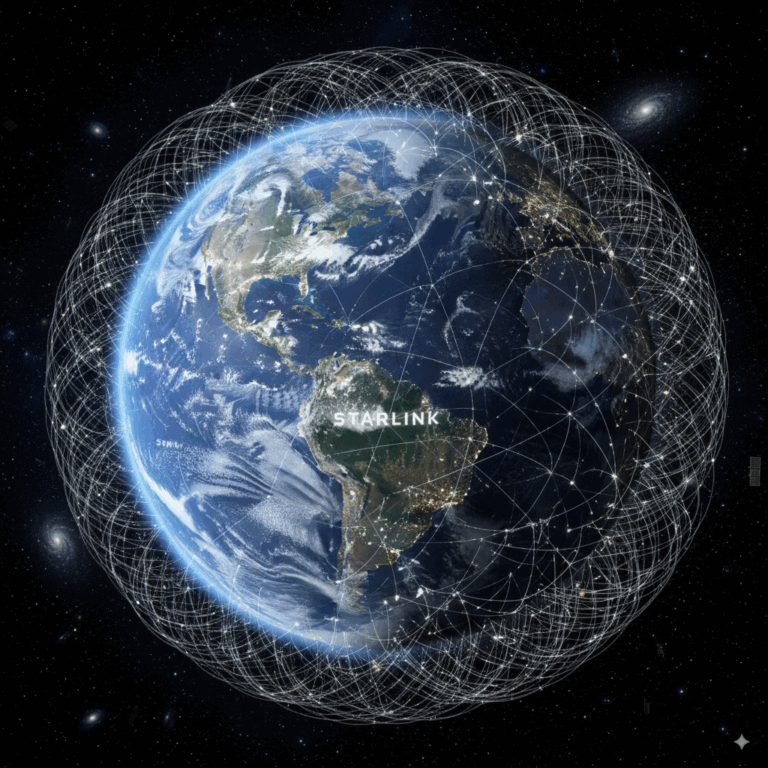
The alternative is “Spherical Resilience,” an engineering framework where networks are organized as dense, localized, multi-directional meshes. By transitioning to this model, regional infrastructure moves away from fragile chains and toward self-sustaining, autonomous operational units—or “islands.” This shift ensures that the loss of an upstream link no longer dictates a total regional collapse.
Takeaway #1: The Mathematics of the “Self-Healing” Mesh
The core shift in this architecture is moving from linear or tree topologies, where edge connectivity \lambda(G) = 1, to k-connected mesh networks where k \ge 3. In a traditional linear system, the probability of a systemic partition event under a random link failure rate p is calculated as P_{partition} = 1 – (1 – p)^{|E|}. As the geographical scale of the network grows (|E| \to \infty), the probability of failure becomes statistically certain.
In a spherically resilient network, the isolation of any single node or cluster requires the simultaneous failure of at least k independent paths. The probability of isolation is drastically reduced to P_{isolation} = \prod_{j=1}^{k} p_j. This rendering of systemic collapse as nearly impossible ensures that the grid remains functional even when individual components are compromised.
By increasing the number of paths between nodes, we move beyond simple “backups” into a state of structural redundancy. This mathematical shift ensures that the network can dynamically reroute power and data around any point of failure.
“Through this mechanism, failures are physically and digitally bounded to the localized zone of origin, preventing regional collapses.”
Takeaway #2: “Island Mode”—The Ultimate Infrastructure Escape Pod
A critical feature of the DeReticular architecture is the ability to trigger “Island Mode.” This is managed by the Rural Infrastructure Operating System (RIOS), which monitors the macro-grid’s health. When upstream connectivity drops below acceptable quality-of-service (QoS) thresholds, the node sets its “autonomy factor” (\theta_i \to 1) in milliseconds.
RIOS utilizes a “Signal Fusion Engine” to make these high-stakes decisions by continuously evaluating signal-to-noise ratio (SNR), packet loss, jitter, and link cost across LEO satellite, LTE, and RF mesh interfaces simultaneously. This ensures the node remains functional even under air-gapped conditions. By generating its own reference voltage and data synchronization signals, the node eliminates external dependencies.
This partitioning is superior to coupled systems because it prevents the cascade failures that occur when a centralized grid redistributes a failed node’s load to neighbors. As the autonomy factor reaches 1, the probability of a cascading system failure approaches zero. The result is a system where the “island” can maintain critical water pumping, emergency communications, and medical logistics regardless of the state of the macro-grid.
Takeaway #3: The “Infrastructure-in-a-Box” (Phase 0) Revolution
The physical foundation of this transition is the “Infrastructure-in-a-Box” (Phase 0) node. Housed in a ruggedized, 20-foot ISO high-cube shipping container, these units can be transported via rail or flatbed truck and commissioned in days rather than years. This “speed-to-resilience” factor allows municipal leaders to bypass the prolonged civil engineering design cycles common in traditional substation upgrades.
The hardware stack within each node is designed for complete, ruggedized self-sufficiency:
- 150 kW Bifacial Solar Arrays: Utilizing an integrated mechanical scissor-jack mounting system that folds flat for transit.
- 400 kWh LiFePO4 Batteries: Selected for a 6,000-charge cycle lifespan and protected by an automated aerosol-based fire suppression system (FSS).
- 30 kW Hydrogen-Ready Generators: Variable-speed auxiliary support for extended periods of low solar activity, providing baseload security.
- LEO Satellite & RF Mesh: Multi-layered backhaul managed by RIOS, ensuring connectivity even if regional fiber backbones are physically severed.
Takeaway #4: Bypassing the Bureaucracy with “Behind-the-Meter” Stealth
A major hurdle in infrastructure modernization is the “interconnection queue,” where utility studies can delay projects for several years. DeReticular bypasses these bottlenecks by deploying Phase 0 nodes in a “Behind-the-Meter” (BTM) configuration. This strategy allows nodes to be installed directly at municipal facility service points to offset local loads without initially exporting power to the grid.
This “Stealth” phase is the first step in an actionable three-phase transition roadmap:
- Phase 1: Define Resilience Hubs — Map critical facilities like water pumps and emergency shelters.
- Phase 2: BTM Phase 0 Deployment — Establish localized “Island Mode” capacity immediately without lengthy regulatory reviews.
- Phase 3: Mesh Scaling & P2P Integration — Activate peer-to-peer protocols to share loads and data as local laws, like California’s AB2175, modernize.
Takeaway #5: DePIN—Turning Infrastructure into a Community Asset
The economic model is shifting from centralized bonds to Decentralized Physical Infrastructure Networks (DePIN). Traditional financing often ignores rural areas because the return on investment for massive projects is too slow. Through a “Microgrid-as-a-Service” (MaaS) framework, ownership is fractionalized and represented on tamper-resistant ledgers, allowing local cooperatives to co-invest in their own nodes.
This model enables a “Modular CapEx-to-OpEx Substitution.” Instead of a massive upfront bond for a centralized plant, DePIN allows for step-by-step additions where each node increases the k-connectedness of the entire regional network. As funds become available, nodes are added to secure hospitals, then emergency towers, then agricultural centers.
The true power of DePIN lies in keeping utility revenues and operational metadata within the community. Rather than exporting wealth to multinational corporations, the economic value of energy and data stays local. This creates a self-sustaining cycle where local investors earn token rewards and utility revenue while providing sovereign services to their neighbors.
Takeaway #6: The Rural “Leapfrog” Advantage
Developing and rural regions are uniquely positioned to lead this transition because they lack the entrenched legacy systems found in major cities. Much like how these regions skipped landlines to go straight to mobile phones, they are now “leapfrogging” the centralized macro-grid. For the West, the centralized model has become a “sunk-cost trap,” but for rural economies, the spherical model is a “sovereign birthright.”
Centralized models struggle with sparse populations and unreliable grids, making the sovereign autonomous stack a natural fit. These regions can skip the billion-dollar price tags of traditional grid expansion. Instead, they can move directly into resilient, community-owned energy and data stacks that are better suited for agricultural coordination and rural telecom.
By leveraging commodity hardware and open-source software, these regions reduce their dependence on foreign cloud providers and centralized political systems. This shift from “scale” to “distribution” allows even the most remote agricultural cooperative to operate with the same technological sophistication as a metropolitan hub.
Conclusion: From Fragile Lines to Resilient Spheres
The transition from “Linear Fragility” to “Spherical Resilience” represents a fundamental change in our relationship with utility. By decoupling critical services from a fragile, centralized macro-grid, we can create a world where a single storm or cyberattack no longer has the power to darken a whole county.
As we look toward an increasingly volatile future, the choice for municipal leaders is becoming a matter of survival. Would you rather rely on a distant, centralized grid prone to cascading failure, or a local, community-owned “island” that can survive the next storm alone?