The Architecture of Ecological Integrity: Hardware-Anchored Cryptography for Global Carbon Compliance

1. The Strategic Realignment: From Avoidance to Verified Removal
The global carbon market is undergoing a fundamental structural realignment, pivoting from volume-driven “avoidance” offsets toward high-quality, durable “removal” credits. Historically, the market was dominated by legacy assets—such as avoided deforestation (REDD+) or early-stage renewable projects—which were frequently undermined by “soft baselines” and speculative counterfactuals. This reliance on subjective modeling has resulted in a systemic “trust deficit,” with over 15 million credits canceled recently due to integrity failures. To resolve this and enable institutional scaling, the market is shifting toward physical removals that can be mathematically and technologically verified. Hardware-anchored verification is the only viable path to providing the transparency required by corporate net-zero commitments and the emerging rigor of the ICVCM Core Carbon Principles (CCPs).
video
This “Flight to Quality” has created a stark bifurcation in market pricing and risk profiles, as detailed in the following table:
| Feature | Legacy Avoidance Credits | High-Integrity Removal Credits |
| Pricing Tiers | Depressed: Frequently <$5 per tonne | ARR: 22–55; Blue Carbon: 55–80; Engineered CDR: 115–1,100+ |
| Verification Methods | Manual plot-sampling; retrospective paper audits; satellite proxies | Hardware-anchored dMRV; real-time edge sensing; Zero-Knowledge Proofs |
| Primary Risks | Greenwashing; baseline manipulation; temporal latency | Technical: Requires hardware roots of trust; Environmental: Climate-induced reversal risks |
Strategic mandates like California’s AB 1305 and the EU’s CSRD now demand “Hard Physical Attestation”—a standard where the physical existence, quality, and carbon density of biomass are recorded on-site in an unalterable format. By integrating hardware-secured verification, the Sovereign Stack converts environmental claims into bankable, institutional-grade assets.
2. The Core Technologies of Automated Truth: ZKPs and ADC Sampling
The Rural Infrastructure Operating System (RIOS), known as “The Mind” of the Sovereign Stack, replaces fragile, cloud-dependent verification with hardware-sequestered workflows. RIOS is a solar-powered, AI-native environment designed to execute localized logic via the OpenClaw framework. By moving verification to the “edge,” the system eliminates the “Linear Fragility” of centralized registries and protects sensitive operational data from the vulnerabilities of the public cloud.
Zero-Knowledge Proofs (zkVerify) and the Carbon Oracle
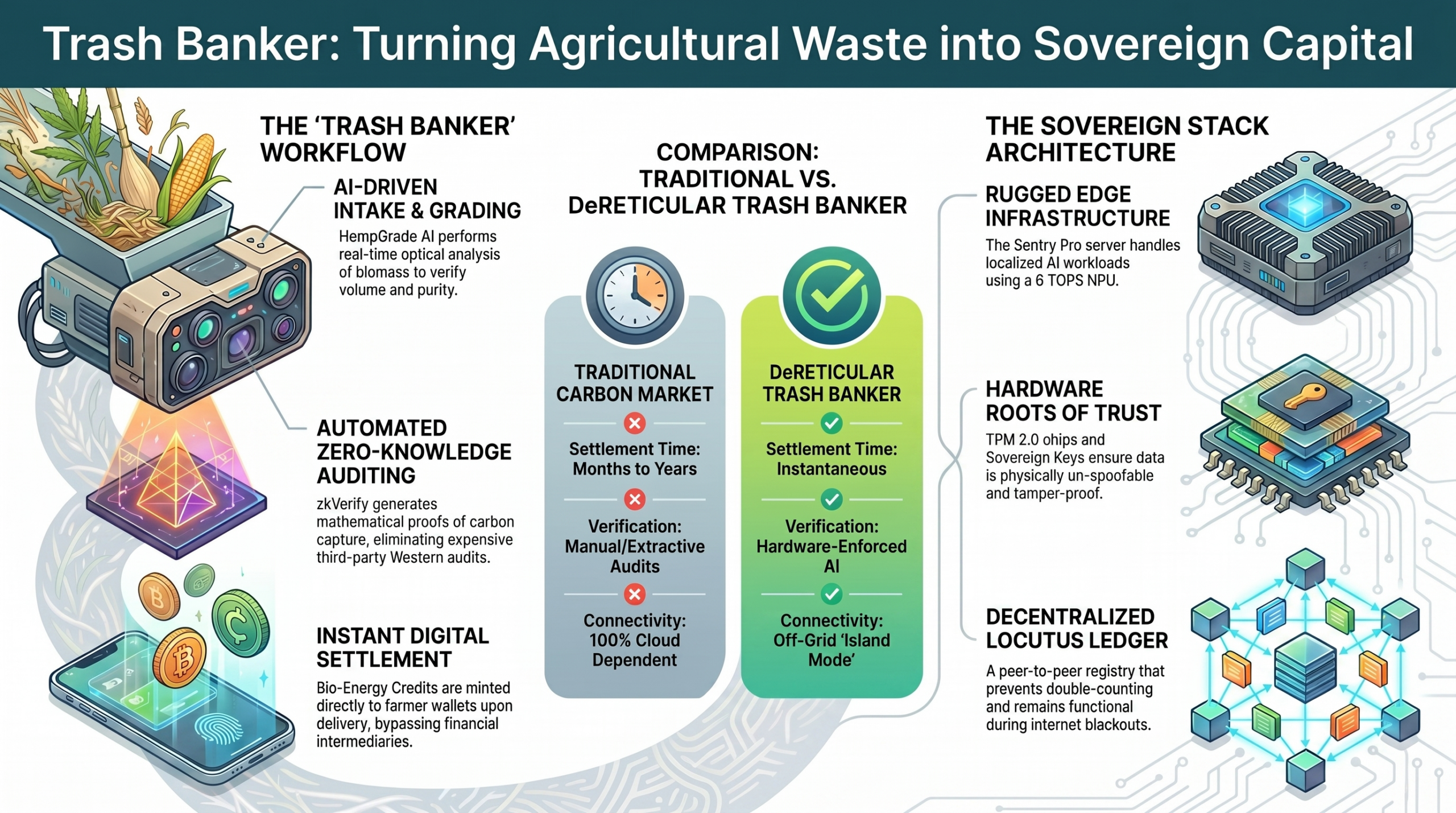
The “Carbon Oracle” within RIOS utilizes Zero-Knowledge Proofs (zkVerify) to provide mathematical certainty of carbon sequestration without exposing proprietary engineering data. This engine processes high-fidelity thermodynamic inputs—including exact biomass mass verified by HempGrade AI, gasifier operating temperatures, and clean megawatt-hours generated. The system generates a ZKP that proves a specific volume of carbon was safely processed and offset. These proofs can be verified on-chain in milliseconds, providing continuous, mathematically certain proof for global registries.
Edge Intelligence and Hardware-based ADC Sampling
To support intensive localized machine learning, the Sovereign Sentry Pro utilizes the Rockchip RK3588 Octa-core SoC with an integrated 6 TOPS Neural Processing Unit (NPU). Critically, the Sentry Pro is equipped with 32GB of DDR4 RAM, the precise memory footprint required to hold a quantized 8-billion parameter model (Llama 3) entirely in local memory for offline inference.
To secure the network, the system employs Direct ADC Sampling. The Sentry captures sub-microsecond electromagnetic transients to “fingerprint” the unique physical variations in a transceiver’s silicon. Because these physical properties cannot be cloned, virtual node spoofing and Sybil attacks become physically impossible, ensuring the integrity of the local TriFi Mesh.
Automated vs. Human-Centric Auditing
The Sovereign model systematically eliminates the flaws of traditional MRV:
- Verification Speed: Shrinks the cycle from years (manual audits) to seconds (automated dMRV).
- Cost: Eliminates expensive Western consulting site-visits, which typically drain 30% to 40% of project margins.
- Tamper-Resistance: Replaces vulnerable paper logs with TPM 2.0 hardware-signed data, creating an unalterable audit trail ready for international compliance mandates.
3. Regulatory Synchronization: CORSIA and Article 6 Standards
Under the Paris Agreement and the International Civil Aviation Organization’s (ICAO) CORSIA scheme, the global market faces a zero-tolerance mandate for double-counting. Double-counting occurs when a single reduction is claimed both by a host nation for its Nationally Determined Contribution (NDC) and by an international buyer.
Article 6.4 (PACM) and Corresponding Adjustments
DeReticular’s architecture meets the rigorous Article 6.4 (PACM) standards finalized at COP30. The system generates hardware-signed Quality Certificates that serve as the “truth layer” required for host nations to issue formal Letters of Authorization (LoAs). These LoAs guarantee a Corresponding Adjustment (CA), ensuring the asset is not double-counted.
Unlocking the CORSIA Supply Bottleneck
CORSIA Phase 1 (2024–2026) requires airlines to retire an estimated 100 to 200 million Eligible Emissions Units (EEUs) before the January 2028 compliance deadline. Currently, a scarcity of CA infrastructure has created a supply bottleneck, driving a price premium of $1.50 to $6.00 over non-adjusted credits. Automated auditing via the Sovereign Stack provides the high-integrity data needed to streamline CA issuance and unlock this restricted supply.
Wasm Contracts as Cryptographic Gatekeepers
The Locutus Ledger (built on a Rust-based Freenet implementation) manages these assets using WebAssembly (Wasm) contracts. These contracts act as gatekeepers, mathematically rejecting any attempt to partition or duplicate unique token IDs. By enforcing rules at the protocol level, the ledger natively prevents double-spending, facilitating the direct flow of capital to local communities managing the assets.
4. Economic Transformation: The “Trash Banker” and Audit Elimination
Traditional carbon finance fails to reach Indigenous Peoples and Local Communities (IPLCs) due to the “Collateral Barrier.” Smallholders often possess vast quantities of “Dead Capital”—agricultural waste (hemp stalks, crop residues) that stores carbon but has zero liquidity because banks reject biomass as collateral.
The Trash Banker at Project Umoja (Node 4)
Project Umoja in Kaabong, Uganda, utilizes a sovereign topology to resolve this:
- The Muscle (Agra Dot Energy): Employs plasma gasification to convert waste into 24/7 carbon-negative power.
- The Motion (Kurb Kars): Autonomous logistics handling within the industrial park.
- The Mind (DeReticular RIOS): Managing the “Trash Banker” intake loop.
As a farmer delivers biomass, the Industrial Foreman AI and HempGrade AI perform volumetric and optical analysis to verify carbon content and dry-weight mass. Upon intake, the system instantly mints “Bio-Energy Credits” directly to the farmer’s digital wallet via the local TriFi Mesh.
Critique of Extractive Auditing
This model dismantles the “colonial-style philanthropy” of legacy carbon projects, where Western firms extract 30–40% of margins through manual inspections. By eliminating these extractive foreign liabilities, the Sovereign Stack ensures that local communities retain structural ownership. Projects that verify these co-benefits—such as IPLC equity and biodiversity—command a 37% average price premium over standard credits.
Economic Impacts of Instant Settlement:
- Dead Capital Transformation: Monetizes worthless agricultural “trash” as instant liquidity.
- Regional Self-Reliance: Credits are exchangeable locally for power, clean water, or biochar fertilizer.
- Ownership: Communities own the infrastructure and the verified commodities it produces.
5. Resilient Infrastructure: “Island Mode” and TriFi Mesh Operations
In contrast to the “Linear Fragility” of centralized registries, the Sovereign Stack employs “Spherical Resilience” to maintain operations in off-grid or unstable regions.
Island Mode and Isotonic Regression Routing
When macro-network connectivity fails, edge hardware shifts to Island Mode. The local network remains functional by routing data across the TriFi Mesh using Isotonic Regression Routing. This algorithm optimizes data propagation across low-bandwidth, high-latency connections, ensuring that field verifications and asset transfers maintain cryptographic consistency while disconnected from the global internet.
Conflict-Free Reconciliation
Once connectivity is restored, the “islands” merge their off-grid transaction blocks back into the global Locutus Ledger. This process uses a Conflict-Free Resolution Protocol where deterministic Wasm contracts integrate updates sequentially based on physical timestamps verified by the TPM 2.0 hardware clock. This mathematically prevents double-minting during reconciliation, making the architecture invaluable for projects in regions prone to internet blackouts or geopolitical instability.
6. Registry Integrity and the Prevention of Double-Counting
Centralized registries are vulnerable to DNS poisoning, administrative leakage, and database tampering. The Sovereign Stack utilizes decentralized state machines to isolate raw data from these public cloud vulnerabilities.
The Digital Airlock and Hard Physical Attestation
To ensure the integrity of global carbon accounting, RIOS implements a “Digital Airlock” protocol. This protocol isolates raw camera feeds and sensor telemetry locally on an encrypted ledger. The raw data is sterilized before logic instructions are outputted to the ledger, preventing unauthorized modification. This creates a “Hard Physical Attestation” standard where it is physically impossible to retroactively forge the recorded carbon density. This high-integrity data is designed for seamless integration into the UN’s CARP (Centralized Accounting and Reporting Platform).
DeReticular Commercial SKUs
| SKU | Product Name | Primary Role |
| DR-SENTRY-PRO-CDR-INT | Sovereign Sentry Pro | Industrial gatekeeper. Features RK3588 SoC, 32GB DDR4 RAM, and 6 TOPS NPU for real-time feedstock verification via Modbus RTU/CAN Bus. |
| DR-DECK-FIELD-MRV | Sovereign Deck | Rugged IP65 field terminal. Uses HempGrade AI for optical canopy scans and biomass grading in off-grid “Island Mode.” |
| DR-BADGE-IPLC-SEC | Sovereign Badge | RF attestation node. Provides hardware-enforced Proof of Presence for rangers via Direct ADC transient fingerprinting. |
By synthesizing hardware-enforced truth with decentralized ledgers, this blueprint transforms carbon credits from speculative paper promises into bankable, high-integrity assets, providing the transparency and equity required to scale the global environmental commodity market.