The Architecture of Autonomy: Why We Didn’t Just Build a Network, We Built a New Foundation
The Architecture of Autonomy: Why We Didn’t Just Build a Network, We Built a New Foundation
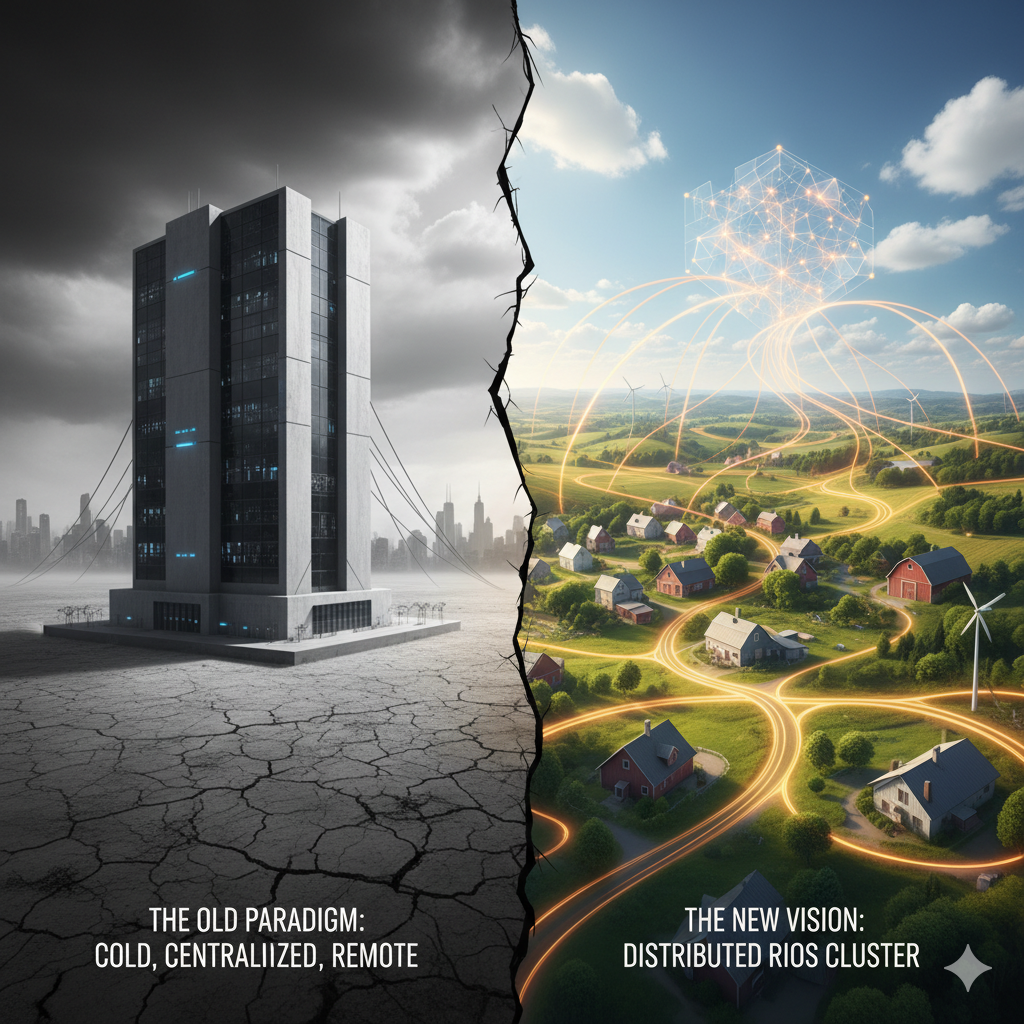
For decades, the story of rural infrastructure has been a story of compromise. It has been defined by what is missing: the fiber optic lines that stop at the county line, the reliable power that falters in a storm, the economic opportunities that seem to exist only in distant urban centers. The conventional approach has been to treat this as a problem of extension—to simply push a fragile, centralized model a little further down the road.
At DeReticular, we believe this approach is fundamentally flawed. You cannot solve a problem of isolation by offering a longer tether to a system that was never designed for resilience or autonomy in the first place.
That is why we created the Rural Infrastructure Operating System (RIOS). It is not another attempt to patch the old model. It is a paradigm shift. RIOS is built on a single, core conviction: that infrastructure should not be a community’s greatest cost, but its most valuable, revenue-generating asset.
To achieve this, we didn’t just look to the future; we reached into the past, synthesizing decades of proven networking principles into a single, cohesive platform. RIOS is the logical culmination of ideas forged in the crucibles of the world’s most demanding networks, reimagined to build the sovereign communities of tomorrow.
The Economic Engine: From Cost Center to Profit Center
The heart of every RIOS deployment is its economic engine: a high-performance AI Compute Cluster. This is our answer to the flawed business model of traditional infrastructure. Instead of relying on subscription fees from a small local population, a RIOS network generates its primary revenue by performing intensive computational workloads for the global AI and tech industries.
This revenue stream, decoupled from the local economy, is what makes the entire system self-sustaining. It pays for the resilient power, the advanced connectivity, and the ongoing maintenance. The essential services provided to the community are the dividends of a profitable, independent enterprise.
But for this model to work, the underlying network architecture must be exceptionally intelligent, resilient, and secure. It must be built on the right principles.
Principle 1: The Sanctity of the Economic Lifeline (The MPLS Legacy)
In the late 1990s, as the internet’s traffic soared, a technology called Multiprotocol Label Switching (MPLS) was developed to bring order to the chaos. Its genius was in creating a “fast lane” for high-priority data, ensuring that critical applications would never be stuck in digital traffic.
We have embedded this principle of ruthless prioritization into the very core of RIOS. The data flowing to and from our AI Compute Cluster is the economic lifeblood of the community. It must have priority. Our network architecture is designed to manage its bandwidth with precision, creating a protected, high-performance path for its revenue-generating workloads. This ensures the economic engine runs at peak efficiency, safeguarding the financial viability that underpins the entire system’s autonomy.
Principle 2: The Power of Shared Abundance (The NDN Vision)
The current internet is host-centric. It is built to fetch data from a specific location. This is incredibly fragile. If the path to that location is cut, the data is inaccessible. For a remote community, this is a fatal flaw.
RIOS is designed around a more advanced, data-centric philosophy known as Named Data Networking (NDN). Instead of asking “Where is the server?”, an NDN-architected network asks, “What is the data I need?”.
This enables a powerful form of in-network caching. When the first person in a RIOS community accesses a piece of data—be it an educational video, a software update, or an agricultural sensor reading—it is cached locally. The next person who needs it gets it from their neighbor, not from a server a thousand miles away.
The implications are profound:
- Unbreakable Resilience: The community’s digital life can continue seamlessly even during an internet outage. The local “library” of cached data remains fully accessible.
- Radical Efficiency: By eliminating redundant data fetches, we dramatically reduce the consumption of expensive satellite bandwidth, lowering operational costs and freeing up resources.
This is the architecture of shared abundance, built for environments where resources must be preserved and resilience is non-negotiable.
Principle 3: The Foundation of Digital Sovereignty (The ldns Mandate)
A community cannot be truly autonomous if it is dependent on outside systems for its core identity and addressing. The global Domain Name System (DNS) is a modern marvel, but reliance on it is a strategic vulnerability.
RIOS incorporates the principles of secure, independent naming, as embodied by technologies like DNSSEC and the libraries like ldns that implement it. Each RIOS deployment operates with its own sovereign naming system. It establishes a local root of trust, allowing all users, devices, and services within the network to find and verify each other securely, without ever needing to consult an external server.
This is the digital equivalent of a community having its own deed and its own government. It provides the security and autonomy necessary for a self-governing digital ecosystem to flourish.
The DeReticular Synthesis
These principles are not implemented in isolation. RIOS is their synthesis. It is an operating system that intelligently integrates them into a single, resilient platform.
We understand the history of this challenge. We studied ventures like Wam!Net, which tried to solve the problem of large-scale data transfer for niche industries in the 90s. They had the right vision but were limited by the technology and business models of their time.
RIOS is the fulfillment of that vision, powered by a sustainable economic model and a holistic architectural design. It is the intelligence of MPLS ensuring profitability, the resilience of NDN ensuring continuity, and the autonomy of a sovereign naming system ensuring independence.
This is the future of rural infrastructure. Not as an extension of the old world, but as the foundation for a new one. A future that isn’t just connected, but empowered. A future that is sovereign, resilient, and built to last.
This is the promise of DeReticular.