The $50,000 Blueprint to Securing Your Town’s Digital Border
The modern village is built on sand. For all our technological advancement, our local communities remain dangerously tethered to the “macro-internet”—a fragile, centralized cloud infrastructure that treats small towns as mere data-harvesting endpoints. When the fiber line is cut or a Silicon Valley giant changes its terms of service, the local doctor’s office, the town’s transit, and the community’s commerce can vanish overnight.
For mayors, visionary founders, and real estate developers, the status quo is a liability. The DeReticular “Village Infrastructure” Genesis Package offers the first radical alternative: a “Turnkey Sovereign Micro-City Operating System.” Designed for populations of 100 to 1,000 residents, this system allows a community to transition into “Island Mode”—a state of total operational autonomy where the town’s digital life continues regardless of global outages or platform censorship.
1. True “Island Mode” Resilience
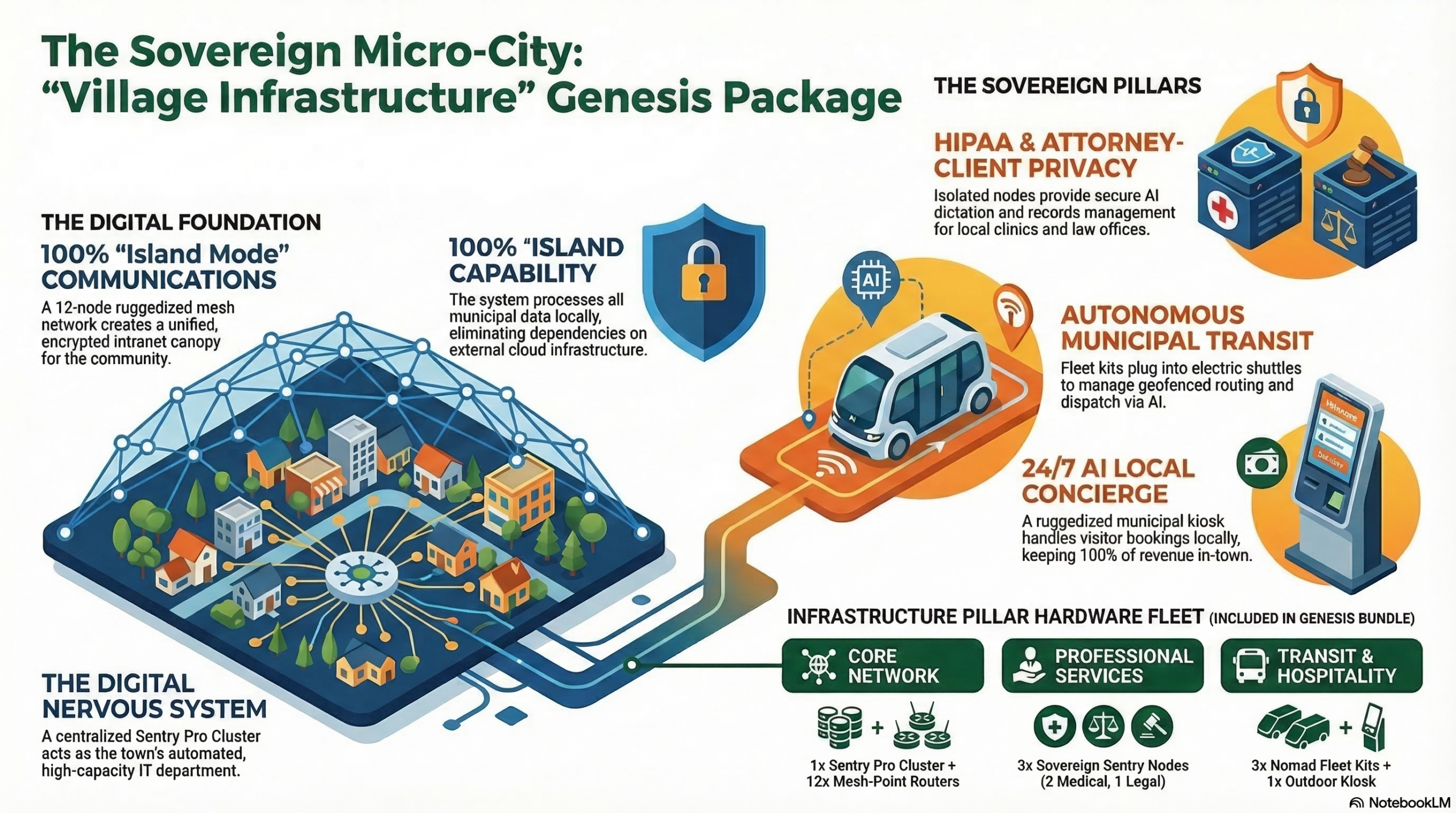
The backbone of this sovereign community is the “Digital Nervous System.” Unlike traditional networks, this is a 19-unit hardware fleet anchored by a 3-Node Sentry Pro Cluster (64GB RAM per node) running DevOps Sovereign (Deep Admin). This cluster hosts the town’s own Root Certificate Authority (CA), meaning the community owns its identity at the cryptographic level.
This core compute power feeds a network of 12 ruggedized Nomad Mesh-Point routers. Using a hybrid of Wi-Fi 6E and LoRaWAN, these nodes cast an “un-killable intranet canopy” over the village center.
The stability of the town is no longer a factor of external providers. Because the RIOS-powered mesh manages its own traffic, the local nervous system remains active even under extreme conditions.
“Even if the main fiber line feeding the town from the macro-internet is severed, the internal VoIP, scheduling, and local transit systems continue to operate flawlessly via the DeReticular mesh.”
2. Professional AI Without the Data Harvest
High-tier professional services—medicine and law—have long been the hardest to localize because of their dependence on cloud-based AI and storage. The “Professional Pillar” of the Genesis Package solves this via three dedicated Sovereign Sentry nodes running the Sovereign Executive software.
These nodes provide local clinics and law offices with Whisper AI (voice-to-text) and OCR (document processing) in a completely air-gapped environment. Most critically, the system utilizes Cryptographic Sub-Netting. While the medical and legal nodes share the same physical mesh as the visitor kiosk, they are “mathematically isolated.” This provides absolute, cryptographically guaranteed HIPAA and Attorney-Client privacy—a level of security major cities tethered to the public cloud cannot match.
3. The Autonomous Transit Brain
Mobility within a sovereign village requires more than just vehicles; it requires “spatial logic.” The package includes three Nomad Fleet Kits—mobile edge servers that plug directly into the CAN Bus or OBD-II ports of standard municipal electric shuttles or maintenance carts.
Governed by the Industrial Foreman AI, these kits turn a basic fleet into a coordinated municipal transit system. The Foreman manages:
- Geofenced Local Logistics: Precise control over vehicle movement within community borders.
- Battery Load Balancing: Dynamic energy management to ensure fleet readiness.
- Autonomous Dispatch: Real-time coordination of rides and deliveries.
“If a visitor at the kiosk requests a ride to the clinic… the Industrial Foreman agent in the electric shuttle autonomously navigates the geofenced village roads to pick them up.”
4. Economic Sovereignty: Killing the “Platform Tax”
Digital localism is a financial strategy as much as a technical one. The Municipal Kiosk acts as the community’s “Sovereign Concierge.” By running a local LLM, the town can manage hospitality bookings for local inns and services directly, bypassing the 15–30% “middleman tax” levied by platforms like Expedia or Airbnb.
This ensures 100% of revenue stays within the town. The kiosk, protected by Vault Warden software, serves three essential roles:
- Hospitality Booking: Direct, fee-free local commerce.
- Local LLM Concierge: 24/7 interactive guidance for residents and guests.
- Volumetric LiDAR: Advanced spatial monitoring of the town square for security and visitor flow.
5. A Self-Healing, Self-Defending Infrastructure
The Genesis Package represents a shift from reactive security to proactive, hardware-level protection. Managed by OpenClaw agents and the Deep Admin core, the system utilizes “Elastic Clustering.” If one node is bottlenecked, the system dynamically reassigns CPU and RAM resources across the cluster to maintain health.
Physical security is equally rigorous. The Vault Warden protocol monitors the physical chassis of all units. If a bad actor attempts to tamper with or breach the hardware—specifically the Municipal Kiosk—the system executes an immediate software-level “self-destruct,” wiping all local decryption keys. “The entire ecosystem is monitored and healed by a centralized Digital Nervous System,” ensuring that the town’s infrastructure is a self-defending organism.
Conclusion: The Blueprint for the Next America
At $49,999, the Genesis Package is not an expense; it is a Capital Expenditure for Liberty. By utilizing Enterprise Perpetual Licenses, DeReticular ends the era of “subscription-slavery” where a town’s infrastructure is rented from Big Tech.
This is the shift from being a consumer to being a sovereign owner. It is the architectural foundation for the next generation of American communities—those that value resilience, privacy, and local wealth above the convenience of the cloud.
——————————————————————————–
The choice for future residents is simple: Would you prefer to live in a “Cloud City” vulnerable to every global outage, or a “Sovereign Village” that owns its own future?