
Technical White Paper Securing the Kinetic Edge: A Sovereign Stack Evaluation of NB-IoT, LTE-M, and 5G RedCap
The global telecommunications ecosystem is undergoing a profound structural evolution, driven by the urgent need for resilient, scalable, and secure connectivity across the physical world. This transition is being catalyzed by the active global sunsetting of legacy 2G and 3G networks, as operators reclaim valuable spectrum and seek to eliminate fundamental security vulnerabilities, such as weak encryption and unidirectional authentication.
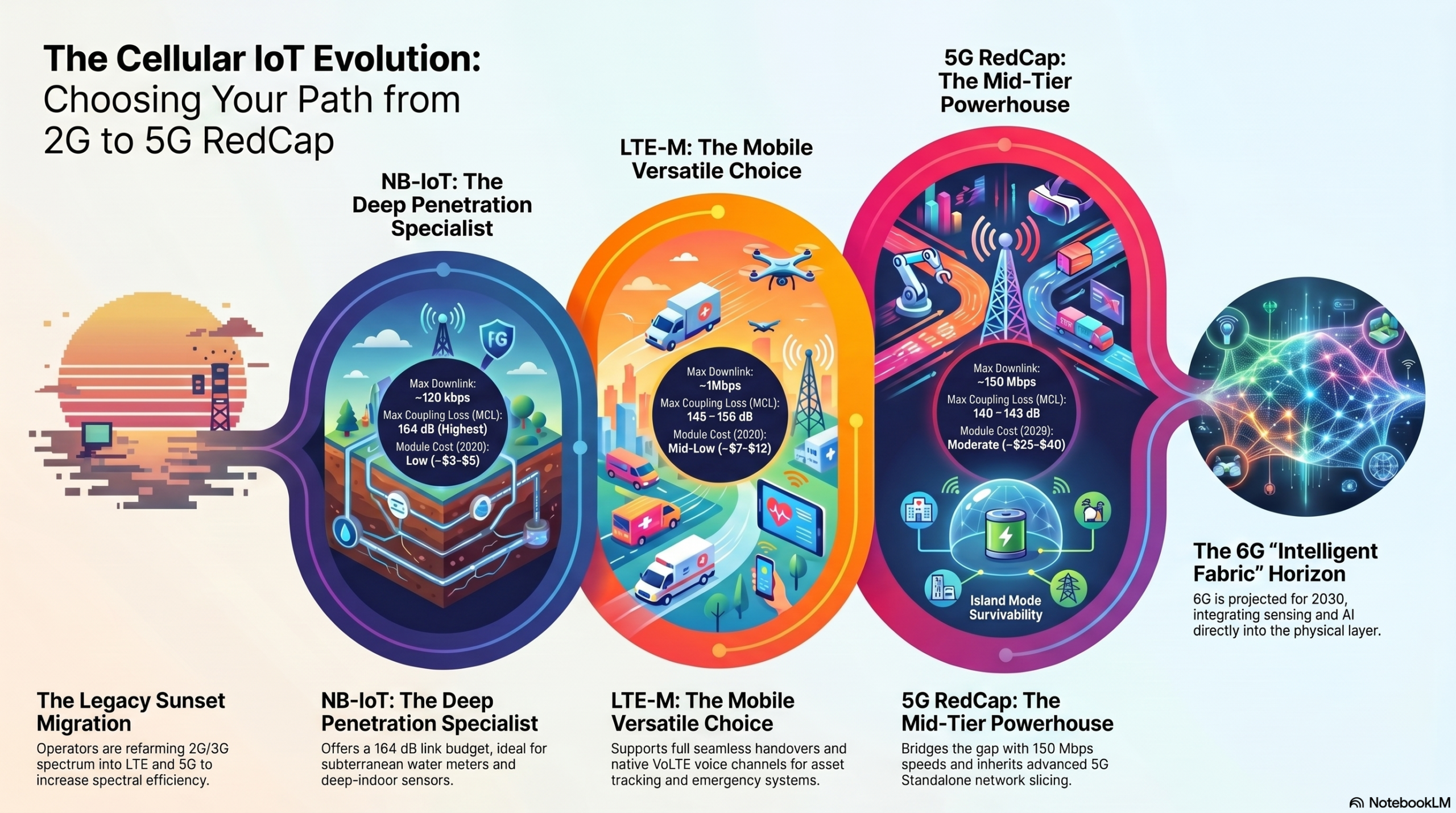
In response to this mass migration, a tiered hierarchy of cellular Internet of Things (IoT) technologies has emerged to dominate the modern landscape. At the foundation, NB-IoT and LTE-M have matured into the standard workhorses for massive, low-power IoT deployments, offering exceptional physical signal penetration and reliable mobility. Building upon this, 5G RedCap (Reduced Capability) and the upcoming eRedCap are actively bridging the critical gap between low-throughput systems and high-end 5G broadband. These mid-tier 5G technologies reduce hardware complexity and costs while introducing advanced 5G Standalone (5G SA) capabilities like network slicing, Time-Sensitive Networking (TSN), and enhanced security frameworks.
Furthermore, the industry is experiencing a strategic architectural shift toward the “Sovereign Stack.” This paradigm emphasizes deploying private, software-defined cellular networks at the edge to enable “Island Mode” survivability, ensuring that critical infrastructure—such as microgrids and autonomous logistics—can operate resiliently and independently of centralized cloud backhauls.
As these 4G and 5G IoT standards achieve widespread commercialization in 2026, the industry is simultaneously laying the groundwork for the next frontier. 6G mobile technology, currently in its study phase and targeted for commercial rollout by 2030, promises to transform wireless networks into an AI-native “intelligent fabric” that seamlessly integrates high-speed communications, edge computing, and real-time physical environmental sensing. Together, these advancements represent a continuous, unified roadmap from the retirement of legacy systems to the fully autonomous, intelligent networks of the next decade.
Technical White Paper Securing the Kinetic Edge: A Sovereign Stack Evaluation of NB-IoT, LTE-M, and 5G RedCap
- Executive Summary: The Communications Dilemma of the Edge
The deployment of Decentralized Physical Infrastructure Networks (DePIN) and
Physical/Kinetic AI requires local systems to interact directly with the
physical world. Centralized microgrids, autonomous logistics systems, and
off-grid water networks require telemetry networks that can operate reliably
under any conditions. However, the legacy architectures supporting modern
cellular Internet of Things (IoT) remain structurally dependent on centralized
telecommunication cores and global cloud networks. This structural centralized
backhaul introduces a critical single point of failure. If the link to a
centralized cloud server fails, localized operational infrastructure should not
fail with it.
To build resilient, self-healing networks capable of operating in complete
“Island Mode” (fully functional, localized, off-grid autonomy), system
architects must carefully evaluate their choice of physical wireless links.
Centralized Paradigm Sovereign Edge Paradigm (Island Mode)
┌──────────────────────┐ ┌───────────────────────────────────┐
│ Edge Nodes │ │ Localized Mesh Nodes │
│ │ │ │ │ (RF Propagation Link) │
│ ▼ (Backhaul) │ │ ▼ │
│ Telecom Carrier Core │ │ Private Edge gNodeB / Open5GS │
│ │ │ │ │ │
│ ▼ │ │ ▼ │
│ Centralized Cloud │ │ Local RIOS / Kinetic AI Core │
└──────────────────────┘ └───────────────────────────────────┘
Narrowband IoT (NB-IoT), LTE-M (eMTC), and 5G RedCap (Reduced Capability)
represent distinct physical and architectural approaches to routing edge data.
Evaluating their physical limitations, RF propagation profiles, and
compatibility with private, software-defined cellular infrastructures is a
fundamental prerequisite for building resilient, off-grid infrastructure.
- The Physical Layer: RF Propagation & Link Budgets
At the physical layer, the limits of communication are governed strictly by the
laws of electromagnetics. For off-grid and rural deployments, the critical
metric is the Maximum Coupling Loss (MCL)—the maximum amount of signal
attenuation a link can tolerate before communication drops.
| Technical Parameter | NB-IoT (Cat-NB1/NB2) | LTE-M (Cat-M1) | 5G RedCap (Release 17) | 5G eRedCap (Release 18) |
|---|---|---|---|---|
| Standard Bandwidth | 180 kHz | 1.4 MHz | Up to 20 MHz (FR1) | 5 MHz (FR1) |
| Maximum Coupling Loss (MCL) | 164 dB | 145 dB to 155.7 dB (CE Mode A/B) | 140 dB to 143 dB | 141 dB to 144 dB |
| Spectral Efficiency | Low (Optimized for coverage) | Moderate | High | Moderate-High |
| Power Spectral Density (PSD) | Extremely High | Moderate | Low to Moderate | Moderate |
| Default Antenna Config | 1 RX | 1 RX or 2 RX | 1 RX or 2 RX | 1 RX |
| Duplexing Mode | Half-Duplex (HD-FDD) | Half-Duplex or Full-Duplex | Half-Duplex or Full-Duplex | Half-Duplex (HD-FDD) |
| Uplink/Downlink Rates | ~160 kbps UL / ~120 kbps DL | ~1 Mbps UL / ~1 Mbps DL | ~50 Mbps UL / ~150 Mbps DL | ~5 Mbps UL / ~10 Mbps DL |
2.1. Power Spectral Density (PSD) and the Subterranean Advantage of NB-IoT
NB-IoT achieves an exceptional 164 dB MCL by concentrating the transmitter’s
power into an ultra-narrow 180 kHz bandwidth (or even down to a 15 kHz
single-tone uplink allocation) [1.1.5]. This extreme concentration of Power
Spectral Density (PSD) ensures that the signal remains readable even when buried
deep underground, beneath concrete structures, or in packed soil [1.1.5, 2.2.5].
Standard Wideband Carrier (LTE/5G) Narrowband Carrier (NB-IoT)
┌──────────────────────────────────────┐ ┌───┐
│ │ │ ▲ │ <– Concentrated PSD
│ 10 MHz – 20 MHz Bandwidth │ │ █ │ In 180 kHz
│ (Power diluted across spectrum) │ │ █ │ Punches through concrete
└──────────────────────────────────────┘ └───┘
For static, deep-indoor, or subterranean infrastructure—such as municipal water
flow sensors or buried geothermal monitoring nodes—NB-IoT’s PSD profile provides
unmatched physical penetration capabilities [1.1.5].
2.2. LTE-M and Coverage Enhancement (CE) Modes
LTE-M operates in a 1.4 MHz bandwidth, which dilutes its native PSD compared to
NB-IoT. To compensate for this, the standard relies on Coverage Enhancement (CE)
Modes to boost its link budget:
- CE Mode A: Utilizes moderate signal repetitions to achieve a baseline MCL of
roughly 145 dB. - CE Mode B: Extends coverage by repeating transmissions up to 2,048 times,
pushing the effective MCL up to 155.7 dB.
However, CE Mode B introduces a major operational trade-off: repeating messages
thousands of times drastically increases latency and consumes significant
battery power, which can undermine the low-power advantages of the device.
2.3. The RedCap “Structural Deficit” and Recovery Mechanisms
By design, standard 5G New Radio (NR) relies on four receive (RX) antennas to
maintain high-quality spatial multiplexing and receiver diversity [1.1.4]. To
reduce unit cost and power requirements for mid-tier devices, 5G RedCap reduces
this configuration to 1 or 2 RX antennas [1.1.4, 2.4.3].
This reduction introduces a 3 dB to 4 dB structural coverage penalty relative to
standard 5G baseline devices [1.1.4]. To prevent RedCap devices from dropping
connection at standard 5G cell edges, 3GPP Release 17 and 18 specifications
introduce several coverage recovery protocols:
- Slot Aggregation: Automatically groups consecutive slots to repeat Physical
Uplink Shared Channel (PUSCH) transmissions. - Inter-Slot Frequency Hopping: Alternates transmit frequencies between
consecutive slots to restore frequency diversity lost when scaling the
channel bandwidth down from 100 MHz to 20 MHz (or 5 MHz for eRedCap). - Transport Block Scaling (TBS): Downscales transport blocks dynamically when
signal-to-noise ratios (SNR) degrade, maintaining link stability at the
expense of peak throughput.
- Sovereignty and “Island Mode”: Private Base Stations vs. Centralized Backhaul
The defining architectural requirement of the Sovereign Stack is local
survivability. If the connection to a centralized carrier’s core is severed, a
localized network node must continue to coordinate local energy, water, and
peer-to-peer data transactions.
              ┌─────────────────────────────────────────┐
              │          DE RETICULAR NODE              │
              │  ┌───────────────┐   ┌───────────────┐  │
              │  │ Open5GS / srs │   │ local RIOS Core│  │
              │  │ Local gNodeB  │<─>│  (Edge Apps)  │  │
              │  └───────────────┘   └───────────────┘  │
              └─────────────────────────────────────────┘
                                  ▲
                                  │ (Local private RF Link)
                                  ▼
                    ┌──────────────────────────┐
                    │ Edge Sensor / Controller │
                    │  (RedCap / LTE-M / NB)   │
                    └──────────────────────────┘
3.1. NB-IoT: The Carrier-Tethered Trap
While highly efficient for low-power tracking, NB-IoT is structurally designed
to operate on centralized carrier networks. Deploying a private,
software-defined NB-IoT base station using open-source projects like Open5GS or
Osmocom is technically complex. NB-IoT’s narrow frequency allocations and strict
scheduling requirements make it difficult to operate on private, non-licensed
spectrum. As a result, standard NB-IoT nodes remain heavily tethered to
centralized telecom operators and their cloud backhauls, limiting their
viability for true off-grid “Island Mode” operations.
3.2. LTE-M: Highly Practical Private LTE Integration
LTE-M is highly compatible with private, software-defined networks. Using tools
like srsRAN or Open5GS combined with low-cost Software Defined Radios (such as
USRPs or LimeSDRs), operators can deploy highly resilient private LTE-M base
stations.
- Operational Control: Private LTE-M networks can run entirely at the edge
without requiring an external internet backhaul. - Voice Integration: LTE-M natively supports Voice over LTE (VoLTE), allowing
local operators to maintain secure, off-grid voice and emergency dispatch
channels across an entire site or township using software-defined
infrastructure.
3.3. 5G RedCap: The Localized 5G Standalone (5G SA) Powerhouse
5G RedCap is designed to operate on 5G Standalone (5G SA) networks, which are
built on a cloud-native, flat IP architecture that is highly compatible with
software-defined edge deployments.
- Private 5G SA Slicing: A private 5G SA core running locally on a DeReticular
node can partition the local spectrum using network slicing. This allows the
system to allocate a dedicated, low-latency, high-priority slice for
critical kinetic telemetry (such as microgrid load controllers), while
routing lower-priority data (like localized sensor streams) through a
separate slice. - Time-Sensitive Networking (TSN): RedCap inherits 5G’s native support for TSN
and ultra-reliable low latency, enabling microsecond-level synchronization
of decentralized energy nodes and physical machinery. - Edge-Only Routing: RedCap devices communicate directly with the local edge
core, keeping sensitive data entirely local and ensuring continuous
operational capacity even during complete external backhaul failures.
- Cryptographic Provenance and Threat Vectors
Deploying physical infrastructure in remote, public, or hostile environments
requires robust security at the physical and cryptographic layers.
4.1. The Legacy Sunset Mandate
Legacy 2G and 3G networks are rapidly sunsetting globally because of severe,
unfixable security vulnerabilities.
- Unidirectional Authentication: In 2G networks, only the user device
authenticates to the base station, while the base station does not
authenticate to the device. This allows attackers to easily deploy low-cost
IMSI-catchers (“Stingrays”) to intercept traffic, spoof commands, and
perform man-in-the-middle attacks. - Weak Encryption: Legacy encryption algorithms (like A5/1 and A5/2) have been
thoroughly compromised and can be decrypted in real-time. To protect
critical utility infrastructure, migrating to modern standards that enforce
robust mutual authentication is a fundamental security requirement.
4.2. Security Comparison: LTE-M/NB-IoT vs. 5G RedCap
- Mutual Authentication: Both LTE-M and 5G RedCap enforce mutual
authentication, preventing unauthorized or spoofed base stations from
hijacking local devices. - IMSI Encryption (SUPI/SUCI): In standard LTE-M networks, a device transmits
its international mobile subscriber identity (IMSI) in cleartext during
initial attachment. Attackers can intercept this transmission to track the
physical location of devices. 5G RedCap addresses this by encrypting the
Subscription Permanent Identifier (SUPI) into a Subscription Concealed
Identifier (SUCI) before transmission, mitigating passive eavesdropping and
location-tracking attacks.
4.3. Integrating the Hardware Root of Trust
To establish absolute data integrity, DeReticular edge nodes must pair their
wireless links with physical security chips:
┌────────────────────────────────────────────────────────┐
│ DE RETICULAR NODE │
│ ┌───────────────────┐ ┌──────────────────┐ │
│ │ Hardware Root of │ │ Cellular Modem │ │
│ │ Trust (TPM/HSM) │<─────────>│ (RedCap/LTE-M) │ │
│ │ Cryptographic Keys│ Secure │ Mutual Auth │ │
│ └───────────────────┘ Bus └──────────────────┘ │
└────────────────────────────────────────────────────────┘
By linking cellular modems with an on-board Trusted Platform Module (TPM) or
Hardware Security Module (HSM), edge nodes can cryptographically sign all
physical telemetry (such as water volume or energy output) before transmission.
This ensures that even if a cellular link is compromised, the data payload
itself remains tamper-proof, preserving data integrity across the decentralized
network.
- The Sovereign Builder’s Decision Matrix
When building off-grid utility networks, system architects must select wireless
technologies based on the physical environment and operational requirements:
                      DATA FREQUENCY & BANDWIDTH
         Low (Infrequent)    Medium (Frequent/VoLTE)    High (Streaming)
       ┌───────────────────┬─────────────────────────┬───────────────────┐
Static │ NB-IoT │ LTE-M │ 5G RedCap │
├───────────────────┼─────────────────────────┼───────────────────┤
Mobile │ Not Recommended │ LTE-M / eRedCap │ 5G RedCap │
└───────────────────┴─────────────────────────┴───────────────────┘
- Select NB-IoT if:
- The deployment consists of static, deeply buried utility assets (such as
water flow meters, soil sensors, or waste tanks). - The node must run for 10–15 years on a single small battery.
- Data transmissions are small, infrequent, and do not require real-time
latency or local voice capabilities.
- The deployment consists of static, deeply buried utility assets (such as
- Select LTE-M / eRedCap if:
- The node is mobile, requiring seamless cell handovers (such as
autonomous transport vehicles or mobile asset trackers). - The system requires fallback local voice channels (via VoLTE) for
emergency operations. - The device must run on local, private software-defined LTE base stations
running Open5GS or srsRAN.
- The node is mobile, requiring seamless cell handovers (such as
- Select 5G RedCap if:
- The application requires high bandwidth and low latency (such as
edge-computing thermal cameras, real-time microgrid load balancers, or
heavy industrial machinery). - The network is built on a private 5G SA core that utilizes advanced
network slicing to isolate critical data pathways. - The system requires sub-millisecond precision timing synchronization via
Time-Sensitive Networking (TSN).
- The application requires high bandwidth and low latency (such as
- Conclusion: Engineering the Autonomous Grid
Building truly resilient, off-grid infrastructure requires looking beyond
traditional, centralized carrier networks. Every wireless link deployed at the
physical edge represents a critical operational choice.
While NB-IoT provides excellent physical penetration for buried, low-frequency
sensors, its architectural dependency on centralized carrier cores makes it
difficult to deploy in fully autonomous local networks. Conversely, LTE-M offers
a highly practical pathway for deploying private, software-defined cellular
networks at the edge.
For advanced, high-performance deployments, 5G RedCap combined with 5G
Standalone (5G SA) private cores represents the premier standard for the
Sovereign Stack. By supporting advanced features like localized network slicing,
precise edge-timing synchronization, and secure, air-gapped “Island Mode”
operations, RedCap provides the technical foundation needed to build robust,
self-healing utility networks independent of centralized cloud infrastructure.