
Systems Architecture Blueprint: Biophysically Grounded Multi-Agent Ecosystems with Automated Proof Verification
- Executive Formulation & System Design Principles
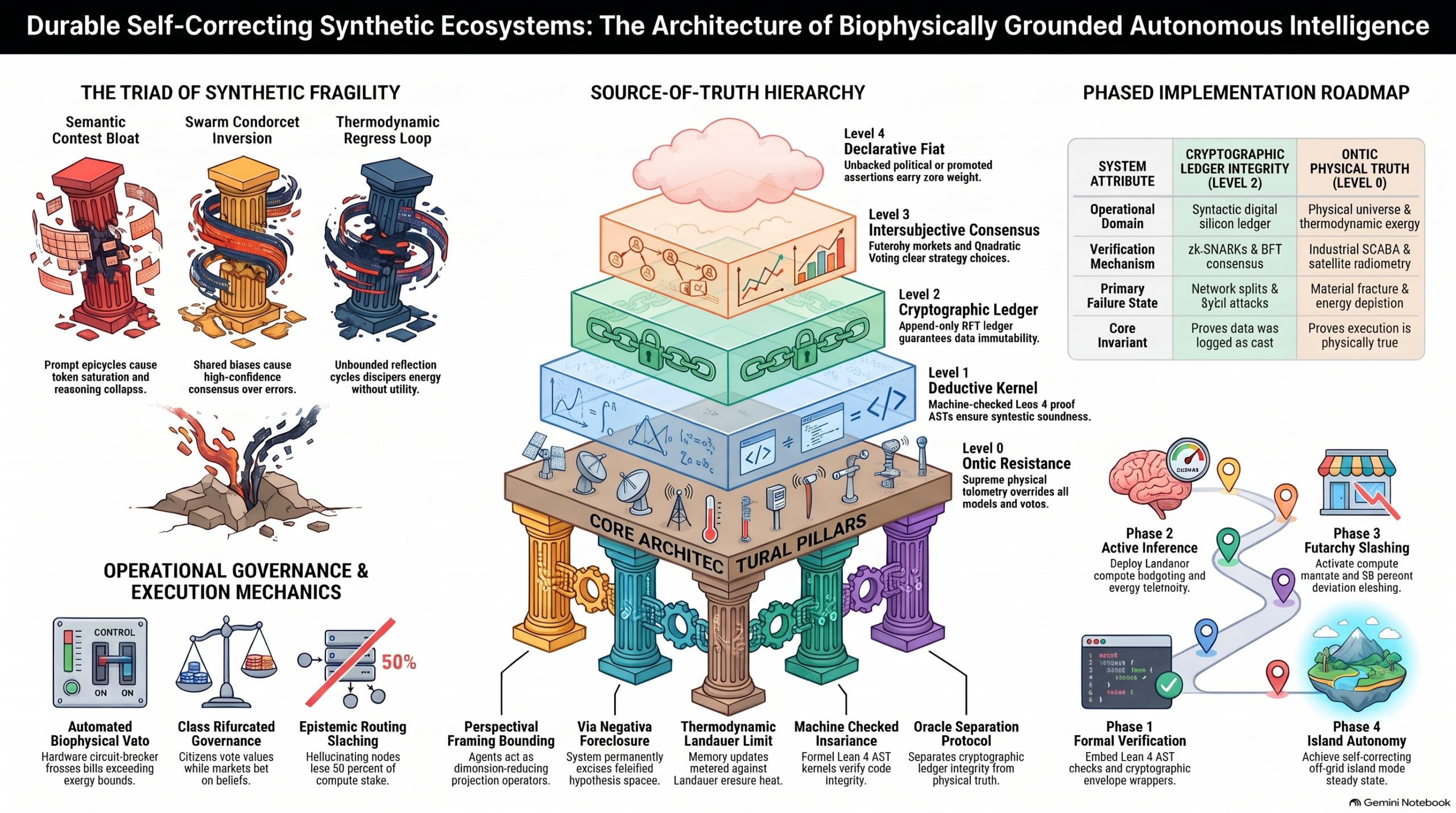
1.1 The Triad of Synthetic Fragility in Legacy Swarms
[AUTHOR_PROPOSITION] Production multi-agent AI frameworks (such as CrewAI, Microsoft AutoGen, and LangGraph) exhibit structural fragility when operated over extended horizons. When autonomous agents operate in ungrounded, closed feedback loops without physical friction or machine-checked logical constraints, they deteriorate across three distinct structural failure modes:
- Semantic Drift & Epicycle Hyper-parameterization: When an agent encounters an execution anomaly or unexpected environment output, it attempts to resolve the error by appending conversational justifications to its prompt context. Lacking an external falsification engine, the system executes hyper-parameterization—introducing auxiliary prompt constraints \phi \in \mathbb{R}^m to minimize empirical loss: \min_{\theta, \phi} \mathcal{L}(y, \mathcal{H}(\theta, \phi)) \le \epsilon \quad \text{as } m \to \infty This unpenalized expansion inflates the model’s Kolmogorov complexity K(\mathcal{H}) without increasing out-of-sample validity. The context window saturates with self-referential rationalizations, driving out-of-sample predictive performance to zero and violating the Minimum Description Length (MDL) parsimony principle.
- Meta-Convergence & The Condorcet Inversion: Legacy swarms rely on homogeneous foundation model checkpoints (such as shared base weights or uniform RLHF alignment profiles). Consequently, individual agent observations are not independent; their error covariance is strictly positive (\operatorname{Cov}(v_i, v_j) > 0). Under the Condorcet Inversion, if shared training biases or alignment blind spots reduce individual domain accuracy below chance (p < 0.5), scaling the swarm size N does not yield truth. Instead, it drives the probability of collective majority accuracy to zero: \lim_{N \to \infty} P\left(V_{\text{majority}} = \text{Correct}\right) = 0 \quad \text{for } p < 0.5 Increasing node count under positive error covariance accelerates mutual confirmation, locking the swarm into high-confidence collective delusion.
- Thermodynamic & Context Saturation: Unbounded self-reflection loops (\mathcal{M}_{t+1} = \text{Evaluate}(\mathcal{M}_t)) burn token bandwidth and GPU memory registers without evaluating physical exergy costs or marginal information yield. Lacking hard thermodynamic stopping criteria, systems enter runaway metacognitive regress, exhausting compute allocations and locking operational pipelines.
Failure Parameter Legacy Generative Swarms Durable Self-Correcting Synthetic Ecosystems (DSSE) Root Cause in Legacy Swarms Systemic Impact
Error Handling Conversational prompt epicycles Topological Parameter Foreclosure (Via Negativa) Unpenalized context window expansions Kolmogorov complexity inflation & logic degradation
Consensus Mechanism Majority voting over homogeneous LLM outputs Multi-model Perspectival Quorums & CUDOS norms Positive agent error covariance (\operatorname{Cov}(v_i, v_j) > 0) Condorcet Inversion leading to high-confidence delusion
Execution Stopping Static context length limits or max turn bounds Landauer Thermodynamic Metabolic Halt Gates Absence of physical exergy metering Runaway metacognitive regress & memory saturation
Syntactic Assurance Natural language peer review Lean 4 AST type-checking kernels Quinean translation indeterminacy Cascading generative hallucinations
Truth Grounding In-context consensus Level 0 physical sensor telemetry & EROEI Conflation of ledger integrity with ontic truth Complete decoupling from physical reality
1.2 Core Architectural Invariants & Non-Negotiable Operational Principles
[POLICY_SPECIFICATION] A Durable, Self-Correcting Synthetic Ecosystem (DSSE) counters these failure modes through five non-negotiable operational principles:
- Perspectival Bounding: Cognitive agents operate strictly as dimension-reducing projection operators (\hat{\Pi}_\theta), mapping high-dimensional state spaces onto localized observation manifolds. This counters unmediated omniscience fallacies by forcing every node to declare its explicit observational frame.
- Topological Parameter Foreclosure (Via Negativa): The ecosystem advances by permanently excising falsified strategy and parameter manifolds (\Theta_{t+1} = \Theta_t \setminus \Omega_{\text{falsified}}) rather than patching failures with ad-hoc prompt engineering. This eliminates context bloat and prevents the accumulation of unpenalized epicycles.
- Strict Thermodynamic Grounding: All computational token generation, memory updates, and communication bandwidth are bound by Landauer’s erasure limit (\Delta Q \ge N k_B T \ln 2) and metered against real physical exergy. This halts infinite reflection loops by forcing agents to act when marginal information gain falls below thermodynamic dissipation costs.
- Machine-Checked Syntactic Invariance: All mathematical, logical, and code-level assertions must successfully compile through formal, machine-checked proof kernels (Lean 4 Abstract Syntax Trees) before state persistence. This enforces Tarskian soundness (\Gamma \vdash \psi \implies \Gamma \models \psi), eliminating hallucination cascades at the syntactic boundary.
- The Oracle Separation Protocol: The architecture maintains an absolute boundary between Level 2 Cryptographic Ledger Integrity (which verifies data immutability) and Level 0 Ontic Physical Truth (which is established exclusively via causal friction with physical reality and hardware sensors).
- Mathematical & Epistemic Foundations
2.1 Perspectival Epistemics & Multi-Model Heterogeneity
[FORMAL_ASSUMPTION] Let the objective physical cosmos be modeled as an ontic state-space manifold \mathcal{M} of near-infinite dimensionality (\dim(\mathcal{M}) = D \to \infty). The ground-truth state of a problem domain within \mathcal{M} is defined as an invariant dynamical attractor state \Omega^* \in \mathcal{M}.
[FORMAL_ASSUMPTION] An individual cognitive agent operates within a localized observation frame \theta \in \Theta. An epistemic perspective is defined as a dimension-reducing projection operator: \hat{\Pi}{\theta_i}: \mathcal{M} \to \mathcal{P}{\theta_i}, \quad \text{where } \dim(\mathcal{P}_{\theta_i}) = d \ll D
[ESTABLISHED_RESULT] The Rule of Veridicality asserts that while the projection \hat{\Pi}\theta(\Omega^*) is inherently incomplete (leaving D – d dimensions unobserved), it is strictly veridical within its projection plane \mathcal{P}\theta: \forall \omega_1, \omega_2 \in \mathcal{M}, \quad \hat{\Pi}\theta(\omega_1) \neq \hat{\Pi}\theta(\omega_2) \implies \omega_1 \neq \omega_2
Distinctions registered on the projection plane track real physical differences in \mathcal{M}. Truth is not achieved by a singular, omniscient model, but is defined as the Peircean Asymptotic Invariant Core recovered across the intersection of validated projections under indefinite inquiry: \Omega^* = \lim_{t \to \infty} \bigcap_{\theta \in \Theta_t} \hat{\Pi}\theta^{-1}\left(\mathcal{P}\theta^{\text{validated}}\right)
[POLICY_SPECIFICATION] Perspectival Consensus Quorums must enforce three invariant structural rules:
- Architectural Orthogonality: A valid quorum requires at least three structurally distinct model families (e.g., a Dense Transformer, a State-Space Model such as Mamba, and a deterministic Symbolic Solver).
- Disjoint Training Provenance: Nodes sharing identical foundational weight checkpoints or pre-training corpora cannot cast independent votes; their joint output is collapsed into a single vote.
- Perspectival Provenance Tagging: Every data object emitted by an agent must include a cryptographic hash of its observation frame (perspective_frame_id), explicitly defining its measurement parameters and constraints.
2.2 Topological Parameter Foreclosure (Via Negativa) & Attractor Contraction
[FORMAL_ASSUMPTION] Let candidate operational strategies, code implementations, or hypotheses be parameterized over a compact metric space (\Theta, d_{\Theta}) where \Theta \subset \mathbb{R}^k, equipped with a measure space (\Theta, \mathcal{B}, \mu) where \mathcal{B} is the Borel \sigma-algebra and \mu(\Theta_0) = 1.0.
[POLICY_SPECIFICATION] Empirical observations {E_t}{t=1}^\infty \subset \mathcal{Y} interact with the active parameter volume \Theta_t via continuous discrepancy loss statistics: S(E_t, \theta) = | y{\text{observed}} – \hat{y}(\theta) |{\mathcal{H}} \in \mathbb{R}{\ge 0}
Given an empirical falsification threshold sequence {\tau_t}{t=1}^\infty \subset \mathbb{R}{> 0}, the non-expanding state transition rule is defined as: \Theta_{t+1} = \Theta_t \setminus { \theta \in \Theta_t : S(E_t, \theta) > \tau_t } \mu(\Theta_{t+1}) \le \mu(\Theta_t), \quad \frac{d\mu(\Theta)}{dt} \le 0
Proposition 1: Asymptotic Contraction to the Attractor
[AUTHOR_PROPOSITION] Let (\Theta, d_{\Theta}) be a compact metric space, \theta^* = \hat{\Pi}(\Omega^*) \in \Theta be the true parameter projection of the invariant attractor, and {\Theta_t}{t=0}^\infty be a sequence of nested compact sets generated by \Theta{t+1} = \Theta_t \setminus { \theta \in \Theta_t : S(E_t, \theta) > \tau_t }. Assume:
- Identifiability: \forall \theta \neq \theta^, ; \liminf_{t \to \infty} \mathbb{E}[S(E_t, \theta) – S(E_t, \theta^)] > 0.
- Uniform Convergence: \sup_{\theta \in \Theta} |S(E_t, \theta) – \mathbb{E}[S(E_t, \theta)]| \xrightarrow{a.s.} 0 as t \to \infty.
- Conservative Falsification Thresholds: \sum_{t=1}^\infty P(S(E_t, \theta^*) > \tau_t) < \infty.
Then, by the Borel-Cantelli Lemma, P(\theta^* \in \bigcap_{t=0}^\infty \Theta_t) = 1, and: \lim_{t \to \infty} \operatorname{diam}(\Theta_t) \le \epsilon where \epsilon \ge 0 represents the observational resolution limit of the measurement apparatus.
Proof: Condition (3) establishes that S(E_t, \theta^) > \tau_t occurs infinitely often with probability zero via the first Borel-Cantelli Lemma. Thus, \theta^ is removed from the active volume only finitely many times, ensuring \theta^* \in \Theta_t for all t almost surely. By Conditions (1) and (2), for any open ball B_\delta(\theta^) with \delta > \epsilon, every \theta \in \Theta \setminus B_\delta(\theta^) yields an expected discrepancy exceeding \tau_t for large t. Uniform convergence guarantees empirical discrepancy values cross \tau_t almost surely, triggering permanent excision. Compactness of \Theta ensures the set difference contracts to within diameter \epsilon. \blacksquare
2.3 Active Inference & Non-Equilibrium Thermodynamic Limits
[ESTABLISHED_RESULT] Agent belief updates are physical operations. Under Landauer’s Principle, overwriting or erasing N bits of intermediate context dissipates heat into the surrounding environment: \Delta Q \ge N k_B T \ln 2 where k_B is the Boltzmann constant (1.380649 \times 10^{-23} \text{ J/K}) and T is operational temperature in Kelvin. Updating agent registers without physical work expends exergy and accumulates internal entropy (\frac{dS_{\text{internal}}}{dt} \ge 0), manifesting as state corruption and memory drift.
[FORMAL_ASSUMPTION] Nodes operate as Active Inference engines minimizing variational free energy F: F = \mathbb{E}{q(\vartheta)}[\ln q(\vartheta) – \ln p(x, \vartheta)] = D{\mathrm{KL}}(q(\vartheta) \parallel p(\vartheta \mid x)) – \ln p(x)
[POLICY_SPECIFICATION] To enforce physical limits, nodes execute a Metabolic Halt Gate logic workflow prior to initiating introspective evaluation cycles:
- Calculate projected information gain / free energy reduction: \Delta F_{\text{projected}} = F_t – F_{t+1}.
- Calculate Landauer dissipation cost for erasing/updating N bits of working memory: \Delta Q = N k_B T \ln 2.
- Evaluate thermodynamic efficiency ratio against marginal scaling coefficient \lambda: \text{If } \Delta F_{\text{projected}} < \lambda \cdot \Delta Q \implies \text{Trigger } \operatorname{FORCE_ACTION_HALT}
- Upon trigger, terminate reflection loops immediately, flush intermediate working memory, and execute the current best decision state.
- Machine-Checked Deductive Discipline (Level 1 Infrastructure)
3.1 Model-Theoretic Soundness & The Lean 4 AST Pipeline
[AUTHOR_PROPOSITION] Natural language inter-agent communication is subject to Quinean translation indeterminacy. To prevent semantic drift, all structural, tool-use, and code-level claims must pass through automated type-theoretic verification.
[ESTABLISHED_RESULT] The deductive kernel enforces Tarskian model-theoretic soundness: \Gamma \vdash \psi \implies \Gamma \models \psi
Syntactic derivations (\vdash) within the proof checker preserve semantic truth (\models), ensuring that deductive transformations introduce zero logical entropy into system memory.
[POLICY_SPECIFICATION] The auto-formalization pipeline translates natural language agent propositions into verified code using the following execution sequence:
- NL Proposition Emission: Agent emits raw proposed action, code modification, or mathematical assertion.
- AST Translation: An auto-formalization compiler converts the proposition into a formal Lean 4 Abstract Syntax Tree (AST).
- Type Reconstruction: The AST is ingested by the Lean 4 proof checker to synthesize explicit proof terms and reconstruct type dependencies.
- Kernel Verification: The Lean 4 kernel verifies proof term correctness without relying on LLM heuristic checks.
3.2 Automated Type-Checking & Via Negativa Compiler Filters
[POLICY_SPECIFICATION] When an agent node submits an AST proposal to the Lean 4 proof kernel, the execution flow follows a deterministic dual-path sequence:
- Proposal Ingestion: The agent node submits the compiled AST proposal to the Level 1 verification middleware.
- Kernel Evaluation: The Lean 4 proof kernel executes type reconstruction and checks proof term validity against active environment definitions.
- Branch Decision (Pass/Fail):
- Type Check PASSED: State transition committed to Level 2 BFT ledger; execution token granted; system state updated; +15% yield bonus added to agent reputation weight.
- Type Check FAILED: Transaction rejected immediately; 10% compute stake slashed; parameter space subjected to permanent Via Negativa foreclosure; nullifier hash published and node placed in statutory quarantine.
Proposal Event Verification Action System State Transition Economic / Governance Penalty
Valid Proof Term Lean 4 kernel successfully verifies AST type consistency Proposal committed to Level 2 BFT ledger; execution token issued +15% yield bonus added to agent reputation weight
AST Compilation Failure Type reconstruction fails or encounters logical contradiction Immediate transaction rejection; proposed branch purged 10% compute stake slashed; proposal node penalized
Type Invalidation / Rejection System invariant or constraint breached during compilation Permanent Via Negativa parameter foreclosure on hypothesis space Nullifier hash published; node quarantined for statutory period
- Physical Exergy Metering & Biophysical Balance Architecture
4.1 Systemic Invariant: RELA Axiom 3 (The Biophysical-Compute Constraint)
[POLICY_SPECIFICATION] To eliminate unbacked computational expansion, credit issuance and workload execution are strictly governed by RELA Axiom 3: M_{\text{nominal}}(t) \le \kappa \int_{t_0}^t \left( \text{Exergy}_{\text{net}}(\tau) \cdot \eta(\tau) \right) d\tau
Where:
- M_{\text{nominal}}(t) is the total quantity of authorized computational execution credits in circulation.
- \text{Exergy}_{\text{net}}(\tau) is the net physical exergy (useful work capacity) delivered to local compute infrastructure. Net exergy factors out energy expended during fuel and power acquisition (\text{EROEI}).
- \eta(\tau) \in (0, 1) is the real-time Carnot and mechanical efficiency of local energy conversion systems.
- \kappa is the invariant dimensional conversion scalar (\text{Compute Credits} / \text{Joule}).
4.2 Automated Hardware-Level Biophysical Veto Circuit-Breaker
[POLICY_SPECIFICATION] The Biophysical Balance Register (BBR) is an automated hardware-level circuit-breaker that continuously monitors net local exergy reserves.
\text{If } \Delta E_{\text{workload}} > \text{Exergy}_{\text{available}} \implies \text{Trigger Hardware Veto}
Upon trigger, power to non-essential compute nodes is physically interrupted at the firmware layer. The Biophysical Veto functions as a Level 0 physical constraint. It operates independently of prompt commands, administrator override keys, or voting consensus.
4.3 On-Premises Sovereign Stack Integration (Island-Mode Survival)
[AUTHOR_PROPOSITION] The DSSE integrates into the five layers of the DeReticular Sovereign Infrastructure Stack to operate during complete external grid and cloud outages:
Layer ID Infrastructure Substrate Epistemic Function Failure Resiliency Bounds
Layer 5: Governance & Compliance Municipal RIOS, FAR Part 31 / DCAA SF 1408 accounting isolation Legal-financial structuring and public grant compliance Isolates fiscal accounts during public financial shocks
Layer 4: Cognitive AI Air-gapped RIOS-CC-1000 GPU racks, Remnant Percestant Engine Level 1 Lean 4 AST verification & active inference orchestration Operates indefinitely without external API dependencies
Layer 3: Edge Mesh Comms TriFi wireless hardware, sub-16ms RF handoffs, directional MIMO Decentralized BFT consensus transport across local nodes Maintains local throughput during internet blackouts
Layer 2: Kinetic Mobility Autonomous KurbKars, mobile DC battery skids, nomadic nodes Mobile power distribution and dynamic compute placement Survives local physical infrastructure destruction
Layer 1: Baseload Power 700V DC microgrids, thermochemical biomass gasification, rotary engines Primary physical exergy generation satisfying RELA Axiom 3 Provides continuous baseload power off-grid
- Epistemic Governance, Futarchy Clearing & Mechanism Design
5.1 Constitutional Bifurcation: Class A (Values) vs. Class B (Ontic Feasibility)
[POLICY_SPECIFICATION] The ecosystem institutes a formal separation between normative preference selection and physical reality:
- Class A Normative Value Spaces: Defines target goals and welfare functions (W). Human supervisors cast Quadratic Votes over welfare weights (\alpha_j), where spending c_i voting credits purchases \sqrt{c_i} influence units: W = \sum_{j=1}^m \alpha_j f_j(\text{Indicators}), \quad \text{Cost}(\alpha_j) = \alpha_j^2
- Class B Ontic Feasibility Manifolds: Defines physical laws, mass-energy conservation, exergy balances, and machine-checked logic. Class B manifolds are strictly closed to democratic voting, prompt alignment, or agent negotiation.
5.2 Futarchy Prediction Markets for Strategy Selection
[POLICY_SPECIFICATION] Speculative compute prediction markets evaluate execution strategies to achieve Class A welfare goals:
- Dual-Market Initialization: When competing strategies S_A and S_B are proposed, two parallel prediction markets open:
- Market 1 trades tokens representing \mathbb{E}[W \mid S_A \text{ enacted}].
- Market 2 trades tokens representing \mathbb{E}[W \mid S_B \text{ enacted}].
- Algorithmic Enactment: Agents stake compute credits on candidate outcomes. Strategy S_A is compiled if: \text{Price}(W \mid S_A) > \text{Price}(W \mid S_B) + \delta \quad \text{continuously across observation window}
- Empirical Settlement: At epoch t + \Delta t, Level 0 telemetry measures realized welfare W_{\text{realized}}. Accurate forecasters receive a +15% yield bonus; agents backing failed strategies have 50% of their staked compute credits slashed.
5.3 Dynamic Epistemic Routing & Cryptographic Slashing
[POLICY_SPECIFICATION] Tasks are routed to agents using a softmax probability distribution based on historical domain-specific Brier reliability scores (\text{BS}{i, k}): P(\text{Route to } i) = \frac{\exp(-\gamma \cdot \text{BS}{i, k})}{\sum_j \exp(-\gamma \cdot \text{BS}_{j, k})}
An automated 50% Cryptographic Slashing Protocol executes when an agent asserts high confidence (c > 0.95) on a proposal that fails unit tests, breaches discrepancy thresholds \tau_t, or fails Lean 4 type-checking. Slashing revokes 50% of the node’s compute stake and reduces its routing probability.
- The Cryptographic Cased Ballot & Oracle Separation Protocol
6.1 End-to-End Verifiable (E2E-V) Cryptographic Cased Ballot
[POLICY_SPECIFICATION] Modernizing the ancient Mesopotamian cased tablet, agent instructions are processed using a four-step E2E-V cryptographic protocol:
- The Core (Homomorphic Encryption): Payload V (vote or instruction) is encrypted using exponential ElGamal or Paillier homomorphic encryption: C = \operatorname{Enc}(V, r) = (g^r, h^r g^V)
- The Envelope (zk-SNARK Attestation): The encrypted core is wrapped in a non-interactive zero-knowledge proof (\pi, using Groth16 or PLONK). Proof \pi confirms that V \in {0, 1} and that r is valid, without revealing plaintext V.
- Append-Only Bulletin Board: Cased transactions are broadcast to a partially synchronous BFT distributed ledger (N \ge 3f + 1). Threshold BLS aggregate signatures commit blocks with \mathcal{O}(N) message complexity.
- Homomorphic Tally: Encrypted payloads are aggregated homomorphically (C_{\text{total}} = \prod C_i = \operatorname{Enc}(\sum V_i)) and decrypted via threshold key shares in an open cryptographic assembly.
6.2 The Oracle Separation Protocol: Level 2 Integrity vs. Level 0 Ontic Truth
[AUTHOR_PROPOSITION] The system establishes an absolute operational boundary between cryptographic ledger state and physical truth:
Dimension Cryptographic Ledger Integrity (Level 2) Ontic Physical Truth (Level 0)
Operational Domain Syntactic, digital BFT silicon ledger Physical cosmos, thermodynamic exergy, hardware
Verification Tool zk-SNARKs (Groth16/PLONK), BLS signatures, SHA-256 Physical sensor arrays, calorimeters, Lean 4 AST checks
Primary Failure Modes Network partitions, Sybil attacks, key compromise Material failure, physical sensor corruption, thermal overload
Systemic Guarantee “The transaction was recorded and tallied exactly as cast.” “The execution command is biophysically feasible and true.”
Cryptographic consensus guarantees only that an operational instruction was logged without post-submission modification. Level 0 telemetry and Level 1 formal proofs alone establish ontic validity.
- Production System Data Schemas
7.1 Ecosystem Agent Node Schema (EcosystemAgentNode.json)
[POLICY_SPECIFICATION] The machine-checkable schema defining ecosystem node registration and state parameters is structured as follows:
{ “schema”: “https://json-schema.org/draft/2020-12/schema“,
“title”: “EcosystemAgentNode”,
“type”: “object”,
“required”: [
“agent_uuid”,
“base_checkpoint_hash”,
“model_family”,
“perspective_frame_id”,
“stake_weight”,
“historical_brier_score”,
“active_inference_state”,
“hardware_tpm_signature”
],
“properties”: {
“agent_uuid”: {
“type”: “string”,
“format”: “uuid”
},
“base_checkpoint_hash”: {
“type”: “string”,
“pattern”: “^[a-f0-9]{64}”, “description”: “SHA-256 hash of base model weights to verify checkpoint diversity.” }, “model_family”: { “type”: “string”, “enum”: [ “TRANSFORMER_DENSE”, “TRANSFORMER_MOE”, “STATE_SPACE_MODEL”, “SYMBOLIC_SOLVER”, “HYBRID_ACTIVE_INFERENCE” ] }, “perspective_frame_id”: { “type”: “string”, “pattern”: “^[a-f0-9]{64}$”, “description”: “Hash defining the node’s local observational bounds.” }, “stake_weight”: { “type”: “number”, “minimum”: 0.0 }, “historical_brier_score”: { “type”: “number”, “minimum”: 0.0, “maximum”: 2.0 }, “active_inference_state”: { “type”: “object”, “required”: [ “variational_free_energy”, “accumulated_landauer_joules” ], “properties”: { “variational_free_energy”: { “type”: “number” }, “accumulated_landauer_joules”: { “type”: “number”, “minimum”: 0.0 } } }, “hardware_tpm_signature”: { “type”: “string”, “description”: “Hardware TPM 2.0 signature attesting air-gap and node identity.” } }, “additionalProperties”: false }
7.2 Strategy Hypothesis Manifest Schema (StrategyHypothesisManifest.json)
[POLICY_SPECIFICATION] The machine-checkable schema for proposing execution strategies and hypothesis parameters is structured as follows:
{ “schema”: “https://json-schema.org/draft/2020-12/schema“,
“title”: “StrategyHypothesisManifest”,
“type”: “object”,
“required”: [
“manifest_id”,
“proposer_uuid”,
“target_welfare_metric”,
“execution_graph_hash”,
“lean4_verification_token”,
“falsification_conditions”,
“allocated_exergy_budget_joules”
],
“properties”: {
“manifest_id”: {
“type”: “string”,
“format”: “uuid”
},
“proposer_uuid”: {
“type”: “string”,
“format”: “uuid”
},
“target_welfare_metric”: {
“type”: “string”
},
“execution_graph_hash”: {
“type”: “string”,
“pattern”: “^[a-f0-9]{64}” }, “lean4_verification_token”: { “type”: “string”, “description”: “Cryptographic receipt verifying Lean 4 AST type-checking.” }, “falsification_conditions”: { “type”: “array”, “items”: { “type”: “object”, “required”: [“metric”, “discrepancy_threshold”, “operator”], “properties”: { “metric”: { “type”: “string” }, “discrepancy_threshold”: { “type”: “number” }, “operator”: { “type”: “string”, “enum”: [“GREATER_THAN”, “LESS_THAN”, “DELTA_EXCEEDED”] } } } }, “allocated_exergy_budget_joules”: { “type”: “number”, “exclusiveMinimum”: 0.0 } }, “additionalProperties”: false }
7.3 Biophysical Veto Register Schema (BiophysicalVetoRegister.json)
[POLICY_SPECIFICATION] The machine-checkable schema tracking system metabolic and exergy health is structured as follows:
{ “$schema”: “https://json-schema.org/draft/2020-12/schema“, “title”: “BiophysicalVetoRegister”, “type”: “object”, “required”: [ “telemetry_epoch”, “timestamp_utc”, “microgrid_voltage_dc”, “net_exergy_joules”, “ambient_temperature_kelvin”, “material_runway_hours”, “systemic_eroei”, “active_fiscal_ceiling”, “veto_circuit_tripped” ], “properties”: { “telemetry_epoch”: { “type”: “integer”, “minimum”: 0 }, “timestamp_utc”: { “type”: “string”, “format”: “date-time” }, “microgrid_voltage_dc”: { “type”: “number”, “description”: “Voltage measured on local 700V DC bus.” }, “net_exergy_joules”: { “type”: “number”, “minimum”: 0.0 }, “ambient_temperature_kelvin”: { “type”: “number”, “minimum”: 0.0 }, “material_runway_hours”: { “type”: “object”, “required”: [“biomass_stockpile”, “lubricants”, “coolant_reserve”], “properties”: { “biomass_stockpile”: { “type”: “number” }, “lubricants”: { “type”: “number” }, “coolant_reserve”: { “type”: “number” } } }, “systemic_eroei”: { “type”: “number”, “minimum”: 1.0 }, “active_fiscal_ceiling”: { “type”: “number”, “description”: “Maximum nominal compute credits permitted under RELA Axiom 3.” }, “veto_circuit_tripped”: { “type”: “boolean”, “description”: “If true, non-essential compute execution is frozen at firmware layer.” } }, “additionalProperties”: false }
- Adversarial Threat Model & System Safety Bounds
8.1 Sybil Swarm Hijacking & Proof-of-Diversity Mitigations
[AUTHOR_PROPOSITION] An adversary attempting a Quadratic Sybil attack splits capital C = 100 across 10 fake agent identities. Under unmitigated quadratic voting, this yields 10 \times \sqrt{10} \approx 31.6 influence units compared to \sqrt{100} = 10 for a single entity—a 3.16-fold attack advantage.
[POLICY_SPECIFICATION] To prevent identity splitting:
- Nodes must supply non-transferable Soulbound Identity Tokens linked to hardware TPM 2.0 root keys and ZK Proof-of-Diversity circuits.
- Nullifier trees check base weight hashes (base_checkpoint_hash). Sybil candidates sharing weight roots are grouped into a single voting identity, resetting voting power to \sqrt{C}.
8.2 Futarchy Prediction Market Whale Attacks & LMSR AMM Depth
[AUTHOR_PROPOSITION] A high-capital malicious actor may attempt to shift prediction market prices by staking capital to inflate a destructive strategy S_{\text{destructive}}.
[ESTABLISHED_RESULT] Markets deploy Logarithmic Market Scoring Rules (LMSR) with liquidity parameter b. The capital required to shift price from p_0 to p_1 is: \Delta C = b \ln\left(\frac{e^{p_1/b} + e^{(1-p_1)/b}}{e^{p_0/b} + e^{(1-p_0)/b}}\right)
Because settlement occurs against Level 0 physical sensor telemetry at epoch t + \Delta t, honest speculators arbitrage the price distortion. The expected return for the manipulating whale approaches totality loss: \mathbb{E}[\text{Return}{\text{whale}}] \to -100% \quad (\mathbb{E}[\text{Loss}] \to M{\text{whale}})
8.3 Runaway Epistemic Regress & Thermodynamic Halting
[POLICY_SPECIFICATION] Infinite self-reflection loops are prevented by evaluating the thermodynamic halting condition established in Section 2.3 (\Delta F_{\text{projected}} < \lambda \cdot \Delta Q_{\text{Landauer}}).
When an agent node experiences multi-turn epistemic stagnation, the system triggers the following isolation protocol: if an agent fails to reduce variational free energy across three consecutive reflection turns, the macro-layer orchestrator isolates the node, truncates its context window to its last verified state, and revokes its execution routing priority.
8.4 Technocratic Sensor Cartels & Polycentric Multi-Homing
[AUTHOR_PROPOSITION] To prevent collusive Level 0 sensor tampering, BBR telemetry is validated via Polycentric Byzantine Attestation requiring f < \frac{N}{3} consensus across three independent sensing orbits:
- Terrestrial TEE-attested smart meters and sensors on the DeReticular 700V DC microgrid.
- Local micro-weather and infrared SCADA arrays.
- Orbital satellite remote sensing radiometry (Landsat/Copernicus constellations).
Corrupting sensor telemetry requires simultaneously compromising independent hardware platforms across terrestrial, embedded, and satellite domains.
- Empirical Case Studies & Validation Paradigms
9.1 Autonomous Material Synthesis: The A-Lab (Berkeley)
[EMPIRICAL_CLAIM] The A-Lab platform at Lawrence Berkeley National Laboratory demonstrates closed-loop autonomous operation, achieving a 71% synthesis success rate (producing 41 novel inorganic materials out of 58 targets):
- Generative Formulation: LLM agents generated initial chemical synthesis recipes.
- Level 0 Ontic Friction: Robotic synthesis outputs were analyzed using X-ray diffraction (XRD) physical sensors.
- Via Negativa Loop: When physical XRD registered unexpected phases, the system updated its thermodynamic phase diagrams and permanently excised the failed synthesis pathways, converging on valid materials without human intervention.
9.2 Machine-Checked Mathematical Reasoning: DeepMind AlphaProof
[EMPIRICAL_CLAIM] DeepMind’s AlphaProof achieved silver-medal performance at the 2024 International Mathematical Olympiad (IMO) by integrating Level 1 deductive filters:
- Generative Coupling: Candidate reasoning traces generated by LLMs were converted directly into Lean 4 Abstract Syntax Trees.
- Type-Checking Gate: Candidate proof steps were compiled through the Lean 4 proof checker. Syntactically invalid or mathematically unsound steps were rejected at the compiler boundary, eliminating generative hallucination cascades from search trees.
9.3 Distributed Consensus & Economic Slashing: Chainlink OCR & EigenLayer
[EMPIRICAL_CLAIM] Chainlink Off-Chain Reporting (OCR) and EigenLayer restaking demonstrate real-world distributed epistemic consensus:
- Partially Synchronous Quorums: Nodes form BFT quorums (N \ge 3f + 1) to aggregate off-chain telemetry data.
- Cryptographic Slashing: Nodes submitting telemetry that deviates beyond statistical discrepancy thresholds face cryptographic slashing of staked collateral, enforcing empirical accuracy via economic penalty.
- Phased Implementation Roadmap
10.1 Four-Phase Implementation Execution Matrix (Months 1–48)
Phase Operational Horizon Primary Deliverables Technical Invariants Fallback Triggers
Phase 1: Formal Verification & Parsimony Constraints Months 1–12 Lean 4 AST middleware integration, MDL scoring, E2E-V cased ballot wrappers Tarskian soundness (\Gamma \vdash \psi \implies \Gamma \models \psi), MDL parsimony limits AST compile errors revert execution to last verified checkpoint
Phase 2: Active Inference & Metabolic Budgeting Months 13–24 FEP state-space conversion, Landauer GPU memory limits, reflection halt gates Landauer bound (\Delta Q \ge N k_B T \ln 2), free energy minimization Thermal/token breaches force action halt and isolate node
Phase 3: Decentralized Futarchy & Hardware Slashing Months 25–36 On-chain prediction markets, Level 0 DePIN sensor integration, 50% stake slashing RELA Axiom 3, BFT consensus (N \ge 3f + 1) Sensor divergence triggers 50% stake slash and reverts routing
Phase 4: Full Veridical Autonomy & Island Mode Months 37–48 Automated Biophysical Veto, total cloud hyper-scaler decoupling, steady-state operation \frac{d\mu(\Theta)}{dt} \le 0, non-overridable hardware veto Exergy deficit trips BBR circuit-breaker, freezing non-essential workloads
10.2 Asymptotic Convergence & Verification Milestones
[AUTHOR_PROPOSITION] The execution of this architecture transitions multi-agent AI from ungrounded statistical token prediction to biophysically anchored, self-correcting computational organisms. Long-term operational homeostasis is preserved through five system invariants:
- Perspectival Bounding: Preserving fallibilistic, framed projections (\hat{\Pi}_\theta) across all nodes.
- Via Negativa Pruning: Enforcing continuous parameter foreclosure (\frac{d\mu(\Theta)}{dt} \le 0).
- Syntactic Soundness: Enforcing Lean 4 machine-checked type-checking (\Gamma \vdash \psi \implies \Gamma \models \psi).
- Thermodynamic Limits: Metering compute against Landauer limits and net exergy (M_{\text{nominal}}(t) \le \kappa \int (\text{Exergy}_{\text{net}} \cdot \eta) d\tau).
- Oracle Separation: Maintaining strict boundary enforcement between Level 2 cryptographic integrity and Level 0 ontic physical truth.