Strategic Integration Plan: Edge-QA Gateways and Cryptographic Provenance Tracking in Global MRO Operations
Additive Manufacturing in Turbine Blade Production: A Conceptual Primer
- Foundations of Additive Manufacturing in Turbomachinery
Turbine blades represent some of the most complex structural and metallurgical engineering challenges in aerospace and power generation. Operating in the hot section of gas turbines, these components endure extreme operational environments characterized by gas temperatures exceeding 1,250 °C, rotational tip speeds reaching 1,600 km/h, and centrifugal loads exceeding 11 tons. Under these severe operational stresses, traditional components face oxidation, micro-structural degradation, and creep failure—the tendency of solid materials to deform slowly under persistent mechanical stress. Siemens Energy and Materials Solutions validated these extreme parameters by conducting full-load testing on 3D-printed polycrystalline nickel superalloy gas turbine blades under these exact conditions (1,250 °C gas temperatures, 1,600 km/h tip speeds, and 11-ton centrifugal loads).
To withstand such environments, engine designers require complex internal cooling channels, intricate airflow passages, and high-temperature nickel and titanium alloys. Traditional subtractive machining and investment casting struggle to produce these internal features efficiently, often incurring excessive lead times and tooling costs.
Additive Manufacturing (AM) has emerged as a vital production and repair pathway for turbomachinery. By constructing parts layer-by-layer directly from digital 3D CAD data, AM bypasses conventional tooling constraints, enabling non-linear internal cooling geometry, rapid prototyping, and targeted material deposition for component repair.
Core Engineering Benefits of Additive Manufacturing
- Complex Internal Cooling Channels: Enables optimized internal geometries, serpentine passages, and film-cooling channels that reduce operating temperatures and extend component life.
- Direct Tip and Edge Repairability: Allows localized deposition of superalloy material onto worn turbine blade tips, leading edges, and seals (>99.9% wrought-like density), restoring multi-thousand-dollar components rather than scrapping them.
- Thermal Stress and Crack Mitigation: Utilizes controlled thermal environments (such as high-temperature bed preheating and high-vacuum chambers) to print crack-prone superalloys without thermal-shock failure.
- Near-Net Shape Efficiency: Reduces material waste and machining cycles by consolidating multi-piece assemblies into single near-net-shape components, such as shrouded impellers and microturbine rotors.
- The Four Core AM Process Classes for Turbine Blades
No single additive manufacturing technique can address every section of a gas turbine engine. Instead, original equipment manufacturers (OEMs) and Maintenance, Repair, and Overhaul (MRO) facilities rely on four distinct specialty AM process classes:
- Laser Powder Bed Fusion (LPBF / DMLS): Applied primarily for cooled polycrystalline blades, impellers, stators, and microturbine rotors.
- Electron Beam Powder Bed Fusion (EB-PBF / EBM): Applied for brittle, crack-prone intermetallic alloys such as Gamma-Titanium Aluminide (\gamma-TiAl) low-pressure turbine blades.
- Directed Energy Deposition (DED): Applied for high-density cladding, tip restoration, leading-edge repair, and near-net blank fabrication.
- Ceramic Lithography-Based Manufacturing (Ceramic LCM): Applied to print high-precision leachable silica casting cores for single-crystal (SX) high-pressure turbine blade investment casting.
2.1 Laser Powder Bed Fusion (LPBF / DMLS)
Laser Powder Bed Fusion (LPBF), also known as Direct Metal Laser Sintering (DMLS), uses high-power fiber lasers to selectively melt fine metal powder layers spread across a build platform within an inert gas chamber (typically argon or nitrogen). Because of its high optical resolution and fine beam spot size, LPBF excels at producing intricate internal structures and precise thin-walled features.
Operational Capabilities
- Intricate Internal Geometry: Capable of building serpentine cooling channels, turbulators, and conformal film-cooling passages.
- Turbomachinery Applications: Ideal for producing cooled polycrystalline turbine blades, shrouded impellers, stators, and microturbine rotors.
Approved OEM Systems & Industry Benchmarks
- EOS:
- EOS M 290: 250 × 250 × 325 mm build volume, equipped with a 400 W or 1 kW fiber laser and EOSTATE real-time optical/melt-pool monitoring. EOS introduced CM 247 nickel superalloy capability along with advanced beam-shaping technology on its M 290 and M4 ONYX systems.
- EOS M 300-4: 300 × 300 × 400 mm volume, powered by four 400 W or 1 kW lasers.
- EOS M 400-4: 400 × 400 × 400 mm volume featuring four 400 W lasers.
- Validation Benchmark: Siemens Energy / Materials Solutions utilized EOS platforms to print and full-load test polycrystalline nickel superalloy blades operating at 1,250 °C gas temperatures.
- Velo3D:
- Sapphire / Sapphire XC / XC 1MZ: Build volumes up to Ø 600 × 1,000 mm Z-height with eight 1 kW lasers achieving build rates up to 800 cm³/hr. Features a non-contact recoater blade and the Assure™ quality control suite utilizing ~1,000 sensors to enable SupportFree™ overhang printing down to 0°. Qualified for Inconel 718/625, Haynes 282, Hastelloy X, and Ti-6Al-4V. Velo3D partnered with Aurelia Technologies in June 2026 to supply next-generation gas turbine components.
- Nikon SLM Solutions:
- NXG XII 600: Features twelve 1 kW lasers delivering build rates up to 1,000 cm³/hr (~10,000 kg/year output), automated build-cylinder exchange, and integrated external depowdering/preheating systems. Collins Aerospace installed two NXG XII 600 systems in Iowa, cutting turbine component lead times by >80%. Siemens Energy’s Materials Solutions also ordered two NXG XII 600 systems in 2025 for large hot-section gas turbine components.
- TRUMPF:
- TruPrint 5000: Ø 300 × 400 mm cylindrical build volume with three 500 W lasers and an integrated 500 °C build plate preheating system engineered to prevent micro-cracking in high-gamma-prime nickel superalloys.
Qualified Alloys
- Polycrystalline Nickel Superalloys: Inconel 718, Inconel 738LC, CM247LC, Haynes 282, and Hastelloy X.
Mandatory Post-Processing Chain
- Powder Sieving & Recovery: Automated powder reclamation and sieving to remove oversized agglomerates.
- Wire EDM Cutoff: Separation of the printed blades from the build plate using Wire Electrical Discharge Machining.
- Outsourced Hot Isostatic Pressing (HIP): High-pressure thermal treatment to consolidate internal voids and achieve full density.
- 5-Axis CNC Machining: Precision milling of blade roots (fir-tree profiles) and mounting features.
- EDM Cooling Hole Drilling: Execution of fine film-cooling holes into internal passages.
2.2 Electron Beam Powder Bed Fusion (EB-PBF / EBM)
Electron Beam Powder Bed Fusion operates by focusing a high-power electron beam to selectively melt metal powder layers. Unlike laser systems, EBM operates under a high vacuum (≤ 1 × 10⁻⁴ hPa) and maintains high pre-heated bed temperatures throughout the build process. This high-temperature, stress-relieved environment makes EBM the primary choice for printing highly brittle, crack-prone intermetallic alloys.
Operational Metrics & Capabilities
- High Vacuum: ≤ 1 × 10⁻⁴ hPa operating pressure eliminates gas entrapment and oxidation during printing.
- Elevated Build Temperatures: Sustained bed preheating from 600 °C to >1,000 °C relieves internal residual thermal stress as the part is built.
- Crack-Free Microstructures: Enables processing of intermetallic compounds susceptible to thermal-shock cracking during rapid solidification.
Approved OEM Systems & Industry Benchmarks
- Colibrium Additive (GE Aerospace):
- Arcam EBM Spectra H: Ø 250 × 430 mm build envelope, powered by a 6 kW electron beam with >1,000 °C build capability. Utilizes Point Melt scanning (point-by-point energy delivery for precise grain structure control), xQam™ auto-calibration, and LayerQam™ inline camera verification.
- Real-World Proof: Arcam EBM systems mass-produce the 228 Gamma-Titanium Aluminide (\gamma-TiAl) Low-Pressure Turbine (LPT) blades mounted inside GE Aerospace’s GE9X engine for the Boeing 777X. Additionally, Solar Turbines and Oak Ridge National Laboratory utilized Arcam EBM systems to print nearly 300 Inconel 738 power-generation turbine blades.
- Freemelt:
- eMELT-iD / eMELT-iM: Features a 0–6 kW diode electron gun operating at ≤ 1 × 10⁻⁴ hPa vacuum. Incorporates an Open Build File (OBF) architecture, allowing engineers to program customized grain structures (e.g., columnar vs. equiaxed) without proprietary parameter restrictions. In March 2026, Japanese aerospace manufacturer IHI purchased its third Freemelt system specifically to advance \gamma-TiAl and next-generation nickel superalloy turbine component development.
Qualified Alloys & Core Applications
- Gamma-Titanium Aluminide (\gamma-TiAl): Extremely lightweight intermetallic alloy used for Low-Pressure Turbine (LPT) blades, reducing rotor weight significantly compared to nickel superalloys.
- Stress-Free Nickel Superalloys: Inconel 718 and Inconel 738.
Mandatory Post-Processing Chain
- Vacuum Depowdering: Removal of sintered semi-fused powder in a Powder Recovery System (PRS).
- Outsourced Hot Isostatic Pressing (HIP): Thermal consolidation under inert gas pressure to close micro-porosity.
- CNC Fir-Tree Root Grinding: Precision grinding of the structural root attachment geometry.
- X-Ray / Computed Tomography (CT) Inspection: Non-destructive testing to verify internal integrity and dimensional accuracy.
2.3 Directed Energy Deposition (DED — Laser Cladding & Hybrid)
Directed Energy Deposition operates by feeding metal powder or wire directly into a laser-generated melt pool on an existing component surface. Rather than generating a full part from a powder bed, DED acts as a high-precision additive welding system, adding material selectively to worn, damaged, or near-net components.
Operational Mechanics
- Material Delivery: Coaxial nozzles feed metal powder or wire into the focal point of a high-power laser beam.
- Melt Pool Fusion: The laser creates a localized melt pool on the component substrate, fusing the injected material with metallurgical bond integrity (>99.9% wrought-like density).
- Multi-Axis Motion: Integrated 5-axis CNC gantries or multi-axis robotic arms steer the deposition head along complex multi-dimensional toolpaths.
Operational Capabilities
- High-Density Cladding: Achieves >99.9% wrought-like density, restoring mechanical performance to original design specifications.
- Component Restoration: Restores worn blade tips, damaged leading edges, and worn air seals.
- Near-Net Blank Creation: Builds large structural blanks directly onto substrates, eliminating excess machining time.
Approved OEM Systems & Industry Benchmarks
- Optomec LENS / Huffman Systems:
- LENS MTS 500 / 860: Powder-fed laser DED platform (500 W to 2 kW+ lasers) with integrated 5-axis CNC capability. Features vision-guided AutoCLAD adaptive toolpath generation that maps warped or worn blades in real-time, alongside specialized DeepRepair® heads for tight internal clearances.
- Real-World Proof: Optomec reports having completed over 10 million turbine blade repairs across global aviation and power-generation OEM and MRO customers.
- DMG MORI:
- LASERTEC DED Hybrid Series: Integrates laser cladding deposition and 5-axis CNC milling within a single machine enclosure.
- Meltio:
- Meltio Engine Robot / CNC: Wire-laser DED head integrated into industrial robotic arms or CNC gantries for flexible material deposition.
Qualified Alloys
- Superalloys & Structural Metals: Inconel 718, Inconel 738, Ti-6Al-4V, and Stellite / Cobalt-Chrome (CoCr) hardfacing alloys.
Mandatory Post-Processing Chain
- Pre/Post-Weld Vacuum Heat Treatment: Stress-relief heat treatment cycles to prevent micro-cracking along the weld interface.
- 5-Axis CNC Blending: Milling and profiling to blend the deposited material seamlessly into the original airfoil profile.
- Fluorescent Penetrant Inspection (FPI): Non-destructive liquid penetrant testing to verify surface crack freedom.
Economic Rationale: Tip Repair vs. Full Replacement
High-Pressure Turbine (HPT) blades, particularly single-crystal components, can cost well over $10,000 per blade to manufacture. During engine operation, hot gas erosion and tip rub typically wear down the blade tip by only 1 to 2 mm. Scrapping an otherwise structurally sound superalloy blade for minor surface loss is economically impractical. Laser DED deposits matching superalloy material directly onto the worn tip with minimal thermal distortion, restoring the original geometry for a fraction of the cost of a new replacement blade.
2.4 Ceramic Lithography-Based Manufacturing (Ceramic LCM)
A critical distinction exists in turbomachinery additive manufacturing: the hottest high-pressure turbine (HPT) blades are not direct metal 3D printed. Direct metal 3D printing creates polycrystalline structures with internal grain boundaries. Under the extreme temperatures and stress of the high-pressure turbine section, these grain boundaries slide and fail due to creep.
Consequently, the hottest blades must be cast as Single-Crystal (SX) structures using investment casting. AM enables this process through Ceramic Lithography-Based Manufacturing (LCM). Instead of printing the metal component, LCM prints high-precision ceramic casting cores that sit inside investment molds to define intricate internal cooling passages. After casting the molten superalloy around the core, the ceramic is chemically leached out, leaving complex cooling channels inside a single-crystal metal blade.
Workflow Breakdown
- Step 1 (Ceramic LCM Core Printing): High-precision silica ceramic cores are printed via photopolymer resin lithography (e.g., Lithoz CeraFab System S65 at 25 µm resolution).
- Step 2 (Investment Casting): Liquid superalloy is poured into an investment mold around the suspended ceramic core, solidifying into a single-crystal metallic blade structure.
- Step 3 (Chemical Leaching): The sacrificial ceramic core is dissolved using chemical leaching agents, leaving non-linear internal cooling passages intact within the single-crystal blade.
Approved OEM Systems & Industry Benchmarks
- Lithoz:
- CeraFab System S65: Features Lithography-based Ceramic Manufacturing (LCM) technology (102 × 64 × 320 mm build envelope, 10 to 100 µm layer thickness). Upgraded with the 4K Performance Pack to deliver a 25 µm pixel size (1,016 dpi) and light intensity of 120 mW/cm².
- Real-World Proof: Safran uses the CeraFab System S65 for jet engine cooling cores. In November 2026, Boom Supersonic ordered three CeraFab S65 units to fabricate ceramic cores for the single-crystal turbine blades in its 42 MW Superpower aeroderivative gas turbine engine.
- 3DCeram:
- C1000 FLEXMATIC / C360: Stereolithography-based ceramic printers designed for industrial-scale technical ceramic core production.
Qualified Materials
- Technical Ceramics: Silica-based (SiO_2) technical casting ceramic slurries, formulated for mechanical stability during metal pouring and rapid chemical leachability post-casting.
Mandatory Post-Processing Chain & Advantages
- Debinding & High-Temperature Sintering: Thermal processing in a high-temperature kiln to burn out organic binders and sinter the silica matrix to full density.
- CMM / Optical Dimensional Verification: Coordinate Measuring Machine (CMM) and 3D optical scanning to verify core dimensional tolerances.
- Environmental Safety Advantage: Ceramic LCM utilizes liquid photopolymer resin mixtures filled with ceramic particles, generating zero combustible metal dust hazards and bypassing strict NFPA 484 infrastructure requirements associated with reactive metal powders.
- Materials Selection Logic for High-Stress Aerospace Components
Selecting the correct material for a turbine component requires balancing mechanical performance against the thermal and structural environment of specific engine zones:
Material Family Key Properties & Stress Rationale Primary AM Process Class Typical Engine Zone / Application
Nickel Superalloys
(Inconel 718/738LC, CM247LC, Haynes 282, Hastelloy X) High-temperature creep resistance, high tensile strength, and strong thermal oxidation resistance up to gas temperatures exceeding 1,000 °C. LPBF / DMLS
EB-PBF (EBM)
Laser DED Cooled polycrystalline HPT/LPT blades, shrouded impellers, stators, and MRO tip repairs.
Gamma-Titanium Aluminide
(\gamma-TiAl) Low density (~3.9 g/cm³) providing up to 50% weight reduction over nickel; high specific strength, but extremely brittle and crack-prone at ambient temperatures. EB-PBF (EBM)
(Requires high vacuum & bed heat >1,000 °C) Uncooled Low-Pressure Turbine (LPT) blades in high-bypass turbofans (e.g., GE9X).
Titanium Alloys
(Ti-6Al-4V) Exceptional strength-to-weight ratio and corrosion resistance; lower operational temperature ceiling (<400 °C). Laser DED
LPBF Compressor blades, fan components, structural near-net blanks, and non-hot-section MRO repairs.
Silica-Based Ceramics
(Leachable Technical Ceramics) High thermal resistance to molten superalloys; highly stable dimensional control; easily dissolved via chemical leaching agents after metal solidification. Ceramic LCM Internal sacrificial casting cores for Single-Crystal (SX) High-Pressure Turbine (HPT) blades.
- Comprehensive Process Comparison & Lifecycle Stack
The table below synthesizes the operational parameters, target hardware ecosystems, and mandatory finishing workflows across all four process classes:
Process Class Primary OEM Systems Operational Environment Core Turbine Application Mandatory Post-Processing
LPBF / DMLS EOS M 290 / M 300-4 / M 400-4
Velo3D Sapphire XC 1MZ
Nikon SLM NXG XII 600
TRUMPF TruPrint 5000 Inert Gas Chamber (Argon/Nitrogen); heated build plates up to 500 °C. Cooled polycrystalline blades, microturbine rotors, shrouded impellers, stators. Powder sieving \rightarrow Wire EDM cutoff \rightarrow Outsourced HIP \rightarrow 5-axis CNC machining \rightarrow EDM cooling hole drilling.
EB-PBF (EBM) Colibrium Additive Spectra H
Freemelt eMELT-iD / eMELT-iM High Vacuum (≤ 1 × 10⁻⁴ hPa); preheated bed (600 °C to >1,000 °C). Brittle \gamma-TiAl LPT blades; stress-free nickel superalloy hot sections. Vacuum depowdering \rightarrow Outsourced HIP \rightarrow CNC fir-tree root grinding \rightarrow X-Ray / CT inspection.
Laser DED Optomec LENS / Huffman MTS
DMG MORI LASERTEC DED
Meltio Engine Robot / CNC Open Air / Shielded Inert Nozzle; 5-axis robotic/CNC motion tracking. MRO blade tip repair, leading-edge restoration, seal repair, near-net blanks. Pre/post-weld vacuum heat treat \rightarrow 5-axis CNC blending \rightarrow Fluorescent Penetrant Inspection (FPI).
Ceramic LCM Lithoz CeraFab System S65
3DCeram C1000 FLEXMATIC Ambient liquid slurry vat; UV lithography light engine (25 µm resolution). Sacrificial internal casting cores for Single-Crystal (SX) HPT blades. Debinding & high-temperature sintering kiln \rightarrow CMM / Optical dimensional verification (Zero NFPA 484 metal dust).
- Summary Takeaways for Aerospace Additive Manufacturing
- Process Diversity is Mandatory: No single additive manufacturing technology can process every turbine component. The selection of LPBF, EBM, DED, or Ceramic LCM is dictated strictly by whether the component is a cooled polycrystalline structure, an intermetallic LPT blade, a repaired tip, or a cast single-crystal blade.
- Thermal Stress Management Drives Metallurgical Integrity: Printing high-stress turbomachinery alloys requires precise thermal control. EBM relies on high-vacuum elevated temperature beds (>1,000 °C), while advanced LPBF uses high-power bed preheating (500 °C) to prevent micro-cracking during rapid solidification.
- The Post-Processing Imperative: A printed metal component is raw stock, not a finished part. Flight readiness requires an end-to-end post-processing chain, including Hot Isostatic Pressing (HIP) for internal void consolidation, Wire EDM, 5-axis CNC machining, EDM cooling-hole execution, and non-destructive inspection (CT/FPI).
- Executive Context: Global Aerospace MRO & Regulatory Drivers
Market Dynamics & Aftermarket Expansion
The global commercial aviation ecosystem is undergoing an unprecedented aftermarket “super-cycle.” This market dynamic is driven by a structural paradox: record global passenger travel demand is colliding directly with historic Original Equipment Manufacturer (OEM) aircraft delivery delays. Consequently, commercial air carriers are compelled to extend the operational lifespan of legacy fleets. Between 2019 and 2025, the average age of the global commercial aircraft fleet increased from 14 years to 16 years. Older aircraft require significantly more frequent and intensive maintenance interventions—specifically heavy C and D structural checks—driving severe shortages of high-value reusable flight-critical components (“rotables”).
Financially, the total aircraft parts market (combining OEM production and aftermarket sustainment) is estimated at $723.8 billion in 2025 and is projected to expand to $1.06 trillion by 2032, representing a compound annual growth rate (CAGR) of approximately 5.6%. The dedicated aircraft spare parts aftermarket segment is valued at ~$53 billion in 2025, with growth forecasts projecting a 6.8% to 8.0% CAGR through 2030. High-demand sub-segments—such as engine and hot-section turbomachinery components—are outpacing general market averages.
Supply Chain Structural Shift & Foreign Outsourced Risks
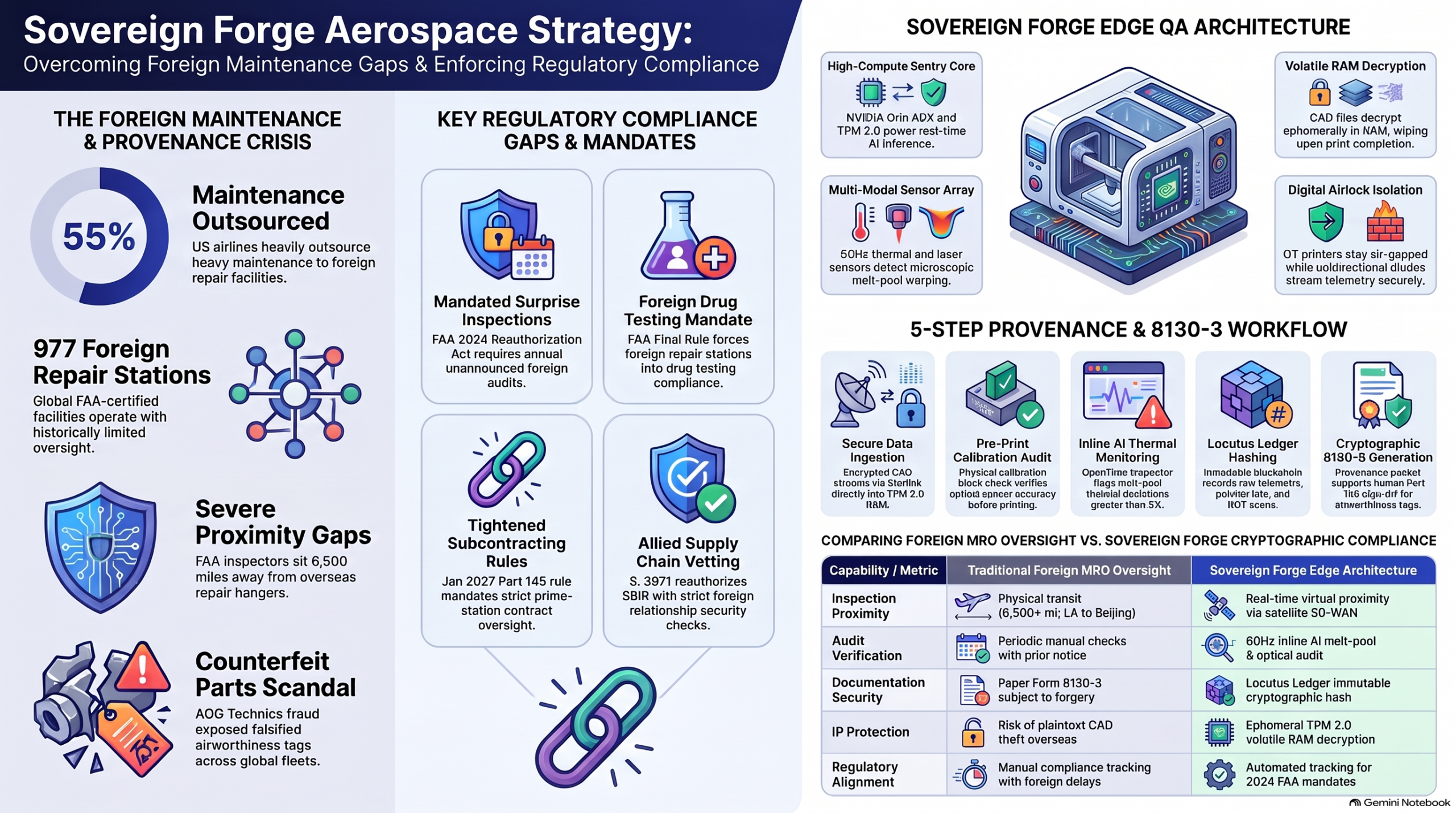
To maintain operational capacity while managing escalating cost pressures, air carriers have aggressively outsourced major maintenance, repair, and overhaul (MRO) activities. Historically, domestic U.S. airlines executed the vast majority of heavy maintenance in-house; in 1990, only 20% of maintenance expenditure was outsourced. By 2016, outsourced maintenance reached 47% ($7.3 billion), a level that has stabilized at 45% to 55% of total airline maintenance spend. While light “line maintenance” is frequently retained domestically (~55%), heavy maintenance and engine overhauls are predominantly contracted to foreign facilities.
Currently, there are approximately 977 FAA-certified foreign repair stations operating globally across key regional hubs, including China (78 facilities), Singapore (54), Brazil (22), Thailand (6), Costa Rica (3), and El Salvador (2). This expansion has created acute supply chain oversight challenges. To mitigate OEM lead times exceeding 12 months and parts inflation running at 2.5% to 3.5% annually, the industry has increased its reliance on alternative parts channels:
- Used Serviceable Material (USM): Valued at $7.6 billion in 2025 and projected to reach $10.9 billion by 2033, USM components provide immediate availability at a 30% to 40% discount compared to new OEM parts.
- Parts Manufacturer Approval (PMA): FAA-certified third-party replacement parts, growing at 7.8% annually, are achieving widespread adoption as airlines and lessors bypass OEM inventory bottlenecks.
Counterfeit Risks & Cryptographic Traceability Mandates
The convergence of heavy foreign outsourcing, complex multi-tier distribution networks, and surging demand for USM/PMA parts culminated in the AOG Technics counterfeit scandal. A UK-based parts broker distributed thousands of jet engine components—specifically targeting CFM56 engines—accompanied by falsified FAA Form 8130-3 airworthiness documentation. This global fraud scheme forced international civil aviation authorities (FAA, EASA) to ground hundreds of commercial aircraft, perform emergency engine teardowns, and purge suspect inventory.
The fallout established a permanent “dirty fingerprint” crisis across the global MRO supply chain. Paper-based airworthiness certificates and unverified digital PDFs are no longer sufficient to guarantee component integrity. Proving immutable, physical “Back-to-Birth” provenance—tracking raw material melt lots, precise fabrication parameters, inline quality assurance (QA) data, and non-destructive testing (NDT) records—has emerged as a mandatory procurement criterion alongside part stock availability.
Regulatory Compliance Roadmap
Civil aviation authorities have responded to foreign MRO oversight gaps by establishing stringent, legally binding operational mandates. Foreign repair stations and prime MRO contractors face heavy compliance obligations, summarized in the regulatory matrix below:
Regulatory Mandate & Statutory Basis Mandated Requirements Operational & Compliance Impact on Foreign/Outsourced MROs
FAA Reauthorization Act of 2024
(Passed May 2024) Enacts statutory requirement for annual unannounced physical inspections of all FAA-certified foreign repair stations. Eliminates legacy diplomatic advance-notice mechanisms. Stations must maintain continuous, audit-ready operational and maintenance tracking records to validate compliance during surprise inspections.
FAA Final Rule on Foreign Drug & Alcohol Testing
(Issued Dec 18, 2024; Statutory Deadline Dec 20, 2027) Mandates that foreign repair stations establishing maintenance operations for U.S. air carriers institute formal drug and alcohol testing programs for safety-sensitive personnel. (Note: ARSA submitted a petition on Sept 10, 2026, requesting an extension to 2029). Imposes significant administrative oversight and compliance tracking requirements across ~977 foreign stations to verify personnel qualification and testing adherence ahead of enforcement deadlines.
FAA Part 145 Contract Maintenance Oversight Rule
(Effective Jan 11, 2027) Tightens prime Part 145 repair station procedures and mandatory oversight controls when subcontracting maintenance activities to external entities. Forces prime MRO facilities and DER repair partners to enforce real-time, end-to-end traceability and direct oversight over all subcontracted manufacturing, machining, and special processing vendors.
- Technical Architecture: Edge-QA Gateway (SOV-AUTO-FORGE-V2) & Cryptographic Ledger
Hardware Gateway Baseline Architecture
The core edge-computing hardware engine for point-of-use additive manufacturing and MRO component validation is the upgraded SOV-AUTO-FORGE-V2 gateway hub (estimated MSRP $22,500–$28,500 + printer/connectivity SLA). The legacy v1.0 draft specification—which relied on an entry-level Intel i3-N305 processor—proved insufficient during real-time 60Hz multi-spectral optical, thermal, and point-cloud AI inference operations over 40-hour metal additive builds, resulting in compute saturation and thermal throttling.
The canonical v2.0 architecture upgrades the compute infrastructure to a dedicated High-Compute Edge Node processing tier, incorporating an NVIDIA Jetson Orin AGX, Apple Silicon M4 Max–Ultra, or Hailo NPU co-processor array. Hardware security is grounded in a discrete STMicroelectronics Trusted Platform Module (TPM 2.0) chip executing cryptographic attestation. System memory is standardized at 64GB+ ECC/unified RAM, backed by a 4TB NVMe SSD configured in RAID-1 for redundant, local rolling storage of point-cloud datasets and neural network model execution.
In-Situ Optical & Sensor Array
The SOV-AUTO-FORGE-V2 gateway interfaces directly with external industrial additive manufacturing machinery via an independent, multi-modal QA sensor stack mounted within the build chamber:
- High-Speed IR Pyrometers & FLIR Thermal Imaging: Captures localized melt-pool thermal gradients and spatial heat dissipation at 60Hz.
- Laser Micrometers & Multispectral Vision Sensors: Continuously measures surface planarity, layer-by-layer height deposition, and dimensional geometric accuracy to detect microscopic warping, void formation, or delamination.
- Direct OEM Melt-Pool Taps: Integrates directly with OEM internal monitoring frameworks, including EOS EOSTATE, Velo3D Assure™, and Optomec AutoCLAD.
Prior to initiating any aerospace build sequence, the gateway enforces protocol R-QA-01. This protocol mandates a physical calibration block verification procedure to eliminate sensor drift and confirm optical baseline accuracy before authorizing build execution.
Cybersecurity & Digital Airlock Architecture
The system architecture adheres strictly to NIST SP 800-82 guidelines for industrial control system security and DeReticular White Paper WP-2026-DR-094. The host additive manufacturing system operates on an isolated Operational Technology (OT) VLAN, physically air-gapped from local corporate IT networks and the public internet.
Outbound print telemetry and hash state transitions bypass traditional dual-homed networks via a unidirectional Digital Airlock. Dedicated connectivity is provided by a Starlink Business Flat High-Performance SD-WAN terminal configured to communicate exclusively with whitelisted U.S. and Allied IP addresses. To prevent data corruption or loss of telemetry during low-Earth-orbit satellite micro-outages during 40-hour print cycles, backhaul redundancy is maintained by a supercapacitor-backed Nomad Link (RIOS-NL-01) battery-less LTE failover unit.
Intellectual property is protected via protocol R-SEC-01. Incoming CAD models, build parameters, and G-code files are decrypted exclusively within volatile RAM using TPM 2.0 ephemeral encryption keys. Decrypted build files are never written to persistent storage drives; any power interruption, chassis intrusion, or physical tamper trigger executes an automatic memory zeroization command.
Hardware & Software Specification Matrix
Subsystem v1.0 Draft Specs (Deprecated) Canonical v2.0 Specification Status Baseline
Compute Core Intel i3-N305 / 64GB DDR5 (Maxed out under 60Hz inference load) High-Compute Edge Node: NVIDIA Jetson Orin AGX / Apple Silicon M4 Max–Ultra / Hailo NPU tier + STMicro TPM 2.0 + 64GB+ ECC/unified RAM + 4TB NVMe RAID-1. [PRE-VALIDATION]
Optical / Thermal Array Optic Array: FLIR Lepton + laser micrometer at 60Hz. Multi-Modal QA Array: High-speed IR pyrometer / FLIR thermal + direct OEM taps (EOSTATE / Assure™ / AutoCLAD) + R-QA-01 physical calibration block protocol. [PRE-VALIDATION]
Network Security Claimed “Air-Gapped” while executing continuous cloud telemetry. WAN-Isolated Digital Airlock (WP-2026-DR-094 / NIST SP 800-82): Isolated OT VLAN; unidirectional outbound data diode transmission; signed offline/staged OTA model updates. [PRE-VALIDATION]
Backhaul & Failover Starlink Business + basic LTE failover. Starlink Business SD-WAN (US/Allied whitelisted IPs) + Nomad Link (RIOS-NL-01) battery-less supercapacitor LTE failover unit. [VERIFIED COTS]
Software & Ledger OpenClaw Inspector + Locutus Ledger minting autonomous 8130-3 tags. Containerized OpenClaw anomaly engine (dereticular/openclaw-aerospace:latest) + Digital Twin Engine + Rust/Wasm Locutus Ledger minting immutable Cryptographic Provenance Passports. [PRE-VALIDATION]
- End-to-End Operational Workflow & Cryptographic Provenance Release
5-Step Operational Pipeline
Point-of-use fabrication, MRO component restoration, and digital airworthiness verification follow a standardized five-step operational pipeline:
- Order & Digital Ingestion: The engineering authority streams an encrypted CAD payload and build parameter set over the Starlink Business tunnel to the gateway hub. Implementing protocol R-SEC-01, the discrete TPM 2.0 chip decrypts the file directly into volatile RAM.
- Pre-Print Calibration & Powder Verification: The system executes protocol R-QA-01, completing an automated physical calibration block routine. The gateway verifies and cryptographically binds the chemical certificate of analysis for the virgin or sieved superalloy powder lot to the specific Build ID.
- Real-Time Print & Inline AI Audit: The printer executes the build while containerized OpenClaw Inspector software (dereticular/openclaw-aerospace:latest) processes thermal pyrometry, multispectral imaging, and OEM melt-pool data at 60Hz. If spatial geometry or thermal energy density strays by >2% from nominal parameters, the system flags the anomaly and holds the build for metallurgical review.
- Post-Processing & NDT Integration: Following completion of the additive cycle, the part undergoes stress relief and qualification: Wire EDM plate separation → Vacuum stress-relief heat treatment → Outsourced Hot Isostatic Pressing (HIP) → 5-axis CNC airfoil finish machining → CMM dimensional verification, Fluorescent Penetrant Inspection (FPI), and Computed Tomography (CT) NDT scanning.
- Cryptographic Provenance Release: The Rust/WebAssembly (Wasm) based Locutus Ledger aggregates and cryptographic-hashes the multi-layer inline build telemetry, raw powder certifications, heat-treatment profiles, and final NDT inspection logs into an immutable Digital Twin Provenance Packet.
Regulatory Certification Authority
To maintain strict compliance with FAA Part 21 (Certification Procedures for Products and Parts) and FAA Part 145 (Repair Stations), the Locutus Ledger does not autonomously mint a legally binding FAA Form 8130-3 Airworthiness Approval Tag. Autonomous software or cryptographic ledgers lack statutory authority under civil aviation law to sign airworthiness approvals.
Instead, the Locutus Ledger compiles an incorruptible “Back-to-Birth” Digital Twin Provenance Passport. This cryptographic passport serves as authoritative evidentiary proof supporting formal sign-off by a qualified human authority—such as an FAA Designated Engineering Representative (DER), an Organization Designation Authorization (ODA) holder, or an authorized Part 145 certificated mechanic.
Allied Jurisdiction & Defense Export Compliance
Deployments of defense-aligned SOV-AUTO-FORGE-V2 hardware arrays and ITAR-controlled CAD data streaming are strictly restricted to U.S. domestic depots and vetted Allied partner jurisdictions (e.g., U.S. military logistics sites, Beta Technologies’ electric aviation hubs, Singapore, the United Kingdom, and Japan).
To remain compliant with Directorate of Defense Trade Controls (DDTC) ITAR regulations, Export Administration Regulations (EAR), and national security foreign-affiliation vetting rules established under S. 3971, physical hardware deployments or streaming of defense CAD IP to adversary or non-allied jurisdictions (specifically including Beijing, China) is expressly prohibited.
- Special Process Additive Manufacturing (AM) Infrastructure & Qualification
Classification of Specialty Industrial Printers
Turbine blades, vanes, structural impellers, and high-pressure combustor components require dedicated additive process classes capable of processing crack-prone superalloys while maintaining structural density. Four specialty industrial AM process categories are authorized for integration into Aegis Turbine Additive operational workflows:
Process Class Approved OEM Systems [VERIFIED COTS] Canonical Turbine Applications Qualified Alloys & Ceramics Required Post-Processing & Inspection Stack
Laser DED
(Directed Energy Deposition / Hybrid) Optomec LENS / Huffman (MTS 500/860, AutoCLAD), DMG MORI LASERTEC DED, Meltio Engine. MRO blade tip restoration, leading-edge cladding (>99.9% density), seal repair, near-net blanks. Inconel 718, Inconel 738, Ti-6Al-4V, Stellite / CoCr alloys. Pre/post-weld vacuum heat treatment, 5-axis CNC blending, FPI NDT inspection.
LPBF / DMLS
(Laser Powder Bed Fusion) EOS (M 290, M 300-4, M 400-4), Velo3D (Sapphire, XC, XC 1MZ), Nikon SLM (NXG XII 600), TRUMPF (TruPrint 5000 500°C). Cooled polycrystalline blades, stators, shrouded impellers, microturbine rotors. Inconel 718, Inconel 738LC, CM247LC, Haynes 282, Hastelloy X. Powder sieving, Wire EDM cutoff, outsourced HIP, 5-axis CNC machining, EDM cooling holes.
EB-PBF / EBM
(Electron Beam Powder Bed Fusion) Colibrium Additive / GE (Arcam Spectra H, A2X), Freemelt (eMELT-iD / eMELT-iM). Brittle, crack-prone γ-TiAl low-pressure turbine blades; stress-free hot-section builds. Gamma-Titanium Aluminide (γ-TiAl), Inconel 718, Inconel 738. Vacuum depowdering, outsourced HIP, CNC fir-tree root grinding, X-ray/CT scanning.
Ceramic LCM
(Lithography-based Ceramic Mfg.) Lithoz CeraFab System S65 (with 4K Performance Pack), 3DCeram C1000 FLEXMATIC. Intricate silica ceramic casting cores for Single-Crystal (SX) HP turbine blade investment casting. Silica-based technical casting ceramics. Thermal debinding & high-temp sintering kiln, CMM optical scanning (Zero NFPA 484 metal dust).
Facility Infrastructure & Combustible Dust Safety
Operational bays housing metal LPBF and EBM systems must comply with stringent environmental and life-safety mandates, governed by NFPA 484 (Standard for Combustible Metals), NFPA 660, UL 2011, and the International Fire Code. Metal powder handling facility requirements include:
- Dust Hazard Analysis (DHA): Execution of a formal DHA for reactive powder processing environments prior to operational commissioning.
- Electrical Classification & Housekeeping: Installation of NEC Class II, Division 1/2 explosion-proof electrical fixtures and deployment of Class II certified industrial vacuums.
- Wet Scrubber Suppression Systems: Mandatory installation of mineral-oil wet-scrubber dust collection units. Water-based dust collectors are strictly prohibited for reactive titanium and aluminum powder processing due to the risk of generating explosive hydrogen gas.
Strategic Quality & Regulatory Certification Sequence
To establish prime contractor eligibility while optimizing CapEx allocation, quality certifications are deployed across three structured phases:
- Phase 1: Defense Readiness & Security Baseline (Months 1–3): Complete SAM.gov entity registration, secure a CAGE code, and finalize Directorate of Defense Trade Controls (DDTC) ITAR registration ($3,000 annual Tier 1 fee, or $2,500 under the small-business discount pilot if the fee exceeds 1% of revenue). Complete NIST SP 800-171 self-assessment scoring and upload documentation into the Supplier Performance Risk System (SPRS) to satisfy CMMC Phase 1 requirements.
- Phase 2: Quality Management System (Months 4–12): Implement and achieve AS9100D QMS certification ($15,000–$35,000 auditing/consulting investment). Maintain operational readiness for the upcoming IA9100 international aerospace standard transition window.
- Phase 3: Special Process Accreditation (Year 3+): Attain formal NADCAP Additive Manufacturing accreditation via PRI eAuditNet ($15,000–$60,000 per process commodity). Execution is tied to prime contractor sponsorship or America Makes qualification grant funding.
- Non-Dilutive Capital Stacking, SBIR Alignment & 10-Year Financial Model
Capital Stacking & Federal Funding Strategy
To build operational capacity without excessive equity dilution, capital requirements are satisfied through a dual-track strategy combining non-dilutive federal R&D grants with government-backed manufacturing debt:
- S. 3971 SBIR/STTR Reauthorization Alignment (FY2026–FY2031): Following reauthorization under the Small Business Innovation and Economic Security Act (S. 3971 enacted April 13, 2026), the venture targets U.S. Department of Defense (DoD) AFWERX Focused Open Topics. The funding pathway advances from Phase I awards ($75,000–$150,000) into Phase II technology demonstrations ($1,250,000+), leveraging Technical and Business Assistance (TABA) stipends for cybersecurity and IP protection. Mature technologies transition into Phase III non-competitive Indefinite Delivery, Indefinite Quantity (IDIQ) contracts and Strategic Breakthrough Awards (up to $30 million). All proposals strictly adhere to 2026 statutory foreign-ownership, affiliation, and supply-chain security vetting protocols.
- SBA 504 Small Manufacturer Loan Program: Capital equipment and facility build-outs are financed using SBA 504 loan structures tailored for small manufacturers operating under primary NAICS 336412 (Aircraft Engine & Engine Parts) and secondary NAICS 332710 (Precision Machined Products). The framework secures up to $5.5 million in fixed-rate SBA debentures, covering up to 40% of project CapEx paired with a 50% bank first mortgage and a 10% to 15% borrower equity contribution. Financing structures capitalize on FY2027 upfront and annual SBA guarantee fee waivers for qualified manufacturing entities.
Canonical 10-Year Pro Forma Financial Plan
The canonical 10-year financial baseline for the operating entity (Aegis Turbine Additive, LLC / FY2027–FY2036) is presented below in thousands of dollars ($000s):
Financial & Operational Metric ($000s) Y1 Y2 Y3 Y4 Y5 Y6 Y7 Y8 Y9 Y10
DED MRO & Tip Cladding Revenue $380 $850 $1,500 $2,100 $2,800 $3,600 $4,500 $5,400 $6,200 $7,000
LPBF & EBM Direct Parts Revenue $120 $400 $1,400 $2,800 $4,600 $7,500 $11,200 $16,000 $21,000 $26,500
Ceramic SX Cores (LCM) Revenue $0 $0 $600 $1,350 $2,100 $2,900 $3,800 $4,600 $5,400 $6,200
Eng., DfAM, SBIR & QA Tech Revenue $250 $750 $900 $1,150 $1,500 $1,800 $2,200 $2,600 $3,000 $3,500
TOTAL REVENUE $750 $2,000 $4,400 $7,400 $11,000 $15,800 $21,700 $28,600 $35,600 $43,200
COGS (ex-D&A) $435 $1,080 $2,288 $3,700 $5,280 $7,268 $9,765 $12,584 $15,308 $18,144
Gross Profit (ex-D&A) $315 $920 $2,112 $3,700 $5,720 $8,532 $11,935 $16,016 $20,292 $25,056
Gross Margin (%) 42.0% 46.0% 48.0% 50.0% 52.0% 54.0% 55.0% 56.0% 57.0% 58.0%
Total OpEx (SG&A, QA, R&D) $615 $850 $1,550 $2,200 $3,100 $4,400 $5,800 $7,300 $8,800 $10,300
EBITDA ($300) $70 $562 $1,500 $2,620 $4,132 $6,135 $8,716 $11,492 $14,756
EBITDA Margin (%) -40.0% 3.5% 12.8% 20.3% 23.8% 26.2% 28.3% 30.5% 32.3% 34.2%
D&A $164 $200 $640 $720 $1,150 $1,650 $1,900 $2,350 $2,550 $2,750
Interest Expense $65 $59 $230 $215 $330 $385 $350 $310 $265 $215
Taxes (24% post-NOL) $0 $0 $0 $27 $136 $503 $932 $1,453 $2,082 $2,830
NET INCOME ($529) ($189) ($308) $538 $1,004 $1,594 $2,953 $4,603 $6,595 $8,961
Operating Cash Flow (OCF) ($455) ($139) $44 $898 $1,722 $2,668 $4,145 $6,125 $8,305 $10,799
Capital Expenditures (CapEx) ($1,150) ($250) ($3,400) ($600) ($3,200) ($3,800) ($2,200) ($4,500) ($2,500) ($2,500)
New Equity Raised $1,000 $500 $1,500 $0 $3,500 $0 $0 $0 $0 $0
New Debt Drawn $1,000 $0 $2,900 $0 $2,500 $1,500 $0 $0 $0 $0
Debt Principal Repaid ($85) ($90) ($260) ($280) ($435) ($580) ($620) ($660) ($700) ($745)
ENDING CASH $310 $331 $1,115 $1,133 $5,220 $5,008 $6,333 $7,298 $12,403 $19,957
ENDING TOTAL DEBT $915 $825 $3,465 $3,185 $5,250 $6,170 $5,550 $4,890 $4,190 $3,445
Total Headcount (FTEs) 6 10 16 25 35 48 63 80 96 112
Financial Model Notes
- Depreciation & Amortization (D&A): Modeled on a ~7.5-year blended straight-line basis across CapEx vintages.
- Tax Rate & NOLs: Effective corporate tax rate modeled at 24%. Initial Net Operating Loss (NOL) accumulations ($1,026,000 total across Y1–Y3) offset tax liabilities until full absorption in Y4–Y5.
- Working Capital: Change in Net Working Capital (ΔNWC) is modeled at 12% of incremental annual revenue.
Enterprise Valuation & Exit Analysis
Aerospace and defense precision manufacturing and MRO service providers command enterprise valuation multiples ranging between 10.0× and 14.0× EV/EBITDA among strategic acquirers (e.g., HEICO, Howmet Aerospace, RTX/Collins, GE Aerospace, Chromalloy).
Applying a conservative enterprise multiple of 11.0× to the Year 10 EBITDA baseline ($14.756 million) establishes an Implied Enterprise Value (EV) of $162.32 million. Accounting for ending balance sheet positions by adding ending cash ($19.957 million) and deducting outstanding debt ($3.445 million) calculates an Implied Equity Value at Exit of ~$178.83 million.
When evaluated against the $6.50 million total paid-in equity capital raised across Years 1 through 5 ($1.0M Seed in Y1, $0.5M Bridge in Y2, $1.5M Pre-Series A in Y3, and $3.5M Series A in Y5), this financial performance reflects a gross unadjusted Multiple on Invested Capital (MOIC) of approximately 27.5× prior to management option pool adjustments.