Strategic Feasibility Assessment: Transitioning Industrial Operations to Sovereign Microgrids and Off-Grid Power
- Executive Framework: Structural Vulnerability & Strategic Imperative
Industrial enterprise operations face severe structural risks due to near-total reliance on centralized regional electrical utility grids. Aging high-voltage transmission lines, increasing frequency of severe weather events, and severe regulatory bottlenecks have transformed regional grid connections from reliable delivery systems into existential operational threats. Historical precedents illuminate this dynamic: in 1963, Jack Goeken and Bill McGowan challenged AT&T’s transcontinental long-distance monopoly by deploying private microwave towers along Route 66, a movement that culminated in Judge Harold Greene’s 1982 consent decree breaking up the Bell System.
Today, industrial facilities face an identical structural crisis. The electric utility monopoly holds enterprise growth hostage through multi-year interconnection delays, punitive demand charges, and rolling brownouts. Evaluating behind-the-meter energy sovereignty is no longer merely a corporate sustainability initiative; it is the direct thermodynamic equivalent of telecommunications deregulation. By establishing autonomous, on-premises energy generation, industrial facilities can decouple from fragile external infrastructure, eliminate exposure to volatile utility tariffs, and achieve unassailable operational resilience.
Quantify Centralized Grid Failure Modes
Regional Transmission Organizations (RTOs) and Independent System Operators (ISOs) across North America operate under extreme thermal and structural constraints. Regional high-voltage transmission lines regularly operate near maximum capacity, creating systemic vulnerabilities that lead to frequent curtailments, rolling brownouts, and severe voltage sags.
The primary failure modes and operational penalties of centralized grid dependency include:
- Interconnection Queue Delays: Average wait times across North American ISOs (e.g., PJM, MISO, ERCOT, CAISO) range from 5.4 to 7 years to secure utility substation transformer connections, stalling facility expansions and capital deployment.
- Power Transformer Lead Times: Sourcing high-voltage utility power transformers currently requires lead times of 3 to 4 years (extending through 2024–2026 delivery timelines).
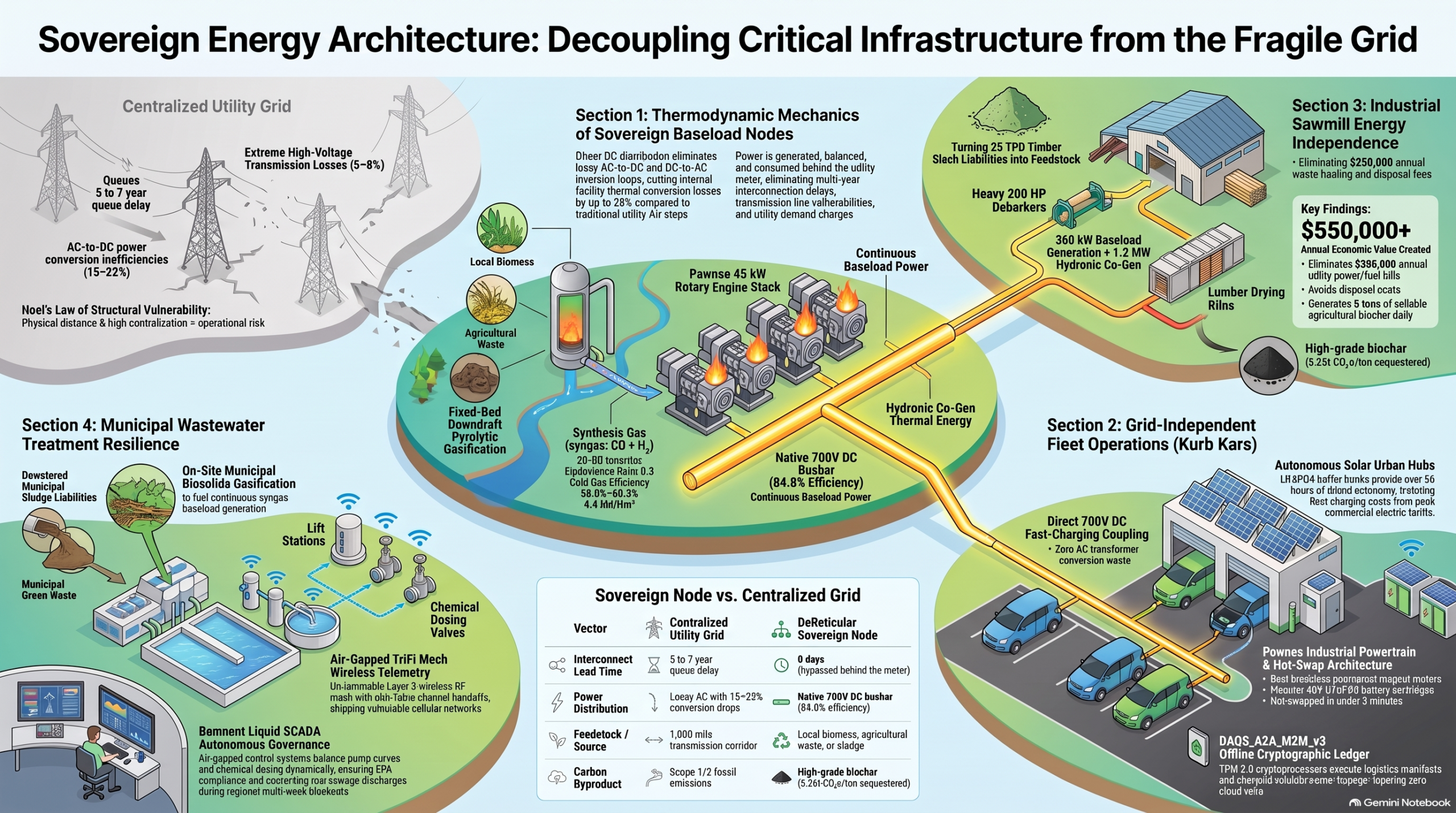
- High-Voltage Transmission Losses: Long-distance high-voltage transmission lines suffer parasitic thermodynamic losses of 6% to 8% before electricity reaches the facility meter.
- AC-to-DC Conversion Losses: Inefficient alternating current (AC) to direct current (DC) conversion cycles burn an additional 15% to 22% of incoming power as thermal waste across standard industrial distribution loops.
Operational Metric Centralized Grid Dependencies Sovereign Islanding
Energization Timeline 5.4 to 7-year queue delay Rapid behind-the-meter deployment (e.g., 120 days)
Infrastructure Lead Time 3 to 4 years for utility transformers Modular, site-assembled generation assets
Transmission & Conversion Loss 21% to 30% combined parasitic loss 84.8% net efficiency via native direct DC distribution
Operational Continuity Subject to rolling brownouts and grid sags Continuous, dispatchable 24/7/365 baseload power
Regulatory Exposure Captive to Investor-Owned Utility (IOU) tariffs Total regulatory bypass via statutory carve-outs
Formalize Noel’s Law of Structural Vulnerability
To quantify the operational risks inherent in centralized utility infrastructure, enterprise risk models apply Noel’s Law of Structural Vulnerability:
\text{Vulnerability} \propto \frac{\text{Distance of Dependency} \times \text{Centralization Factor}}{\text{Local Autonomous Capacity}}
Under this mathematical formulation:
- Distance of Dependency: Measures the physical length of exposed infrastructure supplying the facility.
- Centralization Factor: Represents the operational degree of reliance on single-point utility gatekeepers, regional substations, and public utility commission ratemaking decisions.
- Local Autonomous Capacity: Measures the facility’s behind-the-meter generation, storage, and control capability capable of operating independently of external inputs.
Consider a practical comparative scenario: an industrial manufacturing plant relying on a 1,000-mile high-voltage transmission corridor crossing forested, wildfire-exposed, or storm-prone terrain exhibits extreme Distance of Dependency and a Centralization Factor approaching 1.0. With zero on-site continuous generation (Local Autonomous Capacity \approx 0), the facility’s enterprise risk exposure approaches 100%. A single transmission line trip or wildfire curtailment halts plant operations entirely. Conversely, deploying a localized, on-premises thermochemical generation node compresses the physical dependency distance to zero, eliminates external centralization, and maximizes local autonomous capacity—effectively neutralizing structural vulnerability regardless of regional grid collapse.
Define Layer 1 Baseload Infrastructure
Achieving true off-grid sovereignty requires an unyielding foundation: continuous, dispatchable behind-the-meter baseload power. Intermittent renewable energy systems—such as solar arrays and wind turbines—fail to deliver this standard because they depend on variable atmospheric conditions. While Battery Energy Storage Systems (BESS) function well as dynamic buffers, they act as chemical reservoirs rather than continuous power generators, making them cost-prohibitive when attempting to sustain operations through multi-day cloud cover or extended grid blackouts.
Layer 1 Baseload Infrastructure solves this challenge by pairing behind-the-meter thermochemical biomass gasification with a 700V DC microgrid busbar. Thermochemical gasification converts locally sourced solid organic feedstocks (agricultural residues, timber slash, or municipal biosolids) into high-energy synthesis gas (syngas). This syngas feeds modular engine arrays that run continuously 24/7/365, delivering uncompromised, dispatchable mechanical, thermal, and electrical power directly to the facility.
This baseline of sovereign thermochemical power provides the thermodynamic foundation required to evaluate the native direct-current power conversion architecture.
- Technical Viability Analysis: Thermochemical Generation & 700V DC Architecture
Traditional industrial energy models rely on alternating current (AC) distribution systems designed for long-distance utility transport. However, modern industrial loads—such as variable-frequency motor drives (VFDs), high-density GPU compute clusters, and electric vehicle charging infrastructure—operate natively on direct current (DC). Interfacing DC machines with AC grid inputs forces facilities through multiple lossy conversion steps, generating significant thermal friction and parasitic power drops. Eliminating these conversion penalties through direct direct-current generation is central to technical viability.
+——————————————————————-+
| LAYER 1 BASELOAD ENERGY TOPOLOGY |
+——————————————————————-+
│
▼
+——————————————————————-+
| LOCAL BIOMASS & ORGANIC FEEDSTOCKS |
| (Agricultural Residues / Timber Slash / Sawmill Waste) |
+——————————————————————-+
│
▼
+——————————————————————-+
| 20–30 TPD PYROLYTIC GASIFIER CORE |
| (High-Temp Downdraft, ER: 0.3, Cold Gas Efficiency: 58.0%–59.5%) |
+——————————————————————-+
│ │
▼ ▼
+———————————–+ +—————————+
| RAW LOW-BTU SYNGAS OUTPUT | | HIGH-GRADE BIOCHAR |
| (4.4 MJ/Nm³ Caloric Value) | | (3.26t CO₂e/ton Carbon |
+———————————–+ | Sequestration + Acids) |
│ +—————————+
▼
+——————————————————————-+
| PAWNEE 45 kW MODULAR ROTARY ENGINE ARRAYS |
| (Valveless Low-BTU Combustion, Multi-Stack Engine Design) |
+——————————————————————-+
│ │
▼ ▼
+———————————–+ +—————————+
| DIRECT RECTIFICATION TO BUSBAR | | HYDRONIC THERMAL EXPORT |
| (84.8% Net Conversion Efficiency) | | (1.2 MW Heat for Kilns / |
+———————————–+ | Absorption Cooling) |
│ +—————————+
▼
+——————————————————————-+
| NATIVE 700V DC DISTRIBUTION BUSBAR |
+——————————————————————-+
│ │ │
▼ ▼ ▼
+———————+ +———————+ +——————-+
| HIGH-DENSITY GPU | | COMMERCIAL EV FAST | | INDUSTRIAL VFDs |
| (RIOS-CC-1000) | | (Kurb Kars Depots) | | (Direct DC Link) |
+———————+ +———————+ +——————-+
Evaluate Pyrolytic Gasification Core Parameters
The core thermochemical generation unit utilizes fixed-bed downdraft pyrolytic gasification reactors operating at throughput capacities of 20 to 30 tons per day (TPD). The technical and operational parameters governing this conversion process include:
- Feedstock Versatility: Accommodates dry agricultural residues, timber slash, organic manufacturing waste, sawdust, pelleted forestry residues, and dewatered municipal biosolids.
- Equivalence Ratio (ER): Maintained precisely at 0.3, optimizing partial oxidation to maximize syngas yield while minimizing char carbon burn-off.
- Cold Gas Efficiency: Operates in the 58.0% to 59.5% range, converting solid chemical energy into usable gaseous fuel with minimal thermal degradation.
- Syngas Caloric Value: Produces clean synthesis gas (\text{CO} + \text{H}_2) delivering a lower heating value of 4.4\text{ MJ/Nm}^3.
- Carbon Sequestration & Byproducts: Yields high-grade biochar that sequesters 3.26\text{ t CO}_2\text{e} per ton of biochar, alongside pyroligneous acid (wood vinegar) captured for agricultural soil conditioning, bio-pesticides, and water retention applications.
Assess Pawnee Powertrain Integration
Standard reciprocating piston generators frequently fail when fueled by raw syngas due to low energy density (low-BTU) and tar condensates that coat intake/exhaust valves and destroy engine seals. The Layer 1 architecture integrates the Pawnee 45 kW modular rotary internal combustion engine to address these dynamic fuel conditions.
The Pawnee rotary engine features specific engineering nuances that optimize it for syngas combustion:
- Valveless Port Architecture: The complete absence of intake and exhaust valves eliminates the mechanical seating surfaces where syngas tar condensates accumulate, preventing valve sticking and thermal fouling.
- Low-Vibration Multi-Stack Design: The continuous rotary motion avoids the extreme stress spikes characteristic of reciprocating pistons. Stacking multiple 45 kW rotary units allows precise power scaling while eliminating seal degradation caused by uneven low-BTU gaseous combustion.
- Hydronic Thermal Coupling: Each engine array features integrated cooling jackets and exhaust heat exchangers capable of capturing 1.2 MW of hydronic thermal energy. This high-temperature fluid is piped directly to process loads (e.g., lumber dry kilns, grain drying columns, absorption chillers), replacing natural gas or propane combustion entirely.
Analyze the Native 700V DC Busbar Architecture
Traditional power distribution introduces dynamic conversion losses at every junction: high-voltage AC from the utility is stepped down via transformers, converted to DC for battery storage, inverted back to AC for internal distribution, converted back to DC inside electronic power supplies, and modulated for motor drives. Each step bleeds between 3% and 8% of total power as waste heat.
The native 700V DC busbar architecture achieves an overall system distribution efficiency of 84.8% by outputting direct current straight from the Pawnee generator rectifiers onto a unified DC bus, bypassing the AC conversion process entirely.
Industrial Load Type Traditional AC Loss Profile & Mechanics Native 700V DC Busbar Flow & Efficiency Advantage
High-Density GPU Racks (RIOS-CC-1000) Multi-stage transformation: 480V AC distribution \rightarrow localized AC-to-DC rectification \rightarrow server VRM conversions (15%–22% thermal loss). Direct DC connection straight to liquid-immersed racks; eliminates power distribution unit (PDU) heat generation.
Commercial EV Fast-Charging (Kurb Kars) Grid 480V AC \rightarrow heavy step-up/step-down transformers \rightarrow external AC-to-DC fast-charger cabinet rectifiers (12%–18% thermal loss). Native DC-to-DC fast-charging pedestals feeding off 700V busbar; zero inversion loss, instantaneous power transfer.
Industrial VFD Drives (Pumps/Saws/Chillers) Utility 480V AC \rightarrow internal VFD diode bridge rectifier \rightarrow DC bus \rightarrow output inverter to motor (8%–14% thermal loss). Direct feed to VFD internal DC link; skips AC input rectification, eliminates line harmonics, reduces drive heat load.
By establishing native 700V DC busbar efficiency and valveless rotary combustion, the technical stack directly supports sector-specific operational deployments.
- Operational Viability: Sector-Specific Infrastructure Deployment Blueprints
Deploying sovereign energy infrastructure requires matching the thermochemical generation stack to the operational profiles of specific industrial sectors. Each operational environment presents unique thermodynamic input liabilities (such as biomass waste or process heat demands) and power reliability requirements that dictate microgrid architecture.
Evaluate Manufacturing & Forestry Sector Feasibility (Sawmills/Hardwood)
Commercial sawmills and hardwood processing facilities in rural corridors face high waste disposal expenses alongside poor electric grid quality. Heavy induction motor startups (e.g., 200 HP head-rig saws) cause severe voltage sags on long rural utility lines, triggering costly monthly demand charges.
- Operational Profile & Liabilities: A representative Appalachian hardwood facility processing timber generates 25 TPD of green sawdust, bark, and slash, incurring 35/ton in off-site hauling fees (250,000 annually). Simultaneously, grid power instability triggers up to $18,000/month in utility demand charges while brownouts disrupt dry kiln cycles.
- Sovereign System Blueprint: The mill deploys an on-site 25 TPD pyrolytic gasification reactor (sourced via agra.energy) paired with stacked Pawnee 45 kW rotary engines. The system delivers 360 kW of continuous electrical baseload onto a native 700V DC bus powering debarker VFDs, head-rigs, and plant lighting.
- Hydronic Thermal Coupling: The system captures 1.2 MW of hydronic thermal co-generation output from engine cooling jackets and exhaust loops. Piping this fluid directly into lumber dry kilns eliminates natural gas and propane OpEx entirely.
- Biochar & Co-Product Monetization: Processing 25 TPD of wood waste yields 5 TPD of high-grade biochar. Sequestering 3.26\text{ t CO}_2\text{e} per ton of char generates 16.3\text{ t CO}_2\text{e} in daily certified carbon credits. Monetizing these credits alongside local agricultural soil amendment sales generates over $150,000 in annual top-line byproduct revenue. Capturing pyroligneous acid provides organic bio-pesticides for regional forestry operations, offsetting initial CapEx and shortening simple project payback to under 2.4 years.
Evaluate High-Density Edge AI & Defense Compute Facilities
High-density artificial intelligence cluster operators face multi-year utility interconnect delays that stall deployment timelines. Furthermore, defense and secure computing facilities cannot risk transmitting sensitive telemetry through shared public cloud infrastructure.
- Operational Profile & Liabilities: A 2.5 MW high-density compute facility hosting an 800-GPU training cluster faces an 18-month utility interconnection study, a $3.2 million forced substation upgrade fee, and a transmission queue energization date set 5 years out.
- Sovereign System Blueprint: The facility establishes a Certified Microgrid District (under West Virginia Code §5B-2-21) and installs a 2.5 MW modular Pawnee syngas generation farm fueled by regional forestry residues sourced within a 30-mile radius. Power feeds directly into direct-bus liquid immersion cooling tanks housing RIOS-CC-1000 GPU racks running air-gapped Remnant compute nodes (engineered via energy.dereticular.com).
- Economic Impact: Energization drops from 5 years to 120 days. The levelized cost of energy stabilizes at $0.038/kWh, with zero exposure to grid brownouts, zero reliance on external cooling water towers, and zero cloud API telemetry leaving the facility boundary.
Evaluate Agriculture & Cold-Chain Logistics Hubs
Grain Cooperatives
- Peak Mitigation & Thermal Drying: Agricultural cooperatives face extreme seasonal load spikes during harvest, causing utility standby tariffs that penalize the facility year-round. Operating dual 20 TPD pyrolytic gasifiers fueled by corn stover and crop residues delivers 450 kW continuous electricity and high-volume hydronic heat directly to grain drying columns, eliminating propane purchases.
- Agricultural Circularity: The generated biochar is returned to member farms. Applying biochar to fields reduces crop irrigation demands by up to 40% and restores soil organic matter, while captured pyroligneous acid bypasses expensive synthetic bio-stimulants.
Cold-Storage & Fleets
- Chiller Protection: A 250,000-square-foot distribution hub running 40 industrial ammonia chillers risks million-dollar inventory loss events when 2-second utility voltage sags trip compressor drives. Driving compressor variable-frequency drives directly off a stable 700V DC bus eliminates voltage sag sensitivity and peak summer demand charges.
- Thermal Integration & Fleet Fast-Charging: Engine waste heat passes through absorption chillers to pre-cool low-temperature staging rooms. Simultaneously, the 700V DC bus connects directly to fast-charging pedestals for Kurb Kars logistics fleets (detailed at kurbkars.com), bypassing transformer step-down losses.
Evaluate Critical Infrastructure & Emergency Services
Wastewater Reclamation
- Sludge Conversion: Municipal wastewater treatment plants must maintain continuous operational compliance under EPA clean water standards. By process-drying municipal biosolids and green waste, a 20 TPD gasifier turns a costly sludge disposal liability (80–120/ton tipping fees) into a behind-the-meter baseload energy source.
- Regulatory Defense: Sludge gasification powers raw sewage lift pumps and chemical dosing systems continuously during regional blackouts, preventing raw sewage discharges into public waterways and shielding municipalities from statutory environmental fines.
Nomadic Kinetic Mobility & Communications
For mobile emergency management, disaster response, and field logistics, utility grid reliance creates critical failure points. The Layer 2 Kurb Kars platform provides mobile off-grid infrastructure:
+——————————————————————-+
| KURB KARS LAYER 2 KINETIC ARCHITECTURE |
+——————————————————————-+
│
┌───────────────────────────┼───────────────────────────┐
▼ ▼ ▼
+——————-+ +——————-+ +——————-+
| PAWNEE POWERTRAIN | | TRIFI MAST ROVER | | TACTICAL NEMT POD |
| Dual PM Motors | | 30-Ft Pneumatic | | 45 CFR 160/164 |
| Hot-Swap LiFePO₄ | | Telescoping Mast | | HIPAA Compliant |
| 120/240V Aux Out | | 4.5+ Mile Mesh | | Pure-Sine Medical |
| Native 700V DC | | Sub-16ms Sync | | Auxiliary Bus |
+——————-+ +——————-+ +——————-+
│ │ │
└───────────────────────────┼───────────────────────────┘
▼
+——————————————————————-+
| OFFLINE MACHINE SETTLEMENT: DAOS_A2A_M2M_v3 Protocol |
| Hardware TPM 2.0 Cryptoprocessors • Zero External Cloud Calls |
+——————————————————————-+
- Pawnee Electric Powertrain: Utilizes hot-swappable 48V \text{LiFePO}_4 battery cartridges that swap in under 3 minutes, integrated with 120V/240V auxiliary pure-sine inverters to run heavy field equipment directly off the chassis.
- TriFi Nomadic Mesh Rovers: Deploys a 30-foot pneumatic telescoping antenna mast projecting an omnidirectional 4.5+ mile line-of-sight tactical mesh bubble with sub-16ms channel synchronization, maintaining local command-and-control without public cell towers or satellite links.
- Tactical NEMT Pods: Non-Emergency Medical Transport pods feature automated hydraulic lift gates, pure-sine medical equipment power buses, and onboard air-gapped telemetry terminals meeting federal 45 CFR Part 160 and Part 164 (HIPAA) compliance standards to protect patient identity and medical transport data.
Demonstrating domain deployment feasibility across these sectors leads directly to navigating state statutory microgrid carve-outs and utility bypass law.
- Regulatory & Statutory Feasibility: Monopoly Carve-Outs & Utility Bypass
Investor-Owned Utilities (IOUs) routinely use regulatory protectionism to delay or block commercial facilities from disconnecting from the grid. Achieving complete energy sovereignty requires structured legal strategies that leverage statutory carve-outs, offline operational protocols, and independent communication layers.
Analyze Statutory Microgrid Carve-Outs
The legal path to unassailable off-grid operation relies on microgrid designation statutes enacted at the state level. A primary legal blueprint is West Virginia Code §5B-2-21 (Certified Microgrid Districts).
Under WV Code §5B-2-21, qualifying commercial and industrial entities can petition for formal designation as a Certified Microgrid District. Establishing a designated district provides explicit legal protections:
- Monopoly Franchise Bypass: Legally exempts behind-the-meter generation assets from Public Service Commission (PSC) oversight and regional utility franchise territorial monopolies.
- Elimination of Interconnect Constraints: Eliminates the legal obligation to submit to RTO/ISO interconnection queue studies, mandatory network upgrade fees, or multi-year delay schedules.
- Direct Power Offtake Authorization: Permits facilities within the district boundary to construct, interconnect, and trade direct behind-the-meter power without triggering utility tariff structures or public utility regulations.
Assess Communication & Data Sovereignty Mandates
Physical energy independence is vulnerable if operational logic relies on centralized public telecom networks or cloud servers. Sovereign nodes integrate native communication and settlement protocols to secure operational data.
Offline Machine Settlement Protocols
Automated equipment, fleet charging stalls, and site telemetry execute via the DAOS_A2A_M2M_v3 protocol. Anchored locally by hardware TPM 2.0 (Trusted Platform Module) cryptoprocessors embedded in the control hardware:
- Machine-to-machine transactions, vehicle charging sessions, and logistics manifests settle autonomously off-grid.
- Operational telemetry stays contained on local networks, completely eliminating public cloud API calls, software-as-a-service (SaaS) subscription dependencies, and remote cyber-attack vectors.
Mesh Communication Layer
Site operations utilize the TriFi Layer 3 wireless mesh network for local telemetry and control loop backhaul. The TriFi mesh operates as an un-jammable, self-healing radio frequency (RF) fabric capable of sub-16ms channel synchronization. During regional grid failures, public cell tower outages, or physical fiber cuts, TriFi nodes maintain continuous control-loop telemetry across pumps, VFDs, security perimeters, and dispatch hubs without external carrier infrastructure.
Establishing legal decoupling and statutory bypass mechanisms translates directly into non-dilutive capital stacking and financial TCO performance.
- Economic Viability & Capital Stacking Evaluation
Transitioning an industrial facility to sovereign baseload power requires a disciplined capital strategy. By combining federal grants, tax incentives, and low-interest loan guarantees, project sponsors assemble a non-dilutive capital stack that minimizes upfront equity requirements and accelerates project payback.
Formulate Non-Dilutive Capital Stacking Models
NON-DILUTIVE FEDERAL CAPITAL STACK ARCHITECTURE
+—————————————————————–+
| Total Eligible Capital Expenditure (CapEx) |
+—————————————————————–+
│
┌───────────────────────────┼───────────────────────────┐
▼ ▼ ▼
+——————-+ +——————-+ +——————-+
| USDA REAP Sec 9007| | IRA Section 6417 | | FEMA BRIC |
| Direct Grants | | Direct Pay Cash | | Pre-Disaster |
| (Up to 50% CapEx) | | Reimbursement | | Mitigation Grants |
| Guaranteed Loans | | (30% Base + up to | | (Community |
| (Up to 75% CapEx) | | 50% with Add-ons)| | Lifelines) |
+——————-+ +——————-+ +——————-+
Federal Funding Vector Program Scope & Mechanism Applied Eligibility & Capital Contribution
USDA REAP (Section 9007) Rural Energy for America Program offering direct grants and loan guarantees for rural clean energy systems. Direct grants cover up to 50% of total project CapEx; loan guarantees cover up to 75% of capital costs for qualifying rural sites.
IRA Section 6417 (Direct Pay) Elective pay provision allowing non-taxable entities, municipalities, and qualified rural facilities to receive direct cash refunds. Provides a 30% base elective pay credit, scaling up to 50% when factoring in domestic content and energy community bonuses.
FEMA BRIC (Building Resilient Infrastructure) Pre-disaster mitigation grant program funding continuous infrastructure resilience for community lifelines. Subsidizes microgrid islanding infrastructure for critical assets (water, hospitals, emergency EOCs) to maintain continuous operations during natural disasters.
Conduct Comprehensive Financial & TCO Analysis
Evaluating economic viability requires comparing the Reticular Complex Model (standard grid connection, cloud dependencies, public cellular) against the DeReticular Sovereign Node Model over a 10-year operational horizon.
+———————————————————————————–+
| 10-YEAR NET FINANCIAL MATRIX (2.5 MW LOAD) |
+—————————————————+——————————-+
| FINANCIAL / CAPITAL COST VECTOR | RETICULAR | DERETICULAR |
| | COMPLEX MODEL | SOVEREIGN NODE|
+—————————————————+—————+—————+
| Gross Infrastructure CapEx | $3,200,000 | $4,500,000 |
| Less: USDA REAP Direct Grant (50%) | $0 | ($2,250,000) |
| Less: IRA Sec 6417 Direct Pay Cash Credit (40%) | $0 | ($1,800,000) |
+—————————————————+—————+—————+
| NET INITIAL CAPITAL OUTLAY | $3,200,000 | $450,000 |
+—————————————————+—————+—————+
| 10-Year Cumulative Utility Power & Demand Charges | $8,400,000 | $0 |
| 10-Year Biomass Feedstock & Plant O&M OpEx | $0 | $2,700,000 |
| 10-Year Cloud Egress & SaaS Subscriptions | $1,800,000 | $0 |
| 10-Year Estimated Blackout & Sag Downtime Losses | $2,100,000 | $0 |
| Less: 10-Year Biochar & Carbon Credit Revenue | $0 | ($1,500,000) |
| Less: 10-Year Avoided Thermal Fuel Costs (Co-Gen) | $0 | ($1,200,000) |
+—————————————————+—————+—————+
| NET 10-YEAR TOTAL COST OF OWNERSHIP (TCO) | $15,500,000 | $450,000 |
+—————————————————+—————+—————+
| TOTAL 10-YEAR SAVINGS VIA DE-RETICULATION | — | $15,050,000 |
+—————————————————+—————+—————+
Operational Dimension Reticular Complex Model (Centralized Monopoly) DeReticular Sovereign Node Model (Island Architecture)
Primary Energy Source 1,000-mile centralized transmission line; captive to IOU rate hikes. On-premises thermochemical biomass gasification; 100% behind-the-meter.
Interconnection Schedule 5.4 to 7-year administrative waitlist; high upgrade study fees. Bypassed. Rapid deployment behind the meter under WV Code §5B-2-21.
Power Distribution Lossy AC distribution; vulnerable to line voltage sags and harmonic drops. Native 700V DC microgrid bus; 84.8% net efficiency, stable voltage.
Network Backhaul Public telco fiber & cell towers; single-point backhoe/weather failures. TriFi Layer 3 Mesh: Self-healing, sub-16ms RF channel handoffs.
Data & Intelligence Centralized cloud APIs (AWS/Azure); high egress fees, surveillance, latency. Remnant Silicon: Air-gapped, zero-telemetry execution on site.
Disaster Posture High fragility; backup diesel gensets fail after 48–72 hours due to fuel depletion. Permanent Island Mode: Continuous, self-sustaining baseload generation.
Levelized Cost / Risk Uncapped utility rate increases, demand charges, and outage losses. Fixed levelized energy cost ($0.038/kWh); insulated from grid shocks.
Demonstrating project economics and non-dilutive capital stacking connects directly to executing the 120-day three-phase deployment roadmap.
- Implementation Roadmap & Risk Mitigation Protocols
Transitioning an industrial or municipal facility to off-grid energy sovereignty follows a disciplined, three-phase deployment plan designed to systematically reduce statutory, technical, and operational risk.
THREE-PHASE IMPLEMENTATION ROADMAP
===================================================================================
PHASE 1: FEEDSTOCK ASSAY & STATUTORY TRIAGE [Days 1–30]
├── Perform Biomass Feedstock Assay (Caloric Value & Moisture Profile)
├── File Site Boundary Designation under WV Code §5B-2-21 (Microgrid District)
└── Assemble Non-Dilutive Capital Stack (USDA REAP / IRA Sec 6417 / FEMA BRIC)
│
▼
PHASE 2: LAYER 1 & DIRECT DC BUS DEPLOYMENT [Days 31–90]
├── Site & Civil Preparation for 20–30 TPD Pyrolytic Gasifier Core
├── Install Stacked Pawnee 45 kW Rotary Engine Generation Arrays
├── Establish Native 700V DC Distribution Busbars & Solid-State Controls
└── Interconnect Direct DC Loads (RIOS Compute / VFDs / EV Charging)
│
▼
PHASE 3: KINETIC INTEGRATION & ISLAND MODE LOCKING [Days 91–120]
├── Deploy Layer 2 Kurb Kars Kinetic Platforms & Direct DC Fast Chargers
├── Raise TriFi Pneumatic Mast Rovers & Sync Layer 3 Wireless Mesh Network
└── Perform Full Breaker Separation & Lock Sustained Off-Grid Island Mode
===================================================================================
Define the Three-Phase Execution Matrix
Phase 1: Feedstock Assay & Statutory Triage (Days 1–30)
- Biomass Feedstock Assay: Collect site-specific biomass samples (timber slash, agricultural residues, sawdust, or municipal sludge) to profile moisture content, caloric output (4.4\text{ MJ/Nm}^3 target), and daily TPD availability.
- Statutory Filing: File for Certified Microgrid District status under West Virginia Code §5B-2-21 (or state equivalent) to legally establish behind-the-meter autonomy and bypass public service commission jurisdiction.
- Capital Stack Assembly: Structure federal financing vectors (USDA REAP grant applications, IRA Direct Pay registration, and FEMA BRIC mitigation submittals) to lock in non-dilutive funding.
Phase 2: Layer 1 & Direct DC Bus Deployment (Days 31–90)
- Civil & Thermal Site Prep: Prepare foundation pads and install the 20–30 TPD pyrolytic gasification core, gas-conditioning modules, and biochar extraction hoppers.
- Powertrain Installation: Position and stack modular Pawnee 45 kW rotary internal combustion engine arrays, coupling cooling jackets to facility hydronic heat loops.
- Direct DC Bus Wiring: Construct the native 700V DC busbar distribution system, interconnecting direct DC inputs for VFD motor drives, liquid-immersed GPU racks, and plant systems.
Phase 3: Kinetic Integration & Island Mode Locking (Days 91–120)
- Kinetic Integration: Deploy Layer 2 Kurb Kars utility platforms, fast-charging pedestals, and mobile energy storage units directly onto the DC busbar.
- Communications Synchronization: Erect TriFi 30-foot pneumatic antenna masts to establish the Layer 3 self-healing wireless mesh fabric, ensuring sub-16ms control loop synchronization.
- Islanding Lock: Perform formal breaker isolation testing, severing physical links to the regional electric utility and locking the facility into sustained, unassailable Island Mode.
Synthesize Triage Protocol Actions
To initiate facility evaluation and execute the implementation roadmap, decision-makers should execute the following initial steps:
- Biomass Assay Submission: Submit local organic waste profiles (forestry residues, agricultural waste, or municipal sludge) for thermal generation lab assays at agra.energy.
- Microgrid Blueprints: Review technical engineering specifications for Pawnee rotary generation, 700V DC native busbars, and direct-coupled liquid compute racks at energy.dereticular.com.
- Kinetic Platform Integration: Inspect mobile kinetic schematics, 30-foot pneumatic mast rovers, and Tactical NEMT Pod specifications at kurbkars.com.
- Statutory Triage & DCAA Accounting: Request executive legal triage and job-costing accounting system compliance consultation under DCAA SF 1408 (Standard Form 1408) and FAR Part 31 guidelines at bizbuildermike.com.
Conclusion
Centralized transmission grids, volatile utility tariffs, and long interconnection waitlists represent severe structural threats to modern industrial operations. Transitioning to behind-the-meter pyrolytic baseload power, direct 700V DC distribution, and air-gapped communications provides an unassailable path to complete enterprise sovereignty. By seizing control of on-site energy generation, industrial facilities eliminate external grid dependencies and secure continuous, long-term thermodynamic and computational sovereignty.