
Sovereign Infrastructure: A Guide to Island Mode and Decentralized Trust
1. The Philosophy of Sovereignty: Beyond the Cloud
In the contemporary architectural landscape, “Cloud-Dependency” has created a fragile ecosystem where data sovereignty and identity are leased from centralized providers. Sovereign Infrastructure defines the “Post-Cloud Era” by shifting the locus of control back to the edge. This paradigm treats infrastructure as a set of decentralized, autonomous nodes capable of maintaining operational integrity regardless of external network availability.
By upcycling and ruggedizing commodity hardware, we transform consumer-grade technology into industrial assets. These “Sovereign Nodes” are engineered for high availability in austere environments—ranging from mobile “Kurb Kar” deployments and drones to stationary agricultural and clinical outposts.
Cloud-Dependency vs. Sovereign Infrastructure
| Attribute | Cloud-Dependency (Traditional) | Sovereign Infrastructure (DeReticular) |
| Identity | Centralized Passwords/Oauth | Physical Hardware Keys (Sovereign Key) |
| Connectivity | Always-on / WAN Dependent | Island Mode (Offline-First) |
| Hardware | Consumer-grade / Fragile | Ruggedized / Industrial-grade |
| Trust Model | Third-Party Authority | Hardware Root of Trust |
| State Persistence | Remote Server Sync | Local Ledger with State Synchronization |
The cornerstone of this architectural independence is a mechanism known as Island Mode, which ensures that a system remains a productive “island” even when the global network is unreachable.
2. Island Mode: Operating in the “Offline-First” Reality
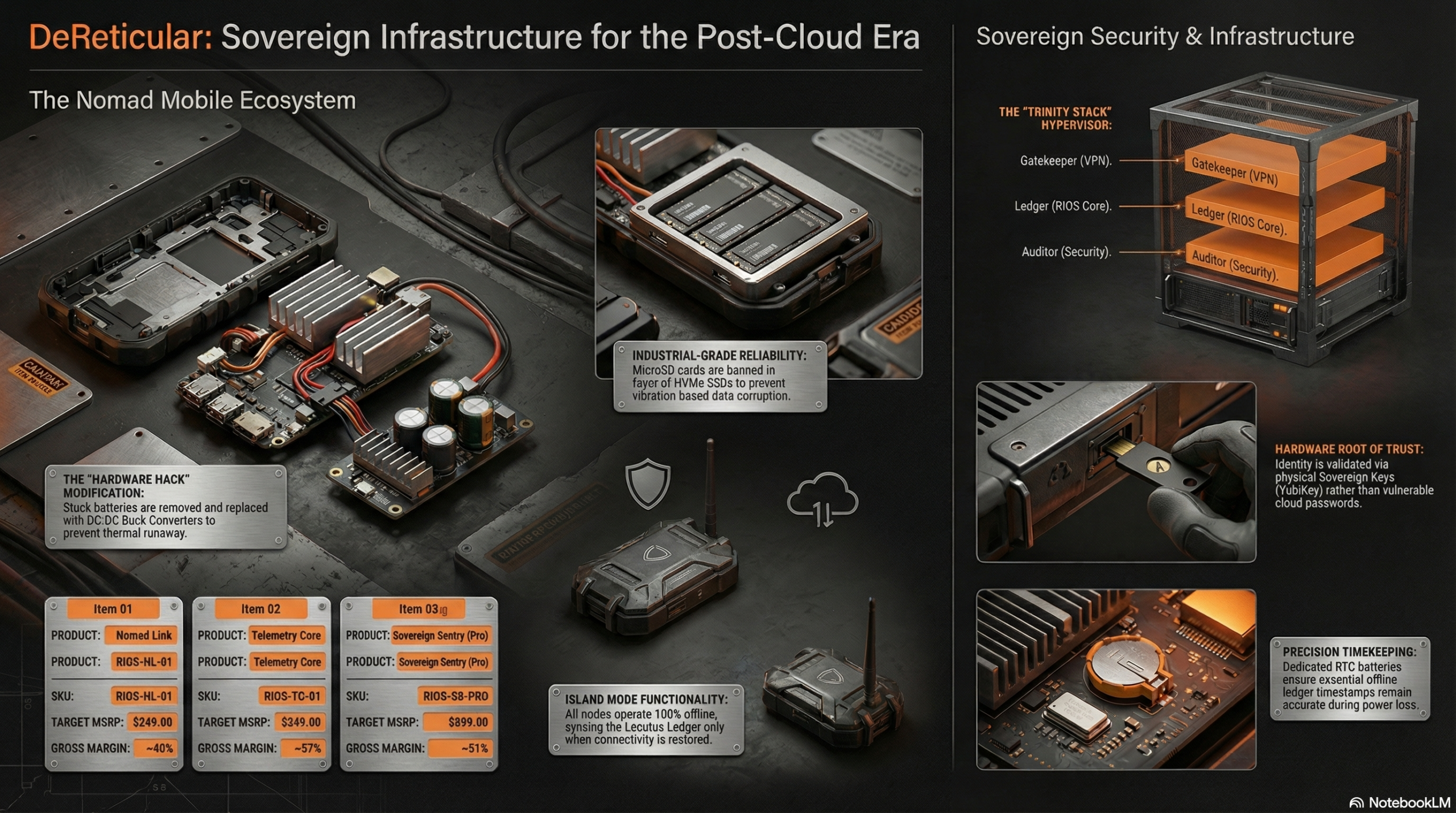
“Island Mode” is the protocol-level ability of a node to maintain 100% functional autonomy without an active internet connection. Unlike traditional systems that fail upon losing WAN access, Sovereign Nodes utilize the Locutus Ledger—managed by the Locutus Daemon—to ensure local state persistence and data integrity.
The transition from isolated operation to network-wide state synchronization follows a rigid Sync Cycle:
- Offline Operation: The node processes telemetry, signs logs, and executes local logic, committing all state changes to the local Locutus Ledger.
- Temporal Integrity: Decentralized ledgers require precise timestamps to resolve conflicts. The node utilizes a Panasonic ML-2020 RTC (Real-Time Clock) Battery to maintain a hardware-backed timeline while disconnected from NTP servers.
- Reconnection & Ledger Sync: Upon detecting a backhaul (LTE, Satellite, or Mesh), the Locutus Daemon initiates state synchronization, merging local ledger entries with the global network to restore a unified Source of Truth.
[!TIP] Why the RTC Battery is Essential: For a decentralized ledger, time is a cryptographic requirement. Without the Panasonic ML-2020, an offline node loses its temporal anchor during power cycles, rendering its ledger entries orphaned or invalid during reconnection. The RTC battery ensures every offline action is accurately sequenced for the Locutus Daemon.
For an offline node to be trusted upon its return to the network, it must possess a verifiable identity that does not rely on a central server for validation.
——————————————————————————–
3. The Hardware Root of Trust: Your Sovereign Identity
In a sovereign architecture, identity is decoupled from software databases and anchored in a Hardware Root of Trust. DeReticular utilizes the Sovereign Key (RIOS-KEY-01)—a ruggedized, white-labeled YubiKey 5C NFC—to serve as the primary cryptographic identity for all field operations.
The Sovereign Key manages three critical security protocols:
- FIDO2: Facilitates passwordless, phishing-resistant login to Sentry Nodes, ensuring that only physical possession of the key allows system access.
- OpenPGP: Securely stores the user’s Private Key. This is used to digitally sign Locutus Ledger maintenance logs, providing non-repudiable proof of action.
- Dead Man Protocol: A revocation framework managed via DeReticular Academy. If a key is compromised or lost, this protocol triggers the update of the Global Certificate Revocation List (CRL), effectively neutralizing the identity across the entire decentralized network.
While the Sovereign Key represents the user’s “Master Identity,” it requires a hardened environment to execute commands. This brings us to the “Lock” of the system: the ruggedized nodes themselves.
——————————————————————————–
4. Anatomy of a Node: Ruggedization & The “Hardware Hack”
To achieve industrial-grade reliability, DeReticular implements “Hardware Hacks” on commodity components, eliminating common failure points such as thermal runaway and data corruption.
| Component | Base Hardware | Critical Modification | Sovereign Purpose |
| Nomad Link (RIOS-NL-01) | Skylink Global SLG-06 | Battery Removal & 10kΩ Resistor Mod | Eliminates fire risk; enables wide-voltage DC operation (12V-48V). |
| Telemetry Core (RIOS-TC-01) | Raspberry Pi 5 (8GB) | NVMe SSD Mandate (via PCIe HAT) | 8GB RAM is mandatory for Ed25519 crypto; NVMe prevents SD corruption. |
The “So What?” of Hardware Modifications
Systems architects must account for environmental stressors that consumer electronics ignore:
- Thermal Runaway Mitigation (Risk ID: R-BAT-01): Standard Li-ion batteries swell or ignite in temperatures exceeding 70°C. We physically remove the battery and solder a 10kΩ resistor between the BSI and Negative pins. This tricks the device into sensing a nominal battery temperature, allowing it to boot via a DC-DC Buck Converter.
- State Persistence & Vibration (Risk ID: R-DAT-01): MicroSD cards fail under the high-write IOPS of the Locutus Ledger and physical vibration. We mandate NVMe SSDs to ensure high-speed processing and data longevity.
- Cryptographic Overhead: The Telemetry Core utilizes a Raspberry Pi 5 with 8GB of RAM specifically to handle the intensive Ed25519 elliptic curve cryptography required for secure node-to-node communication.
These hardened components are orchestrated into a resilient network through the deployment of the Trinity Stack.
——————————————————————————–
5. The Trinity Stack: Orchestrating the Sovereign Sentry
The Sovereign Sentry (RIOS-SS-PRO) acts as the high-availability “brain” for stationary installations. Powered by an Intel Core i3-N305 (8-Core) and featuring 4x Intel i226-V 2.5GbE LAN ports for robust I/O, the Sentry utilizes the Proxmox hypervisor to run the Trinity Stack:
- VM1 (Gatekeeper): A dedicated pfSense/OPNsense instance managing all routing, firewalling, and encrypted VPN tunnels.
- VM2 (Ledger): The core operational layer running Ubuntu Server. This VM hosts the RIOS Core and integrates with Freenet, the protocol that enables decentralized “Island Mode” synchronization by distributing data across the network without central servers.
- VM3 (Auditor): A Kali Linux instance performing continuous, automated vulnerability scanning and security auditing (Sovereign Shield).
By integrating physical hardware trust (The Key), local state persistence (Island Mode), and virtualization-based orchestration (The Trinity Stack), we create a system that is resilient to both physical environmental failure and centralized digital collapse.
——————————————————————————–
6. Summary: The 3 Pillars of Decentralized Safety
Pillar 1: Offline Autonomy
Impact Statement: Through Island Mode and Freenet-based state synchronization, nodes maintain full operational utility and ledger integrity in total isolation from the global internet.
Pillar 2: Hardware-Based Trust
Impact Statement: By anchoring identity in physical Sovereign Keys and hardware-backed Ed25519 cryptography, we eliminate the systemic vulnerabilities of cloud-managed credentials.
Pillar 3: Industrial Ruggedization
Impact Statement: Tactical hardware modifications, such as battery elimination and NVMe mandates, transform fragile consumer electronics into resilient infrastructure capable of surviving extreme field conditions.
——————————————————————————–
⚠️ WARNING: FIELD OPERATOR NOTICE
SYSTEM TYPE: RIOS-NL-01 (Modified) STATUS: NO INTERNAL BATTERY. This unit has completed “Station E” workflow. The stock Li-ion battery has been REMOVED to prevent thermal runaway. A 10kΩ resistor has been soldered to the BSI/Negative pins.
POWER REQUIREMENT: 12V-48V DC via external whip. Do not attempt to charge. WARRANTY: Manufacturer warranty is VOID. DeReticular “Sovereign 90-Day” applies to modifications only. Tamper Seal must remain intact.