Operational Risk Assessment: Sovereign AI Governance and Safety Architecture
1. Strategic Context: The Liability of Cloud-Tethered Industrial Intelligence
Industrial automation is currently undermined by a critical “Design Paradox”: while AI integration is essential for optimizing complex kinetic assets, the prevailing reliance on cloud-centric deployment introduces catastrophic structural vulnerabilities. When the intelligence required to manage physical infrastructure resides in remote data centers, the facility’s operational integrity is effectively outsourced to external variables beyond the operator’s control. Shifting to Sovereign Automation—executing AI on localized, air-gapped hardware—is a strategic mandate to ensure that physical assets remain protected and functional regardless of external connectivity or vendor stability.
The operational risks of cloud-dependent AI represent fundamental failure modes in industrial logic:
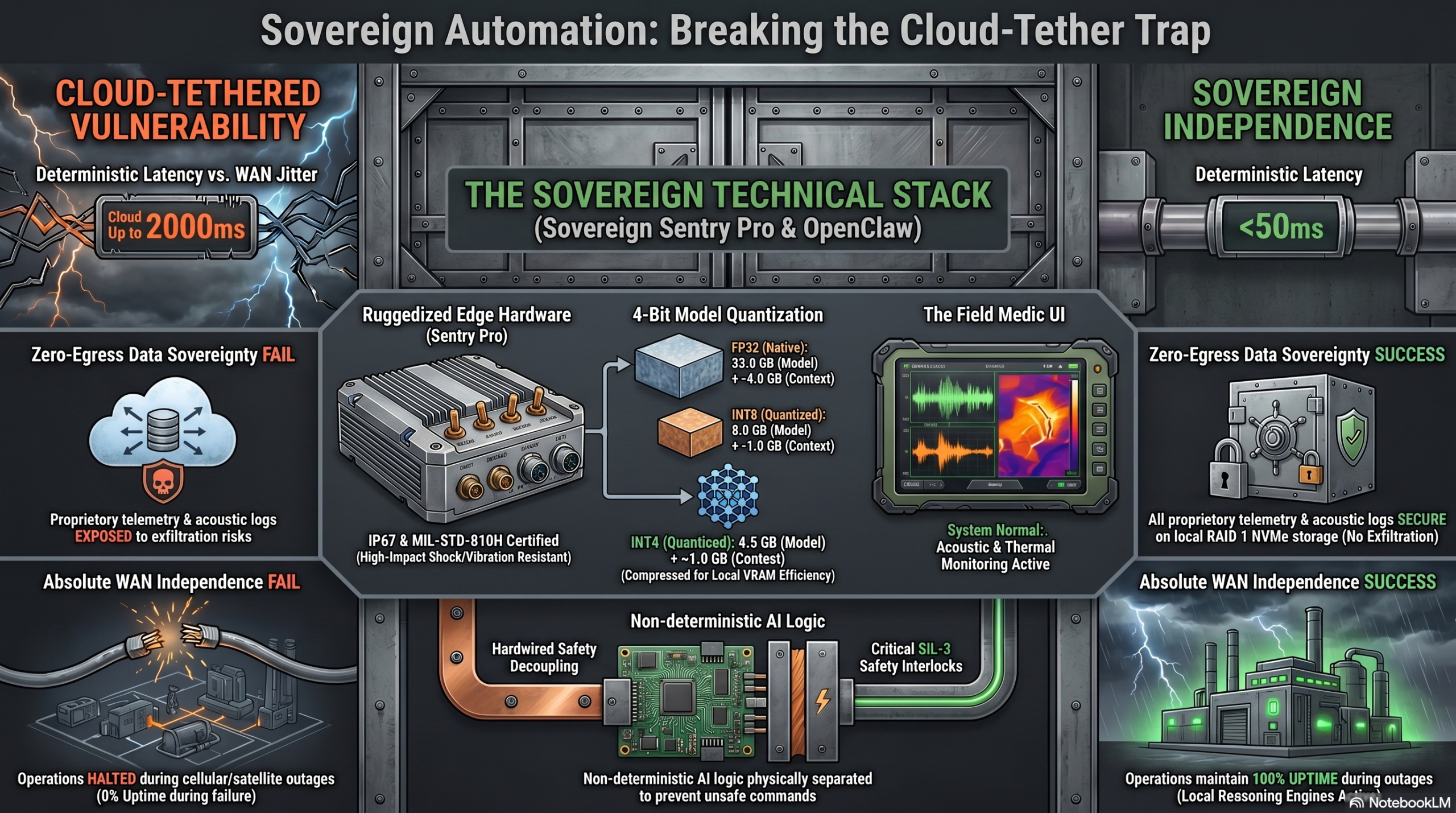
- Latency and Deterministic Deficits: High-level control loops, such as dynamic load balancing or thermal adjustments, cannot tolerate the non-deterministic “jitter” inherent in wide-area networks (WAN). Round-trip time (RTT) fluctuations (30ms to >2000ms) prevent the stability required for real-time safety.
- WAN Fragility: In remote extraction or offshore environments, continuous backhaul is a fantasy. A dropped connection immediately halts predictive pipelines, leaving machinery in unguided, sub-optimal states.
- Data Exfiltration: Streaming high-fidelity telemetry, acoustic logs, and optical feeds to third-party servers exposes proprietary trade secrets to corporate espionage and volatile privacy compliance frameworks.
- Lock-in and the Right to Repair: Cloud-tethered models enforce “software locks” and proprietary cloud handshakes that OEMs utilize to gatekeep maintenance. Sovereign AI restores the Right to Repair by bypassing these external authorizations, allowing operators to perform local diagnostics and mechanical overrides without costly downtime dictated by a vendor’s subscription status.
Failure Mode Analysis: Cloud vs. Localized AI
| Risk Factor | Cloud-Tethered AI Architecture | Localized Sovereign Architecture |
| Network Latency | Non-deterministic (30ms to >2000ms) | Deterministic (<50ms via LAN) |
| Operational Uptime | Dependent on WAN/Backhaul stability | 100% independent of external links |
| Data Privacy | High risk (External egress required) | Zero-egress (On-site data custody) |
| Maintenance Control | OEM Cloud “Handshake” required | Sovereign (Bypasses proprietary locks) |
| Decision Speed | Limited by WAN bandwidth/jitter | Limited by local memory bandwidth |
The mitigation of these external vulnerabilities necessitates a transition toward ruggedized hardware solutions designed specifically for kinetic stability.
——————————————————————————–
2. Hardware Architecture & Physical Integrity: The Sovereign Sentry Pro
Standard edge gateways are insufficient for industrial deployment; they lack the thermal and mechanical resilience required for survivability in high-impact environments. To maintain system integrity, localized AI must utilize hardware certified to MIL-STD-810H and IP67 standards. These specifications ensure the compute cluster can survive continuous multi-axis vibration, dust-heavy atmospheres, and mechanical shocks that would induce immediate failure in consumer-grade electronics.
The Sovereign Sentry Pro hardware cluster is engineered for high-availability autonomous operations. It utilizes a three-node redundant architecture featuring hot-swappable system-on-modules (SOMs). To meet the high-throughput VRAM requirements of AI agents, each node is equipped with 64GB of LPDDR5 unified memory, providing a substantial 204.8 GB/s of bandwidth. Data integrity is anchored by a RAID 1 NVMe array featuring Power Loss Protection (PLP) capacitors, which ensure the local state is preserved during sudden electrical blackouts common in field operations.
Survivability Metrics
- Thermal Management: Passive heat dissipation via a CNC-milled aluminum chassis with deep cooling fins; operational up to 60°C ambient without throttling.
- Mechanical Integrity: MIL-STD-810H certified for kinetic stability; no moving parts in the compute or cooling layers.
- Compute Density: Integrated accelerators delivering up to 275 Sparse TOPS for parallel matrix operations.
- Storage Reliability: Up to 8 TB of local RAID storage hosting technical manuals, vector databases, and historical telemetry without external egress.
This physical robustness provides the deterministic environment required for the intensive memory and compute demands of quantized AI models.
——————————————————————————–
3. The Mathematics of Edge Autonomy: Model Quantization and Inference Optimization
Executing Large Language Models (LLMs) at the edge is governed by the physics of memory bandwidth. Inference occurs in two distinct phases: the Prefill Phase (compute-bound, requiring high FLOPS for prompt processing) and the Decoding Phase (memory-bandwidth bound). During decoding, the entire model weight set must be loaded from memory to the registers for every token generated. On edge hardware, the bottleneck is the speed at which weights move, not the processor’s clock speed.
To address this, we utilize advanced quantization methods—specifically Activation-aware Weight Quantization (AWQ) and the GGUF binary format—to map floating-point weights to lower-precision representations.
Model Weight Compression & Performance (8B Parameter Model)
| Precision | Weight Memory (GB) | Context Overhead (8k) | Perplexity (Reasoning Cohesion) |
| FP32 | 32.0 GB | ~4.0 GB | 5.72 (Baseline) |
| FP16 | 16.0 GB | ~2.0 GB | 5.72 (Optimal) |
| INT8 (Q8_0) | 8.0 GB | ~1.0 GB | 5.74 (+0.35% degradation) |
| INT4 (Q4_K_M) | 4.5 GB | ~1.0 GB | 5.89 (+2.97% degradation) |
The strategic impact of INT4 quantization is a 71.8% reduction in memory overhead with negligible impact on reasoning (perplexity). While the theoretical maximum generation speed for an 8B model on this architecture is 44.4 tokens/second, the architected practical limit is maintained at 30–35 tokens/second to provide a necessary safety margin for concurrent telemetry ingestion and agentic reasoning.
——————————————————————————–
4. Software Orchestration & Protocol Translation: The OpenClaw Framework
In air-gapped environments, software efficiency is a safety requirement. The OpenClaw Framework prioritizes lightweight, C++ optimized runtimes via llama.cpp over heavy Python-based cloud SDKs. This approach minimizes runtime overhead and eliminates the version conflicts inherent in non-deterministic Python environments, ensuring the AI remains responsive in resource-constrained, zero-egress zones.
The OpenClaw layer serves as the bridge between cognitive agents and the physical bus. It utilizes a local Vector Database (SQLite-VSS) for Retrieval-Augmented Generation (RAG), allowing agents to ground their reasoning in local technical manuals. Simultaneously, protocol proxies ingest raw signals from Modbus, CAN bus, and OPC UA, translating them into structured schemas for AI analysis.
Sample Telemetry Schema (JSON)
OpenClaw translates raw bus signals into human-readable data used by AI agents for diagnostics:
{
  "timestamp": "2026-05-21T14:16:00Z",
  "system": "Hydraulic_Pump_Alpha",
  "metrics": {
    "pump_pressure_psi": 2150,
    "return_flow_gpm": 12.4,
    "oil_temp_c": 54.2
  },
  "active_faults": [0x4F]
}
This software layer enables the precise coordination functions of the “Field Medic” and “Industrial Foreman” agents without external dependencies.
——————————————————————————–
5. Kinetic Risk Mitigation: Safety Decoupling and Deterministic Validation
The primary failure mode in physical AI deployment is the model hallucination, where non-deterministic outputs generate plausible but physically dangerous instructions. To mitigate this, AI reasoning must be logically and physically decoupled from life-safety systems.
We enforce an “Air-Gap Boundary” protocol: AI agents lack direct write access to machinery. All commands must pass through a hardcoded schema validator. If a suggested command exceeds predefined safety boundaries (e.g., torque specifications or pressure limits), the validator halts execution and raises a system flag. Furthermore, all critical safety-integrity functions are hardwired to SIL-3 safety loops and independent PLCs, ensuring that AI-driven logic can never override a physical E-stop or pressure relief valve.
Case Study Synthesis: Diagnostics and Coordination
- The Field Medic: In remote agriculture, the agent uses local RAG and acoustic analysis to identify pump cavitation. It provides repair guidance while the deterministic validator ensures manual mechanical overrides do not exceed component pressure ratings.
- The Industrial Foreman: In sorting facilities, the agent monitors OPC UA signals to slow secondary conveyors during backlogs. If the AI suggests a speed that risks motor burnout, the hardcoded validator overrides the command, while SIL-3 safety PLCs independently monitor for conveyor overweight alerts.
——————————————————————————–
6. Governance & Lifecycle Management: The Offline Cryptographic Pipeline
Air-gapped systems require a shift from “over-the-air” convenience to a secure “Air-Gap Maintenance Tax.” In zero-egress environments, updates must be handled through a secure, offline cryptographic pipeline to maintain the integrity of the root of trust.
The architecture utilizes a physical brass-capped key-switch as the absolute hardware-level network disconnect. When set to “Isolate,” external communication is physically impossible. Lifecycle management is executed via cryptographically signed USB-C update packages, validated by the on-board TPM 2.0 module and a secure boot path.
Manual Lifecycle Requirements
- Cryptographic Verification: All model weights and container images must be signed with enterprise-grade private keys before deployment.
- Hardware Anchor: The TPM 2.0 module verifies all signatures on-site, preventing the execution of unauthorized or tampered code.
- Human Authorization: A physical key-switch intervention is required for all updates, ensuring a human-in-the-loop audit for every system change.
——————————————————————————–
7. Implementation Roadmap: Transitioning to Sovereign Automation
A phased transition is required to move from vulnerable cloud-tethered IoT to local sovereign autonomy while maintaining system stability.
The Four-Phase Roadmap
- Phase 1: Isolation & Decoupling (Weeks 1-4) – Audit safety loops, map telemetry registers, and partition local LAN traffic from WAN access points.
- Phase 2: Hardware Provisioning (Weeks 5-8) – Install Sovereign Sentry Pro clusters and verify thermal/power budgets within existing industrial cabinets.
- Phase 3: Software Mapping (Weeks 9-12) – Deploy OpenClaw, load quantized GGUF models, and index technical manuals into the local SQLite-VSS.
- Phase 4: Local Validation & Commissioning (Weeks 13-16) – Test offline diagnostic loops and confirm that deterministic validators correctly override unsafe AI outputs.
Transition Checklist for Engineering Leads
- [ ] VRAM Budgeting: Maintain a 30% VRAM buffer to prevent out-of-memory (OOM) runtime crashes.
- [ ] Safety Isolation Audit: Verify that all life-safety systems are hardwired and independent of AI orchestration.
- [ ] Inference Latency Validation: Ensure token generation falls within deterministic windows for real-time control.
- [ ] Storage Redundancy: Confirm the deployment of enterprise-grade, power-loss protected (PLP) NVMe drives in RAID configurations.
The future of industrial intelligence is defined by the deployment of localized, independent, and secure edge compute clusters that provide true operational sovereignty.