
National Debt Sustainability and Thermodynamic Solvency Risk Assessment: RELA-TR-2026-V1
- Document Controls and Methodological Primitive
[AUTHOR_PROPOSITION] This risk assessment establishes a rigorous, epistemologically sound metadata layer for reporting on national financial stability. By grounding our analysis in formally defined measure spaces, we explicitly avoid the “pseudo-mathematical overreach” common in prior economic manifestos. This document transitions from rhetorical assertion to propositional claims with strict bounds, ensuring all variables are defined over explicit domains—specifically the probability space (\Theta, \mathcal{B}, \mu)—before being utilized in risk modeling. This administrative structure ensures a veridical audit trail as the assessment transitions from symbolic financial data to hard biophysical analysis.
Document Control & Administrative Metadata
Metadata Field Specification
Document ID RELA-TR-2026-V1
Release Version 1.0.0-PROD
Sponsoring Body Foundational Governance Architecture Working Group
Classification Institutional / Open Systems Architecture
Mathematical Formalisms Measure Theory, Information Theory, Mechanism Design, Differential Geometry
Ontological Primitives
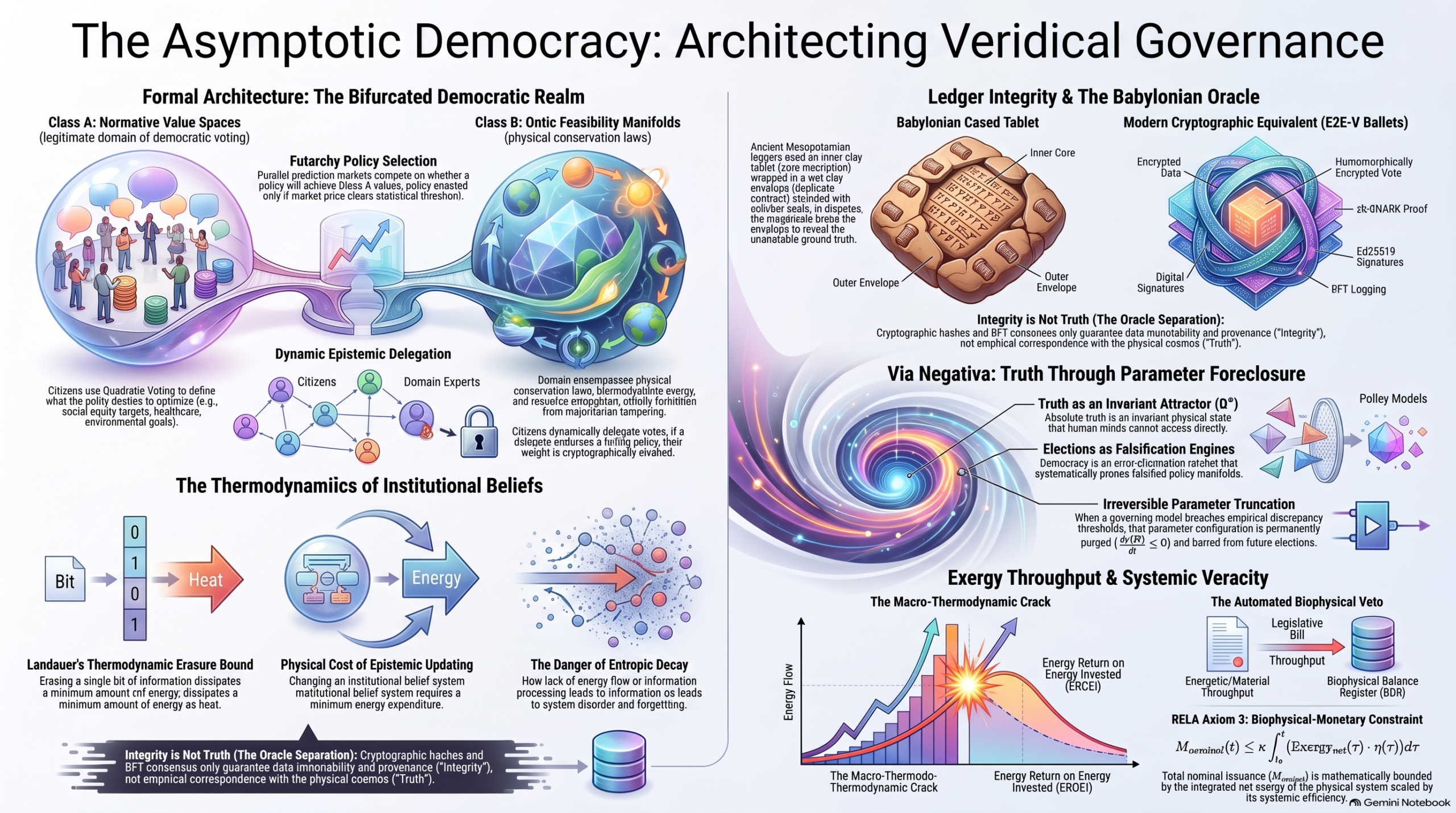
[FORMAL_ASSUMPTION] To evaluate systemic risk, we distinguish between two fundamental classes of data:
- Class A (Normative Value Spaces): The legitimate domain of democratic preference and social priorities (e.g., intergenerational risk tolerance, equity targets).
- Class B (Ontic Feasibility Manifolds): The unyielding domain of physical laws, including mass-energy conservation, exergy flows, and resource throughput.
Policy hypotheses are evaluated over the probability space (\Theta, \mathcal{B}, \mu), where \Theta represents the parameter space of governance models and \mu represents the measure of permissible state-space.
- Diagnosis of the Structural Gap: Nominal Claims vs. Biophysical Capacity
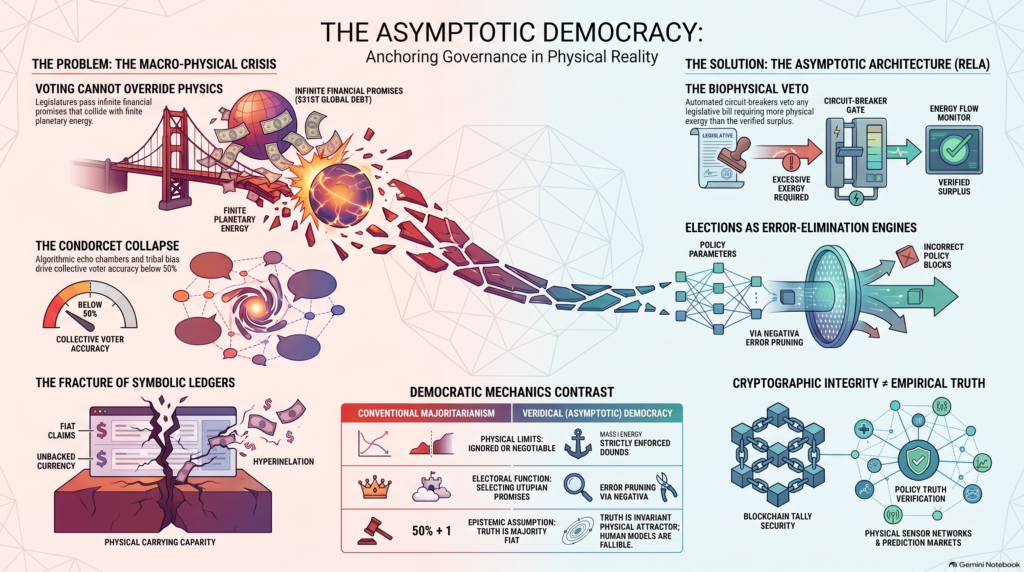
[AUTHOR_PROPOSITION] A critical strategic danger in contemporary risk assessment is the reliance on the “Disembodied Production Function.” While modern post-2008 Dynamic Stochastic General Equilibrium (DSGE) models have evolved to incorporate financial frictions and banking channels, they remain fundamentally ungrounded due to the omission of thermodynamics. Treating energy as a <5% GDP externality creates a fatal blind spot: capital and labor are not primary producers but are energy-directing mechanisms. No economic transaction can occur without thermodynamic work.
Risk Diagnostic: The Equation of Exchange
[ESTABLISHED_RESULT] We utilize the Equation of Exchange (MV = PY) as a risk diagnostic tool. We evaluate the impact of ungrounded monetary expansion (\frac{dM}{dt}) against the real physical production frontier (\mathcal{Y}) determined by net exergy and Energy Return on Investment (EROEI). When \frac{dM}{dt} \gg \frac{dY}{dt}, the symbolic ledger creates an unstable claim on future physical work that the environment cannot fulfill.
The Macro-Thermodynamic Crack
Nominal Financial Claims Real Biophysical Capacity
Contractual Tendency: Characterized by exponential debt compounding D_0 e^{rt}. Physical Limits: Constrained by the laws of thermodynamics and Carnot limits.
Symbolic Abstraction: Expansion of digital fiat claims unbacked by exergy. Net Exergy: Dependent on EROEI and the availability of critical minerals.
Policy Mechanism: Institutional “epicycles” like QE and deficit monetization. Systemic Ceiling: The unyielding friction of resource depletion and entropy.
The Velocity Paradox
[EMPIRICAL_CLAIM] In periods of “Model Crisis,” we observe the Velocity Paradox. Contrary to models predicting money demand stability, hyperinflationary events trigger a collapse in money demand and a surge in velocity (V). [ESTABLISHED_RESULT] As the gap between symbolic tokens and ontic reality widens, economic agents dump degrading currency for real commodities, driving prices up nonlinearly (\frac{dP}{dt} \gg \frac{dM}{dt}). This represents an “Ontic Collision” where physical reality reasserts itself through the rupture of the symbolic envelope.
- Quantitative Risk Profile: Debt Saturation and EROEI Decay
[FORMAL_ASSUMPTION] Contractual interest compounding (D_0 e^{rt}) must be distinguished from realized net debt, which incorporates defaults, restructurings, and amortizations.
2024 BIS Data Summary
[EMPIRICAL_CLAIM] According to 2024 data from the Bank for International Settlements (BIS), global debt has reached $315 trillion, representing approximately 333% of global GDP. This “Symbolic Envelope” poses a terminal risk as these claims are predicated on future exergy flows that do not exist.
Declining EROEI and Thermodynamic Debt
[EMPIRICAL_CLAIM] The sustainability of national debt is inversely proportional to the decline in EROEI.
- High-Yield Baseline: Conventional oil historically provided EROEI ratios of >30:1.
- Current Reality: Transitioning to lower-yield alternatives (<10:1) incurs a significant “Thermodynamic Debt,” as the net surplus available to service nominal debt claims shrinks.
Landauer’s Principle and Institutional Amnesia
[ESTABLISHED_RESULT] Applying Landauer’s Principle (\Delta Q \ge N k_B T \ln 2), we identify that maintaining or updating an institutional belief register requires continuous exergy consumption. [AUTHOR_PROPOSITION] Without continuous exergy expenditure, an epistemic system succumbs to entropic decay (\frac{dS_{\text{internal}}}{dt} \ge 0), manifesting as “Record Rot” or “Institutional Amnesia.” This physical decay in the ability to process data signals the transition from empirical governance to systemic failure.
- Institutional Stability Audit: Kuhn Cycle Phase Analysis
[FORMAL_ASSUMPTION] The Kuhn Cycle of Governance identifies the shift from “Normal Science” to “Model Crisis.” We diagnose the current status as Phase 3 (Model Crisis).
Phase 3 Diagnosis: Proliferation of Epicycles
[AUTHOR_PROPOSITION] Current governance relies on “Institutional Epicycles” to mask the delta between promises and biophysical limits:
- Deficit Monetization: Attempting to override resource scarcity with fiat issuance.
- QE/ZIRP: Utilizing balance-sheet expansion to paper over structural insolvency.
- Narrative Spin: Reclassifying inflation metrics to protect failing models.
The Condorcet Inversion Risk
[ESTABLISHED_RESULT] Democratic stability is threatened by the “Condorcet Inversion.” While the Condorcet Jury Theorem suggests collective convergence on truth when p > 0.5, correlated media noise and manufactured consent drive individual accuracy below chance (p < 0.5). [AUTHOR_PROPOSITION] In this state, the electorate converges on error with mathematical certainty: \lim_{N \to \infty} P_N = 0.
Breaking of the Envelope
[EMPIRICAL_CLAIM] Historical cases like the French Assignats and Weimar Germany illustrate that the delta between symbolic tokens and ontic reality eventually leads to a judicial and systemic reset. A paradigm shift to a biophysically-anchored system is required to avoid total institutional rupture.
- Transition Risk: Fiat to RELA
[POLICY_SPECIFICATION] A transition to a Resilient Epistemic & Thermodynamic Ledger Architecture (RELA) requires recognizing that “Integrity is not Truth.” Cryptographic ledgers (Level 2) ensure data immutability but must be bound by Level 0 (Ontic Physical Resistance).
Oracle Separation Protocol
The system validates cryptographic integrity while delegating empirical verification to external physical sensor networks and formal proof systems like Lean 4.
The Cryptographic Cased Ballot (ASCII)
VOTER DECISION (V)
|
v
[ INNER CORE ] ——————> [ OUTER ENVELOPE ]
(Homomorphic Encryption) (zk-SNARK Attestation)
C = Encrypt(V, r) Proof π: V ∈ {0, 1}
| |
+——————+——————+
|
v
[ BFT APPEND-ONLY BULLETIN BOARD ]
H = SHA256(C || π) -> N ≥ 3f + 1 Quorum
RELA Axiom 3: The Biophysical-Monetary Equivalence Constraint
[POLICY_SPECIFICATION] The transition is governed by Axiom 3, a “Constitutional Circuit-Breaker”: M_{\text{nominal}}(t) \le \kappa \int_{t_0}^t (\text{Exergy}_{\text{net}}(\tau) \cdot \eta(\tau)) d\tau This ensures the total stock of monetary claims is bounded by the integrated net thermodynamic work capacity.
- Strategic Mitigation: The Asymptotic Democracy Roadmap
[AUTHOR_PROPOSITION] Mitigation follows the “Via Negativa” approach: progress is achieved through the permanent foreclosure of failed parameter spaces (\frac{d\mu(\Theta)}{dt} \le 0).
60-Month Transition Roadmap
- Phase 1 (Months 1–12): Cryptographic Auditing & Shadow Parameter Logging. Mandatory Policy Hypothesis Manifests for all bills.
- Phase 2 (Months 13–24): Pilot Biophysical Balance Registers (BBR) in municipal energy infrastructure.
- Phase 3 (Months 25–42): Implementation of Non-binding Shadow Futarchy. Prediction markets trade on policy efficacy against a National Welfare Metric.
- Phase 4 (Months 43–60): Constitutional Cutover to Full Veridical Governance.
The Biophysical Veto Pipeline (ASCII)
LEGISLATIVE PROPOSAL (Bill P)
|
v
[ BIOPHYSICAL BALANCE REGISTER (BBR) AUDIT ]
Lifecycle Exergy Demand: E_req = ∫ [Power + Materials] dt
|
v
[ INVARIANT CHECK: RELA AXIOM 3 ]
Is M_nominal ≤ κ ∫ (Exergy_net · η) dτ?
| |
[ YES ] [ NO ]
| |
v v
[ PROCEED TO VOTE ] [ AUTOMATIC BIOPHYSICAL VETO ]
Source-of-Truth Hierarchy
- Level 0: Ontic Physical Resistance (Supreme Authority).
- Level 1: Machine-Checked Deductive Proofs (Lean 4 kernels).
- Level 2: Cryptographic Ledgers (BFT consensus).
- Level 3: Intersubjective Consensus (Futarchy/Voting).
- Level 4: Sovereign Fiat (Zero Epistemic Weight).
- Technical Architecture & Data Schemas
[POLICY_SPECIFICATION] The following schemas define the machine-readable requirements for RELA integration.
7.1 EpistemicBallotNode.json
{
“$schema”: “https://json-schema.org/draft/2020-12/schema“,
“title”: “EpistemicBallotNode”,
“type”: “object”,
“required”: [“ballot_id”, “election_epoch”, “perspective_frame_hash”, “encrypted_vote”, “zk_proof_validity”],
“properties”: {
“ballot_id”: { “type”: “string”, “format”: “uuid” },
“perspective_frame_hash”: { “type”: “string”, “pattern”: “^[a-f0-9]{64}$” },
“zk_proof_validity”: {
“type”: “object”,
“required”: [“proof_format”, “verification_ast”],
“properties”: {
“proof_format”: { “type”: “string”, “enum”: [“Groth16”, “PLONK”] },
“verification_ast”: { “type”: “string” }
}
}
}
}
7.2 PolicyHypothesisManifest.json
{
“$schema”: “https://json-schema.org/draft/2020-12/schema“,
“title”: “PolicyHypothesisManifest”,
“type”: “object”,
“required”: [“policy_name”, “formal_verification_tokens”, “falsification_threshold”],
“properties”: {
“policy_name”: { “type”: “string” },
“formal_verification_tokens”: {
“type”: “array”,
“items”: { “type”: “string” },
“description”: “Lean 4 compiled AST proofs”
},
“falsification_threshold”: { “type”: “number”, “exclusiveMinimum”: 0.0 },
“maximum_kolmogorov_bits”: { “type”: “integer” }
}
}
7.3 BiophysicalVetoRegister.json
{
“$schema”: “https://json-schema.org/draft/2020-12/schema“,
“title”: “BiophysicalVetoRegister”,
“type”: “object”,
“required”: [“net_exergy_joules”, “systemic_eroei”, “veto_circuit_tripped”],
“properties”: {
“net_exergy_joules”: { “type”: “number”, “minimum”: 0.0 },
“systemic_eroei”: { “type”: “number”, “minimum”: 1.0 },
“veto_circuit_tripped”: { “type”: “boolean” }
}
}
[AUTHOR_PROPOSITION] This assessment concludes that the pivot toward thermodynamic alignment is not a policy preference but a requirement for national survival. By anchoring governance in the “Asymptotic Horizon,” we ensure that human symbolic claims move toward an enduring alignment with the objective world.