INVESTMENT PROSPECTUS: PROJECT OCTAGON NODE 3 (10 MW SOVEREIGN COMPUTE)
podcast
video
- Investment Thesis: Bypassing the “Permitting Wall”
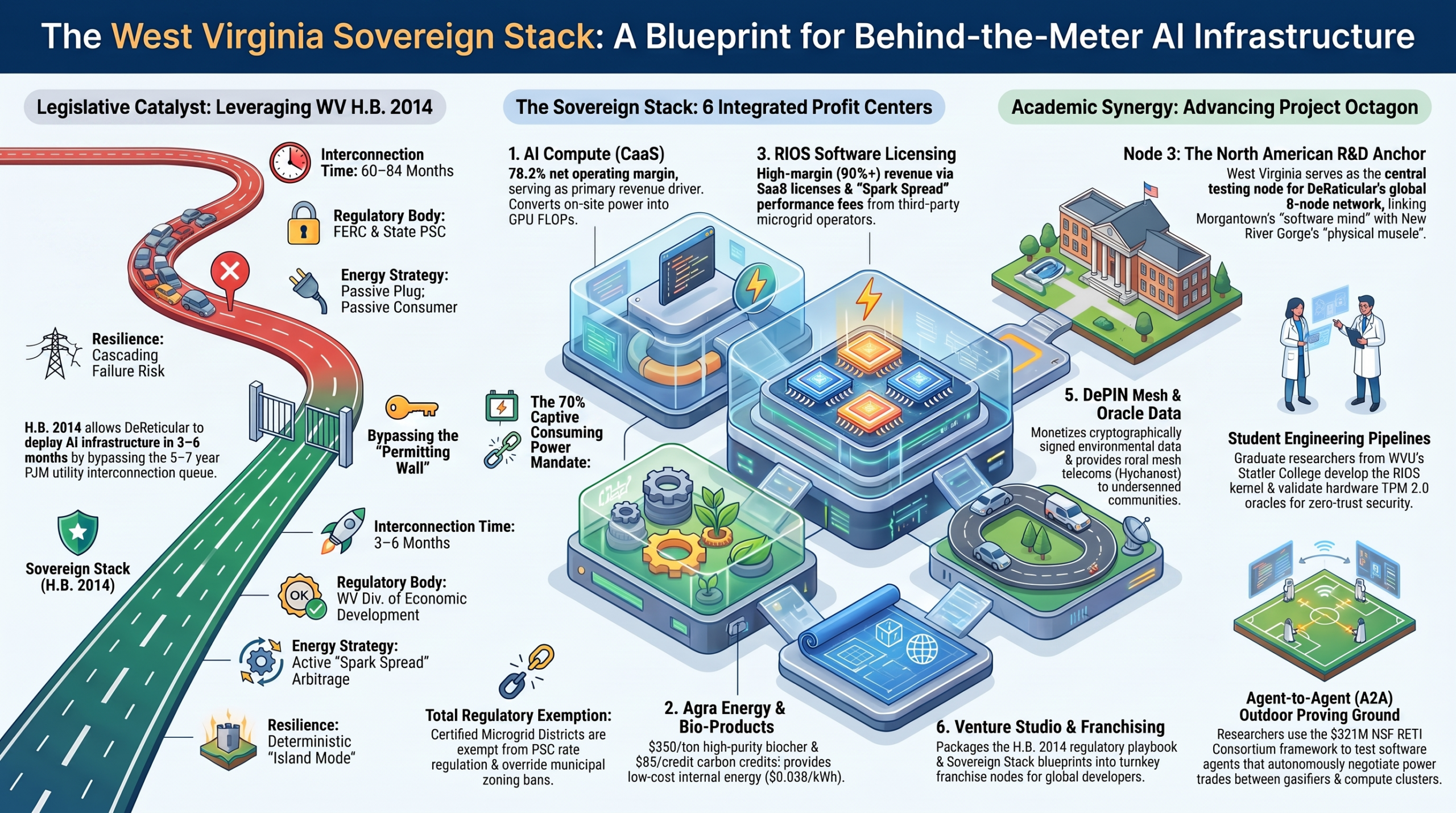
Traditional AI infrastructure is currently hitting a systemic bottleneck known as the “Permitting Wall.” As high-density compute requirements surge, legacy grid-dependent data centers face 5-to-7-year delays in the PJM Interconnection queue due to transmission depletion and mandatory network upgrades. While hyperscale capital remains idled for years, Project Octagon Node 3 represents a fundamental paradigm shift from “The Line”—a linear, single-point-of-failure utility dependency—toward “Spherical Resilience.” By deploying decentralized, autonomous nodes capable of “Island Mode” operation in accordance with IEEE 1547.4 standards, Node 3 captures 1.5 to 2.5 generations of GPU cycles (H100/B200) before a grid-tied competitor even breaks ground. This 3-to-6-month deployment window is not merely a convenience; it is a decisive competitive weapon.
Strategic Comparison: Traditional vs. Sovereign Infrastructure
Feature Traditional Grid-Tied Data Centers DeReticular Sovereign Node (Node 3)
Deployment Timeline 60–84 Months (PJM Queue) 3–6 Months (State Certification)
Uptime Model Dependent (Reliant on PJM Stability) Autonomous (Spherical Resilience)
Reliability Standard Cascading Failure Risk (Linear) IEEE 1547.4 “Island Mode”
Energy Pricing Subject to LMP & Capacity Volatility Fixed Captive Generation / Arbitrage
Capital Efficiency Opportunity Cost of Idle Capital Immediate Cycle Capture (H100/B200)
The Sovereign Stack
Project Octagon Node 3 integrates three proprietary layers to achieve institutional-grade reliability:
- The Mind (RIOS): An AI-native orchestration engine that manages real-time energy-to-compute conversion via the Spark Spread logic.
- The Muscle (Agra Energy): Behind-the-meter plasma gasification providing 24/7 prime power from regional feedstocks, ensuring baseload independence.
- The Motion (Kurb Kars): An autonomous logistics fleet providing deterministic feedstock delivery, bypassing public infrastructure failure points.
This hardware-software convergence ensures that statutory compliance remains a technical certainty, transitioning the project from a utility consumer to a sovereign infrastructure asset protected by a unique regulatory unlock.
- Regulatory Arbitrage: The West Virginia H.B. 2014 Framework
Project Octagon Node 3 leverages West Virginia House Bill 2014 (The Power Generation and Consumption Act) as a strategic legal moat. This framework provides statutory protection that exempts the asset from federal and state utility oversight, effectively de-risking the project by eliminating the multi-year administrative hurdles common in traditional infrastructure.
Statutory Advantages of H.B. 2014
- PSC Exemption (§24-2-21a): Total exemption from Public Service Commission jurisdiction. Financial Impact: Avoids multi-million dollar legal and administrative overhead associated with contested Certificates of Public Convenience and Necessity (CPCN) litigation.
- PJM Interconnect Bypass: Statutory exemption from state net-metering and interconnection standards. Financial Impact: Bypasses PJM grid queue delays, accelerating the path to revenue by 54+ months.
- State Statutory Preemption: Siting authority is consolidated exclusively within the State Division of Economic Development. Financial Impact: De-risks the siting process by eliminating municipal veto power or restrictive local zoning bans.
- Captive Power Mandate: Legally protects districts where energy is generated and consumed locally. Financial Impact: Secures “Certified Microgrid District” status, shielding the asset from retail utility “duty to serve” obligations.
The Captive Power Proof
To maintain “Certified Microgrid District” status, the facility must satisfy a statutory Captive Power Ratio of \ge 70\%. Based on granular annual MWh projections from the formal petition, Node 3 achieves superior compliance:
- Annual District Generation: 78,840 \text{ MWh} (at 90% capacity factor)
- Annual On-Site Compute Consumption: 66,900 \text{ MWh}
- Compliance Calculation: \frac{66,900 \text{ MWh Compute}}{78,840 \text{ MWh Generation}} = \mathbf{84.85\%}
With an 84.85% compliance rate, Node 3 comfortably exceeds the statutory threshold, securing the physical architecture required to fulfill these mandates indefinitely.
- Technical Architecture: The Sovereign Stack Ecosystem
The Sovereign Stack integrates energy and compute into a self-contained, high-margin industrial node, physically fortifying the regulatory moat through engineering efficiency.
Energy Generation (Agra Energy)
The “Muscle” of the node is powered by dual-fuel plasma gasification (>3,000^\circ\text{C}), converting regional biomass and forestry residue into high-purity syngas.
- Risk Mitigation: The system features dual-fuel flexibility, pivoting between syngas and methane (coal-bed/natural gas) to maintain 24/7 baseload reliability regardless of feedstock fluctuations.
Kinetic Compute (RIOS-CC-1000)
Compute is delivered via 1.2 MW liquid-cooled modules designed for extreme power density.
- Direct DC Bus Coupling: By rectifying power directly to a 700V DC busbar, the architecture bypasses AC-to-DC conversion losses. This 7–9% reduction in parasitic power losses results in an automatic ~8% EBITDA margin expansion compared to traditional AC architectures.
- Vibration Isolation: The chassis utilizes multi-axis kinetic dampers, protecting GPU silicon from the mechanical vibrations of on-site prime power generation.
The Orchestration Layer (RIOS)
The “Mind” of the system is the Rural Infrastructure Operating System (RIOS), providing zero-trust data integrity.
- Hardware-Level Security: RIOS utilizes TPM 2.0 hardware oracles and Sysbox rootless isolation. Every telemetric packet is cryptographically signed at the silicon level, satisfying the stringent hardware security requirements of the NSF RETI Consortium.
- The “Spark Spread” Engine: A real-time volatility hedge that optimizes for the highest marginal dollar per kilojoule by evaluating the Floating Point value against the energy market.
- The Multi-Stream Revenue Model: Six Non-Correlated Profit Centers
This ecosystem decouples ROI from single-market volatility, monetizing the Sovereign Stack across six independent channels.
Profit Center Profiles
Profit Center Monetization Mechanism Target Market Expected Gross Margin
- AI Compute CaaS contracts ($2.20/GPU-hr) AI Labs / Enterprise 65% – 82%
- Agra Energy Internal PPA & Biochar sales Internal Node / Ag Co-ops 50% – 70%
- RIOS Software SaaS fee + 12% Performance Royalty 3rd-Party Microgrids 85% – 92%
- Kurb Kars MaaS Freight & Logistics Timber / Ag Operators 40% – 55%
- DePIN Mesh Oracle Data Verification Fees ESG Auditors / P2P 75% – 88%
- Venture Studio $1.5M Upfront + 5% Gross Royalty Municipalities / Devs 70% – 85%
The Spark Spread Optimization
The “Spark Spread” engine operates as a real-time deterministic optimizer. RIOS continuously calculates: \text{Maximize } \Pi(t) = \max \Big( \text{Value of Compute } (V_{FLOP}), \text{ Value of Energy } (P_{LMP}) \Big) If V_{FLOP} exceeds P_{LMP}, 100% of power is routed to the RIOS-CC-1000 modules. If compute rates soften, the system automatically redirects power to high-margin biochar production or BESS storage. This ensures the node executes only the most profitable physical or digital transaction at any given millisecond.
- Consolidated Financial Performance & Capital Requirements
Node 3 is characterized by extreme capital efficiency, featuring an unlevered payback period of just 7.4 months and a Year 2 EBITDA of $53.5M.
CapEx Breakdown (10 MW Sovereign Node)
Category Component Cost (USD)
Generation Agra Energy 10 MW Systems & Gensets $8,500,000
Compute Hardware High-Density GPU Clusters (3,072 H100 Eq) $18,500,000
Infrastructure RIOS Modules (GPUs Excluded), DC Bus, BESS $4,200,000
Site & Logistics Land, Civil Works, Kurb Kars Fleet $1,650,000
Regulatory H.B. 2014 Certification & Permitting $350,000
TOTAL $33,200,000
Projected Year 2 Income Statement
- Total Consolidated Revenue: $59,846,694
- Total OPEX: ($6,288,000)
- Consolidated EBITDA: $53,558,694
Return Metrics
- Unlevered IRR: 142.3%
- 7-Year NPV (10% Discount): $178,450,000
- Simple Payback Period: 0.62 Years (7.4 Months)
Sensitivity Analysis
The project remains resilient to input shocks. Even if biomass costs increase by 42% (to $50/ton), the payback period shifts by less than eight days. This is due to the high-margin nature of GPU compute, where energy remains a minor fraction of the total revenue per V-FLOP.
- Institutional Partnerships and Execution Roadmap
Financial performance at this scale is predicated on an execution roadmap that leverages entrenched state-backed partnerships to minimize operational friction.
Strategic Synergies
- Ascend West Virginia: Provides relocation capital and a low-overhead operational base in the Morgantown Hub, adjacent to WVU.
- $321M NSF RETI Consortium: Led by West Virginia University, this provides direct access to R&D for hardware security validation and grid-edge resilience testing.
Phased Implementation (12 Months)
- Regulatory Mobilization (Months 1–2): Ascend WV headquarters establishment and formal filing for H.B. 2014 District Certification.
- Site & Supply (Months 3–6): Secure 20-acre parcel; execute 5-year biomass supply contracts at $35/ton.
- Hardware Commissioning (Months 7–9): Delivery of Agra Energy units and RIOS-CC-1000 modules; commencement of “Island Mode” testing.
- Commercial Activation (Months 10–12): Deployment of full CaaS workloads and global telemetry sync.
Risk Mitigation Matrix
Risk Category Technical & Structural Mitigation
Feedstock Dual-fuel reactors (Syngas/Methane) + 45-day on-site reserve.
GPU Pricing Spark Spread logic pivots power to Biochar/BESS if FLOP rates crash.
Regulatory Vested statutory protection under H.B. 2014 (§24-2-21a).
Cyber Security Sysbox rootless isolation and cryptographically signed (TPM 2.0) packets.
Weather/Grid Deterministic IEEE 1547.4 detachment in <8ms.
CALL TO ACTION Institutional partners are invited to join the execution phase beginning September 1. Immediate priorities include the finalization of the District Certification filing and Phase 1 capital mobilization. Node 3 represents the premier domestic opportunity to capture high-margin AI growth within a regulatory-protected, infrastructure-backed asset.