
Institutional Capacity Assessment: Addressing the Capacity Chasm in Isolated Rural Jurisdictions
- The Human Capital Asymmetry: Anatomy of the “Two-Desk” Town Hall
The disparity in administrative bandwidth between metropolitan centers and isolated rural governments creates a foundational barrier to national modernization efforts. In the United States, approximately 1,250 counties are classified as “Non-Core” by the Office of Management and Budget (OMB)—jurisdictions containing no urban cluster of 10,000 or more residents. These areas, defined by Rural-Urban Continuum Codes (RUCC) 6–9 and Urban Influence Codes (UIC) 6–12, face a “Capacity Chasm” where the lack of professionalized civil service prevents the absorption of historic federal capital. While federal programs assume a baseline of specialized administrative units, the reality of the “Two-Desk” town hall ensures that competitive funding disproportionately flows toward well-resourced hubs, leaving the most distressed peripheries in a state of structural stagnation.
Administrative Architecture: Metro vs. Non-Core Rural
Feature Metropolitan Administration Non-Core Rural “Two-Desk” Hall
Taxonomy Focus MSAs / RUCC 1–3 Non-Core / RUCC 6–9 / UIC 6–12
Staffing Model Specialized departments (Grants, GIS, Legal, Procurement) “Jack-of-all-trades” clerk or part-time mayor
Technical Expertise In-house Civil Engineers and GIS Cartographers Reliance on expensive (15k–40k) private contractors
Regulatory Support Full-time Regulatory Counsel and Compliance Units Contract attorney on limited, non-contingent retainer
Fiscal Bandwidth Dedicated Office of Management and Budget Single Treasurer managing utility billing, payroll, and grants
The absence of in-house technical expertise, such as civil engineers and GIS specialists, forces small towns to rely on private contractors for even the most basic preliminary studies. These contractors often demand non-contingent retainers between $15,000 and $40,000 to draft a single grant application—capital that is frequently depleted from local reserves before a project is even greenlit. This asymmetry results in profound “Institutional Knowledge Gaps.” The retirement of a single long-tenured clerk often precipitates a total loss of operational memory, as these jurisdictions rarely possess Standard Operating Procedure (SOP) manuals or digitized record-keeping systems. The transition from paper-based legacy systems to digital compliance becomes a failure point during personnel turnover, a vulnerability further compounded by the complexity of federal regulatory frameworks.
- Regulatory Friction: The Compliance Bottleneck (NEPA, BABA, and Section 106)
Federal compliance mandates, while designed for accountability, effectively function as a “reimbursement and compliance tax” that siphons resources from under-resourced jurisdictions. For a rural clerk, navigating 2 CFR 200 Subpart F or Title IX of the Infrastructure Investment and Jobs Act (IIJA) is not a clerical task but a labyrinthine legal hurdle. These mandates require a level of administrative density that non-core governments simply do not possess, turning well-intentioned policy into a bottleneck for regional development.
Regulatory Clearance Hurdles
- NEPA (National Environmental Policy Act): Rural projects must navigate the high-stakes distinction between Categorical Exclusions (CatEx) and full Environmental Assessments (EA). A simple fiber pull through public land can trigger 18-month reviews, requiring biological assessments that small towns cannot self-fund.
- Section 106 (NHPA): Compliance requires assessing impacts on historic properties and conducting tribal consultations via State and Tribal Historic Preservation Offices (SHPO/THPO). The costs of archaeological assessments can derail project timelines and budgets.
- Build America, Buy America (BABA): Under IIJA Title IX, clerks must execute rigorous “Supply Chain Tracking” for every domestic component. Without trade attorneys, these jurisdictions struggle with the complex waiver process for unavailable materials.
- Davis-Bacon Act: This requires municipalities to manage weekly certified payrolls and conduct worker interviews to ensure prevailing wage compliance, a task that overwhelms a single-person office.
This regulatory friction frequently leads to “De-scoping,” where prime contractors skip the most distant rural branches of an infrastructure build to avoid the labor-intensive environmental or historical reviews associated with remote rights-of-way. Beyond the friction of physical construction, digital and data requirements create a separate, invisible barrier to modernizing rural utility stacks.
- Data Inequities: The FCC Mapping Trap and the Challenge Barrier
The FCC National Broadband Map serves as the formulaic basis for the distribution of $42.5 billion in Broadband Equity, Access, and Deployment (BEAD) capital. However, the accuracy of this map depends on a jurisdiction’s ability to navigate the Broadband Serviceable Location (BSL) Fabric—a technical process that systematically disenfranchises non-core counties.
Challenge Capability Contrast
Capability Metropolitan Hubs Non-Core Counties
Process Algorithmic “Bulk Challenges” Manual, location-by-location submissions
Technical Tools GeoJSON layers, M-Lab engine parameters Consumer-grade speed tests
Expertise Specialized GIS and telecom consulting firms Overburdened clerks with no GIS training
Outcome Successful correction of “Paper Availability” ISP over-reporting remains uncorrected
This disparity creates a “Paper Availability Trap,” where major Internet Service Providers (ISPs) claim coverage based on theoretical models. While cities use algorithmic parsing to overturn these claims, rural counties often miss the narrow challenge windows due to a lack of technical personnel capable of uploading GeoJSON coordinate sets. The “So What?” is a long-term data-driven disqualification: unserved rural addresses remain marked as “served” on official maps, locking families into outdated infrastructure while better-resourced communities capture the majority of the modernization capital. Even when data is accurate, the financial engineering requirements of federal grants often remain insurmountable.
- The Fiscal Trap: Reimbursement Cycles and Capital Match Barriers
Most federal grants operate on a “Reimbursement Model,” assuming local governments possess the liquidity to front multi-million dollar costs. For jurisdictions with minimal general fund reserves, this creates a catastrophic cash-flow crisis, part of a “Three-Way Systemic Trap” involving housing obsolescence, insurance retreats, and administrative deficits.
The Financial Engineering Gap
- The 25% Capital Match: For a project where the cost to pass a single home with fiber reaches 12,000–20,000, match requirements can exceed a county’s entire annual operational budget.
- The Letter of Credit (LOC) Hurdle: Strict viability standards requiring irrevocable LOCs for 25% of project value have sidelined local cooperatives and small ISPs who cannot collateralize assets, favoring national incumbents.
- The Appraisal Gap & LTV Limits: In non-core markets, the construction cost inversion (220–320/sq. ft. build cost vs. 90–140 appraisal) prevents the use of traditional debt. Banks cannot originate loans where the cost far exceeds the market-appraised Loan-to-Value (LTV) limits.
Furthermore, the Single Audit Act (2 CFR 200 Subpart F) creates an exposure threshold at $750,000 in federal expenditures. For a small town, the $60,000 cost of a Single Audit and the risk of federal clawbacks due to minor procurement errors can lead to financial receivership. To bridge these gaps, towns often issue high-interest Revenue Anticipation Notes (RANs). These act as a “reverse grant,” where local tax dollars are siphoned to banks as interest while the jurisdiction waits months for federal draw-downs. This fiscal fragility is exacerbated by the “Inland Insurance Retreat,” where catastrophic storm risks and ISO Public Protection Classification (PPC) Class 9/10 ratings drive premiums to 20% of net household income, hollowing out the local tax base.
- Institutional Solutions: Aggregated Capacity and Cooperative Anchors
Breaking the cycle of rural disinvestment requires a shift from competitive “Grant Tournaments” to regionalized, formula-based support. This transition moves jurisdictions from “Linear Fragility”—where a single storm or policy shift causes systemic failure—to “Spherical Resilience.”
Regional Technical Intermediation Technical capacity must be aggregated through Regional Councils of Government (COGs) and Planning and Development Districts (PDDs). These hubs act as a shared administrative backstop, employing the civil engineers and NEPA specialists that individual “Two-Desk” halls cannot afford.
Why Rural Electric Cooperatives (RECs) Outperform Incumbents
Advantage Operational Impact
Existing Rights-of-Way Uses existing pole networks; eliminates real estate acquisition hurdles.
Capital Horizons Operates on 20-to-40-year horizons vs. quarterly EPS targets.
Member Trust 60–80% penetration rates due to established utility billing relationships.
Governance Local boards prioritize service-at-cost over-extractive profit models.
The “Non-Core Bypass” Architecture To secure the future of the 1,250 Non-Core counties, the following reforms are required:
- Formula-Based Capital: Replacing competitive grants with needs-based allocations tied to infrastructure age and poverty.
- Match Waivers: Eliminating cash matches for persistent-poverty and RUCC 9 areas.
- Expanded Categorical Exclusions: Simplifying NEPA for projects within previously disturbed rights-of-way.
- Circuit Rider Programs: Deploying state-funded “Circuit Riders” to provide on-site administrative and engineering support.
- Audit Reform: Raising the Single Audit threshold to $2.5 million for non-core counties to reduce “compliance drag.”
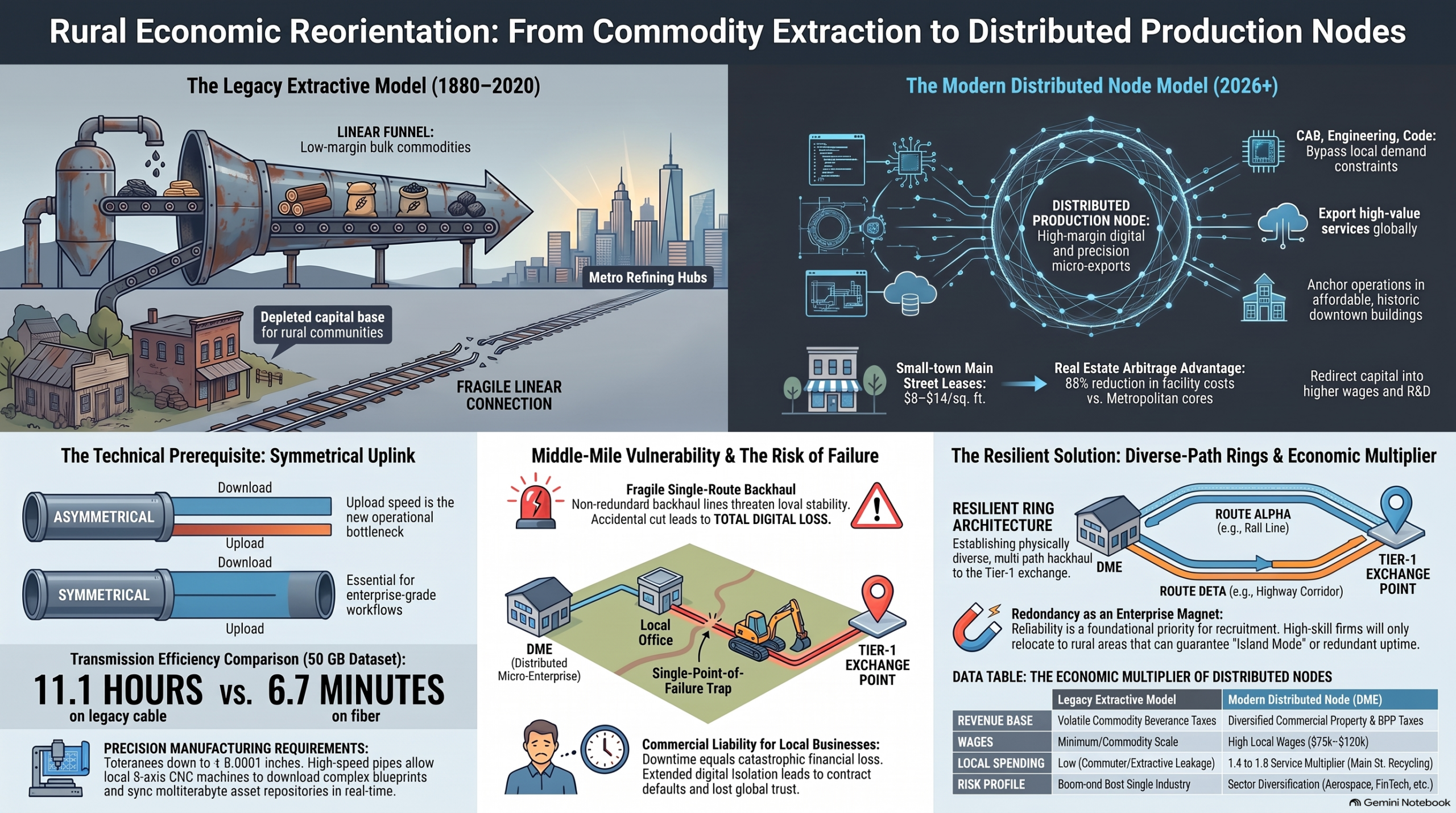
The transition to a “Sovereign Enclave” model—utilizing a “Sovereign Stack” of Layer 1 Baseload Power (DC microgrids) and Layer 4 Cognitive Intelligence (air-gapped AI)—allows rural towns to decouple from fragile centralized nets. By embracing localized power and communications, these communities can foster Distributed Micro-Enterprises (DMEs) that export high-margin precision goods rather than raw commodities. Ultimately, we must adhere to Noel’s Law of Decentralization: the periphery only survives by decoupling from the core. Securing the local sovereignty of these 1,250 counties is the only path to a resilient national interior.