Infrastructure Resilience Assessment: Architecting ‘Island Mode’ Networks for Decentralized Industrial Systems

1. Strategic Framework: The Shift from Centralized to Sovereign Edge
Modern industrial infrastructure is undergoing a decisive architectural pivot, moving away from cloud-dependent frameworks toward localized, edge-resilient coordination. This shift is driven by the rise of Decentralized Physical Infrastructure Networks (DePIN) and the deployment of “Kinetic AI”—systems where local edge compute must interact directly and autonomously with the physical world. Historically, kinetic infrastructure like microgrids and autonomous logistics relied on centralized backhaul for orchestration. However, this dependency creates a critical single point of failure: if the link to the centralized cloud is severed, the local system becomes paralyzed. True resilience requires “Island Mode” survivability—ensuring that operational infrastructure remains fully functional, off-grid, and autonomous regardless of external connectivity status.
Link to the Technical White Paper https://dereticular.com/technical-white-paper-securing-the-kinetic-edge-a-sovereign-stack-evaluation-of-nb-iot-lte-m-and-5g-redcap/
Table 1: Contrast of Network Paradigms
| Attribute | Centralized Paradigm | Sovereign Edge Paradigm (Island Mode) |
| Connectivity Dependency | Constant link to centralized carrier core/cloud | Localized autonomy; off-grid capable |
| Orchestration Location | Remote Cloud Servers | Local DeReticular Nodes / Kinetic AI |
| Data Routing | Backhauled to central data centers | Localized peer-to-peer / Edge-only |
| Failure Modes | Network failure stops local operations | Local operations continue during backhaul loss |
The “Island Mode” mandate is the prerequisite for sovereign compute. By localizing the orchestration layer, architects build self-healing systems capable of surviving the loss of global connectivity. However, the viability of these autonomous nodes is ultimately governed by the physics of the wireless links connecting them.
——————————————————————————–
Link to the Podcast https://academy.dereticular.com/podcast/evolution-of-cellular-iot-from-5g-redcap-to-6g-foundations/
2. Physical Layer Evaluation: RF Propagation and Link Budgets
In decentralized deployments, Radio Frequency (RF) physics—specifically Maximum Coupling Loss (MCL)—serves as the definitive engineering constraint. MCL defines the maximum signal attenuation a link can tolerate between a transmitter and receiver while maintaining a viable session.
Table 2: Comparative RF Metrics (2026)
| Technical Parameter | NB-IoT (Cat-NB1/NB2) | LTE-M (Cat-M1) | 5G RedCap (Rel-17) | 5G eRedCap (Rel-18) |
| Standard Bandwidth | 180 kHz | 1.4 MHz | Up to 20 MHz (FR1) | 5 MHz (FR1) |
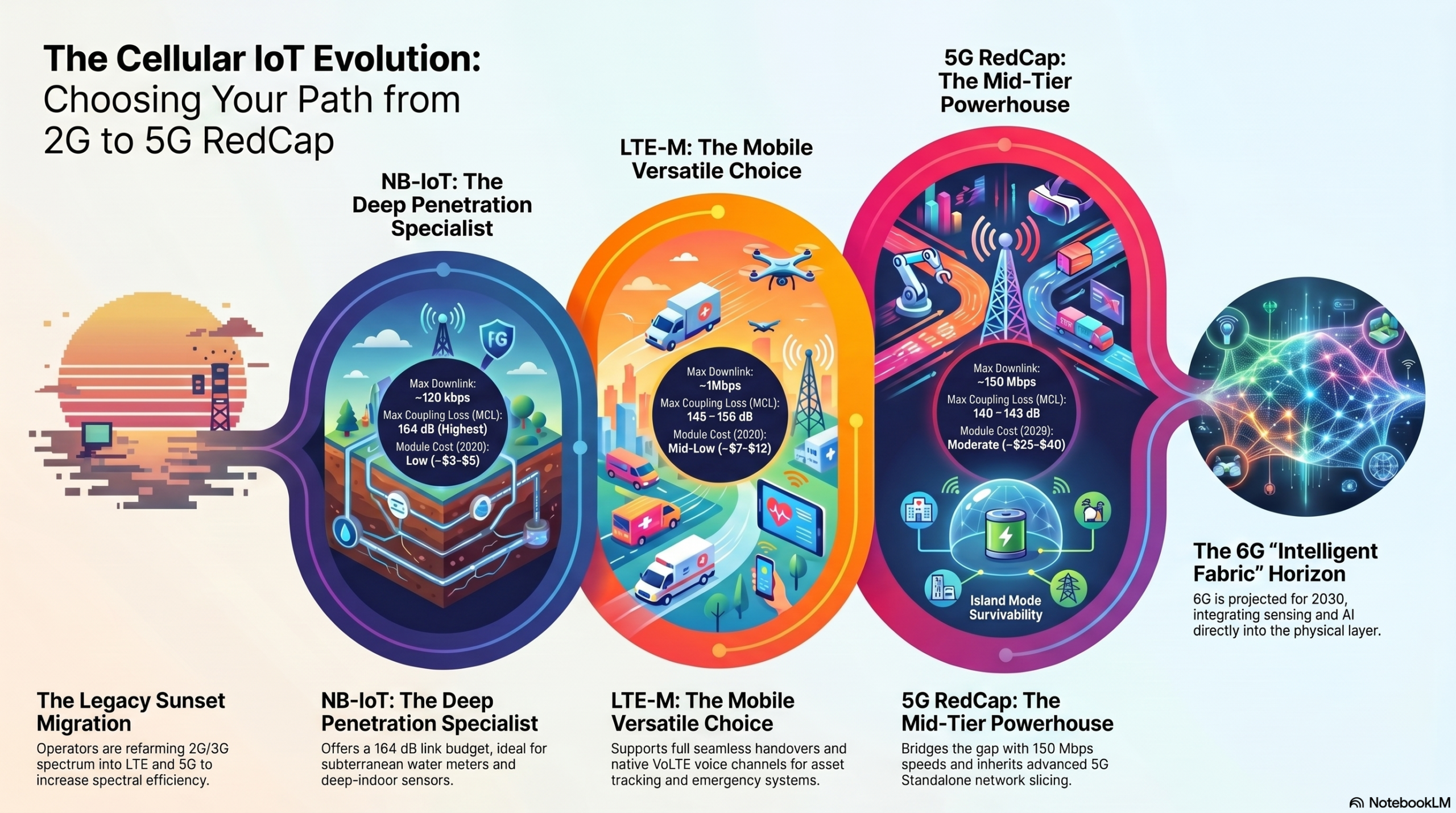
| Max Coupling Loss (MCL) | 164 dB | 145 dB to 155.7 dB | 140 dB to 143 dB | 141 dB to 144 dB |
| PSD Profile | Extremely High | Moderate | Low to Moderate | Moderate |
| Antenna Config | 1 RX | 1 RX or 2 RX | 1 RX or 2 RX | 1 RX |
The Subterranean and Rural Advantage of NB-IoT
NB-IoT achieves an exceptional 164 dB MCL by concentrating the transmitter’s power into an ultra-narrow 180 kHz bandwidth. This relationship is expressed by the formula:
PSD \propto P/B
(Where P = Transmit Power and B = Bandwidth)
By reducing B, NB-IoT maximizes Power Spectral Density (PSD), allowing signals to punch through reinforced concrete, soil, and steel. Architecturally, NB-IoT Release 15 enhancements to the NPRACH (Narrowband Physical Random Access Channel) provide a second major advantage: an unambiguous cell range of up to 120 km in rural environments, a critical capability for sovereign infrastructure in remote territories.
The LTE-M and RedCap Trade-offs
LTE-M offers a balanced profile but requires careful configuration. While it can reach a 155.7 dB MCL, this is only achievable in Coverage Enhancement (CE) Mode B, which utilizes up to 2,048 repetitions. For the architect, this is a “resilience tax”: CE Mode B significantly increases latency and drains battery life, potentially compromising the low-power mandate.
Conversely, 5G RedCap faces a “structural deficit.” By reducing standard 5G’s four receive (RX) antennas to one or two, RedCap incurs a 3–4 dB coverage penalty. 3GPP recovery mechanisms—including Slot Aggregation, Frequency Hopping, and Transport Block Scaling (TBS)—are essential to mitigate this loss and maintain link stability at the cell edge.
——————————————————————————–
3. Protocol Tiering: NB-IoT, LTE-M, and the 5G RedCap Evolution
The cellular IoT hierarchy addresses the gap between ultra-low-power sensors and high-performance broadband, providing the tiered connectivity needed for complex “Island Mode” sites.
Technology Profiles
- NB-IoT: The leader for stationary, deep-indoor, or subterranean assets. While superior in range, it presents a flexibility hurdle for sovereign builders. Private NB-IoT is technically possible but lacks the software-defined radio (SDR) and open-source maturity of LTE-M stacks, often leaving it tethered to centralized carrier scheduling.
- LTE-M: The “Practical Sovereign Edge Layer.” Its support for seamless handovers, VoLTE (voice), and a mature Evolved Packet Core (EPC) makes it the most stable choice for private industrial deployments using tools like Open5GS.
- 5G RedCap/eRedCap: The designated migration path. Release 17 RedCap (150 Mbps) serves mid-tier needs, while Release 18 eRedCap (10 Mbps) reduces complexity further, serving as the direct 5G successor to legacy 4G LTE-M and Cat-1 hardware.
Table 3: Sovereign Builder’s Decision Matrix
| Asset Mobility | Low Bandwidth (Infrequent) | Medium Bandwidth (Frequent/VoLTE) | High Bandwidth (Streaming) |
| Static | NB-IoT | LTE-M / eRedCap | 5G RedCap |
| Mobile | Not Recommended | LTE-M / eRedCap | 5G RedCap |
While protocol selection defines the link, the local core architecture determines its survivability.
——————————————————————————–
4. Architectural Requirements for Island Mode Survivability
True autonomy requires moving the network core to the site. This is achieved via a DeReticular Node, which integrates Software-Defined Radio (SDR) tools like srsRAN with local Kinetic AI cores to process telemetry without external internet dependencies.
Synchronization and 5G Standalone (5G SA)
Native 5G SA features like Network Slicing allow for the isolation of critical kinetic telemetry from general traffic. Furthermore, Time-Sensitive Networking (TSN) supports the microsecond-level synchronization required for decentralized energy nodes. However, engineers must recognize that this is a capability of the standard, not a “free” feature; achieving it requires specialized hardware, including disciplined clocks and IEEE 1588/PTP (Precision Time Protocol) integration, which are rarely present in entry-level SDR setups.
Spectrum Sovereignty: The Primary Barrier
The single largest practical barrier to “Island Mode” is Spectrum Sovereignty. A resilient architecture must account for spectrum access through frameworks beyond standard carrier licensing:
- CBRS (Shared Spectrum): Utilizing local shared frameworks.
- Local Industrial Licensing: Obtaining site-specific spectrum rights from regulators.
- Neutral-Host Architectures: Allowing local nodes to host multiple credentials over a single private radio layer.
——————————————————————————–
5. Security Architecture and Cryptographic Provenance
Critical infrastructure requires a zero-trust posture, especially as legacy 2G/3G networks—which suffer from unfixable unidirectional authentication—are decommissioned. These legacy flaws allow IMSI-catchers (“Stingrays”) to intercept traffic and spoof commands.
The Modern 5G Security Stack
- Mutual Authentication: Ensures both the device and network cryptographically validate one another.
- SUPI/SUCI Encryption: 5G encrypts the Subscription Permanent Identifier (SUPI) into a Concealed Identifier (SUCI) before transmission, preventing the location tracking and eavesdropping common in 4G and 2G/3G environments.
- Hardware Root of Trust: To ensure absolute provenance, cellular modems must be paired with an on-board Trusted Platform Module (TPM) or Hardware Security Module (HSM). This allows the node to cryptographically sign telemetry—such as energy output meters or water flow accounting—before transmission. This ensures data integrity even if the cellular link is compromised.
——————————————————————————–
6. Implementation Roadmap and Strategic Outlook
As of 2026, the ecosystem is transitioning. While 5G RedCap is the future, the economic reality of 4G LTE-M remains dominant for short-lifecycle assets.
Table 4: 2026 Economic Reality
| Technology | Relative Module Cost | Typical Use Case |
| 4G LTE Cat-1bis | ~$4 – $6 | Low-cost, short-lifecycle assets |
| 5G RedCap | ~$25 – $40 | Industrial gateways, mid-tier IoT |
| Full 5G NR | ~$180+ | High-end broadband, premium assets |
| Sovereign Alternatives | Low (LoRaWAN / Wi-Fi HaLow) | Ultra-low-cost, off-grid sensor nodes |
3-Step Migration Strategy
- Phase 1: Immediate Sunset. Terminate all legacy 2G/3G dependencies to eliminate unidirectional authentication vulnerabilities.
- Phase 2: LTE-M Foundation. Deploy LTE-M for current mobile/private edge needs, leveraging its maturity and stable SDR support.
- Phase 3: 5G RedCap Transition. Transition long-lifecycle assets to 5G RedCap/eRedCap as 5G SA cores mature and module pricing converges.
Strategic Outlook
Looking toward 2030, 6G (currently in the Release 20 Study Phase) will introduce Integrated Sensing and Communication (ISAC), turning the network itself into a radar-like sensor. However, the fundamental mission for the architect remains unchanged: resilient infrastructure requires localized, off-grid autonomy to survive the inevitable failures of centralized networks.