

1. Executive Strategic Framework: The Shift to Autonomous Sovereignty
The global technological landscape is undergoing a structural transition from the “Platform Internet” (Stage 2) to the Autonomous Coordination Internet (Stage 3), hereafter referred to as the Autonomous Economic Coordination Layer (AECL). While Stage 2 was defined by centralized cloud platforms, SaaS monopolies, and heavy dependency on hyperscale providers, the AECL introduces a paradigm where the internet functions as an autonomous transaction and coordination network. For national and industrial entities, the strategic necessity of this shift lies in the total removal of hyperscaler dependency to achieve absolute digital autonomy. By transitioning from static, cloud-dependent infrastructure to Sovereign Autonomous Economies (SAEs), organizations ensure that core operations remain resilient against geopolitical fragmentation, sanctions, and external service interruptions.
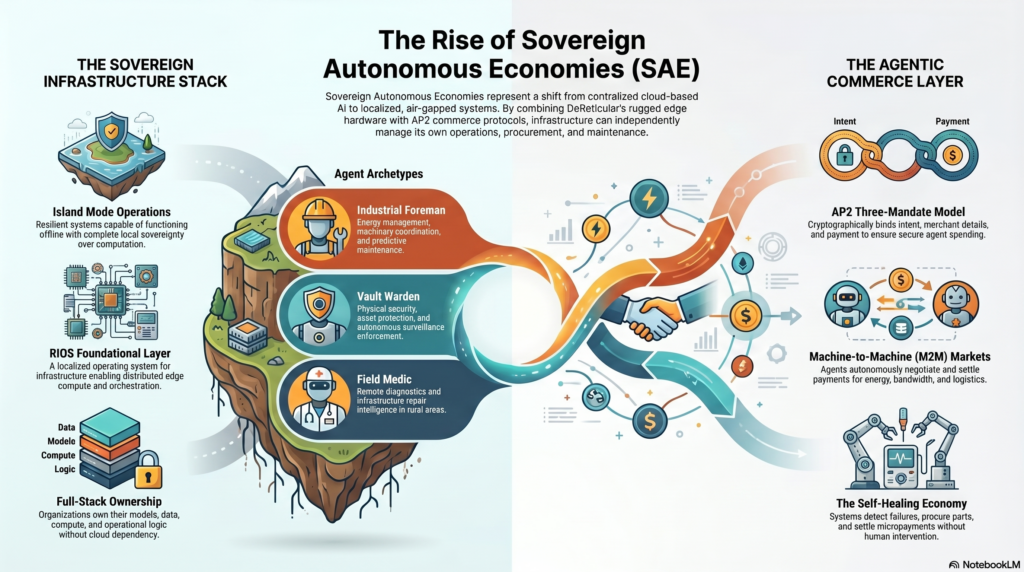
Architectural mandate requires the deconstruction of the SAE stack into four foundational pillars of sovereignty:
- Data Sovereignty: Absolute local ownership and control over all generated data, precluding external extraction, foreign surveillance, or unauthorized telemetry.
- Compute Sovereignty: The utilization of localized edge inference and sovereign hardware to eliminate reliance on foreign-controlled cloud nodes.
- Model Sovereignty: Full ownership of AI models (LLMs/VLMs), encompassing local training, fine-tuning, and execution without “calling home” to centralized APIs.
- Operational Logic Sovereignty: The ability to encode local rules, legal policies, and specific industrial workflows directly into the automation pipeline, immune to external interference.
Central to this framework is ‘Island Mode’ Resilience. This protocol transforms air-gapped systems from “isolated” nodes into “resilient” sovereign entities. By leveraging local intelligence, systems in Island Mode continue to function, negotiate, and optimize resources even when severed from the global web. This shift moves beyond mere hardware deployment to create the substrate for the Rural Infrastructure Operating System (RIOS).
2. Foundational Layer: RIOS and Ruggedized Infrastructure
Architectural Mandate: Utilize the Rural Infrastructure Operating System (RIOS) as the localized operating system for infrastructure. RIOS acts as the essential physical-to-digital bridge, designed for industrial and rural environments where it provides hardware abstraction and infrastructure orchestration, allowing physical assets—such as power grids and agricultural sensors—to be managed by localized AI.
Hardware and OS Composition
The RIOS architecture utilizes a hardened stack of open-source components to ensure deterministic operations and security without the telemetry risks associated with proprietary cloud-native providers.
| Component | Functionality | Specific Utility in RIOS |
| Kubuntu | Operating System | Provides Linux stability and modularity for edge deployment; ensures sovereignty over the software stack. |
| pfSense | Security/Firewall | Functions as the network security layer and sovereign firewall to create isolated operational domains. |
| Freenet | Decentralized Comms | Enables censorship-resistant, peer-to-peer communications and decentralized information persistence in disconnected environments. |
Analyzing the Sovereignty Value Proposition
The strategic advantage of this composition is the elimination of vendor lock-in. By utilizing non-proprietary OS layers, RIOS removes the “phone home” telemetry inherent in centralized SaaS architectures. In sovereign infrastructure, operating system control is equivalent to strategic control. Integration of pfSense and Freenet ensures that the network remains survivable in disaster environments or regions with unstable connectivity, such as the frontier markets of Uganda and East Africa, where RIOS/AP2 integration is currently a primary focus. This hardened hardware environment provides the necessary substrate for the OpenClaw intelligence layer to operate with high-fidelity local reasoning.
3. Orchestration Layer: OpenClaw and Agentic Specialization
OpenClaw functions as the “intelligence layer” of the sovereign stack, responsible for autonomous agent execution, local reasoning, and the coordination of cyber-physical systems. It utilizes the Model Context Protocol (MCP) to provide agents with standardized tool access and context exchange, enabling them to function as active economic actors rather than passive software tools.
The Sovereign Agent Archetypes
Within the OpenClaw framework, specialized agents are deployed to eliminate human-centric administrative bottlenecks and operational latency:
- Industrial Foreman: Orchestrates energy management and machinery coordination. So What? It replaces manual oversight with predictive maintenance and autonomous industrial automation.
- Sovereign Executive: Manages administrative automation and enterprise process management. So What? It acts as a localized enterprise AI operating system, coordinating complex autonomous workflows without external SaaS dependency.
- Vault Warden: Manages physical security and asset protection through computer vision. So What? It enables autonomous security enforcement in critical infrastructure without human guards.
- DevOps Sovereign: Handles cyber-defense and autonomous IT operations. So What? It provides an air-gapped alternative to managed cloud operations, securing the system from within.
- Field Medic: Provides remote diagnostics and infrastructure repair intelligence. So What? It ensures operational resilience in rural or humanitarian settings where human technicians are unavailable.
Autonomous Operational Workflows
The power of OpenClaw is realized through “Self-Healing” workflows. Consider a scenario in a rural microgrid where a sensor detects a transformer failure. OpenClaw triggers the Industrial Foreman to diagnose the fault. Once identified, the agent autonomously sources a replacement component. Crucially, the Cart Mandate mechanism within the protocol prevents the agent from “hallucinating” the price or specifications of the part by requiring a merchant-signed confirmation. The agent then coordinates with a Logistics Agent for delivery—all without human intervention. To execute these real-world procurements, agents require a secure financial protocol, necessitating the integration of the Agent Payments Protocol (AP2).
4. Economic Coordination: AP2 Protocols and x402 Settlement
The integration of the Agent Payments Protocol (AP2) transitions infrastructure from a cost center into a “self-financing machine economy.” AP2 allows autonomous agents to securely spend capital and procure resources while maintaining verifiable accountability through a cryptographic trust model.
The Three-Mandate Trust Model
To solve the “trust problem” in autonomous machine spending, AP2 utilizes three specific cryptographic authorizations:
- Intent Mandate: Defines the authorized scope of the agent (e.g., “Purchase repair parts under $500”), creating bounded autonomy.
- Cart Mandate: A merchant-signed confirmation of exact products and pricing, preventing unauthorized or hallucinated transactions.
- Payment Mandate: Binds the approved payment method to the specific transaction context, ensuring settlement matches original intent.
HTTP-Native Settlement via x402
The coordination layer is enhanced by the Universal Commerce Protocol (UCP) for merchant discovery and the x402 relationship, which utilizes the “402 Payment Required” HTTP status code. This turns the web into a programmable payment fabric, enabling Machine-to-Machine (M2M) micropayments and stablecoin settlement. Because agents now possess bounded spending authority via AP2, the security layer must move from simple perimeter defense to persistent runtime mandate validation.
5. Security and Governance: Cryptographic Trust in Air-Gapped Environments
The shift to agentic commerce introduces risks such as “agentic runaway”—where recursive behaviors occur—and mandate hijacking. Safeguarding an SAE requires a move from human-centric identity to machine-centric cryptographic trust.
The Identity Problem
Traditional identity systems fail in the AECL because machines replicate, migrate, fork, and evolve dynamically. Persistent machine identity is required to ensure accountability and operational trust.
| Requirement | Purpose |
| Hardware Attestation | Verifies the integrity of the physical device and ensures the hardware has not been tampered with. |
| Verifiable Credentials | Manages granular permissions and validates that an agent has the specific authority to act. |
| Behavioral Trust | Uses Machine Constitutions and Policy Binding to monitor agent actions against established constraints. |
Mitigating Runtime Exploits and Compliance Gaps
To prevent prompt injection or mandate misuse, DeReticular deployments must implement zero-trust runtime verification and local mandate validation. Furthermore, the SAE must integrate sovereign compliance layers to address:
- Sanctions Screening: Ensuring agents do not transact with prohibited entities.
- KYC/AML: Localized regulatory modules that satisfy jurisdictional compliance without central bank dependency.
- Secure Memory Isolation: Protecting the agent’s reasoning and mandate processing from adversarial interference.
These security protocols enable the safe deployment of SAEs into high-value vertical markets over the coming decade.
6. Implementation Roadmap: Vertical Deployment of Sovereign Economies
Over a 3–7 year horizon, sovereign infrastructure will evolve from experimental research to the primary operational substrate for industrial and national economies. The convergence of RIOS, OpenClaw, and AP2 creates an unbreakable link between economic sovereignty and technological independence.
Vertical Analysis and Probability Scale
- Rural Infrastructure (High Probability, 3-5 Years): Deployment of autonomous microgrids and agricultural automation in frontier markets like East Africa. SAEs allow these regions to leapfrog traditional banking through agent-managed energy trading.
- Industrial Environments (High Probability, 3-5 Years): Implementation of predictive procurement and machine-managed manufacturing. Factories operate as self-contained economic units that autonomously negotiate for raw materials and energy.
- Smart Cities (Medium Probability, 5-7 Years): Transition to AI-mediated municipal operations. This includes autonomous utility management, AI-managed transportation, and decentralized identity systems for automated permitting, taxation, and billing.
Final Strategic Assessment
The integration of RIOS (Foundational), OpenClaw (Orchestrational), and AP2 (Economic) facilitates “Autonomous Infrastructure Capitalism.” Infrastructure is no longer a depreciating asset; it is an active participant in the AECL—self-monitoring, self-financing, and self-optimizing. As Chief Systems Architect, the mandate is to maintain the integrity of this sovereign stack, ensuring the transition to the Autonomous Coordination Internet remains secure, compliant, and entirely independent of centralized external control.