Field Operations Handbook: Sovereign Deck (RIOS-OP-DECK)
1. The Operational Mandate: The Deck as the Mesh Interface
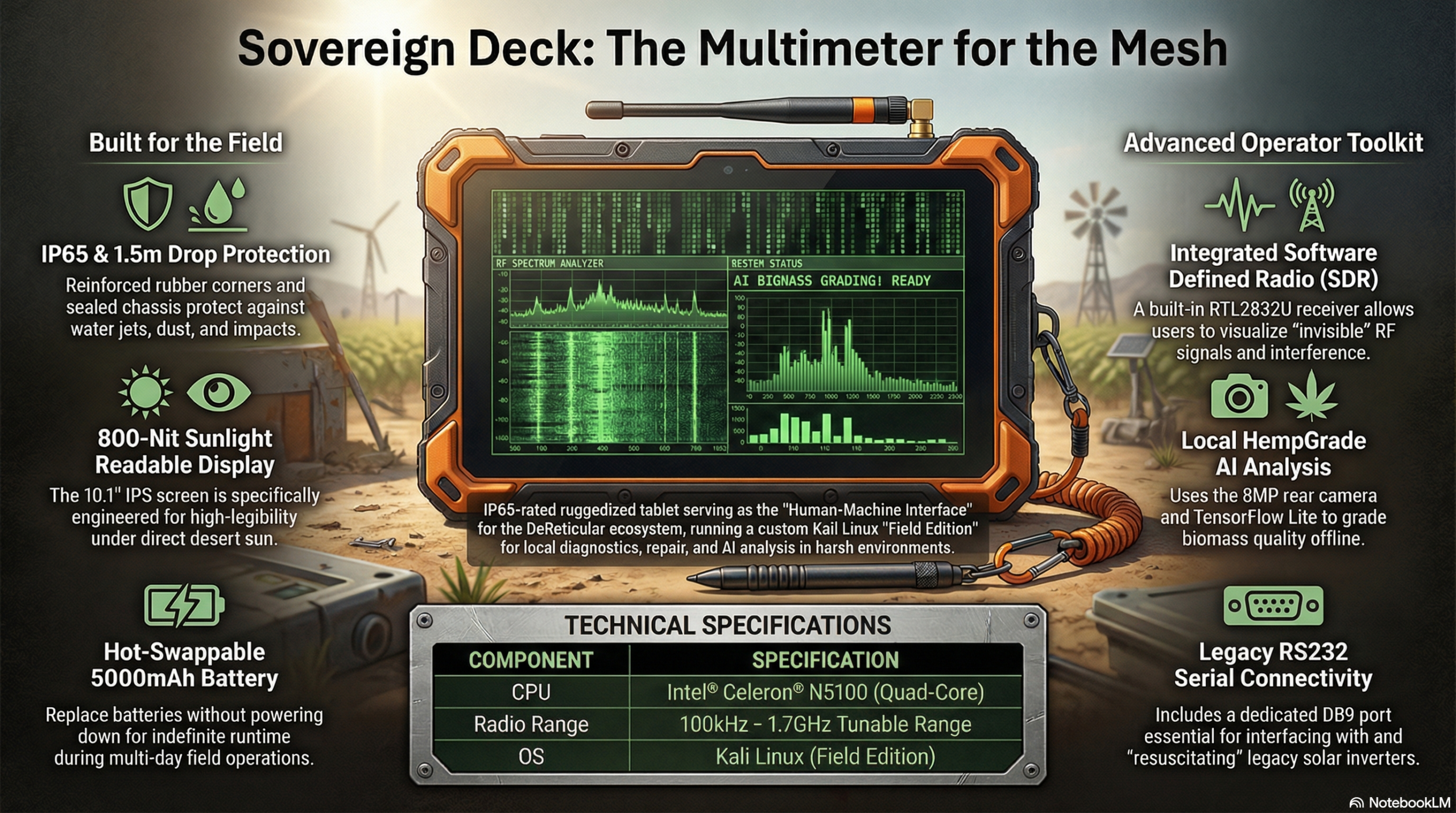
In the DeReticular ecosystem, the Sovereign Deck serves as the primary Human-Machine Interface (HMI). It is the strategic bridge between the high-level data of the Locutus Ledger and the entropic reality of the field. While Nomad Link and Sentry nodes are engineered for autonomous operation, they are not infallible. Digital logs can be spoofed or corrupted; the Deck is the “fail-safe” that allows a human operator to verify physical truth.
This device exists because digital visibility is insufficient. As a Lead Engineer, I’ve seen autonomous systems fail in ways software can’t predict. The Deck transforms the operator into a mobile auditor capable of cross-referencing ledger data against real-world RF signatures and physical assets. Human intervention is the ultimate authority in our mesh—the Deck is the tool that makes that authority actionable.
The following hardware specifications represent the ruggedized foundation required to maintain this interface in the world’s most unforgiving environments.
——————————————————————————–
2. Hardware Architecture: The “Brick” Specifications
We built the Sovereign Deck because consumer tablets are expensive paperweights in an Arizona summer. Industrial-grade hardware isn’t a luxury; it is a tactical requirement for field survival. Each unit is a “Cyberdeck Mod” produced at our Node 3 Workshop in Arizona, where we strip down industrial tablets and integrate custom RF hardware to meet the specific demands of DeReticular field ops.
Technical Specifications & Field Impact Analysis
| Component | Specification | Field Impact Analysis |
| Chassis | IP65 Rugged / 1.5m Drop (MIL-STD-810G) | Survival against high-pressure water jets and high-impact drops on compacted soil or concrete. |
| CPU | Intel® Celeron® N5100 (Quad-Core) | Fanless design eliminates a primary mechanical failure point in dusty, high-heat environments. |
| RAM | 8GB LPDDR4x | Required overhead for running local TensorFlow Lite models and real-time SDR waterfalls simultaneously. |
| Storage | 256GB M.2 SSD (User Replaceable) | Ensures data persistence and allows for rapid “cold-swap” maintenance if a drive fails. |
| Display | 10.1″ IPS (1920×1200) @ 800 Nits | Sunlight readability is mandatory. Anything less is unusable under the direct Arizona noon-day sun. |
| Battery | 5000mAh Li-Po (Hot-Swappable) | Supports indefinite runtime via “bridge battery” tech—swap cells without powering down the OS. |
Specialized I/O & The Cyberdeck Mod
The Deck is designed for interoperability with both legacy and next-gen infrastructure:
- RS232 (DB9) Serial Port: Critical for direct hardware-level communication with legacy solar inverters and industrial PLC systems.
- Internal RTL-SDR PCB: We mount a stripped RTL2832U module directly to the internal USB header, wired to a top-mounted SMA bulkhead.
- USB 3.0 Type-A & USB-C: High-speed ports for peripheral expansion and PD charging.
- RJ45 (Gigabit Ethernet): For hard-line diagnostics when the wireless environment is too noisy for a reliable handshake.
——————————————————————————–
3. DeReticular OS: The Field Edition Environment
The Sovereign Deck runs a hardened Kali Linux kernel, chosen for its native support of auditing and injection tools. This is a security-first environment where updates are locked at the kernel level by default. We do not allow “over-the-air” OS updates in the field to prevent unexpected breakage during a mission.
Identity and “Proof of Presence”
Authentication is handled via the Identity Manager. Operators must use a Sovereign Key (NFC) to unlock the system. This creates a cryptographic “Proof of Presence,” ensuring that every action recorded—whether it is a node repair or a biomass grade—is physically tied to a specific operator at a specific timestamp.
Pre-Installed Operational Tools
- SDR++: The primary visualizer for the internal SDR. Pre-configured with presets for 915MHz (LoRa) and 2.4GHz (Wi-Fi) bands.
- HempGrade AI: A local-only machine learning suite for biomass assessment.
- Locutus CLI: The backbone tool for node management and manual ledger interactions.
——————————————————————————–
4. Operational Procedure: Spectrum Analysis & Interference Debugging
In the DeReticular mesh, the RF spectrum is our most valuable—and vulnerable—asset. Spectrum analysis allows you to “see the invisible” and diagnose network degradation that software logs might misinterpret as a node failure.
SDR++ Professional Workflow
- Antenna Deployment: Thread the Wideband Telescopic SMA Antenna to the top port.
- Visualization: Launch SDR++ and initialize the RF waterfall.
- Noise Identification: Scan for “Noise Spikes” in the ISM bands.
- Machinery Fingerprinting: This is the “So What?” layer. Every piece of industrial equipment (unshielded motors, faulty pumps, rogue monitors) has a unique electromagnetic signature. By “fingerprinting” this signature, you can verify machinery operation for “Proof of Work” audits without relying on a potentially spoofed digital log.
——————————————————————————–
5. Operational Procedure: Biomass Grading via HempGrade AI
The Sovereign Deck removes the need for subjective claims in the supply chain. By using local AI, we eliminate dependency on cloud APIs, ensuring that your audit remains functional even in “dark zones” with zero cellular connectivity.
The Audit Workflow
- Macro Capture: Use the rear 8MP camera to capture trichome density and plant health.
- Local Processing: HempGrade AI processes the image via TensorFlow Lite on the local CPU.
- Ledger Certification: Once the grade is calculated, the operator signs the Quality Certificate using the Sovereign Key.
- Sync: The signed certificate is uploaded to the Locutus Ledger, transforming a subjective quality claim into an immutable, verifiable ledger entry.
——————————————————————————–
6. Node Resuscitation & Maintenance (Locutus CLI)
Firmware corruption on Nomad Link or Sentry nodes is a reality of distributed networks. When a node is “bricked” and unresponsive to remote commands, physical resuscitation is the only path to restoration.
Locutus CLI Recovery Procedure
- Direct Tether: Establish a physical connection via the USB-C or RS232 serial port.
- Bootloader Bypass: Use the CLI to interrupt the boot sequence. If the external ports are unresponsive, you may need to interface with the node’s internal headers.
- Rescue Injection: Flash a verified “Rescue Image” directly to the node’s storage.
- Ledger Sync: Manually force a sync with the Locutus Ledger to re-integrate the node into the mesh.
Physical recovery is prioritized over remote updates whenever a node’s heartbeat becomes erratic or the local RF environment suggests a hardware-level conflict.
——————————————————————————–
7. Field Maintenance, Risk Mitigation, and Compliance
The Sovereign Deck is a precision instrument. If you treat it like a toy, it will fail when you need it most. Long-term stewardship of the device is your responsibility.
Operator Best Practices
- Waterproofing & The SMA Seal: The SMA bulkhead is the Deck’s weakest point. If the marine-grade epoxy seal is damaged or the port is repaired, you must perform a vacuum/pressure test to verify the IP65 integrity before taking it back into the field.
- Power Management: Always keep a charged 5000mAh spare in your Kurb Kar. The hot-swap feature is only useful if you have a fresh cell ready to go.
- Legal Compliance: The integrated SDR can listen to almost anything. Our software is defaulted to ISM bands (915MHz/2.4GHz) for a reason. Adhere to the liability waiver; unauthorized eavesdropping is a breach of contract and local law.
Pre-Departure Field Readiness Checklist
- [ ] Sovereign Key: Verified and on your person.
- [ ] Antenna: Wideband SMA telescopic antenna secured.
- [ ] Serial Tethers: RS232 and USB-C cables verified for continuity.
- [ ] Power: Main battery at 100%; hot-swap spare verified.
- [ ] Visual Inspection: Verify rubber corner integrity and SMA epoxy seal.
As a field technician, you are the vital link in our network. Use the Deck to see what others cannot, fix what is broken, and certify the truth.