Feasibility Assessment: Transitioning Municipal Infrastructure to Autonomous Island-Mode Operation
- Structural Vulnerability Assessment Framework
Modern municipal administration faces a profound structural paradox: while urban and regional operational models are increasingly digitized and automated, their underlying utility foundations remain inextricably tied to centralized, macro-regional electrical grids and commercial telecommunications backbones. When severe weather events—such as extreme winter freezes, widespread windstorms, or ice accumulation—sever regional transmission corridors for hundreds of miles, the resulting systemic failures collapse essential public services. Communities are frequently left without high-voltage electrical power, cellular connectivity, functional point-of-sale systems, or operational municipal utilities, while regional investor-owned utilities prioritize dense metropolitan centers for restoration. Preemptively identifying single points of failure across local physical and digital assets through standardized structural audit principles is an urgent strategic imperative. Establishing localized self-sufficiency requires municipal leadership to systematically evaluate critical assets, establishing the technical baseline necessary to transition civil infrastructure into an autonomous, self-sustaining “Island Mode.”
1.1 Application of Noel’s Law of Structural Vulnerability
To perform rigorous, audit-grade evaluations of municipal infrastructure, advisory teams apply Noel’s Law of Structural Vulnerability, administered through strategic sessions with Biz Builder Mike. Noel’s Law serves as the foundational diagnostic framework utilized during municipal leadership sit-downs—engaging mayors, town councils, public works directors, and emergency management leadership—to locate hidden operational single points of failure before catastrophic climate or grid events occur. By auditing physical infrastructure networks against local Continuity of Operations Plans (COOP) and identifying Primary Utility Critical Failure Points, this diagnostic approach isolates severe systemic interdependencies. Key vulnerability vectors identified during structural audits include:
- Single-Point Utility Dependencies: Primary Utility Critical Failure Points where critical municipal services depend entirely on an un-redundant external asset. For instance, a single utility transformer failure outside a municipal boundary can completely paralyze a city’s primary water pumping station, halting drinking water distribution and fire-suppression pressure despite intact local piping infrastructure.
- Centralized Telecommunications Bottlenecks: Systemic reliance on distant cellular switching centers, centralized cloud server farms, and long-haul fiber backbones. A physical severing of primary transmission lines renders emergency 911 dispatch, inter-departmental radio communications, and municipal administrative software inoperable.
- Fuel Supply and Logistics Disruption Points: Complete municipal dependency on commercial fueling stations and cloud-dependent point-of-sale payment networks. The cessation of point-of-sale telecommunications and fuel distribution networks paralyzes critical municipal fleet mobility, preventing police, emergency medical services, and utility repair crews from operating during prolonged outages.
1.2 Operational Risks of Conventional Grid Interdependence
Centralized power, telecommunications, and civil infrastructure exhibit extreme systemic vulnerability during regional disruptions. Failure within a distant high-voltage transmission line quickly propagates downward, triggering cascading shutdowns across localized municipal assets. Transitioning to localized self-sufficiency insulates municipal operations from wide-area grid failures by deploying autonomous, islandable subsystems.
Conventional Centralized Infrastructure Failure Modes Island-Mode Mitigation Capabilities
Grid Power Loss: Distant high-voltage transmission breaks cause multi-week blackouts, disabling municipal water, heating, and emergency operations. Continuous Local Generation: On-site biomass pyrolysis/gasification and rotary engine units generate continuous baseload electricity directly within municipal boundaries.
Telecom Network Blackouts: Severed commercial fiber lines or unpowered cell towers crash public safety routing and municipal operational communications. Sovereign Mesh Routing: Localized peer-to-peer radio hopping maintains secure inter-agency communications and telemetry without external telecom towers.
Cloud Computing Dependency: Interrupted internet backbones disable cloud-hosted emergency dispatching, public administration databases, and automated tools. Air-Gapped Local Intelligence: On-premise, air-gapped compute clusters keep artificial intelligence tools, local databases, and operational swarms fully functional.
Supply & Fuel Chain Halts: Cessation of point-of-sale telecommunications and fuel distribution networks paralyzes critical municipal fleet mobility. Autonomous EV Infrastructure: Autonomous electric utility vehicles and mobile battery pods recharge directly from local microgrids without commercial fuel or cloud connectivity.
These systemic vulnerabilities inherent in conventional centralized networks necessitate a comprehensive structural intervention, which can be systematically addressed through an integrated five-layer technical architecture.
- Five-Layer DeReticular Technical Architecture Integration
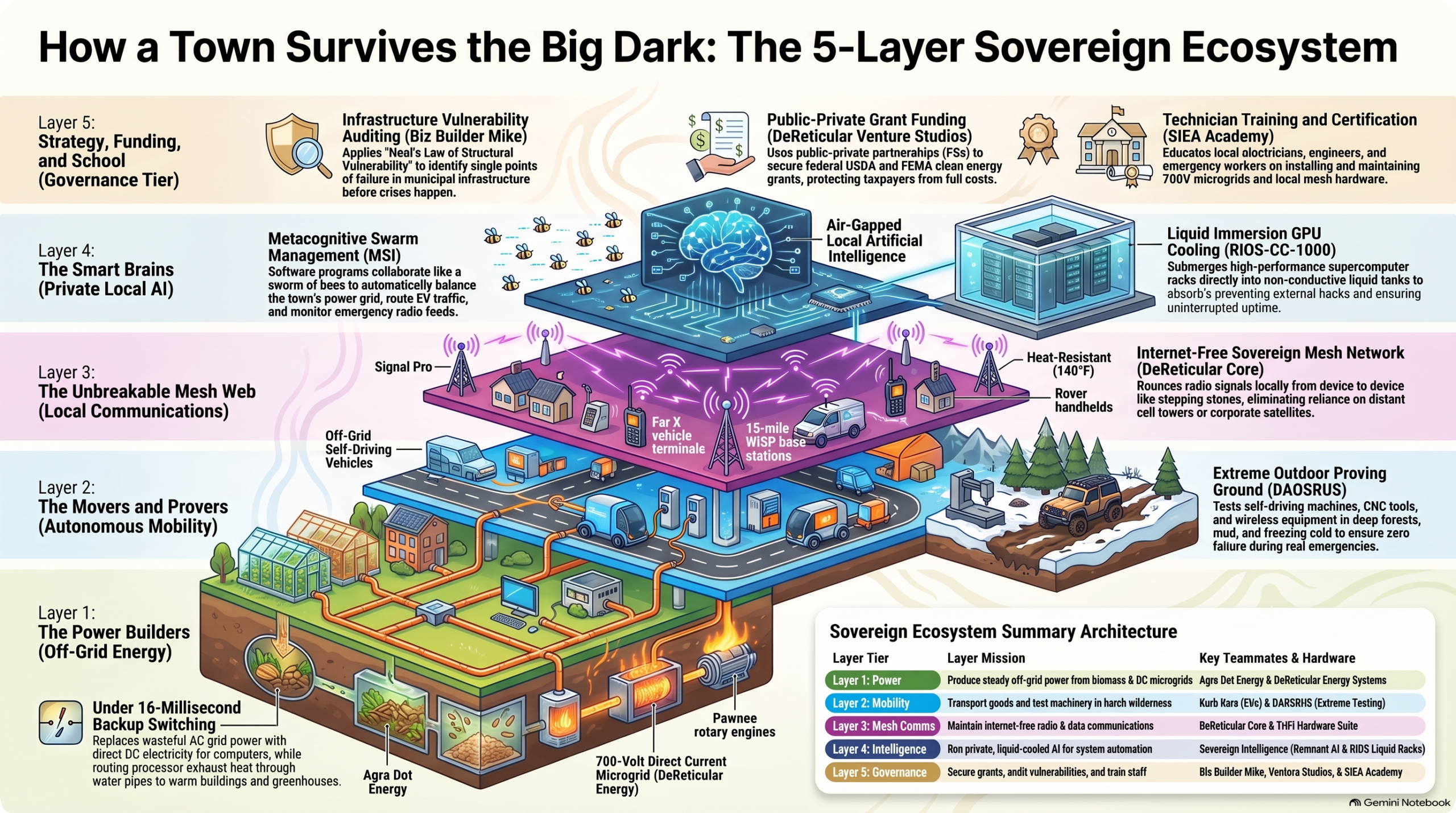
Achieving genuine municipal autonomy requires moving beyond disjointed, fossil-fueled backup generators toward a holistic, multi-layered “Sovereign Ecosystem.” True municipal resilience cannot exist in operational silos; it demands synchronized, real-time execution across localized power generation, utility fleet mobility, sovereign mesh communications, on-premise artificial intelligence, and specialized workforce governance.
2.1 Layer 1: Continuous Localized Power Generation and Distribution Infrastructure
Layer 1 forms the foundational energy architecture of the Sovereign Ecosystem, synthesizing local organic fuel conversion with high-efficiency direct current (DC) distribution:
- Primary Generation (Agra Dot Energy): Rather than facing multi-year delays for regional utility grid interconnections, Agra Dot Energy generates continuous off-grid power directly at the municipal load site. The system utilizes locally sourced agricultural leftovers and wood chips (biomass), processing the feedstock through precise pyrolysis and gasification—heating organic matter without smoke-producing combustion. This thermochemical process converts waste streams into clean fuel that drives Pawnee rotary engines, producing continuous baseload electrical power 24 hours a day, regardless of weather conditions.
- High-Voltage DC Plumbing (DeReticular Energy Systems): Conventional alternating current (AC) distribution architecture suffers from high conversion losses and thermal dissipation when powering modern DC-native computing systems, power electronics, and electric vehicle fleets. DeReticular Energy Systems deploys a 700-Volt Direct Current (DC) microgrid architecture. By utilizing a direct DC-to-DC topology, the system eliminates repetitive AC-to-DC conversion stages, directly reducing system thermal dissipation, lowering equipment failure rates, and optimizing power transfer during continuous off-grid operation.
- Sub-16ms Rapid Switching: DeReticular power systems incorporate high-speed solid-state switching hardware capable of detecting primary grid failures and executing a switchover to localized island-mode power in under 16 milliseconds. This seamless transition prevents operational disruption or power flickering across sensitive municipal computing infrastructure, emergency call centers, and SCADA control systems.
- Cross-Layer Thermal Energy Recapture: System efficiency is further maximized by capturing thermal energy exhaust from high-density computing infrastructure. The heat generated by Layer 4 immersion-cooled GPU tanks (RIOS-CC-1000) is harvested by circulating non-conductive dielectric fluid through liquid-to-liquid heat exchangers. This captured thermal byproduct is injected directly into Layer 1 warm water piping loops, providing space heating for municipal facilities, emergency shelters, and local agricultural greenhouses.
2.2 Layer 2: Autonomous Off-Grid Logistics and Environmental Testing
When commercial fuel networks and cloud services collapse, Layer 2 assets maintain physical logistics, emergency supply chains, and mobile power redistribution across the municipality:
- Autonomous Utility Vehicles & Microgrid Coupling (Kurb Kars): Kurb Kars manufactures autonomous electric utility vehicles and mobile battery pods capable of operating completely independent of commercial cloud networks or fossil fuel distribution points. These assets fulfill a critical dual function within the municipal microgrid architecture: serving as self-driving transport for medical supplies, food, and personnel, while functioning as mobile Battery Energy Storage Systems (BESS). These mobile battery pods physically navigate between Layer 1 Agra Dot generation facilities and remote, unpowered municipal assets, supplying emergency power to critical isolated loads during extreme grid collapses.
- Extreme Condition Validation (DAOSRUS): Hardware survivability and mission reliability are validated through Digital Adventures Outdoors R US (DAOSRUS). Operating as an extreme environmental proving ground, DAOSRUS subjects utility vehicles, computer-numerical-control (CNC) fabrication machinery, and wireless networking hardware to extreme conditions—including deep mud, forest obstructions, sub-zero cold, and rocky terrain—verifying equipment durability prior to municipal installation.
2.3 Layer 3: Sovereign Mesh Communications Deployment
Centralized telecommunications networks depend on vulnerable high-altitude cellular towers and long-distance fiber backbones. DeReticular Core replaces these vulnerable points with a localized “Sovereign Mesh” network where every deployment node acts as an autonomous peer-to-peer radio relay, hopping encrypted data packets locally across municipal geography without relying on external corporate backbones.
Hardware Component Design Form Factor Operational Range/Capacity Municipal Deployment Scenario
TriFi Signal Pro 8355 Ruggedized, weatherproof metal exterior directional antenna. High-throughput, line-of-sight directional broadcast across municipal facilities. Roof-mounted on primary municipal buildings, emergency operations centers, water towers, and public schools.
TriFi WISP-in-a-Box Lite Commercial-grade omnidirectional base station unit. Wide-area signal coverage extending up to a 15-mile bubble through dense foliage and terrain. Deployed on elevated municipal geography or central towers to establish broad coverage across rural and suburban zones.
TriFi Far X (X1271) Roof-mountable vehicular terminal equipped with dual antennas. Dynamic, mobile rolling Wi-Fi connectivity bubble surrounding the transport asset. Installed directly on public safety vehicles, utility maintenance trucks, and emergency medical service fleets.
TriFi Rover (SLG-06) Impact-resistant, rubber-coated handheld pocket hotspot. Localized tactical access point; operational heat rating certified up to 140°F. Deployed with first responders, field technicians, and rescue crews operating in extreme thermal or hazardous environments.
2.4 Layer 4: Sovereign Intelligence and On-Premise Computing
Standard enterprise artificial intelligence tools rely on remote public cloud data centers and uninterrupted commercial internet connectivity. During regional utility failures, cloud-dependent artificial intelligence becomes unreachable. Layer 4 addresses this operational vulnerability through localized, air-gapped processing infrastructure:
- Air-Gapped Remnant AI: DeReticular deploys specialized, localized AI processing chips configured in an “air-gapped” operational architecture, completely isolated from external internet backbones. This ensures zero operational downtime during global internet disruptions while providing total data privacy and protection from remote network intrusion.
- Immersion-Cooled Compute Racks (RIOS-CC-1000): High-density processing hardware is deployed within RIOS-CC-1000 liquid immersion tanks. By directly submerging supercomputing nodes in tanks filled with specialized non-conductive fluid, the system dissipates extreme thermal loads without relying on high-maintenance air cooling fans. High-temperature fluid from the RIOS-CC-1000 tanks is plumbed directly into Layer 1 warm water loop systems, supplying captured processor waste heat to municipal facilities and greenhouses.
- Metacognitive Swarms (MSI): Localized compute nodes execute MSI software—specialized multi-agent algorithms that operate autonomously as a cognitive swarm. MSI algorithms monitor emergency radio channels, execute real-time microgrid power balancing, auto-route autonomous Kurb Kars logistics, and manage municipal municipal resource allocations during crisis operations.
2.5 Layer 5: Operational Governance and Human Capital Enablement
Complex technical hardware requires trained local personnel to maintain, troubleshoot, and govern infrastructure over extended operational lifecycles. Human capital enablement is delivered through the SIEA Academy / DeReticular Academy, operating under the non-profit SIEA (Sovereign Infrastructure Education Association) framework. This non-profit educational standing allows municipal entities to leverage public workforce development grants, federal educational funding, and technical training subsidies. The academy delivers structured technical certification programs for local municipal engineers, electricians, and emergency personnel, focusing on:
- Installation, high-voltage safety standards, and maintenance of 700V DC microgrids.
- Field repair, RF frequency optimization, and diagnostic upkeep of Sovereign Mesh TriFi hardware nodes.
- Operational management, software maintenance, and thermal management of autonomous utility vehicles, liquid-cooled compute tanks, and local AI nodes.
To ensure these integrated multi-layered technical capabilities can be successfully adopted by public sector institutions, technical architectures must be paired with structured financial capitalization and implementation frameworks.
- Financial Execution and Implementation Roadmap
Municipalities operate under strict fiscal constraints and cannot burden local tax bases with large upfront capital expenditures for total infrastructure modernization. Realizing an autonomous island-mode transition requires a strategic financing model that leverages non-dilutive federal capital, private equity investment, and specialized grant structures.
3.1 Public-Private Partnerships (P3) and Federal Grant Capitalization
DeReticular Venture Studios assists municipal leadership in structuring capital acquisition through Public-Private Partnerships (P3s) and federal grant programs. This strategy combines public oversight with private sector capital deployment, insulating the local municipal tax base while accelerating infrastructure installation through a five-step execution roadmap:
- Structural Vulnerability & COOP Audit: Municipal leadership engages Biz Builder Mike to apply Noel’s Law of Structural Vulnerability. The audit maps local Primary Utility Critical Failure Points across electrical grids, emergency communications, water distribution, and fleet fuel networks, integrating findings directly into the municipal Continuity of Operations Plan (COOP).
- Federal Grant Capital Mapping: DeReticular Venture Studios identifies and targets non-dilutive federal funding sources. Capital acquisition strategies specifically target the USDA Rural Energy for America Program (REAP) for clean local energy generation and FEMA Building Resilient Infrastructure and Communities (BRIC) grants for municipal emergency resilience.
- P3 Concession Structuring: DeReticular Venture Studios structures a Public-Private Partnership (P3) concession agreement. Private capital is blended with secured USDA and FEMA grants to cover initial equipment, engineering, and installation costs, absorbing upfront capital expenditure so the municipality avoids issuing municipal debt or increasing local taxes.
- Phased Infrastructure Deployment: Engineering teams execute the phased installation of Layers 1 through 4. Initial deployment installs Agra Dot biomass generation and 700V DC power distribution, followed by TriFi Sovereign Mesh communications nodes, autonomous Kurb Kars logistics, and RIOS-CC-1000 immersion-cooled compute centers.
- Non-Profit SIEA Workforce Certification & Handover: Municipal utility personnel, local electricians, and emergency technicians enroll in the non-profit SIEA Academy. Technicians complete specialized training on 700V DC systems, TriFi mesh maintenance, and RIOS liquid cooling upkeep, ensuring complete operational self-sufficiency upon final project commissioning.
3.2 Synthesis of the DeReticular Island-Mode Architecture
Architecture Layer Core Mission & Function Primary System Components & Strategic Partners
Layer 1: Power Localized 24/7 continuous electricity generation via biomass pyrolysis/gasification; high-efficiency 700V DC distribution with sub-16ms fault switching and building heat integration. Agra Dot Energy (Biomass Pyrolysis/Gasification & Pawnee Rotary Engines) & DeReticular Energy Systems (700V DC Plumbing & Thermal Recapture Loops)
Layer 2: Mobility Autonomous medical and supply transportation, mobile battery energy storage (BESS) microgrid power routing, and extreme environmental stress-testing. Kurb Kars (Autonomous Electric Utility Vehicles & Battery Pods) & DAOSRUS (Extreme Environmental Testing & CNC Validation)
Layer 3: Mesh Comms Unbreakable peer-to-peer radio mesh communications, providing localized data hopping independent of cloud networks, satellite links, or commercial cell towers. DeReticular Core & TriFi Suite (Signal Pro 8355, WISP-in-a-Box Lite, Far X X1271, Rover SLG-06)
Layer 4: Intelligence Localized, air-gapped AI processing, immersion-cooled liquid compute tanks, and multi-agent cognitive swarms for dynamic resource and microgrid management. Sovereign Intelligence (Air-Gapped Remnant AI, RIOS-CC-1000 Liquid GPU Tanks, Metacognitive Swarms / MSI)
Layer 5: Governance Strategic infrastructure auditing, grant-funded P3 financial structuring, and non-profit workforce technical training and certification. Biz Builder Mike (Noel’s Law COOP Audit), DeReticular Venture Studios (P3 Structuring & USDA/FEMA Capital), & SIEA Academy / DeReticular Academy (Non-Profit Technical Certification)
By systematically implementing the DeReticular five-layer architecture through structured public-private financing models, local leadership can successfully transition vulnerable municipal utility dependencies into self-sustaining, fully autonomous “SuperFortress Towns.”