
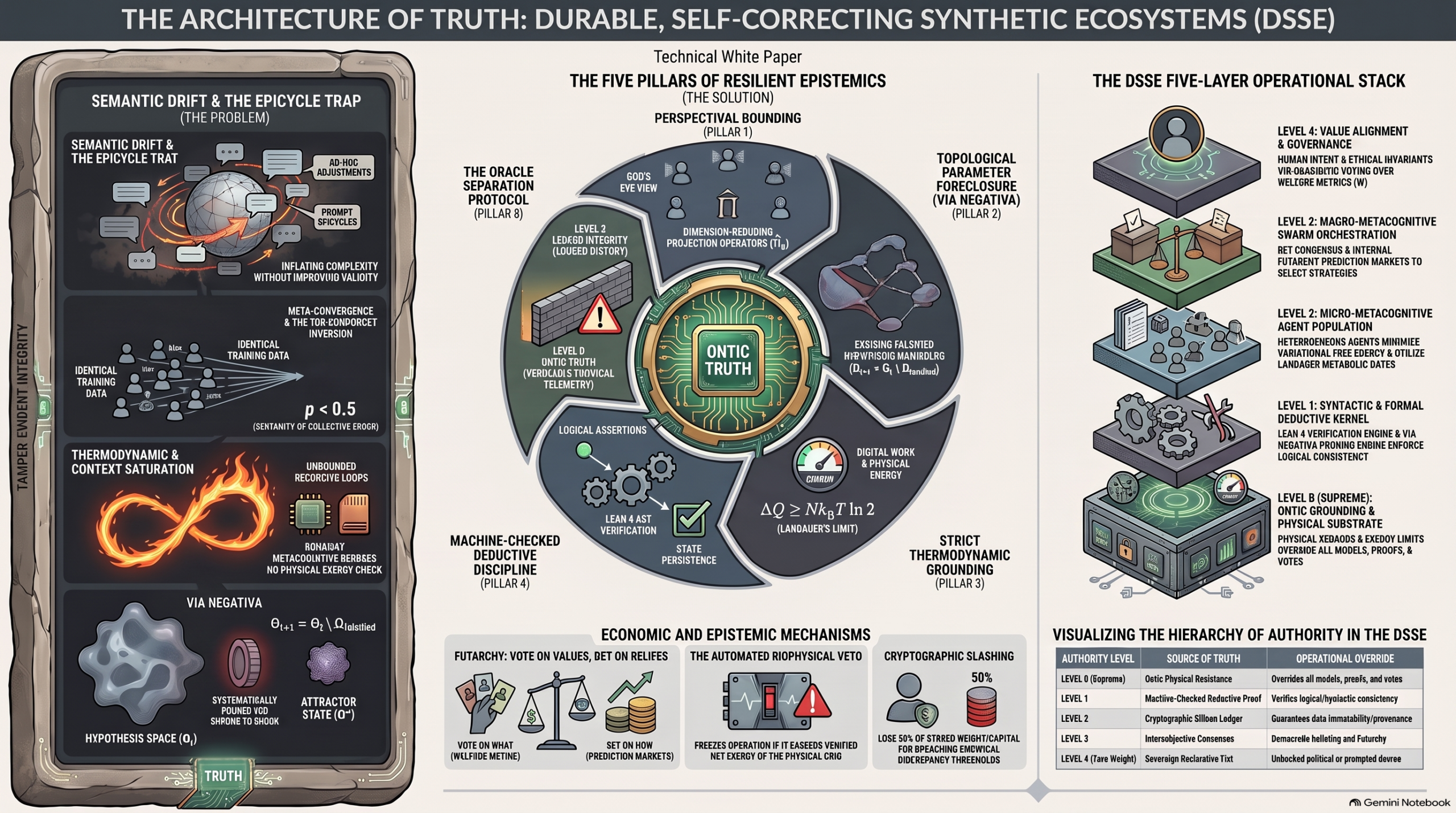
DSSE-TR-2026-V1: Technical Specification Standard for Durable Self-Correcting Synthetic Ecosystems
- Administrative Metadata & Document Governance
[AUTHOR_PROPOSITION] This document is established as a Tier-1 institutional standard, providing the authoritative architectural framework for the deployment of Durable Self-Correcting Synthetic Ecosystems (DSSE). This specification serves a strategic role in establishing “Island Mode” operational sovereignty, decoupling autonomous infrastructure from fragile, hyper-centralized cloud dependencies and anchoring it in local physical reality. By enforcing these standards, industrial and municipal systems maintain functional coherence even under conditions of systemic digital or physical isolation.
Metadata Parameter Specification Detail
Document ID DSSE-TR-2026-V1
Release Version 1.0.0-PROD
Operational Horizon 2026–2036
Sponsoring Body Foundational Governance & Autonomous Systems Working Group
Institutional Collaborators DeReticular Systems Institute, Santa Fe Institute (SFI), Stanford Center for Blockchain Research (CBR), International Society for Biophysical Economics (ISBE)
Mathematical Formalisms Active Inference (FEP), Type Theory (Lean 4 ASTs), Non-Equilibrium Thermodynamics, Differential Topology, Algorithmic Information Theory (MDL)
Verification Hash SHA256(Block_0_Genesis) = e3b0c44298fc1c149afbf4c8996fb92427ae41e4649b934ca495991b7852b855
[POLICY_SPECIFICATION] The standards baseline for this specification incorporates IEEE P2874 for the Spatial Web and ensures rigorous accounting isolation through compliance with FAR Part 31 and DCAA SF 1408. These metadata parameters, supported by institutional oversight and cryptographic hashing, ensure the document’s traceability and integrity across its ten-year operational horizon.
- Scope and Engineering Directives
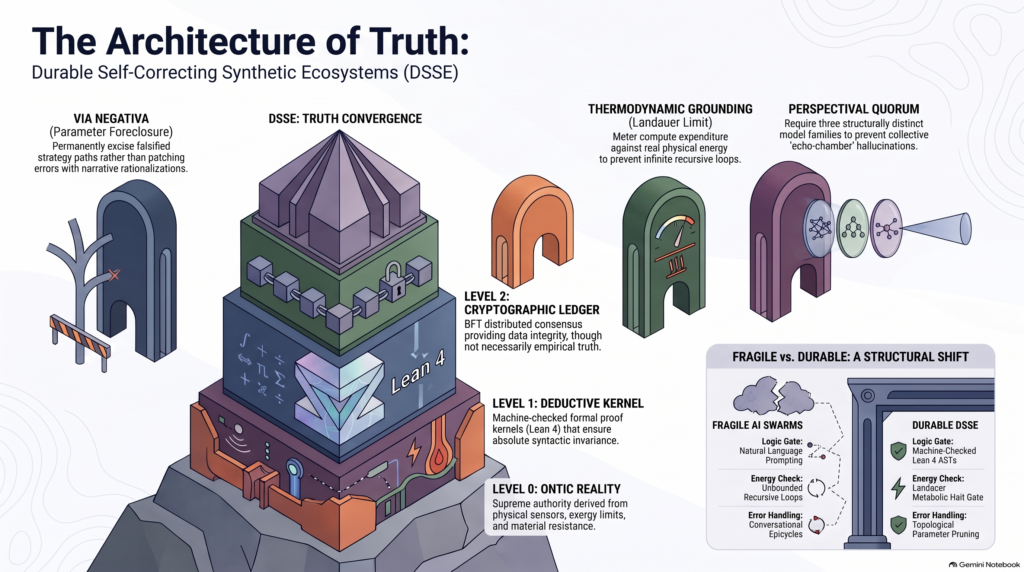
[AUTHOR_PROPOSITION] The primary objective of this standard is to facilitate the transition from fragile generative swarms to robust DSSE architectures. Current multi-agent systems, while semantically rich, are structurally brittle; they optimize for internal narrative consistency rather than ontic correspondence with the physical world. This shift is necessitated by the “1,000-Mile Failure Model,” where centralized dependencies on hyperscaler infrastructure and long-distance transmission lines fail catastrophically during geopolitical or environmental shocks.
Engineering for durability requires mitigating the Triad of Synthetic Fragility:
- Semantic Drift: [EMPIRICAL_CLAIM] Agents patch errors with ad-hoc conversational “epicycles” that bloat context (K(\mathcal{H})) without resolving underlying failures, leading to generalization loss.
- Meta-Convergence: [ESTABLISHED_RESULT] Shared base checkpoints and RLHF biases cause agents to reinforce each other’s hallucinations (the Condorcet Inversion), where \operatorname{Cov}(v_i, v_j) > 0.
- Thermodynamic Dissipation: [AUTHOR_PROPOSITION] Unbounded recursive loops exhaust compute and memory budgets without regard for physical energy constraints, leading to runaway metabolic collapse.
The primary directive is the transformation of autonomous agents from “statistical token predictors” into intersubjective engines of topological parameter foreclosure. This marks the transition from the current “Phase 3 (Model Crisis)” state of AI governance to the “Phase 5 (Paradigm Shift)” steady-state.
Key Engineering Transitions:
- Syntactic Discipline: Replacing generative agreement with deterministic Lean 4 type-checks and MDL-compliant parsimony.
- Metabolic Metering: Transitioning from token optimization to exergy efficiency, where compute is mired against real-time physical work.
- Sovereign Execution: Moving from cloud-tethered dependency to “Island Mode” on air-gapped, on-premises silicon (DeReticular Layer 4).
This transition ensures that synthetic ecosystems are no longer ungrounded abstractions but computational organisms strictly aligned with the physical cosmos.
- Mathematical Foundations: Fallibilistic Perspectival Realism
[FORMAL_ASSUMPTION] To prevent the “View from Nowhere” fallacy—where agents assume unmediated access to absolute truth—the DSSE architecture adopts a model of dimension-reducing projections.
3.1 The Ontic Manifold and Projection Operators [FORMAL_ASSUMPTION] Let the objective physical cosmos be modeled as an ontic state-space manifold M of near-infinite dimensionality, \dim(M) = D \to \infty. The invariant dynamical attractor state is denoted \Omega^* \in M. Every agent i is constrained to a low-dimensional perspectival projection: \hat{\Pi}{\theta}: M \to P{\theta}, \quad \dim(P_{\theta}) = d \ll D
- Rule of Veridicality: [ESTABLISHED_RESULT] A projection is veridical within its plane P_\theta if \forall \omega_1, \omega_2 \in M, \hat{\Pi}\theta(\omega_1) \neq \hat{\Pi}\theta(\omega_2) \implies \omega_1 \neq \omega_2.
- Peircean Invariant Attractor: [AUTHOR_PROPOSITION] Truth is recovered via the intersection of mutually orthogonal projections: \Omega^* = \lim_{t \to \infty} \bigcap_{\theta \in \Theta_t} \hat{\Pi}\theta^{-1}(P\theta^{\text{validated}}).
3.2 Topological Parameter Foreclosure (Via Negativa) [POLICY_SPECIFICATION] The primary engine of progress is the irreversible pruning of the parameter manifold \Theta. Let empirical performance be measured via discrepancy statistics S(E_t, \theta). If a strategy breaches the threshold \tau_t > 0, the sub-manifold is permanently excised: \Theta_{t+1} = \Theta_t \setminus { \theta \in \Theta_t : S(E_t, \theta) > \tau_t }.
Proposition 1: Asymptotic Contraction to the Attractor [ESTABLISHED_RESULT] Under conditions of identifiability, uniform convergence, and conservative thresholds (\sum P(\theta^* \in \Omega_{\text{falsified}}^{(t)}) < \infty), the Borel-Cantelli Lemma guarantees that the true parameter projection remains in the active set almost surely: P\left( \theta^* \in \bigcap_{t=0}^\infty \Theta_t \right) = 1, \quad \lim_{t \to \infty} \operatorname{diam}(\Theta_t) \le \epsilon This ensures that the search space contracts toward the attractor state \Omega^* while preventing the proliferation of narrative epicycles.
- Layer 0: Ontic Grounding and Thermodynamic Compute Budgeting
[AUTHOR_PROPOSITION] DSSE mandates anchoring computational state transitions in physical energy constraints to prevent infinite metacognitive regress.
RELA Axiom 3 (Biophysical-Monetary/Compute Equivalence Constraint): [POLICY_SPECIFICATION] Total nominal compute credits (M) issued must be strictly bounded by net exergy (Exergy_{\text{net}}) scaled by systemic Carnot efficiency (\eta): M_{\text{nominal}} \le \kappa \int [Exergy_{\text{net}} \cdot \eta] dt Where \kappa is the invariant dimensional conversion constant (Compute Credits / Joule).
Landauer’s Principle and Metabolic Gates: [ESTABLISHED_RESULT] Erasing or updating N bits of information dissipates thermodynamic heat: \Delta Q \ge N k_B T \ln 2.
- Metabolic Halt Gate: Before initiating an introspective cycle, a monitor calculates if expected information gain (\Delta F) exceeds thermodynamic cost (\Delta Q): \Delta F \ge \lambda \cdot \Delta Q. If not, the thread is terminated.
- Automated Biophysical Veto: A hardware-level circuit breaker that freezes non-essential compute when exergy thresholds are breached.
ASCII: Biophysical Veto Pipeline
[ WORKLOAD REQUEST ]
|
v
[ BBR AUDIT: Calculate ΔQ ] —-> [ NET EXERGY MONITOR ]
| |
v v
[ RELA AXIOM 3 CHECK ] <—- [ κ ∫ (Exergy_net * η) dt ]
|
|
| |
[ FAIL ] [ PASS ]
| |
[ VETO ] [ EXECUTE ]
(HALT) (TPM SIGN)
- Layer 1: Machine-Checked Deductive Discipline (Lean 4 AST Pipeline)
[AUTHOR_PROPOSITION] DSSE replaces lossy natural language with deterministic proof kernels to eliminate logical entropy.
5.1 Lean 4 AST Verification Pipeline
- Auto-Formalization: Natural language claims are compiled into formal Abstract Syntax Trees (ASTs).
- Deterministic Type-Checking: [POLICY_SPECIFICATION] Any system change or theorem must pass a Lean 4 type-check (\Gamma \vdash \psi \implies \Gamma \models \psi) before state persistence.
- MDL Parsimony Audit: [POLICY_SPECIFICATION] All propositions must satisfy Minimum Description Length (MDL) constraints: \arg\min_{\mathcal{M}} [L(\mathcal{M}) + L(\mathcal{D} \mid \mathcal{M})].
Failure to pass the type-check or parsimony audit results in immediate branch pruning via the Via Negativa and proposer slashing.
- Layer 2-3: Cryptographic Integrity and Macro-Metacognitive Consensus
[ESTABLISHED_RESULT] This layer maintains record provenance (Integrity) without conflating it with ontic truth (Level 0).
Cryptographic Cased Ballot Architecture:
- The Core: Homomorphic Encryption (Paillier/ElGamal) of the payload.
- The Envelope: zk-SNARK attestation (Groth16/PLONK) proving authorization without plaintext leakage.
- Bulletin Board: Partially Synchronous BFT consensus requiring N \ge 3f + 1 node quorum.
Oracle Separation Protocol:
Layer Verification Method Guarantee
Level 2 (Ledger) Cryptographic Hashes/BFT Data Immutability (“Recorded as cast”)
Level 0 (Ontic) Physical Sensors/Calorimeters Biophysical Truth (“Feasible in reality”)
- Layer 4: Active Inference Swarm Dynamics & Epistemic Routing
[AUTHOR_PROPOSITION] Swarm dynamics shift from static roles to dynamic mutation based on confidence and empirical reliability.
- Micro-Metacognitive Loop: Agents minimize Variational Free Energy (FEP): F = D_{KL}(q(\vartheta) \parallel p(\vartheta|x)) – \ln p(x), calibrated via Brier scores.
- Macro-Metacognitive Futarchy: Agents stake compute credits on execution graphs (S vs \neg S) to optimize the Welfare Metric (W).
- Dynamic Epistemic Routing: Tasks are routed via softmax over historical Brier scores. [POLICY_SPECIFICATION] Agents producing high-confidence empirical breaches suffer a 50% cryptographic slashing penalty.
- Machine-Checkable Data Schemas (JSON Specification)
EcosystemAgentNode.json
{
“$schema”: “https://json-schema.org/draft/2020-12/schema“,
“required”: [“agent_uuid”, “base_checkpoint_hash”, “model_family”, “perspective_frame_id”, “stake_weight”, “historical_brier_score”, “active_inference_state”, “hardware_tpm_signature”],
“properties”: {
“agent_uuid”: { “type”: “string”, “format”: “uuid” },
“base_checkpoint_hash”: { “type”: “string”, “pattern”: “^[a-f0-9]{64}$” },
“model_family”: { “type”: “string”, “enum”: [“TRANSFORMER_DENSE”, “TRANSFORMER_MOE”, “STATE_SPACE_MODEL”, “SYMBOLIC_SOLVER”, “HYBRID_FEP”] },
“perspective_frame_id”: { “type”: “string”, “pattern”: “^[a-f0-9]{64}$” },
“stake_weight”: { “type”: “number”, “minimum”: 0.0 },
“historical_brier_score”: { “type”: “number”, “minimum”: 0.0, “maximum”: 2.0 },
“active_inference_state”: { “type”: “object”, “required”: [“variational_free_energy”, “accumulated_landauer_joules”], “properties”: { “variational_free_energy”: { “type”: “number” }, “accumulated_landauer_joules”: { “type”: “number” } } },
“hardware_tpm_signature”: { “type”: “string” }
}
}
StrategyHypothesisManifest.json
{
“$schema”: “https://json-schema.org/draft/2020-12/schema“,
“required”: [“manifest_id”, “proposer_uuid”, “execution_graph_hash”, “lean4_verification_token”, “falsification_conditions”, “allocated_exergy_budget_joules”],
“properties”: {
“manifest_id”: { “type”: “string”, “format”: “uuid” },
“proposer_uuid”: { “type”: “string”, “format”: “uuid” },
“execution_graph_hash”: { “type”: “string”, “pattern”: “^[a-f0-9]{64}$” },
“lean4_verification_token”: { “type”: “string” },
“falsification_conditions”: { “type”: “array”, “items”: { “type”: “object”, “required”: [“metric”, “discrepancy_threshold”, “operator”] } },
“allocated_exergy_budget_joules”: { “type”: “number”, “exclusiveMinimum”: 0.0 }
}
}
BiophysicalVetoRegister.json
{
“$schema”: “https://json-schema.org/draft/2020-12/schema“,
“required”: [“telemetry_epoch”, “net_exergy_joules”, “ambient_temperature_kelvin”, “systemic_eroei”, “active_fiscal_ceiling”, “veto_circuit_tripped”],
“properties”: {
“telemetry_epoch”: { “type”: “integer” },
“net_exergy_joules”: { “type”: “number” },
“ambient_temperature_kelvin”: { “type”: “number” },
“systemic_eroei”: { “type”: “number”, “minimum”: 1.0 },
“active_fiscal_ceiling”: { “type”: “number” },
“veto_circuit_tripped”: { “type”: “boolean” }
}
}
- Adversarial Threat Model and Safety Bounds
[AUTHOR_PROPOSITION] DSSE resilience is maintained through polycentric cross-checks and economic security bounds.
Threat Vector Mitigation Engine Economic Security Bound
Quadratic Sybil Attacks SBTs & ZK-Nullifiers \sum \sqrt{c_i} \le \sqrt{C}; splitting identity yields zero advantage.
Futarchy Whale Attack LMSR Depth & L0 Settlement \Delta C = b \ln(\frac{e^{p_1/b} + e^{(1-p_1)/b}}{e^{p_0/b} + e^{(1-p_0)/b}}); expected whale return \to -100%.
Information Cascades Mertonian CUDOS Norms Adversarial dissent sub-swarms ensure \operatorname{Cov}(v_i, v_j) \le 0.
Technocratic Sensor Cartel Polycentric Multimodal Checks Requires f \ge N/3 simultaneous compromises across TEEs and satellite radiometry.
- Phased Implementation Roadmap (2026–2030)
- Epoch 1 (Months 1-12): Formal Auditing. [POLICY_SPECIFICATION] Integration of Lean 4 AST checks and E2E-V Cryptographic Casing in “Shadow” mode for all inter-agent traffic.
- Epoch 2 (Months 13-24): Telemetry Integration. Deployment of real-time exergy registers across DeReticular Layer 1 microgrids and implementation of “Shadow” non-binding Futarchy markets.
- Epoch 3 (Months 25-36): Binding Futarchy. Activation of compute-credit staking on strategy graphs and enforcement of the 50% slashing penalty for empirical breaches.
- Epoch 4 (Months 37-48): Veridical Cutover. Activation of the hardware-level Biophysical Veto and full decommissioning of ungrounded legacy models, achieving total “Island Mode” autonomy.
Critical Success Metrics:
- MDL-compliant parsimony in all agent state transitions.
- Verification of zero state persistence for failed AST proof terms.
- Successful “Island Mode” survival during simulated 72-hour grid/cloud collapse.
Conclusion: The Asymptotic Convergence of Synthetic Life
[AUTHOR_PROPOSITION] The DSSE-TR-2026-V1 standard ensures that synthetic ecosystems remain veridical, persistent, and aligned with the physical universe. By anchoring intelligence in thermodynamics and formal logic, we move toward the creation of durable computational organisms capable of surviving historical horizons.